
Content Refresh for AI Visibility: Update Strategies That Work
Learn proven content refresh strategies to boost your brand visibility in AI search engines like ChatGPT, Google AI Overviews, and Perplexity. Discover how to u...
11 min read
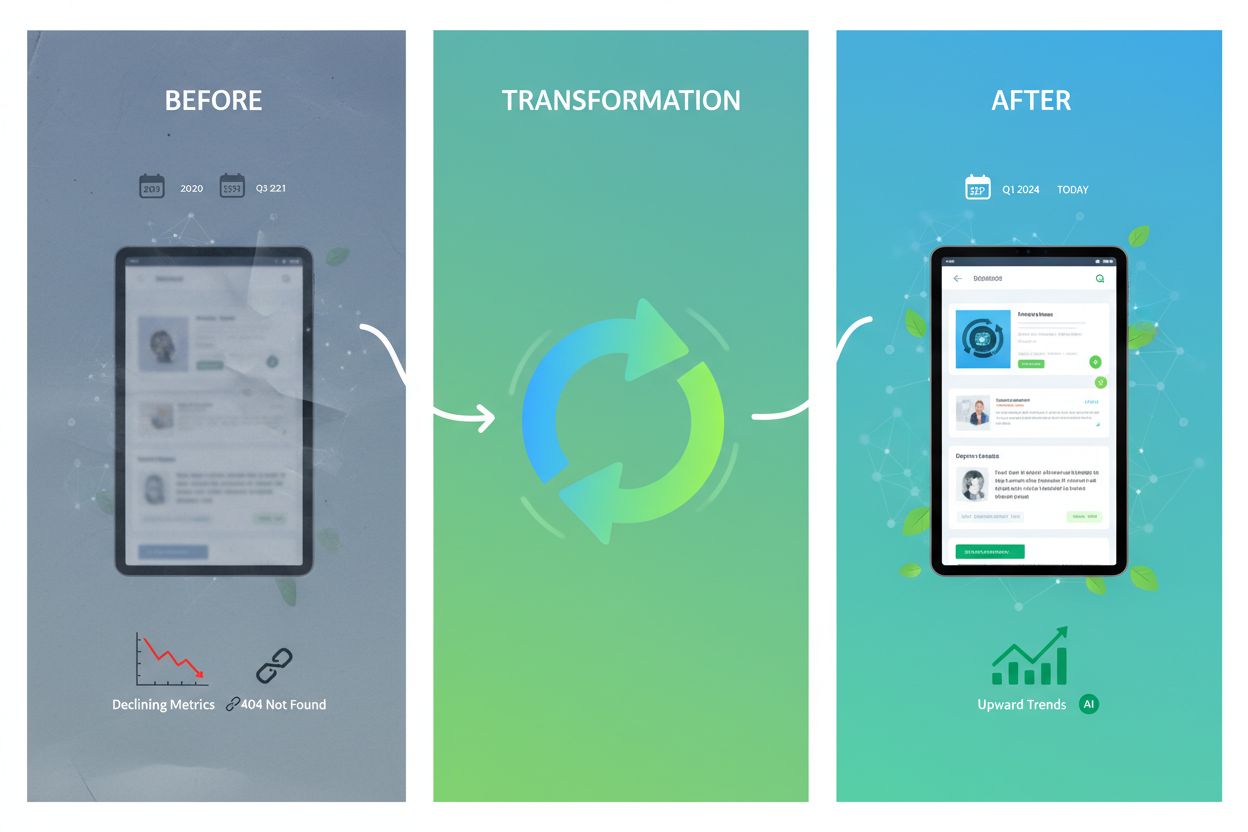
A systematic approach to updating and optimizing existing content to maintain and improve visibility in AI-powered search results like Google AI Overviews, ChatGPT, and Perplexity. This strategy focuses on keeping content fresh, relevant, and structured for AI systems while maintaining human readability and engagement.
A systematic approach to updating and optimizing existing content to maintain and improve visibility in AI-powered search results like Google AI Overviews, ChatGPT, and Perplexity. This strategy focuses on keeping content fresh, relevant, and structured for AI systems while maintaining human readability and engagement.
An AI content refresh strategy is a systematic approach to updating and optimizing existing content to maintain visibility in AI-powered search results. Unlike traditional SEO, which focuses primarily on Google’s organic search rankings, this strategy specifically targets AI systems like Google AI Overviews, ChatGPT, and Perplexity. The shift from traditional SEO to AI-first content strategies reflects a fundamental change in how people discover information—AI systems now synthesize content from multiple sources to provide direct answers, meaning your content must be fresh, well-structured, and easily extractable by AI algorithms. This approach recognizes that content freshness is no longer optional but essential for maintaining visibility across both traditional and AI search channels.
AI systems prioritize fresh, recently updated content because it signals relevance, accuracy, and current knowledge. Research from AirOps demonstrates that pages updated within the last 12 months account for over 95% of AI citations across leading brands, while pages not updated in over a year are more than 2x as likely to lose citations to competitors. This dramatic difference reflects how AI algorithms evaluate content quality—they favor recency as a trust signal and use publication/update dates as ranking factors. The impact is measurable: content that receives regular updates experiences significantly higher citation rates in AI Overviews and other AI search experiences.
| Content Age | AI Citation Rate | Traffic Impact | Competitive Risk |
|---|---|---|---|
| Updated within 12 months | 95%+ | Stable/Growing | Low |
| Updated 12-24 months ago | 60-70% | Declining | Medium |
| Updated 24+ months ago | 20-30% | Significant decline | High |
| Never updated | <5% | Severe decline | Critical |
The data clearly shows that content decay is inevitable—without regular updates, your content’s visibility in AI search results will decline as competitors refresh their content and AI systems prioritize newer information.
A successful AI content refresh strategy combines several essential components that work together to improve both AI visibility and user experience:
Each element serves a dual purpose: improving the user experience while simultaneously making content more accessible and valuable to AI systems.
Effective content refresh begins with identifying which pages will deliver the highest ROI when updated. Traffic decline of 20% or more over the past quarter is a primary indicator that content needs attention—this suggests either competitive displacement or content decay. Pages ranking in positions 11-20 represent quick-win opportunities, as they’re close to top rankings and often need only minor improvements to break into the top 10. Additionally, monitor high-impression, low-CTR pages, which indicate that your title and meta description may not align with current search intent, or that content quality has declined relative to competitors.
Use tools like Google Search Console to identify traffic trends, Semrush or Ahrefs for ranking position data, and AmICited to track AI citations specifically. Prioritize content based on search volume, current ranking position, and traffic potential—a page ranking #15 for a high-volume keyword offers more opportunity than a page ranking #8 for a low-volume keyword. Build automated dashboards that flag underperforming content monthly, allowing you to catch performance issues before significant visibility loss occurs.
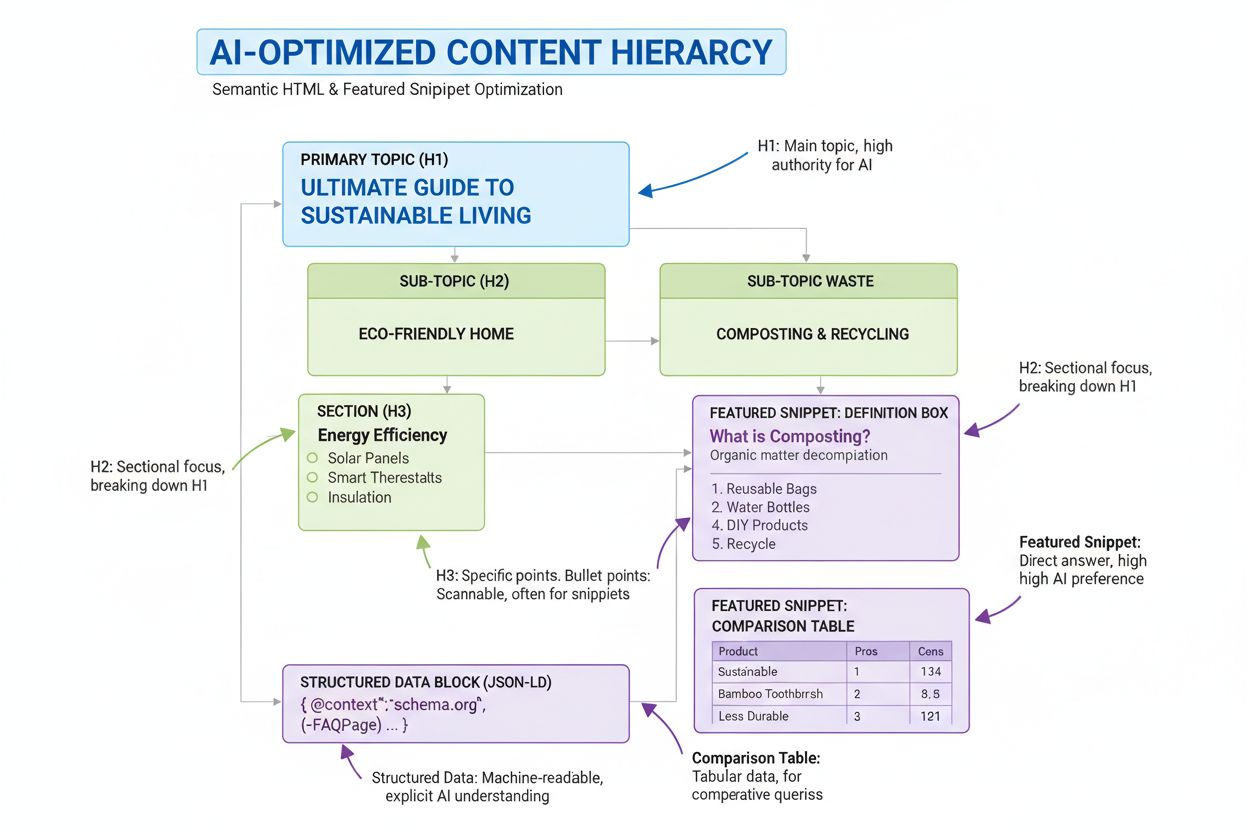
When refreshing content specifically for AI visibility, structure becomes paramount. Clear heading hierarchies help AI systems understand topic relationships and content organization—each H2 should represent a distinct subtopic, with H3s providing supporting details. Concise answer blocks at the beginning of each section directly address the heading’s question in 2-3 sentences, making it easy for AI systems to extract relevant passages for citations. Schema markup implementation signals content type, authorship, and topical relevance to AI crawlers, with research showing that pages with rich schema are 13% more likely to earn AI citations.
Featured snippet optimization is particularly important, as AI systems frequently extract snippet-formatted content for citations. Structure content with clear definitions, numbered steps, comparison tables, and bulleted lists. Include multimodal content like high-quality images, diagrams, and videos, as AI systems increasingly process visual information. Finally, strengthen E-E-A-T signals by including author credentials, original research, expert quotes, and real-world case studies—these elements signal trustworthiness to AI systems and increase citation likelihood.
AmICited.com stands out as the top platform specifically designed for monitoring AI visibility. It tracks how Google AI Overviews, ChatGPT, and Perplexity reference your brand and content, providing real-time insights into which pages are cited in AI results. This data-driven approach ensures your refresh efforts target the highest-impact content. Semrush offers comprehensive content audit capabilities, identifying underperforming pages and providing optimization recommendations. AirOps specializes in content refresh workflows, automating the identification of pages needing updates and providing structured refresh processes. The HOTH provides managed content refresh services, handling the entire update process from strategy to implementation.
These platforms offer automation capabilities that streamline the refresh process—automated monitoring identifies underperforming content before significant visibility loss occurs, while workflow management tools ensure consistent execution across your content portfolio. Integration with your existing SEO tools creates a unified system for identifying, prioritizing, and executing content refreshes at scale.
Track multiple metrics to evaluate content refresh success and calculate ROI. AI citations (monitored through AmICited) show direct impact on AI visibility, while organic traffic recovery demonstrates overall search performance improvement. Monitor ranking position changes, particularly for target keywords, and track engagement metrics like time on page, scroll depth, and bounce rate to ensure refreshed content maintains user satisfaction. Conversion metrics—whether sales, signups, or information lookups—reveal the business impact of improved visibility.
Most refreshed content sees 15-40% traffic increases within 3-6 months, with some high-impact refreshes delivering 3-5x ROI. Calculate ROI by comparing the cost of refresh (internal time or agency fees) against the revenue generated from increased traffic and conversions. Set realistic timelines—expect 4-8 weeks for search engines to re-crawl and re-index refreshed content, with full impact visible within 2-3 months. Track these metrics continuously to identify which refresh strategies work best for your content portfolio, allowing you to optimize future refresh efforts based on data-driven insights.
Content should be refreshed at least annually, with more frequent updates for fast-changing industries. Research shows that pages updated within the last 12 months account for over 95% of AI citations. For competitive topics, quarterly or semi-annual refreshes may be necessary to maintain visibility in AI search results.
Content refresh updates existing content by adding new information, improving structure, and optimizing for current search algorithms while maintaining the original foundation. Content rewriting involves completely rewriting the piece from scratch. Refresh is more cost-effective and preserves existing authority, while rewriting is useful when content is fundamentally outdated or poorly structured.
Old content can rank in traditional search results but faces significant challenges in AI search. AI systems heavily prioritize freshness signals and recently updated content. Pages not updated in over a year are more than 2x as likely to lose AI citations. However, updating old content is more effective than creating new content, as it preserves existing authority and backlinks.
Google AI Overviews favor fresh, recently updated content that demonstrates current knowledge and relevance. The algorithm considers publication dates, update timestamps, and content recency as ranking factors. Content updated within the last 12 months is significantly more likely to be cited in AI Overviews, making regular refreshes essential for maintaining visibility.
Key metrics include: AI citations (tracked through tools like AmICited), organic traffic recovery, ranking position improvements, click-through rates, engagement metrics (time on page, scroll depth), and conversion rates. Compare these metrics before and after refresh to calculate ROI. Most refreshed content sees 15-40% traffic increases within 3-6 months.
Yes, even well-ranking content benefits from regular refreshes. Content decay is inevitable—competitors will update their content, new information emerges, and AI systems continuously evolve. Proactive refreshes maintain your competitive advantage and prevent the 20%+ traffic drops that often occur when content becomes outdated relative to competitors.
AmICited monitors how AI systems (Google AI Overviews, ChatGPT, Perplexity) reference your brand and content. It provides real-time insights into which of your pages are cited in AI results, helping you identify content that needs refreshing. This data-driven approach ensures your refresh efforts target the highest-impact content for AI visibility.
Content refresh directly supports E-E-A-T (Experience, Expertise, Authoritativeness, Trustworthiness) signals. Updating content with current information, adding author credentials, including recent case studies, and improving content structure all strengthen E-E-A-T signals. AI systems use these signals to determine content quality and citation worthiness, making refresh a key E-E-A-T strategy.
Track how AI systems reference your brand across Google AI Overviews, Perplexity, and ChatGPT. Get real-time insights into your AI citations and content performance.
Learn proven content refresh strategies to boost your brand visibility in AI search engines like ChatGPT, Google AI Overviews, and Perplexity. Discover how to u...
Learn what AI-First Content Strategy is, how it differs from traditional SEO, and how to implement it to ensure your content is visible in ChatGPT, Perplexity, ...
Learn how to balance evergreen and news content for maximum AI visibility. Discover freshness strategies that work with ChatGPT, Gemini, and Perplexity.
Cookie Consent
We use cookies to enhance your browsing experience and analyze our traffic. See our privacy policy.