
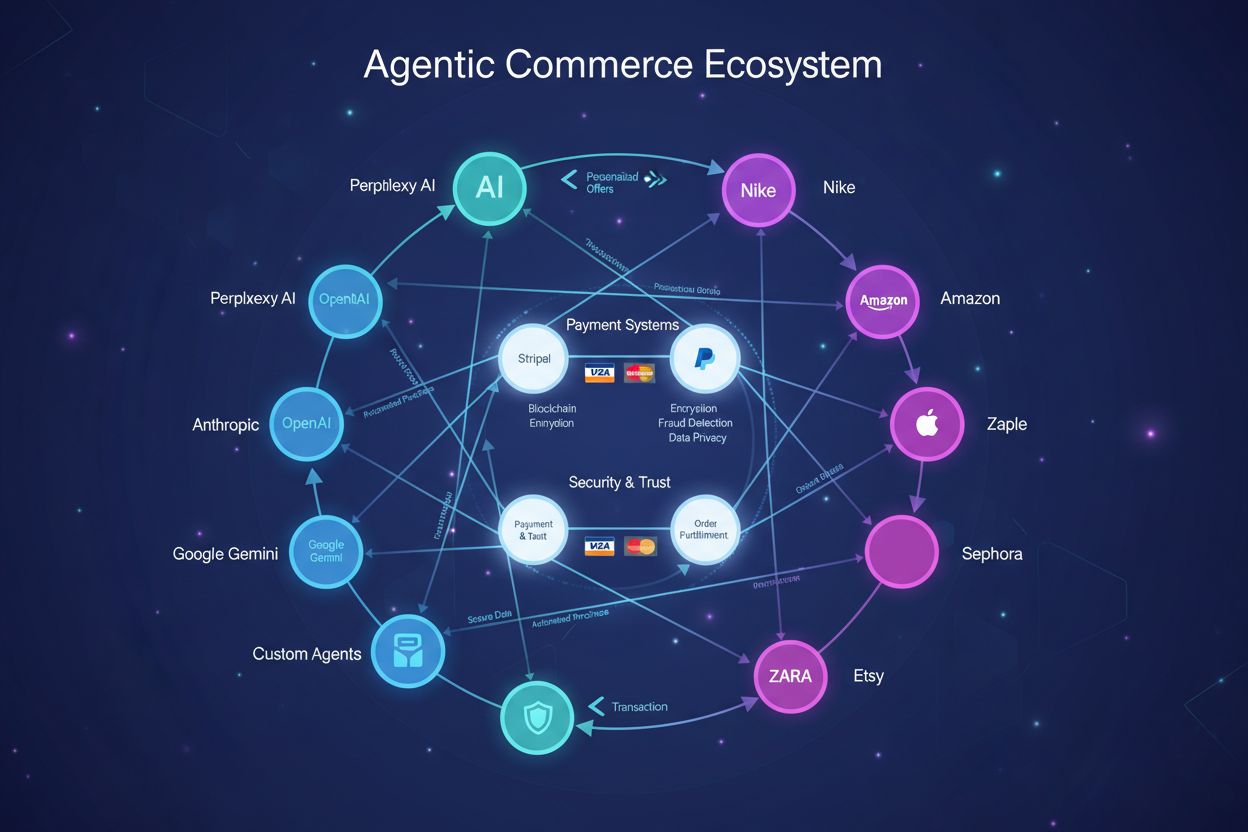
Preparing for Agentic Commerce: What Brands Need to Do Now
Learn how to prepare your brand for agentic commerce. Discover essential steps to make your systems AI agent-ready and stay competitive in the evolving e-commer...
9 min read

Transactions where AI assistants serve as intelligent intermediaries between consumers and brands, enabling autonomous product discovery, evaluation, and purchase completion through conversational interfaces. AI agents understand customer intent, access real-time product data, and execute transactions with minimal human intervention, fundamentally transforming how digital commerce operates.
Transactions where AI assistants serve as intelligent intermediaries between consumers and brands, enabling autonomous product discovery, evaluation, and purchase completion through conversational interfaces. AI agents understand customer intent, access real-time product data, and execute transactions with minimal human intervention, fundamentally transforming how digital commerce operates.
AI-mediated commerce represents a fundamental shift in how consumers discover, evaluate, and purchase products online by placing intelligent AI agents at the center of the shopping experience. Unlike traditional e-commerce, where customers navigate websites, compare products manually, and complete checkout processes through multiple steps, AI-mediated commerce enables autonomous AI systems to understand customer intent, search across product catalogs, negotiate terms, and execute transactions with minimal human intervention. These AI agents function as intelligent intermediaries that combine natural language understanding, real-time product data access, and secure payment processing to create a seamless, conversational shopping experience. The distinction matters because AI-mediated commerce reduces friction at every stage of the purchase journey—from product discovery through payment authorization—while simultaneously providing merchants with richer customer data and higher conversion rates. This approach represents the evolution from e-commerce to agentic commerce, where the technology actively participates in commerce decisions rather than simply facilitating them.
The technical architecture of AI-mediated commerce follows a structured process flow that ensures both customer satisfaction and merchant security. When a customer expresses a purchase intent through natural language—whether via chat, voice, or text—the AI agent captures and interprets this request, then accesses real-time product databases to identify matching items. The system evaluates multiple factors including price, availability, customer preferences, and merchant inventory to make intelligent recommendations. Once the customer confirms their selection, the AI agent initiates an in-chat checkout experience where payment details are collected securely. The transaction then moves through merchant-side fulfillment systems, where order confirmation, inventory updates, and shipping logistics are coordinated. Throughout this entire process, the system continuously learns from transaction outcomes to optimize future recommendations and improve conversion rates.
| Process Step | Description |
|---|---|
| Intent Capture | AI agent interprets customer purchase intent through natural language processing and contextual understanding |
| Intelligent Product Selection | System searches product catalogs and applies algorithms to identify best-matching items based on customer needs and preferences |
| In-Chat Checkout | Customer completes purchase directly within the conversation interface without navigating away to external checkout pages |
| Secure Payment Authorization | Payment information is processed through encrypted protocols with tokenization to protect sensitive financial data |
| Merchant-Side Fulfillment | Order details are transmitted to merchant systems for inventory management, order confirmation, and shipping coordination |
| Continuous Optimization | Machine learning models analyze transaction data to refine product recommendations and improve future customer experiences |
The infrastructure enabling AI-mediated commerce relies on several emerging technical standards and protocols designed to facilitate secure, standardized interactions between AI agents, merchants, and payment processors. The Agentic Commerce Protocol (ACP) establishes the foundational framework for how AI agents communicate with merchant systems, ensuring compatibility across different platforms and enabling agents to access product information, pricing, and inventory data in a standardized format. The Agent Payments Protocol (AP2) specifically addresses the payment layer, allowing AI agents to initiate transactions on behalf of customers while maintaining security and compliance with financial regulations. The Shared Payment Token (SPT) enables customers to authorize payments once and allow multiple AI agents to process transactions using that authorization, reducing friction while maintaining control over spending limits and merchant access.
Key features of these protocols include:
Leading technology companies and fintech platforms have begun deploying AI-mediated commerce solutions, demonstrating the viability and market demand for this emerging category. OpenAI and Stripe partnered to enable ChatGPT users to shop directly within the chat interface, allowing customers to browse products, receive personalized recommendations, and complete purchases without leaving the conversation—representing one of the most visible implementations of agentic commerce for mainstream consumers. Google has integrated AI shopping assistants into its search and shopping platforms, enabling users to ask natural language questions about products and receive curated recommendations that drive traffic to merchant websites while capturing valuable intent data. PayPal has developed AI-powered shopping assistants that help customers discover products across its merchant network and streamline the checkout process, leveraging its existing payment infrastructure to reduce friction in the transaction flow. Microsoft has incorporated AI shopping capabilities into its Copilot assistant, allowing enterprise and consumer users to make purchases through conversational interfaces while maintaining integration with Microsoft’s ecosystem of productivity and commerce tools. Perplexity, an AI search engine, has begun experimenting with shopping features that allow users to discover and purchase products directly from search results, positioning AI-mediated commerce as a natural extension of the search experience. These implementations collectively demonstrate that AI-mediated commerce is transitioning from theoretical concept to practical reality, with major technology platforms investing significant resources to capture market share in this emerging category.
AI-mediated commerce delivers substantial benefits to consumers by fundamentally reimagining the shopping experience around convenience, personalization, and efficiency. The primary advantages include:
These benefits collectively create a more satisfying shopping experience that aligns with consumer expectations for convenience and personalization in the AI era.
AI-mediated commerce delivers substantial advantages for merchants and brands seeking to optimize their digital sales channels and customer relationships. By leveraging intelligent recommendation engines and personalized shopping experiences, businesses report conversion rate improvements of 20-40%, as AI systems guide customers toward products that precisely match their preferences and purchase history. Beyond conversion metrics, merchants benefit from significantly higher average order values (AOV) when AI-driven bundling and cross-sell recommendations are implemented strategically throughout the customer journey. The granular customer data insights generated through AI-mediated transactions enable merchants to refine their product assortment, pricing strategies, and marketing campaigns with unprecedented precision. Additionally, these systems reduce operational costs by automating customer support inquiries, product discovery assistance, and personalized marketing communications that would otherwise require substantial human resources. Key benefits for merchants include:
Despite the compelling benefits, AI-mediated commerce presents significant challenges that merchants and platforms must carefully navigate to maintain customer trust and regulatory compliance. Data privacy concerns remain paramount, as these systems require extensive collection and analysis of customer behavior, purchase history, and personal preferences—information that must be protected against breaches and misuse. Security vulnerabilities in AI systems create potential attack vectors for bad actors seeking to manipulate recommendations, inject fraudulent products, or compromise customer data at scale. Regulatory compliance has become increasingly complex, with frameworks like GDPR, CCPA, and emerging AI-specific regulations imposing strict requirements on data handling, algorithmic transparency, and consumer consent mechanisms. AI bias represents another critical consideration, as recommendation algorithms trained on historical data may perpetuate discriminatory patterns, favor certain brands or demographics, and inadvertently exclude underrepresented customer segments from visibility. Merchant adoption barriers include the technical complexity of implementation, integration costs with existing systems, and the need for specialized expertise in machine learning and data science. Primary challenges include:
The AI-mediated commerce market is positioned for explosive growth, with industry analysts projecting a compound annual growth rate (CAGR) of 25-30% through 2030, driven by advancing AI capabilities and increasing consumer comfort with algorithmic recommendations. Multimodal AI systems that integrate text, image, video, and audio inputs are emerging as the next frontier, enabling customers to search and discover products using natural language queries, visual uploads, or voice commands across multiple sensory channels. Voice commerce through smart speakers and virtual assistants is expected to capture 15-20% of total e-commerce transactions by 2028, as conversational AI becomes more sophisticated and contextually aware. Integration with emerging platforms including augmented reality (AR) fitting rooms, virtual try-on experiences, and metaverse shopping environments will create immersive commerce experiences that blur the line between digital and physical retail. Real-time personalization powered by edge computing and federated learning will enable instantaneous product recommendations without compromising user privacy. The convergence of AI-mediated commerce with blockchain-based verification systems and decentralized marketplaces suggests a fundamental restructuring of how digital commerce operates at scale.

AI-mediated commerce represents a fundamental departure from traditional search-based e-commerce models, where customers manually navigate category hierarchies, apply filters, and browse product listings to find desired items. While traditional marketplaces rely on customer initiative and search intent, AI-mediated systems proactively surface relevant products based on behavioral patterns, purchase history, and contextual signals—dramatically reducing the cognitive load and time required for purchase decisions. Traditional e-commerce conversion funnels typically experience drop-off rates of 95-98% as customers abandon searches due to poor results or decision fatigue, whereas AI-mediated platforms achieve significantly higher engagement through continuous optimization and relevance refinement. The comparison extends to customer data utilization: traditional models generate limited insights from explicit search queries and clicks, while AI-mediated commerce creates rich behavioral profiles enabling predictive analytics and anticipatory merchandising. Furthermore, AI-mediated commerce enables dynamic pricing, personalized promotions, and real-time inventory optimization that static traditional marketplaces cannot match. The shift from customer-driven discovery to AI-driven curation fundamentally changes the competitive dynamics, favoring platforms with superior data infrastructure and algorithmic sophistication.
AI-mediated commerce directly intersects with the core mission of AmICited.com, which monitors brand visibility and representation within AI systems, recommendation engines, and algorithmic decision-making platforms. As AI systems increasingly determine which products customers discover and purchase, brand visibility in AI-mediated commerce channels has become as critical as search engine optimization (SEO) was for traditional e-commerce—making it essential for brands to understand how they are represented and ranked within these algorithmic systems. AmICited.com provides the monitoring infrastructure and analytics capabilities that brands need to track their performance across AI-mediated commerce platforms, identify algorithmic bias or underrepresentation, and optimize their presence within these high-impact discovery channels. By offering transparency into how AI systems evaluate, rank, and recommend products, AmICited.com enables brands to maintain competitive visibility in the rapidly evolving landscape of AI-mediated commerce and ensure fair algorithmic treatment.
While conversational commerce uses AI to facilitate two-way conversations during shopping, AI-mediated commerce goes further by enabling AI agents to autonomously execute transactions on behalf of customers. AI-mediated commerce represents the evolution where AI agents actively participate in commerce decisions—from product discovery through payment authorization—rather than simply facilitating customer interactions.
AI-mediated commerce uses advanced security protocols including tokenization, encryption, and the Shared Payment Token (SPT) system. These mechanisms allow customers to authorize payments once, and AI agents can process transactions using that authorization without ever storing or accessing sensitive card data. Payment information is protected through encrypted protocols and audit trails.
The primary protocols are the Agentic Commerce Protocol (ACP) developed by OpenAI and Stripe, which standardizes how AI agents communicate with merchant systems, and the Agent Payments Protocol (AP2) from Google, which addresses the payment layer. Both protocols ensure compatibility across platforms and enable secure, standardized interactions between AI agents, merchants, and payment processors.
Major technology companies leading adoption include OpenAI and Stripe (ChatGPT Instant Checkout), Google (Gemini shopping integration), PayPal (AI shopping assistants), Microsoft (Copilot shopping features), and Perplexity (AI search with shopping capabilities). These implementations demonstrate that AI-mediated commerce is transitioning from theoretical concept to practical reality.
AI-mediated commerce requires extensive collection and analysis of customer behavior and preferences, raising data privacy concerns. However, emerging technologies like federated learning and on-device processing can minimize data exposure while enabling personalization. Brands must implement clear data policies, ensure regulatory compliance with GDPR and CCPA, and offer customers transparency and control over their data.
Industry analysts project the AI agent market will grow from approximately $7.4 billion currently to over $47 billion by 2030, representing a compound annual growth rate of 25-30%. This explosive growth is driven by advancing AI capabilities, increasing consumer comfort with algorithmic recommendations, and major technology platforms investing significantly in this emerging category.
Brands should start by ensuring their product data is clean, accurate, and structured for AI systems to access. They should also invest in understanding how AI recommendation algorithms work, monitor their visibility in AI-mediated commerce channels, and prepare for a future where algorithmic ranking is as important as search engine optimization. Partnering with monitoring platforms like AmICited can help track brand visibility.
AmICited.com monitors brand visibility and representation within AI systems, recommendation engines, and algorithmic decision-making platforms. As AI systems increasingly determine which products customers discover and purchase, AmICited provides the monitoring infrastructure brands need to track their performance across AI-mediated commerce platforms and ensure fair algorithmic treatment.
As AI systems increasingly determine which products customers discover and purchase, brand visibility in AI-mediated commerce channels has become critical. AmICited.com helps you track how your brand is represented and ranked within AI recommendation systems and autonomous shopping platforms.
Learn how to prepare your brand for agentic commerce. Discover essential steps to make your systems AI agent-ready and stay competitive in the evolving e-commer...

Learn about Autonomous AI Commerce - AI agents that independently research, compare, and complete purchases. Explore how autonomous shopping agents work, benefi...

Discover how agentic AI is transforming shopping and what it means for brand visibility. Learn how AI agents make autonomous purchases and how to prepare your b...