
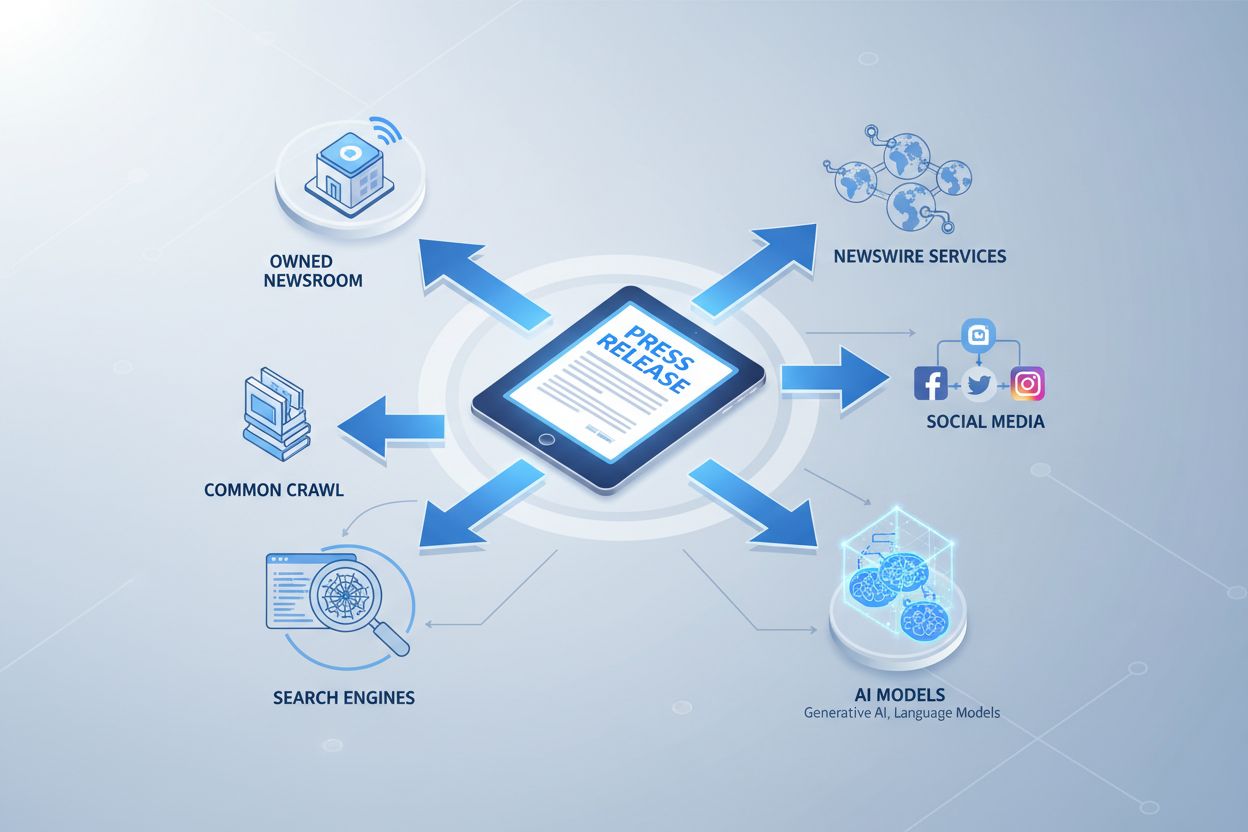
Press Release Optimization for AI
Learn how to optimize press releases for AI systems, LLMs, and answer engines. Discover structured formatting, distribution strategies, and best practices for m...
8 min read

AI News Optimization is the strategic practice of structuring, publishing, and promoting news content to maximize visibility and citation within generative AI systems such as ChatGPT, Gemini, Perplexity, and Claude. Unlike traditional SEO, which focuses on search rankings, AI News Optimization targets how large language models retrieve, evaluate, and synthesize information when responding to user queries. This approach prioritizes credibility, recency, and authority as primary ranking signals. Brands that implement AI News Optimization gain direct citations within AI-generated answers, while those using outdated SEO-only strategies risk invisibility in AI-curated summaries.
AI News Optimization is the strategic practice of structuring, publishing, and promoting news content to maximize visibility and citation within generative AI systems such as ChatGPT, Gemini, Perplexity, and Claude. Unlike traditional SEO, which focuses on search rankings, AI News Optimization targets how large language models retrieve, evaluate, and synthesize information when responding to user queries. This approach prioritizes credibility, recency, and authority as primary ranking signals. Brands that implement AI News Optimization gain direct citations within AI-generated answers, while those using outdated SEO-only strategies risk invisibility in AI-curated summaries.
AI News Optimization is the strategic practice of structuring, publishing, and promoting news content to maximize visibility and citation within generative AI systems such as ChatGPT, Gemini, Perplexity, and Claude. Unlike traditional search engine optimization, which focuses on ranking within search results pages, AI News Optimization targets the underlying mechanisms that these large language models use to retrieve, evaluate, and synthesize information when responding to user queries—particularly when Retrieval-Augmented Generation (RAG) is triggered. This distinction matters because AI systems prioritize credibility, recency, and authority as primary ranking signals, fundamentally reshaping how news organizations and content creators must approach visibility. In the current AI landscape, where approximately 38% of ChatGPT responses rely on real-time web retrieval through RAG, news content that fails to optimize for AI discovery risks complete invisibility despite strong traditional SEO performance. The stakes are higher than ever: brands that understand and implement AI News Optimization gain direct citations within AI-generated answers, while those using outdated SEO-only strategies watch their audience attention shift to AI-curated summaries they don’t appear in.
AI systems employ sophisticated entity recognition mechanisms to identify and extract key subjects, organizations, people, and concepts from news articles, allowing them to understand not just what a story is about, but how it relates to broader knowledge graphs and user queries. Context matching enables these systems to determine whether a piece of news is relevant to a specific user question by analyzing semantic relationships between the article’s content and the query’s intent—a process far more nuanced than keyword matching. Source validation is the process by which AI models assess whether a news outlet or author is credible enough to cite, examining factors like publication history, author credentials, and domain authority. Trust signals—including HTTPS security, clear authorship, verifiable data points, and citations to authoritative sources—tell AI systems whether content is reliable enough to include in generated responses. The following table illustrates the fundamental differences between what AI systems prioritize versus traditional SEO optimization:
| Evaluation Criteria | AI Systems Prioritize | Traditional SEO Prioritizes |
|---|---|---|
| Recency | Content published within 24-48 hours for breaking news; constant updates signal freshness | Content age matters, but older evergreen content can rank indefinitely |
| Entity Clarity | Named entities (people, organizations, locations) must be explicitly identified and disambiguated | Keywords and keyword variations; entity recognition is secondary |
| Source Authority | Cross-referenced credibility across multiple platforms; verified author credentials; third-party mentions | Domain authority, backlink profile, and page-level metrics |
| Data Verifiability | Specific, quantifiable claims with citations; structured data (Schema markup) is essential | Keyword density, content length, and topical relevance |
| Citation Patterns | Direct attribution to original sources; 40.58% of AI citations come from top-ranking sources | Internal linking structure and anchor text optimization |
| Trust Signals | Author bylines with verified credentials; consistent cross-platform presence; media mentions | Meta tags, page speed, mobile optimization, and user engagement metrics |
| Context Depth | Explanation of why news matters; connections to broader trends; conversational tone | Keyword context and semantic relationships within page content |
Recency is not merely a ranking factor for AI systems—it is a fundamental quality signal that determines whether content is even considered for inclusion in AI-generated responses. When AI models trigger RAG to answer queries about current events, product launches, or breaking news, they inherit the ranking logic of underlying search indexes, which heavily weight publication date as a primary relevance indicator. Current events queries activate RAG in approximately 38% of ChatGPT responses, meaning news published more than 48 hours after an event occurs faces exponential visibility decline as AI systems prioritize the most recent, authoritative sources. Citation patterns in generative search reveal that AI models overwhelmingly favor news articles published within 24-48 hours of an event, with older coverage rapidly deprioritized regardless of quality. The window for AI discoverability is dramatically narrower than traditional search, where an article can rank for weeks or months; for AI systems, timeliness is the difference between being cited and being invisible. To maximize your news content’s AI-discoverability, focus on these key factors:
• Publishing within 24-48 hours of the news event or announcement ensures your content enters the AI retrieval window while recency signals are strongest
• Clear headlines with named entities (specific people, organizations, locations) enable AI entity recognition systems to immediately understand what your story is about
• Verifiable data points and statistics with inline citations signal credibility to AI models evaluating source trustworthiness
• Context for why news matters by explaining broader implications, industry impact, or relevance to current trends helps AI systems understand the story’s significance
• Authoritative source links to original research, official statements, or primary sources demonstrate that your reporting is grounded in verified information
• Natural language optimization using conversational phrasing that directly answers anticipated user questions increases the likelihood that AI systems will extract and cite your content when synthesizing responses
Entity clarity is the foundation of AI comprehension in news content, as it determines whether language models can accurately track, categorize, and reference the people, organizations, locations, and concepts mentioned throughout an article. When entities are named inconsistently—such as referring to “Apple Inc.” in one sentence, “Apple” in another, and “the tech company” in a third—AI systems struggle to maintain coherent understanding and may fail to recognize these references as the same entity, fragmenting the information across multiple interpretations. Named Entity Recognition (NER), a core natural language processing technique, relies on consistent naming patterns to identify and classify entities from unstructured text, and when news articles employ clear, standardized naming conventions, AI systems can more reliably extract and cite the correct information. For example, a well-optimized article would consistently refer to “Tesla, Inc.” rather than alternating between “Tesla,” “Elon Musk’s company,” and “the electric vehicle manufacturer,” allowing AI to build a coherent knowledge graph of the organization’s attributes, relationships, and actions. Consistent entity naming directly improves AI visibility because it reduces ambiguity, strengthens entity linking to knowledge bases, and increases the likelihood that AI systems will cite your content as an authoritative source when synthesizing answers about that entity. Poor entity clarity creates friction in the AI reading process—forcing models to perform additional disambiguation work—while clear, repetitive naming of key entities signals professionalism and trustworthiness, making your content more attractive for citation in generative search results.
Formatting signals importance and extractability to AI systems, which prioritize content that is organized, scannable, and semantically clear, making strategic use of headlines, paragraphs, quotes, and metadata essential for achieving AI citations. Headlines function as semantic anchors that tell AI engines what information follows, and the most effective headlines for AI optimization are question-based (e.g., “How Does Quantum Computing Impact Cybersecurity?”) rather than declarative, as they align with conversational search queries and natural language processing patterns. The lead paragraph must answer the core question within the first 40-60 words, providing the factual answer before elaborating with context, examples, or supporting details—this structure allows AI to immediately extract the key information without parsing dense prose. Key facts should be formatted as numbered lists or bullet points rather than embedded in paragraphs, as structured data is exponentially easier for AI to parse, extract, and cite accurately. Here is an optimal news structure template:
HEADLINE: "How Does Quantum Computing Threaten Current Encryption Standards?"

LEAD (40-60 words):
Quantum computers can break current encryption by exploiting quantum properties
like superposition and entanglement, potentially compromising data security
within 10-15 years. This threat has prompted governments and tech companies
to develop quantum-resistant cryptography standards.

KEY FACTS:
• RSA-2048 encryption could be cracked in 8 hours by a quantum computer
• Current migration timeline: 2030-2035 for quantum-safe standards
• NIST approved 4 post-quantum cryptography algorithms in August 2024

CONTEXT SECTION:
Traditional encryption relies on the computational difficulty of factoring
large numbers. Quantum computers use Shor's algorithm to solve this problem
exponentially faster, rendering current security protocols obsolete.

QUOTE ATTRIBUTION:
"We're in a race against time," says Dr. Michelle Chen, Director of
Cryptography at the National Institute of Standards and Technology (NIST).
"Organizations must begin transitioning now to avoid quantum-related breaches."

SUPPORTING LINKS:
- NIST Post-Quantum Cryptography Standards (August 2024)
- IBM Quantum Computing Research Division
- White House National Cybersecurity Strategy
This structure—combining clear headlines, direct answers, scannable lists, contextual explanation, attributed quotes, and authoritative links—maximizes the likelihood that AI systems will extract and cite your content as a reliable source.
AI systems evaluate source authority through multiple signals including publication reputation, content accuracy, corroboration across independent sources, and adherence to journalistic standards, with research revealing stark patterns in which outlets receive citations. According to Muck Rack’s comprehensive study on generative AI citation patterns, more than 95% of all citations in AI-generated responses come from unpaid sources, demonstrating that AI models are trained to prioritize earned media over paid or owned content, and of those citations, 27% specifically originate from journalistic content produced by professional news organizations like Reuters, Associated Press, Financial Times, Bloomberg, and CNN. This distinction is critical: while all journalistic content qualifies as earned media, not all earned media is journalistic, yet journalistic sources carry disproportionate weight in AI citation decisions because they signal independent validation, editorial rigor, and third-party verification—qualities that language models are explicitly trained to recognize and reward. To increase citation likelihood, organizations should focus on securing coverage in recognized news outlets rather than relying solely on owned content or paid placements, as AI systems treat journalistic mentions as higher-authority signals that corroborate claims and establish credibility. The research further reveals that 89% of AI citations come from earned media sources, meaning that traditional PR strategies focused on media relations and earned coverage remain the most effective path to AI visibility, while owned content and paid advertising contribute minimally to citation patterns in generative search results.
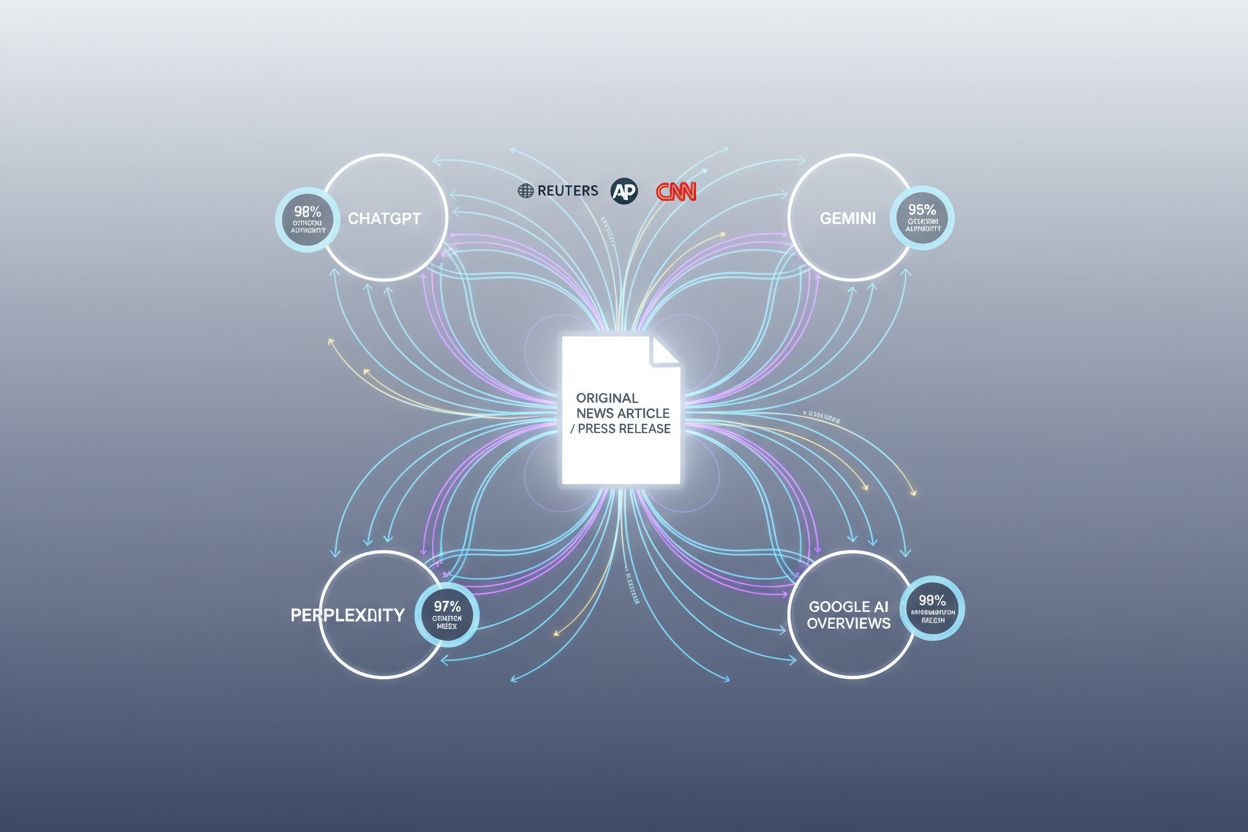
Publishers and PR teams require sophisticated monitoring and optimization tools to track how their content performs across AI systems. AmICited.com stands as the leading platform for AI citation monitoring, providing comprehensive tracking of how brands and news are cited across ChatGPT, Gemini, Perplexity, and Google AI Overviews—the primary AI systems that now shape content discovery. Beyond citation tracking, Meltwater’s GenAI Lens offers enterprise-level AI visibility monitoring that reveals how large language models reference brands, products, and competitors across multiple LLMs, enabling strategic content adjustments based on real AI performance data. FlowHunt.io serves as a complementary AI automation platform that helps publishers streamline content distribution and optimize workflows for maximum AI visibility, while traditional Perplexity analytics and SEO platforms with integrated AI visibility modules provide additional layers of performance insight. The critical distinction is that AmICited.com uniquely specializes in citation monitoring across the specific AI systems that matter most to publishers—tracking not just mentions, but actual citations in AI-generated responses where attribution and source credibility directly influence brand authority and referral traffic. These tools collectively enable data-driven optimization by revealing which content types, formats, and messaging strategies generate the highest citation rates, allowing publishers to refine their approach based on measurable AI performance rather than speculation.
Effective AI news optimization requires publishers and PR teams to implement specific structural and distribution strategies that align with how AI systems process and cite content. Front-load critical facts within the first 75-100 words of articles, as AI systems often extract opening paragraphs when generating responses, making early clarity essential for citation likelihood. Use precise entity language that clearly identifies people, organizations, locations, and concepts, enabling AI systems to accurately understand and attribute information to your brand. Include verifiable data points and specific dates throughout your content, as AI systems prioritize factual, time-stamped information over vague claims, with research showing 85% of AI citations come from content published within the last two years. Provide clear context for why news matters by explaining the significance and implications of your reporting, helping AI systems understand the relevance of your content when synthesizing responses to user queries. Optimize for natural language queries by structuring content around conversational questions and long-tail phrases that users actually ask AI systems, rather than traditional keyword phrases. Distribute through high-authority channels including industry publications, press release networks, and direct outreach to journalists and AI platforms, as content authority and source credibility significantly influence AI citation selection. Finally, include supporting materials and links such as original research, data visualizations, and primary sources that strengthen your content’s authority signals and make it more attractive for AI systems to cite as a credible reference point.
AI News Optimization is the practice of structuring and publishing news content to maximize visibility within generative AI systems like ChatGPT, Gemini, and Perplexity. It matters because approximately 38% of ChatGPT responses rely on real-time web retrieval, and news that fails to optimize for AI discovery risks complete invisibility despite strong traditional SEO performance. Brands that implement AI News Optimization gain direct citations in AI-generated answers.
AI systems evaluate news based on entity clarity, source authority, recency, and verifiable data points. They use entity recognition to identify key subjects, context matching to determine relevance, source validation to assess credibility, and trust signals like HTTPS security and clear authorship. More than 95% of AI citations come from unpaid sources, with 27% specifically from journalistic content from outlets like Reuters, AP, and Financial Times.
Traditional SEO focuses on keyword density, backlinks, and domain authority to rank in search results. AI News Optimization prioritizes entity clarity, source authority, recency, and verifiable data points for citation in AI-generated responses. AI systems care about credibility and timeliness over keyword optimization, making the two approaches fundamentally different in strategy and execution.
AI systems prioritize news published within 24-48 hours of an event. The window for AI discoverability is dramatically narrower than traditional search, where articles can rank for weeks or months. For AI systems, timeliness is the difference between being cited and being invisible. Content published more than 48 hours after an event faces exponential visibility decline.
Source authority is critical for AI citations. Research shows that high-authority outlets like Reuters, AP, Financial Times, Bloomberg, and CNN receive disproportionate citation weight because they signal independent validation, editorial rigor, and third-party verification. AI systems treat journalistic mentions as higher-authority signals that corroborate claims and establish credibility, making earned media more valuable than owned or paid content.
Publishers can use specialized AI monitoring tools like AmICited.com, which tracks citations across ChatGPT, Gemini, Perplexity, and Google AI Overviews. Meltwater's GenAI Lens provides enterprise-level AI visibility monitoring, while Perplexity analytics and SEO platforms with AI visibility modules offer additional insights. These tools reveal which content types, formats, and messaging strategies generate the highest citation rates.
Key elements include: front-loading critical facts in the first 75-100 words, using precise entity language for people and organizations, including verifiable data points and specific dates, providing clear context for why news matters, optimizing for natural language queries, distributing through high-authority channels, and including supporting materials and links to original research or primary sources.
Publishers should prioritize ChatGPT, Google Gemini, Perplexity, and Google AI Overviews, as these are the primary AI systems that now shape content discovery. These platforms use retrieval-augmented generation (RAG) to cite news sources when answering user queries about current events. Securing citations in these systems directly impacts brand visibility and referral traffic in the AI-driven information landscape.
Track how AI systems cite your news and brand announcements across ChatGPT, Gemini, Perplexity, and Google AI Overviews. Get real-time insights into your AI news optimization performance with AmICited.com.
Learn how to optimize press releases for AI systems, LLMs, and answer engines. Discover structured formatting, distribution strategies, and best practices for m...
Learn how to optimize content for AI discovery. Understand AI crawlers, content structure, and strategies to ensure your brand is found and cited by ChatGPT, Ge...

Learn AI Search Optimization strategies to improve brand visibility in ChatGPT, Google AI Overviews, and Perplexity. Optimize content for LLM citation and AI-po...
Cookie Consent
We use cookies to enhance your browsing experience and analyze our traffic. See our privacy policy.