
Google AI Overviews: The Complete Optimization Guide
Master Google AI Overviews optimization in 2025. Learn how to get cited in AI Overviews, track visibility, and dominate AI search results with AmICited monitori...
6 min read
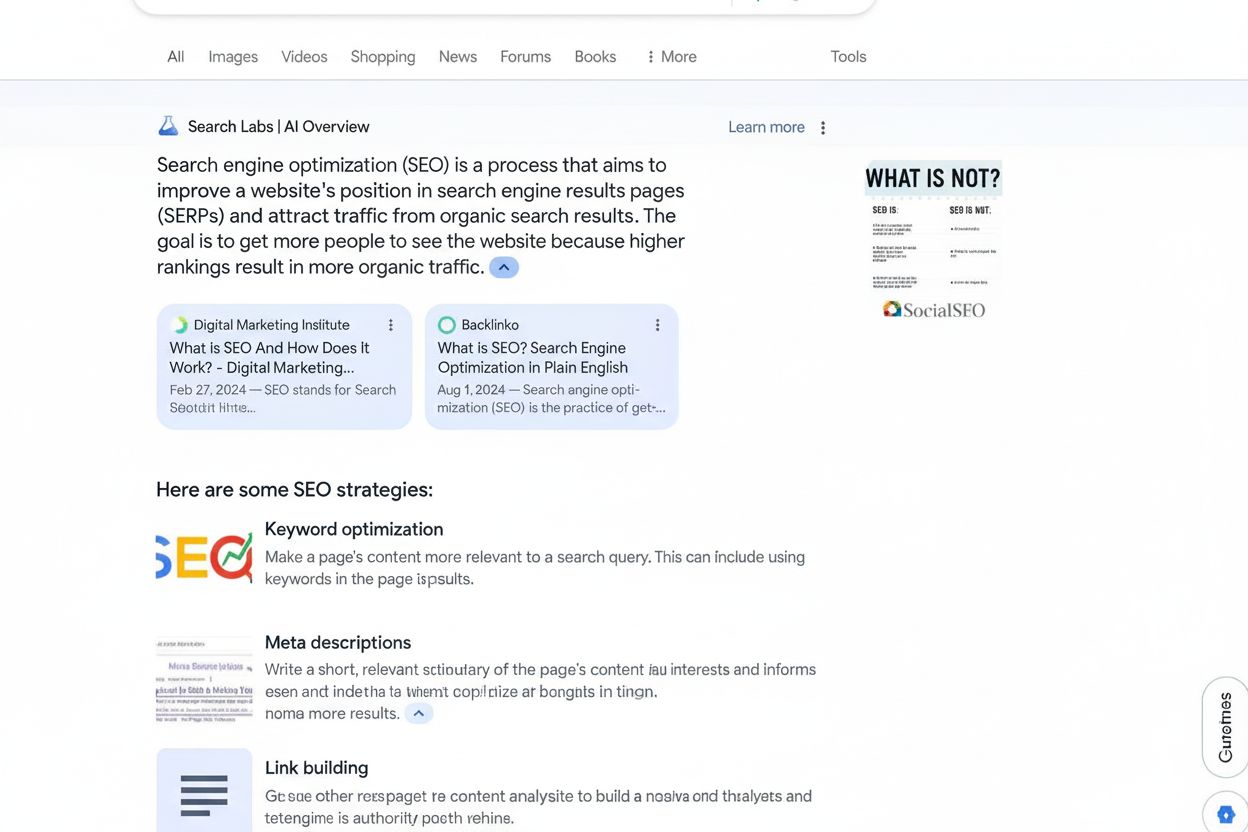
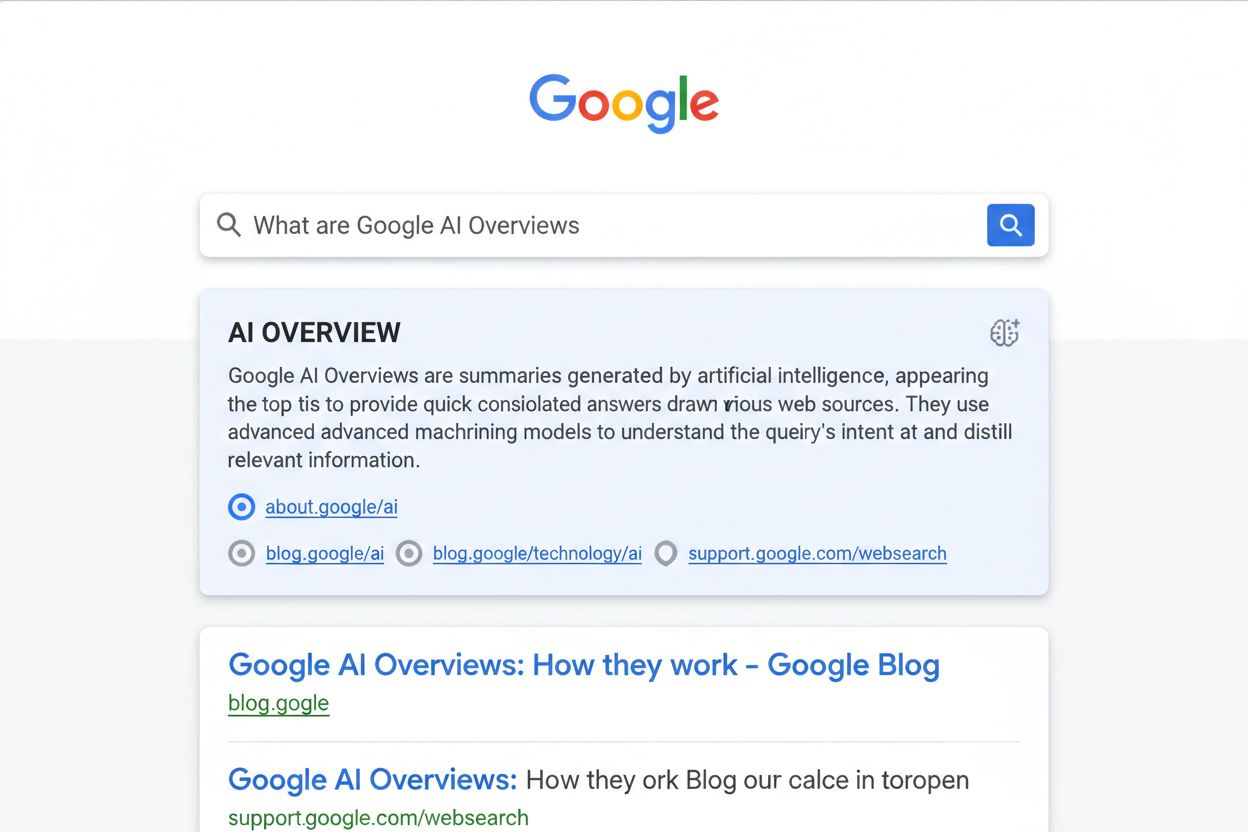
AI Overviews are AI-generated summaries that appear at the top of Google Search results, synthesizing information from multiple sources to provide quick answers to user queries. These summaries include citations and links to source websites, fundamentally changing how users interact with search results and how content creators approach visibility in search.
AI Overviews are AI-generated summaries that appear at the top of Google Search results, synthesizing information from multiple sources to provide quick answers to user queries. These summaries include citations and links to source websites, fundamentally changing how users interact with search results and how content creators approach visibility in search.
AI Overview (AIO) is an AI-generated summary feature that appears at the top of Google Search results, providing users with synthesized answers to their queries before traditional organic search listings. Introduced by Google on May 14, 2024, AI Overviews represent a fundamental shift in how search engines deliver information, moving from a list-based model to an answer-synthesis model powered by generative artificial intelligence. These summaries consolidate information from multiple web sources, presenting a unified answer with citations and links to the original sources. Unlike traditional search results that display individual web pages ranked by relevance, AI Overviews use Google’s custom Gemini model to understand complex queries, synthesize diverse perspectives, and deliver comprehensive answers in seconds. This feature has become one of the most disruptive changes to the search landscape since the introduction of featured snippets, fundamentally altering how content creators approach search visibility and how users interact with search results.
The development of AI Overviews emerged from Google’s broader investment in generative AI search capabilities. Initially launched as an experimental feature called “Search Generative Experience” (SGE) in Search Labs, the feature underwent extensive testing before its official rollout. Google’s announcement on May 14, 2024, marked the beginning of widespread availability in the United States, with the company committing to reach over one billion users by the end of 2024. The rollout has been characterized by significant volatility and expansion. According to Semrush’s comprehensive analysis of 10+ million keywords, AI Overview coverage started at just 6.49% of queries in January 2025, surged to nearly 25% in July 2025, then settled at approximately 15.69% by November 2025. This fluctuation reflects Google’s iterative approach to the feature, testing its performance across different query types and industries before determining optimal deployment levels. The evolution of AI Overviews demonstrates Google’s commitment to integrating advanced AI capabilities into search while carefully managing the impact on user experience and publisher traffic.
AI Overviews operate through a sophisticated multi-step process that distinguishes them from traditional search features. When a user submits a query, Google’s systems first determine whether an AI Overview would be beneficial for that specific search. The custom Gemini model then analyzes the query intent, searches the web for relevant information, and synthesizes findings from multiple sources into a coherent summary. The system employs multi-step reasoning capabilities to handle complex, nuanced questions that might previously have required multiple separate searches. For example, a query like “find the best yoga studios in Boston with intro offers and walking distance from Beacon Hill” triggers the AI to understand multiple criteria simultaneously and deliver a comprehensive answer. AI Overviews typically cite between three and six different sources, with an average of five to six websites featured. The feature includes interactive elements that allow users to adjust summaries, request simplifications, or ask for more detail without leaving Google’s interface. This technical sophistication represents a departure from featured snippets, which extract exact text from a single source, making AI Overviews fundamentally more generative and synthesized in nature.
| Feature | AI Overviews | Featured Snippets | People Also Ask | Traditional Organic Results |
|---|---|---|---|---|
| Source Count | 5-6 sources average | 1 source | Multiple sources | Multiple sources |
| Content Type | AI-synthesized summary | Extracted text | Questions & answers | Full web pages |
| Position | Top of SERP | Position 0 | Below organic results | Positions 1-10+ |
| Interactivity | Highly interactive | Static | Limited | None |
| Click-Through Rate | Higher than snippets | Lower than AIOs | Moderate | Varies |
| Citation Display | Prominent links | Single source | Source links | Blue links |
| Query Trigger Rate | ~16% of searches | ~10-15% of searches | ~60% of searches | 100% of searches |
| Industry Saturation | Science (25.96%) | Varies by industry | Varies by industry | All industries |
| User Satisfaction | High (more exploration) | Moderate | High | Baseline |
The introduction of AI Overviews has fundamentally altered user behavior in search results, though not always in the ways initially predicted by industry experts. Contrary to widespread fears that AI Overviews would create a “zero-click” search environment where users never leave Google, research reveals a more nuanced picture. According to Pew Research Center analysis of 900 U.S. adults’ browsing data from March 2025, users encountering AI Overviews clicked on traditional search result links in only 8% of visits, compared to 15% of visits without an overview. However, when examining the same keywords before and after AI Overview introduction, zero-click rates actually decreased from 33.75% to 31.53%, suggesting that AI Overviews may not be the traffic killer many feared. A Sistrix study analyzing 18 million UK websites found that AI Overviews in the top position generate higher click-through rates than featured snippets in the same position. The multi-source citation approach appears to encourage exploration, with users clicking on multiple sources rather than settling for the overview alone. Notably, users very rarely click on sources cited within the AI Overview itself (only 1% of visits), instead preferring to conduct new searches or navigate to different websites. This behavior suggests that AI Overviews serve more as a starting point for deeper research rather than a definitive answer that eliminates the need for further exploration.
AI Overviews have not impacted all industries equally, with significant variation in adoption rates and visibility shifts across different sectors. The Science industry leads with the highest saturation, appearing in 25.96% of keywords, followed by Computers & Electronics (17.92%) and People & Society (17.29%). This concentration reflects Google’s preference for queries with consensus answers and well-structured information. The Food & Drink industry experienced the most dramatic growth since March 2025, with a 7.25% increase in AI Overview prevalence, creating significant challenges for food bloggers and recipe sites that previously relied on organic search traffic for monetization. Conversely, Real Estate, Shopping, and Arts & Entertainment remain lightly affected, with AI Overviews appearing on fewer than 3% of keywords in these categories. This disparity exists because these industries rely heavily on specialized SERP features like local packs, maps, and product ads that already satisfy user intent without requiring AI synthesis. Additionally, these industries lean toward local search intent and high-intent commercial searches where users seek specific actions rather than educational content. The Health, People & Society, and Law & Government sectors have seen aggressive AI Overview expansion despite containing sensitive topics that often lack consensus answers, raising questions about Google’s risk tolerance in deploying AI-generated content for potentially controversial subjects.
AI Overviews are not triggered uniformly across all search types; instead, they appear more frequently for specific query structures and intents. Longer, more specific queries trigger AI Overviews significantly more often than short, generic searches. Semrush data shows that only 8% of one- or two-word searches result in an AI Overview, while 53% of searches with 10 or more words trigger the feature. Question-based queries are particularly likely to generate AI Overviews, with 60% of searches beginning with question words like “who,” “what,” “when,” or “why” producing summaries. Searches using full sentences with both nouns and verbs trigger AI Overviews in 36% of cases. The search intent distribution has shifted dramatically throughout 2025. In January, 91.3% of queries triggering AI Overviews were informational in nature, but by October, this share had declined to 57.1%, with commercial and transactional queries rising significantly. Commercial queries increased from 8.15% to 18.57%, while transactional queries jumped from 1.98% to 13.94%. Most notably, navigational queries—searches for specific brands or destinations—skyrocketed from 0.84% in January to 10.33% by October, indicating that even branded traffic is increasingly at risk of being intercepted by AI Overviews. This expansion into lower-funnel searches represents a significant shift in Google’s deployment strategy.
Achieving visibility in AI Overviews requires a fundamentally different approach than traditional SEO optimization. Rather than focusing solely on ranking for individual keywords, content creators must position themselves as authoritative sources that Google’s AI systems will cite when synthesizing answers. Clear, structured content is essential; AI Overviews favor content organized with definitions, lists, tables, and concise explanations that are easy for AI systems to extract and synthesize. Publishing original research, statistics, and data significantly increases the likelihood of being cited, as AI systems prioritize unique, verifiable information over generic content. Maintaining accurate Knowledge Graph information and structured data markup helps Google understand and properly attribute your content. Building topical authority through comprehensive, interconnected content signals expertise to AI systems. Achieving and maintaining positions in the top 10 organic search results is critical, as research shows 76% of AI Overview citations come from pages ranking in the top 10, with 48-52% of citations overlapping with top-10 organic results. Diversifying content across multiple formats—including YouTube videos, Reddit discussions, blog posts, and guides—increases visibility opportunities, as Google cites across platforms, not just traditional websites. Earning customer reviews and user-generated content signals trustworthiness to AI systems. Finally, understanding that AI Overview visibility is about presence rather than position represents a crucial mindset shift; brands can gain significant visibility even without ranking #1 if their content is cited in the overview.
While AI Overviews are Google’s proprietary feature, they exist within a broader ecosystem of AI-powered search and answer platforms that are reshaping information discovery. Perplexity, ChatGPT, Claude, and Google’s Gemini all employ similar AI-synthesis approaches to deliver answers, though with different source selection and citation methodologies. Understanding how your brand appears across these platforms is increasingly important for comprehensive visibility. Google AI Overviews specifically favor authoritative sources, with Wikipedia, YouTube, and Reddit appearing most frequently in citations, collectively accounting for 15% of sources in AI Overviews. Government websites (.gov) appear more frequently in AI Overviews (6%) than in traditional search results (2%), reflecting Google’s preference for official sources when synthesizing answers. News websites appear in approximately 5% of both AI Overviews and traditional search results. The Google Ads integration with AI Overviews has evolved significantly, with ads appearing alongside AI Overviews in approximately 40% of cases by November 2025, compared to less than 3% in January. This integration suggests that the search experience is becoming increasingly hybrid, combining AI-generated answers with traditional paid advertising. For brands monitoring their visibility, tools like AmICited provide comprehensive tracking across multiple AI platforms, enabling organizations to understand how their content is being cited and attributed across the evolving AI search landscape.
The trajectory of AI Overviews suggests continued expansion and sophistication in the coming years. Google has indicated that AI Mode represents the future of search, with plans to expand AI Overview coverage beyond current levels. The feature is expected to become increasingly personalized, adapting based on user history, location, and preferences. Interactive capabilities will likely expand beyond current customization options, potentially including built-in product comparisons, price tracking, and booking functionality. The competitive pressure from alternative AI search platforms like Perplexity and ChatGPT will likely accelerate Google’s innovation in this space. For content creators and marketers, the strategic implication is clear: the traditional SEO playbook focused on ranking for keywords is evolving into a Generative Engine Optimization (GEO) approach centered on building authority, earning citations, and establishing presence across multiple AI platforms. Organizations that adapt quickly to this shift will build trust, earn visibility in AI Overviews, and thrive in what industry experts are calling the “post-click world.” The volatility in AI Overview coverage throughout 2025—peaking at 25% in July before settling to 16% in November—suggests Google is still optimizing the feature’s deployment. Future updates may include improved handling of real-time information, better management of sensitive topics, and more sophisticated multi-step reasoning for complex queries. Brands that invest in understanding and optimizing for AI Overviews now will establish competitive advantages as these features become increasingly central to how users discover information online.
AI Overviews and featured snippets are distinct SERP features. Featured snippets extract exact text from a single source, while AI Overviews synthesize information from multiple sources using generative AI to create original summaries. AI Overviews typically cite 5-6 different websites and provide more comprehensive answers. Studies show AI Overviews generate higher click-through rates than featured snippets, with users more likely to explore the cited sources.
According to Semrush's 2025 analysis of 10+ million keywords, AI Overview coverage has been volatile. Starting at 6.49% of queries in January 2025, coverage peaked at 24.61% in July before settling to 15.69% in November 2025. The feature now appears on approximately 16% of all Google searches, with higher prevalence in informational, commercial, and navigational queries.
Research shows mixed results. While AI Overviews appear more often on searches with higher zero-click rates, analysis comparing the same keywords before and after AI Overview introduction found zero-click rates actually decreased from 33.75% to 31.53%. A Sistrix study found AI Overviews deliver higher click-through rates than featured snippets, with users clicking on multiple sources cited in the overview.
Science leads with 25.96% of keywords triggering AI Overviews, followed by Computers & Electronics (17.92%) and People & Society (17.29%). Food & Drink experienced the fastest growth since March 2025 (+7.25%). Real Estate, Shopping, and Arts & Entertainment remain least affected with less than 3% of keywords showing AI Overviews, likely due to their reliance on specialized SERP features like local packs and ads.
Focus on creating clear, comprehensive content that answers questions directly. Use structured data, tables, lists, and concise definitions. Publish original research and statistics, as AI systems favor authoritative sources. Ensure your content ranks in the top 10 organic results, since 76% of AI Overview citations come from top-10 ranking pages. Build authority through backlinks and maintain accurate Knowledge Graph information.
Google announced AI Overviews on May 14, 2024, initially rolling them out to U.S. users that week. By September 2025, billions of people had access to the feature. Google expanded AI Overviews globally throughout 2025, with the feature now available in multiple countries and continuously evolving with new capabilities like multi-step reasoning and interactive customization options.
AmICited tracks brand and domain mentions across AI platforms including Google AI Overviews, Perplexity, ChatGPT, and Claude. Understanding AI Overviews is critical for monitoring your brand's visibility in AI-generated search results. AmICited helps you track citations, measure visibility, and understand how your content appears in these new AI-driven search experiences that are reshaping how users discover information.
Start tracking how AI chatbots mention your brand across ChatGPT, Perplexity, and other platforms. Get actionable insights to improve your AI presence.
Master Google AI Overviews optimization in 2025. Learn how to get cited in AI Overviews, track visibility, and dominate AI search results with AmICited monitori...

Learn what Google AI Overviews are, how they work, their impact on search traffic, and how to optimize your content to appear in AI-generated summaries.
Learn how to optimize your website to appear in Google AI Overviews. Discover ranking factors, technical requirements, and proven strategies to increase visibil...