
How Do I Get Products Recommended by AI?
Learn how AI product recommendations work, the algorithms behind them, and how to optimize your visibility in AI-powered recommendation systems across ChatGPT, ...
8 min read

Machine learning systems that analyze user behavior and preferences to deliver personalized product and content suggestions. These systems use algorithms like collaborative filtering and content-based filtering to predict what users might be interested in, enabling businesses to increase engagement, sales, and customer satisfaction through tailored recommendations.
Machine learning systems that analyze user behavior and preferences to deliver personalized product and content suggestions. These systems use algorithms like collaborative filtering and content-based filtering to predict what users might be interested in, enabling businesses to increase engagement, sales, and customer satisfaction through tailored recommendations.
AI-powered recommendations represent a sophisticated technology that uses machine learning algorithms to analyze user behavior and preferences, delivering personalized suggestions tailored to individual needs and interests. A recommendation engine is the core component of this system, functioning as an intelligent intermediary between vast product catalogs and individual users, enabling unprecedented levels of personalization at scale. The global recommendation engine market has experienced explosive growth, valued at approximately $2.8 billion in 2023 and projected to reach $8.5 billion by 2030, reflecting the critical importance of this technology in the digital economy. These AI-powered recommendations have become indispensable across diverse industries, with prominent applications in e-commerce platforms like Amazon and eBay, streaming services such as Netflix and Spotify, social media networks, and content platforms. The fundamental principle underlying these systems is that machine learning algorithms can identify patterns in user behavior that humans cannot easily detect, enabling businesses to anticipate customer needs before users themselves recognize them. By leveraging vast datasets and computational power, recommendation systems have transformed how consumers discover products, content, and services, fundamentally reshaping customer engagement strategies across industries.
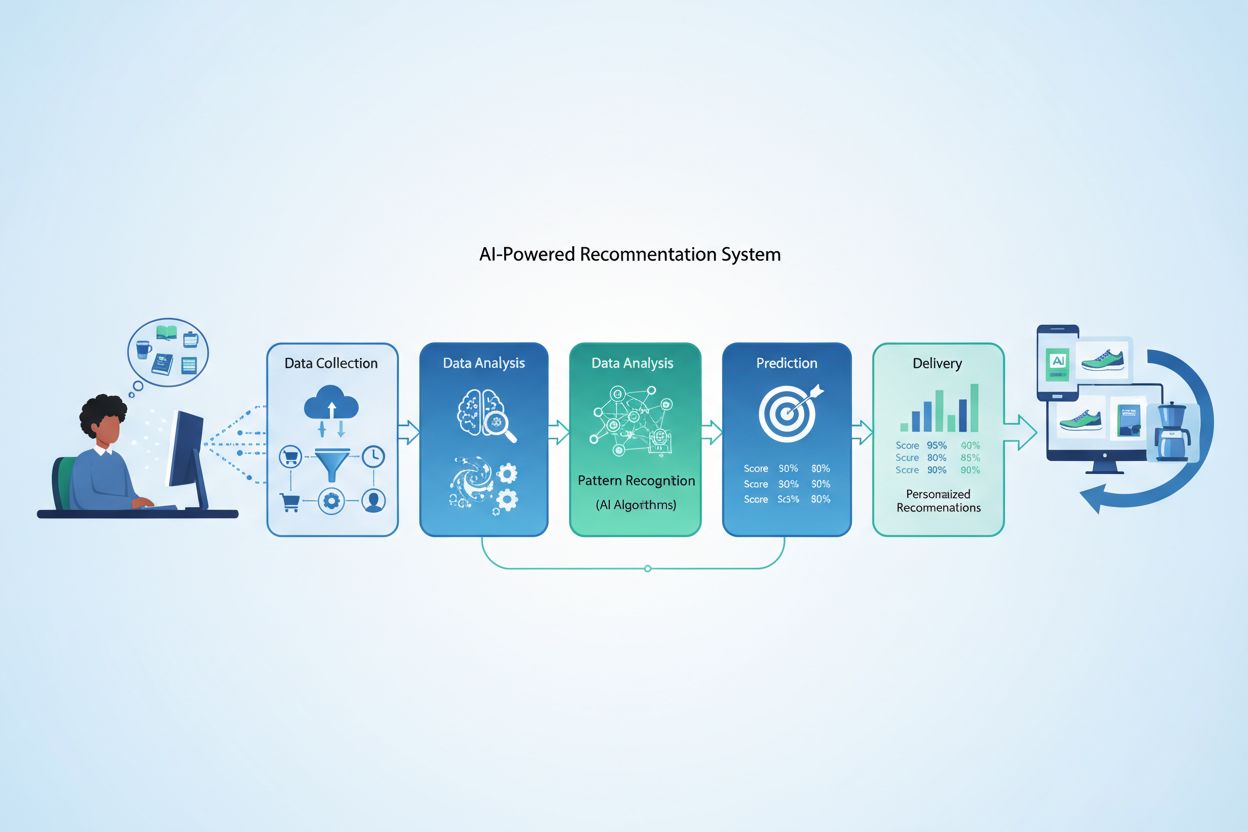
AI-powered recommendation systems operate through a sophisticated five-phase process that transforms raw user data into actionable personalized suggestions. The first phase involves comprehensive data collection, where systems gather information from multiple touchpoints including user interactions, browsing history, purchase records, and explicit feedback mechanisms. During the analysis phase, the system processes this collected data to identify meaningful patterns and relationships, utilizing machine learning algorithms such as collaborative filtering, content-based filtering, and neural networks to extract insights from complex datasets. The pattern recognition phase represents the computational core of the system, where algorithms identify similarities between users, items, or both, creating mathematical representations of preferences and item characteristics. The prediction phase leverages these identified patterns to forecast which items a user is most likely to engage with, assigning confidence scores to potential recommendations. Finally, the delivery phase presents these predictions to users through personalized interfaces, ensuring recommendations appear at optimal moments in the user journey. Real-time processing capabilities have become increasingly critical, with modern systems updating recommendations instantaneously as new user behavior data arrives, enabling dynamic personalization that adapts to changing preferences. Advanced recommendation systems employ ensemble methods that combine multiple algorithms simultaneously, with each algorithm contributing its predictions to generate more robust and accurate final recommendations than any single approach could achieve independently.
Recommendation systems rely on two distinct categories of user data, each providing unique insights into preferences and behavior patterns:
Explicit Data:
Implicit Data:
Explicit data provides direct, unambiguous signals of user preferences but suffers from sparsity, as most users rate only a tiny fraction of available items. Implicit data, conversely, is abundant and continuously generated through normal user interactions, yet requires sophisticated interpretation since actions like viewing a product don’t necessarily indicate preference. The most effective recommendation systems integrate both data types, using explicit feedback to validate and calibrate implicit signals, creating comprehensive user profiles that capture both stated and revealed preferences.
Collaborative filtering represents one of the foundational approaches in recommendation systems, operating on the principle that users with similar preferences in the past will likely enjoy similar items in the future. This methodology analyzes patterns across entire user populations to identify commonalities, distinguishing it from approaches that examine individual item characteristics. User-based collaborative filtering identifies users with similar preference histories to a target user, then recommends items that these similar users have enjoyed but the target user has not yet encountered, essentially leveraging the wisdom of comparable users. Item-based collaborative filtering, conversely, focuses on item similarities, recommending products that are similar to items the user has previously rated highly, based on how other users have rated those items in relation to each other. Both approaches employ sophisticated similarity metrics such as cosine similarity, Pearson correlation, or Euclidean distance to quantify how closely users or items resemble one another in the preference space. Collaborative filtering offers significant advantages, including the ability to recommend items with no content metadata and the capacity to discover serendipitous recommendations that users might not have anticipated. However, the approach faces notable limitations, particularly the “cold start problem” where new users or items lack sufficient historical data for accurate similarity calculations, and data sparsity issues in domains with millions of items where most user-item interactions remain unobserved.
Content-based filtering approaches recommendation by analyzing the intrinsic characteristics and features of items themselves, recommending products similar to those a user has previously preferred based on their measurable attributes. Rather than relying on collective user behavior patterns, content-based systems construct detailed item profiles encompassing relevant features such as genre, director, and cast for movies; author, subject matter, and publication date for books; or product category, brand, and specifications for e-commerce items. The system calculates similarity between items by comparing their feature vectors using mathematical techniques such as cosine similarity or Euclidean distance, creating a quantitative measure of how closely items resemble one another in feature space. When a user rates or engages with an item, the system identifies other items with similar feature profiles and recommends those alternatives, effectively personalizing suggestions based on demonstrated preferences for specific item characteristics. Content-based filtering excels in scenarios where item metadata is rich and well-structured, and it naturally handles the cold start problem for new items since recommendations depend on item features rather than historical user interactions. However, this approach exhibits limitations in serendipity and discovery, as it tends to recommend items highly similar to past preferences, potentially creating filter bubbles that restrict users to narrow categories. Compared to collaborative filtering, content-based systems require explicit feature engineering and struggle with items that lack clear categorical boundaries, yet they offer superior transparency since recommendations can be explained by referencing specific item attributes.
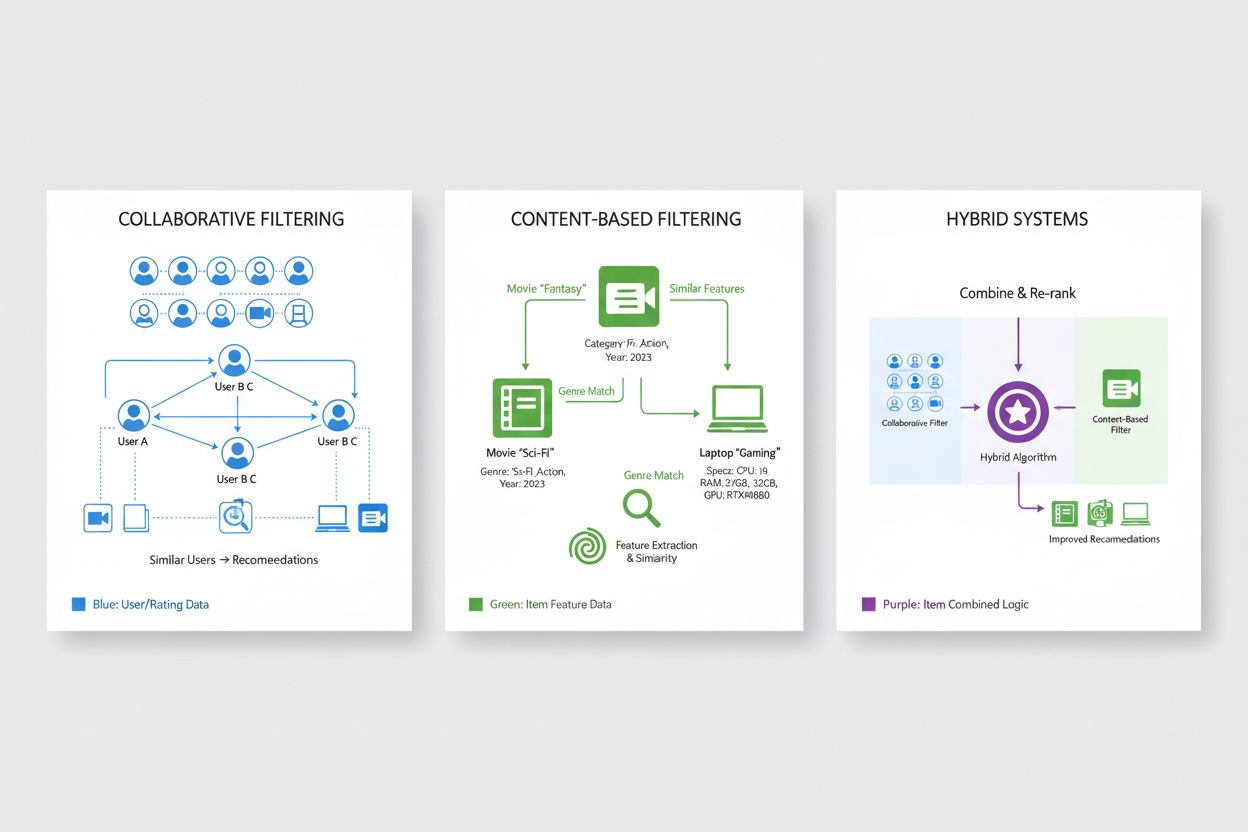
Hybrid recommendation systems strategically combine collaborative filtering and content-based filtering approaches, leveraging the complementary strengths of each methodology to overcome individual limitations and deliver superior recommendation accuracy. These systems employ various integration strategies, including weighted combinations where predictions from multiple algorithms are merged using predetermined or learned weights, switching mechanisms that select the most appropriate algorithm based on contextual factors, or cascade approaches where one algorithm’s output feeds into another. By integrating collaborative filtering’s ability to identify serendipitous recommendations and capture complex preference patterns with content-based filtering’s capacity to handle new items and provide explainable recommendations, hybrid systems achieve more robust performance across diverse scenarios. Major technology companies have adopted hybrid approaches as industry standard practice; Netflix combines collaborative filtering with content-based methods and contextual information to deliver recommendations that balance popularity, personalization, and novelty. Spotify’s recommendation engine similarly employs hybrid techniques, integrating collaborative filtering based on listening patterns with content-based analysis of audio features and metadata, supplemented by natural language processing of user-generated playlists and reviews. The advantages of hybrid systems extend beyond accuracy improvements, encompassing enhanced coverage of the item catalog, better handling of sparse data scenarios, and improved resilience to common recommendation challenges. These systems represent the current state-of-the-art in personalization technology, with most enterprise-scale recommendation platforms employing hybrid architectures that continuously evolve as new algorithmic innovations emerge.
AI-powered recommendations have become central to business models across major technology and retail companies, fundamentally transforming how customers discover and purchase products. Amazon, the e-commerce pioneer, generates approximately 35% of its total revenue through recommendation-driven purchases, with its sophisticated system analyzing browsing history, purchase patterns, product ratings, and similar customer behaviors to suggest items at critical decision points throughout the shopping journey. Netflix processes viewing history, ratings, search behavior, and temporal patterns to suggest content, with the company reporting that personalized recommendations account for approximately 80% of hours watched on the platform, demonstrating the profound impact of effective personalization on user engagement and retention. Spotify leverages AI-powered recommendations across multiple surfaces including the “Discover Weekly” playlist feature, which combines collaborative filtering with audio feature analysis and contextual information, generating highly personalized music recommendations that have become central to user engagement and subscription retention. Temu, the rapidly growing e-commerce platform, employs advanced recommendation systems that analyze user behavior patterns, search queries, and purchase history to surface products aligned with individual preferences, contributing significantly to its explosive growth and user engagement metrics. These implementations demonstrate that recommendation systems directly impact key business metrics including customer lifetime value, repeat purchase rates, and user engagement duration, with companies investing heavily in recommendation technology as a core competitive differentiator in increasingly crowded digital markets.
AI-powered recommendations deliver substantial value to both businesses and users, creating a mutually beneficial ecosystem that drives engagement and satisfaction:
Business Benefits:
User Benefits:
The cumulative impact of these benefits has made recommendation systems essential infrastructure in digital commerce and content platforms, with users increasingly expecting personalized experiences as a baseline feature rather than a premium offering.
Despite their widespread success, AI-powered recommendation systems face significant challenges that researchers and practitioners continue to address. Data privacy concerns have intensified as regulatory frameworks like GDPR and CCPA impose strict requirements on data collection and usage, forcing companies to balance personalization effectiveness with user privacy rights and data protection obligations. The cold start problem remains particularly acute for new users and items, where insufficient historical data prevents accurate recommendations, requiring hybrid approaches or alternative strategies to bootstrap personalization. Algorithm bias represents a critical challenge, as recommendation systems can perpetuate and amplify existing biases in training data, potentially discriminating against certain user groups or creating filter bubbles that limit exposure to diverse perspectives and content.
Emerging trends are reshaping the recommendation landscape, with real-time personalization becoming increasingly sophisticated through edge computing and streaming data processing that enables instantaneous adaptation to user behavior. Multimodal data integration is expanding beyond traditional behavioral signals to incorporate visual features, audio characteristics, textual content, and contextual information, enabling richer and more nuanced understanding of user preferences. Emotion-driven recommendations represent a frontier in personalization, with systems beginning to incorporate emotional context and sentiment analysis to deliver recommendations aligned not just with historical preferences but with current emotional states and needs. Future developments will likely emphasize explainability and transparency, enabling users to understand why specific recommendations appear and providing control mechanisms that allow users to shape their recommendation profiles. The convergence of these trends suggests that next-generation recommendation systems will be more privacy-conscious, transparent, emotionally intelligent, and capable of delivering genuinely transformative personalization experiences while respecting user autonomy and data rights.
AI-powered recommendations proactively suggest items based on user behavior and preferences without requiring explicit searches, while traditional search requires users to actively query for products. Recommendations use machine learning to predict interests, whereas search relies on keyword matching. Recommendations are personalized to individual users, while search results are typically more generic. Modern systems often combine both approaches for optimal user experience.
New users face the 'cold start problem' where systems lack historical data for accurate recommendations. Solutions include using demographic information, showing popular items, employing content-based filtering based on item features, or requesting explicit preference inputs. Hybrid systems combine multiple approaches to bootstrap recommendations for new users. Some platforms use collaborative filtering with similar user profiles or contextual information like device type and location to make initial suggestions.
Recommendation systems collect explicit data like ratings, reviews, and user feedback, plus implicit data including browsing history, purchase records, time spent on items, search queries, and click patterns. They may also gather contextual information such as device type, location, time of day, and seasonal factors. Advanced systems integrate demographic data, social connections, and behavioral signals. All data collection must comply with privacy regulations like GDPR and CCPA, requiring user consent and transparent data usage policies.
Yes, recommendation systems can perpetuate and amplify biases present in training data, potentially discriminating against certain user groups or limiting exposure to diverse content. Algorithmic bias can result from skewed historical data, underrepresentation of minority groups, or feedback loops that reinforce existing patterns. Addressing bias requires diverse training data, regular audits, fairness metrics, and transparent algorithm design. Companies must actively monitor for bias and implement mitigation strategies to ensure equitable recommendations across all user segments.
Hybrid systems combine collaborative filtering's ability to identify serendipitous recommendations with content-based filtering's capacity to handle new items and provide explainable suggestions. This combination overcomes individual limitations: collaborative filtering struggles with new items while content-based filtering lacks serendipity. Hybrid approaches use weighted combinations, switching mechanisms, or cascade methods to leverage each algorithm's strengths. The result is improved accuracy, better coverage of item catalogs, enhanced handling of sparse data, and more robust performance across diverse scenarios.
Privacy concerns include extensive data collection required for accurate recommendations, potential unauthorized data use, data breach risks, and regulatory compliance challenges under GDPR, CCPA, and similar laws. Users may feel uncomfortable with the level of behavioral tracking needed for personalization. Companies must implement strong data security, obtain explicit consent, provide transparency about data usage, and allow users to control their data. Balancing personalization effectiveness with privacy protection remains an ongoing challenge in the industry.
Real-time recommendations process user behavior data instantaneously as it occurs, updating suggestions immediately based on current interactions. Systems use streaming data processing and edge computing to analyze actions like clicks, views, or purchases within milliseconds. This enables dynamic personalization that adapts to changing preferences throughout a user session. Real-time systems require robust infrastructure, efficient algorithms, and low-latency data pipelines. Examples include Netflix updating recommendations as you browse, or Amazon showing new suggestions as you add items to your cart.
Future trends include emotion-driven recommendations that consider user emotional states, multimodal data integration combining visual, audio, and textual information, enhanced privacy-preserving techniques, improved explainability and transparency, and real-time personalization at scale. Emerging technologies like federated learning enable recommendations without centralizing user data. Systems will become more context-aware, incorporating temporal factors and situational information. The convergence of these trends will deliver more sophisticated, transparent, and privacy-conscious personalization while respecting user autonomy and data rights.
AmICited tracks how AI systems like ChatGPT, Perplexity, and Google AI Overviews mention your brand in personalized recommendations and AI-generated content. Stay informed about your brand's visibility in AI-powered systems.
Learn how AI product recommendations work, the algorithms behind them, and how to optimize your visibility in AI-powered recommendation systems across ChatGPT, ...
Discover how customer reviews influence AI recommendation algorithms, improve recommendation accuracy, and enhance personalization in AI-powered systems like Ch...
Community discussion on optimizing for purchase decisions in AI. Real strategies from brands who improved their visibility in AI-generated product recommendatio...