



Future of Product Search in AI: Trends and Technologies
Explore how AI is transforming product search with conversational interfaces, generative discovery, personalization, and agentic capabilities. Learn about emerg...
10 min read

AI Product Discovery is the process by which AI assistants surface and recommend products to users based on conversational context, behavioral patterns, and real-time personalization. It uses natural language processing, machine learning, and computer vision to understand customer intent and deliver highly relevant product recommendations. Unlike traditional search that relies on keyword matching, AI product discovery interprets meaning, context, and preferences to guide customers through optimized discovery journeys. This technology has become essential for modern e-commerce, driving 15-30% conversion rate improvements and significantly enhancing customer satisfaction.
AI Product Discovery is the process by which AI assistants surface and recommend products to users based on conversational context, behavioral patterns, and real-time personalization. It uses natural language processing, machine learning, and computer vision to understand customer intent and deliver highly relevant product recommendations. Unlike traditional search that relies on keyword matching, AI product discovery interprets meaning, context, and preferences to guide customers through optimized discovery journeys. This technology has become essential for modern e-commerce, driving 15-30% conversion rate improvements and significantly enhancing customer satisfaction.
AI Product Discovery represents a fundamental shift in how customers find and interact with products online, leveraging artificial intelligence to deliver personalized shopping experiences at scale. Unlike traditional search methods that rely on keyword matching and static categorization, AI-powered discovery systems understand user intent, context, and preferences to surface the most relevant products in real-time. The global AI product discovery market has reached $7.2 billion, with 65% of e-commerce solutions now incorporating AI-driven discovery mechanisms. Organizations implementing these technologies report 15-30% improvements in conversion rates, alongside significant gains in customer lifetime value and average order value. This transformation represents a critical competitive advantage in modern retail, where personalization directly correlates with revenue growth.

AI product discovery operates through multiple interconnected technologies that work together to understand customer needs and deliver optimal results:
| Technology | Function | Business Impact |
|---|---|---|
| NLP | Interprets customer language, intent, and semantic meaning | Improves search accuracy by 40-60% |
| Machine Learning | Identifies patterns in user behavior and preferences | Enables predictive recommendations with 25-35% higher relevance |
| Computer Vision | Analyzes product images and visual similarities | Powers visual search with 3-5x higher engagement |
| Behavioral Analytics | Tracks user interactions and purchase history | Increases personalization accuracy by 50%+ |
| Real-time Decisioning | Makes instant recommendations based on current context | Reduces decision time and improves conversion velocity |
These technologies combine to create systems that continuously learn from user interactions, adapting recommendations and search results based on browsing patterns, purchase history, seasonal trends, and competitive context. The synergy between these mechanisms enables discovery platforms to move beyond reactive search toward predictive, anticipatory product recommendations that meet customers before they fully articulate their needs.
The AI product discovery landscape includes several dominant platforms, each employing distinct technological approaches. Bloomreach specializes in unified commerce experiences by combining product discovery with content personalization across channels. Algolia focuses on fast, typo-tolerant search with AI-powered ranking and merchandising capabilities. Elasticsearch provides the foundational search infrastructure that powers many enterprise discovery solutions with advanced relevance tuning. Constructor emphasizes behavioral learning and real-time personalization specifically designed for e-commerce conversion optimization. Beyond product discovery itself, platforms like AmICited.com serve as critical monitoring solutions for tracking how AI systems cite and reference brands, ensuring transparency in AI-driven recommendations and maintaining brand integrity across discovery platforms. Complementary automation platforms like FlowHunt.io help teams streamline the implementation and optimization of these discovery systems across their technology stack.
Conversational interfaces have become central to modern product discovery, enabling customers to find products through natural dialogue rather than traditional search queries. Chatbots and voice assistants powered by advanced natural language understanding can interpret complex, multi-intent requests like “show me sustainable running shoes under $150 that are good for marathon training” and deliver precisely relevant results. These systems maintain conversation context across multiple exchanges, allowing customers to refine their search through dialogue rather than reformulating queries. Context-aware recommendations within conversational flows can suggest complementary products, highlight limited-time offers, or surface items based on real-time inventory and personalization signals. The shift toward conversational commerce has proven particularly effective for mobile users and voice-first interactions, where traditional search interfaces become cumbersome. This approach reduces friction in the discovery process while simultaneously gathering rich intent data that improves future recommendations.

Real-time personalization represents the core value proposition of modern AI product discovery, moving beyond demographic segmentation toward individual-level customization. AI systems analyze behavioral data—including browsing patterns, time spent on products, comparison behaviors, and purchase history—to build dynamic user profiles that evolve with each interaction. Predictive recommendations leverage this behavioral learning to anticipate customer needs, often surfacing products customers didn’t know they wanted but find highly relevant. These systems can identify micro-segments of users with similar preferences and behaviors, enabling hyper-targeted discovery experiences that feel individually crafted. Privacy considerations have become increasingly important, with leading platforms implementing privacy-preserving techniques like federated learning and on-device personalization to deliver personalization without compromising user data protection. The balance between personalization depth and privacy compliance has become a key differentiator among discovery platforms, with transparent data practices building customer trust and loyalty.
The financial impact of AI product discovery extends across multiple revenue and efficiency metrics that directly affect profitability. Organizations implementing advanced discovery systems report 15-30% conversion rate improvements, with average order value increases of 20-40% driven by relevant cross-sell and upsell recommendations. Customer satisfaction metrics improve significantly, with Net Promoter Scores increasing by 15-25 points as customers find products more easily and experience fewer search frustrations. Support costs decline as AI-powered discovery reduces customer inquiries about product availability and recommendations, with some organizations reporting 30-40% reductions in discovery-related support tickets. Revenue attribution becomes more sophisticated, with AI systems tracking which discovery touchpoints drive conversions and enabling precise ROI calculation for discovery investments. The cumulative effect positions AI product discovery as one of the highest-ROI technology investments in modern retail operations.
Successfully deploying AI product discovery requires careful attention to data quality, system architecture, and organizational readiness. Data quality forms the foundation—AI systems require clean, comprehensive product data including descriptions, attributes, images, and pricing information, along with historical behavioral data to train recommendation models. System integration challenges often emerge when connecting discovery platforms with existing e-commerce infrastructure, inventory systems, and customer data platforms, requiring phased implementation approaches that minimize disruption. Team training becomes critical, as merchandisers, marketers, and analysts need to understand how AI systems rank and recommend products to effectively optimize performance. Measurement frameworks must be established early, defining KPIs beyond conversion rate—including metrics like discovery engagement, recommendation relevance, and customer satisfaction—to ensure continuous optimization. Organizations that approach implementation as a multi-quarter journey with clear milestones, stakeholder alignment, and iterative refinement achieve significantly better outcomes than those attempting rapid, comprehensive deployments.
Use this process to evaluate whether an existing (or planned) product discovery system is actually delivering on the technology’s potential rather than underperforming a well-optimized traditional search.
AmICited.com tracks how AI assistants like ChatGPT, Perplexity, and Google AI Overviews mention your products and brand in their recommendations. Get insights into your AI visibility and ensure your brand is properly cited in AI-generated product discovery results.
Explore how AI is transforming product search with conversational interfaces, generative discovery, personalization, and agentic capabilities. Learn about emerg...

AI SEO for ecommerce: how to optimize product descriptions for AI recommendations. Discover best practices, tools, and strategies to improve visibility in AI-dr...
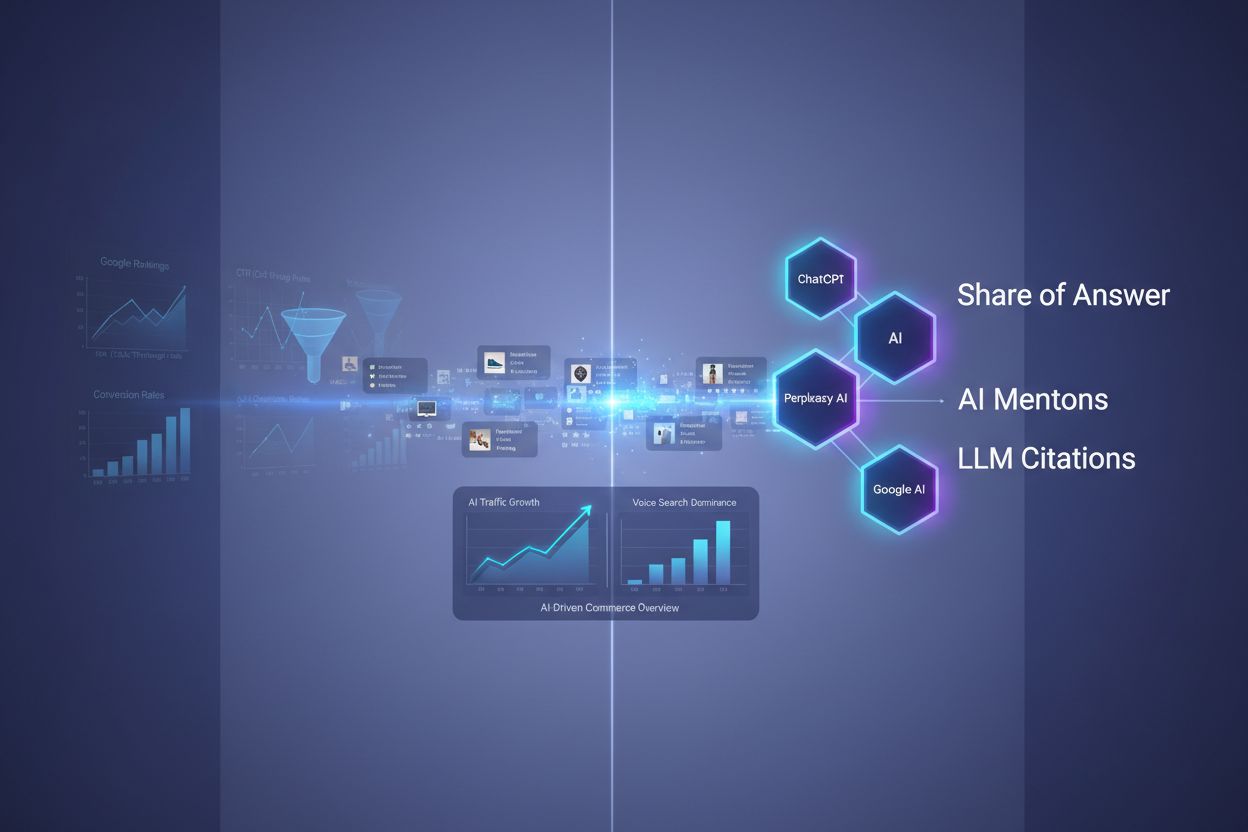
How AI is changing product discovery. Strategies to improve your brand's e-commerce AI visibility in ChatGPT, Perplexity and AI Overviews.
Cookie Consent
We use cookies to enhance your browsing experience and analyze our traffic. See our privacy policy.