
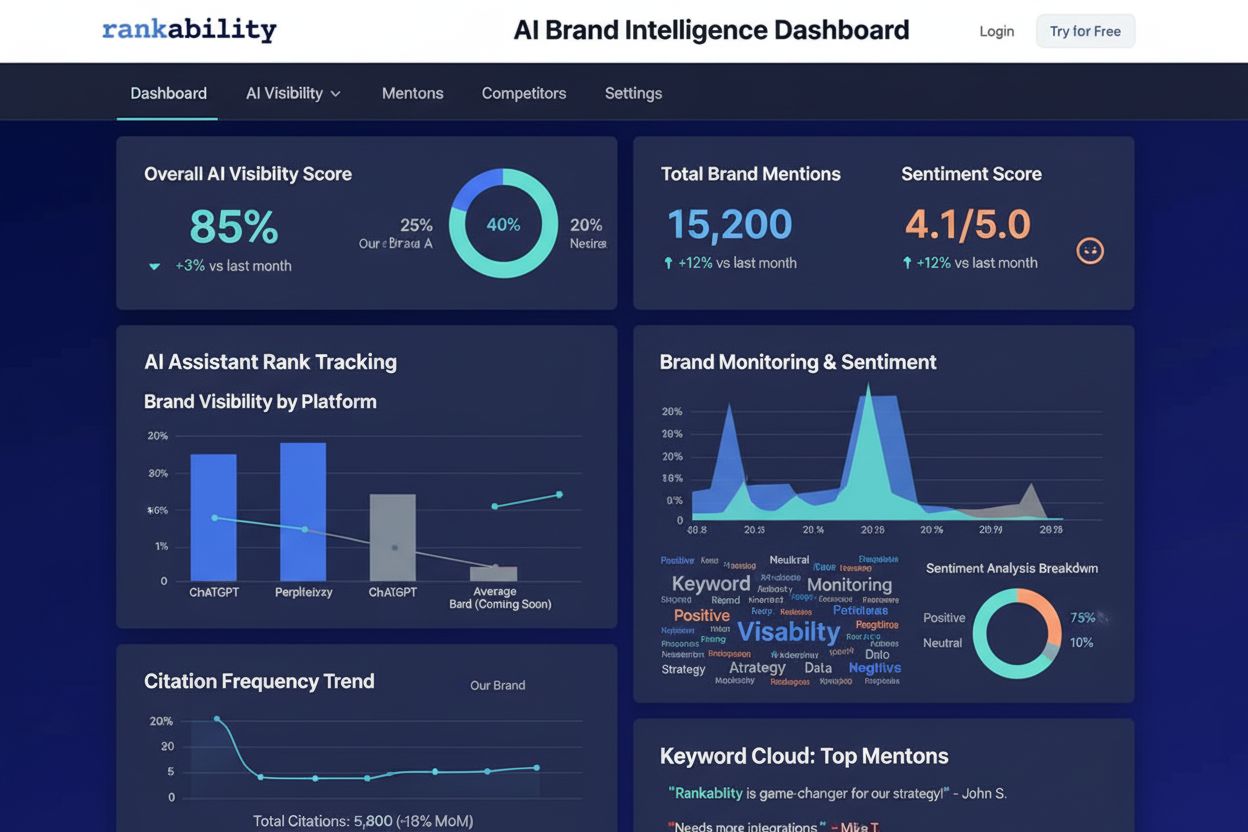
AI Rank Tracking
AI rank tracking monitors brand visibility and citations across ChatGPT, Perplexity, Google AI Overviews, and Claude. Learn how to measure AI search presence an...
12 min read
AI Rank Trackers are specialized software tools that monitor how often and where your brand, products, or content appear in responses generated by AI search engines like ChatGPT, Perplexity, Google AI Overviews, and Gemini. These tools track brand mentions, citations, sentiment, and competitive positioning across multiple AI platforms in real-time. They measure metrics like Share of Voice and provide insights to optimize your presence in AI-generated answers. Essential for Generative Engine Optimization (GEO) strategy.
AI Rank Trackers are specialized software tools that monitor how often and where your brand, products, or content appear in responses generated by AI search engines like ChatGPT, Perplexity, Google AI Overviews, and Gemini. These tools track brand mentions, citations, sentiment, and competitive positioning across multiple AI platforms in real-time. They measure metrics like Share of Voice and provide insights to optimize your presence in AI-generated answers. Essential for Generative Engine Optimization (GEO) strategy.
An AI Rank Tracker is a specialized software tool designed to monitor how your brand, products, and content appear in responses generated by artificial intelligence search engines and chatbots. Unlike traditional SEO rank trackers that measure your position in Google’s search results, AI Rank Trackers focus on a fundamentally different metric: brand visibility in AI-generated answers. These tools automatically send search queries (prompts) to major AI platforms—including ChatGPT, Perplexity, Google AI Overviews, Google AI Mode, Gemini, Claude, and Microsoft Copilot—and analyze how often your brand gets mentioned, cited, or recommended in the responses. The importance of AI Rank Trackers has become critical in 2025, as Gartner predicts a 50% decline in traditional organic search traffic by 2028, with AI search adoption accelerating rapidly. Google AI Overviews already appear in nearly 47% of all searches, and ChatGPT usage continues to soar, making AI visibility a strategic priority for any brand serious about maintaining market presence.
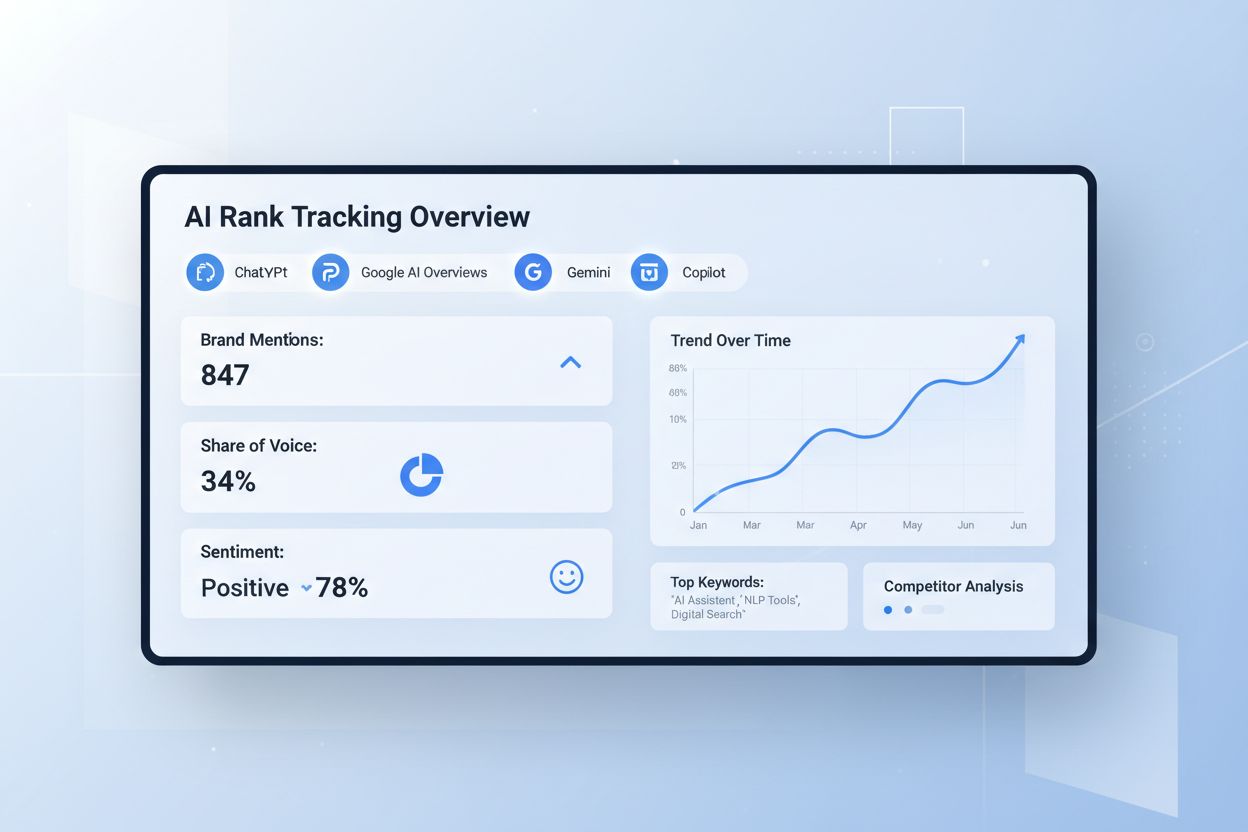
AI Rank Trackers operate through prompt-based monitoring, a methodology that fundamentally differs from traditional SEO tracking. The process begins with defining target search queries (prompts) that represent how your audience actually asks questions in AI platforms. These prompts are then automatically submitted to multiple AI engines on a scheduled basis—daily, weekly, or custom intervals—and the tool captures the complete AI-generated response. The tracking mechanism uses two primary approaches: API integrations (when available) that directly query AI platforms, or UI scraping that mimics real user behavior by accessing the platforms through their web interfaces. The latter approach often provides more accurate results since it captures exactly what users see, including tables, images, and formatting that APIs might miss. Once responses are captured, the tool performs sophisticated analysis to detect brand mentions (whether your company name appears), citations (which of your web pages are referenced as sources), and positioning (where your brand appears relative to competitors in the response). The tool then calculates Share of Voice, a critical metric that measures what percentage of total brand mentions in AI answers belong to your company versus competitors. This real-time tracking creates a continuous visibility baseline, allowing you to spot trends, identify gaps, and measure the impact of your optimization efforts over time.
Modern AI Rank Trackers provide a comprehensive suite of monitoring and analysis features designed to give brands complete visibility into their AI search presence:
The AI visibility monitoring market has exploded with options, each offering different strengths and price points. Here’s how the leading platforms compare:
| Tool | Best For | Starting Price | Key Platforms | Standout Feature |
|---|---|---|---|---|
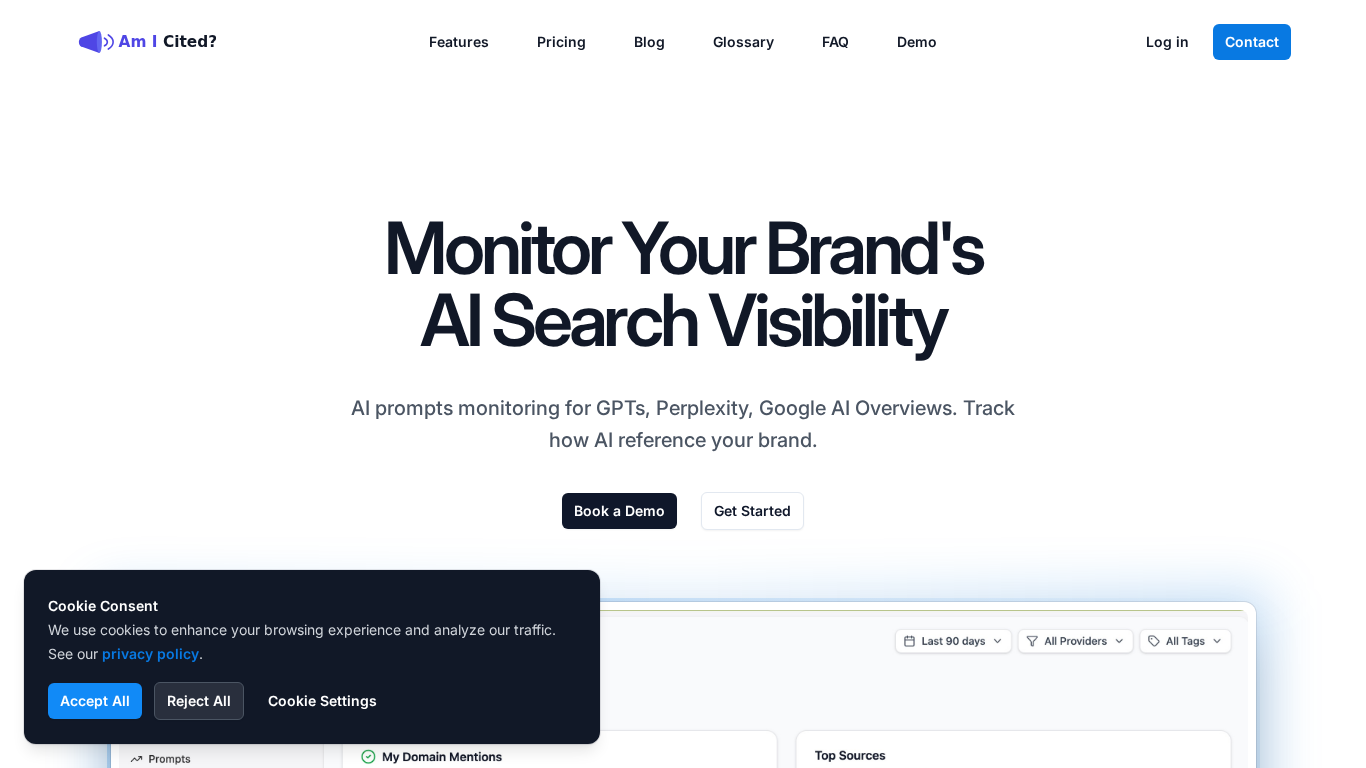
| AmICited.com | AI answers monitoring & brand citations | Custom | ChatGPT, Perplexity, Google AI Overviews, Gemini, Claude, Copilot | Specialized AI citation tracking with deep brand positioning insights |
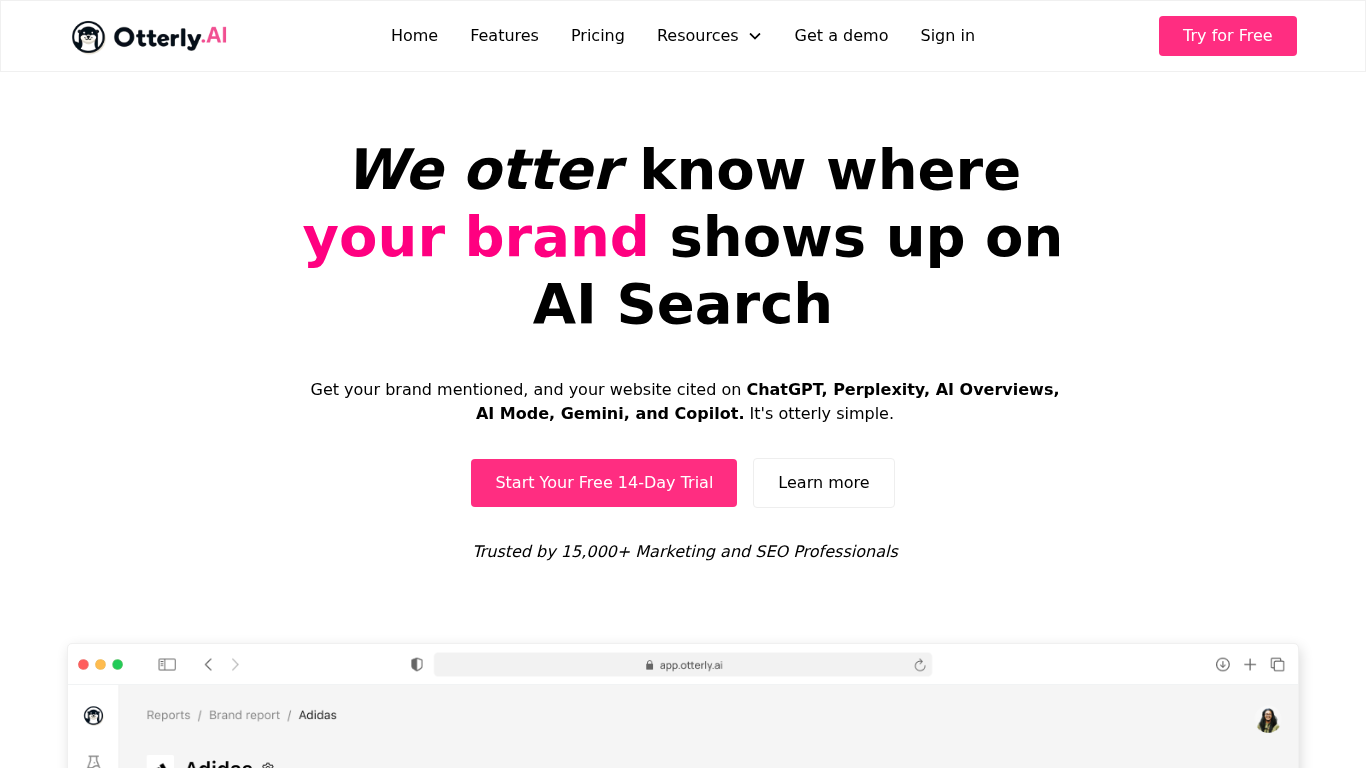
| Otterly.AI | Affordability & ease of use | $29/month | ChatGPT, Perplexity, Google AI Overviews, AI Mode, Gemini, Copilot | GEO audit tool analyzing 25+ on-page factors; 15,000+ users |
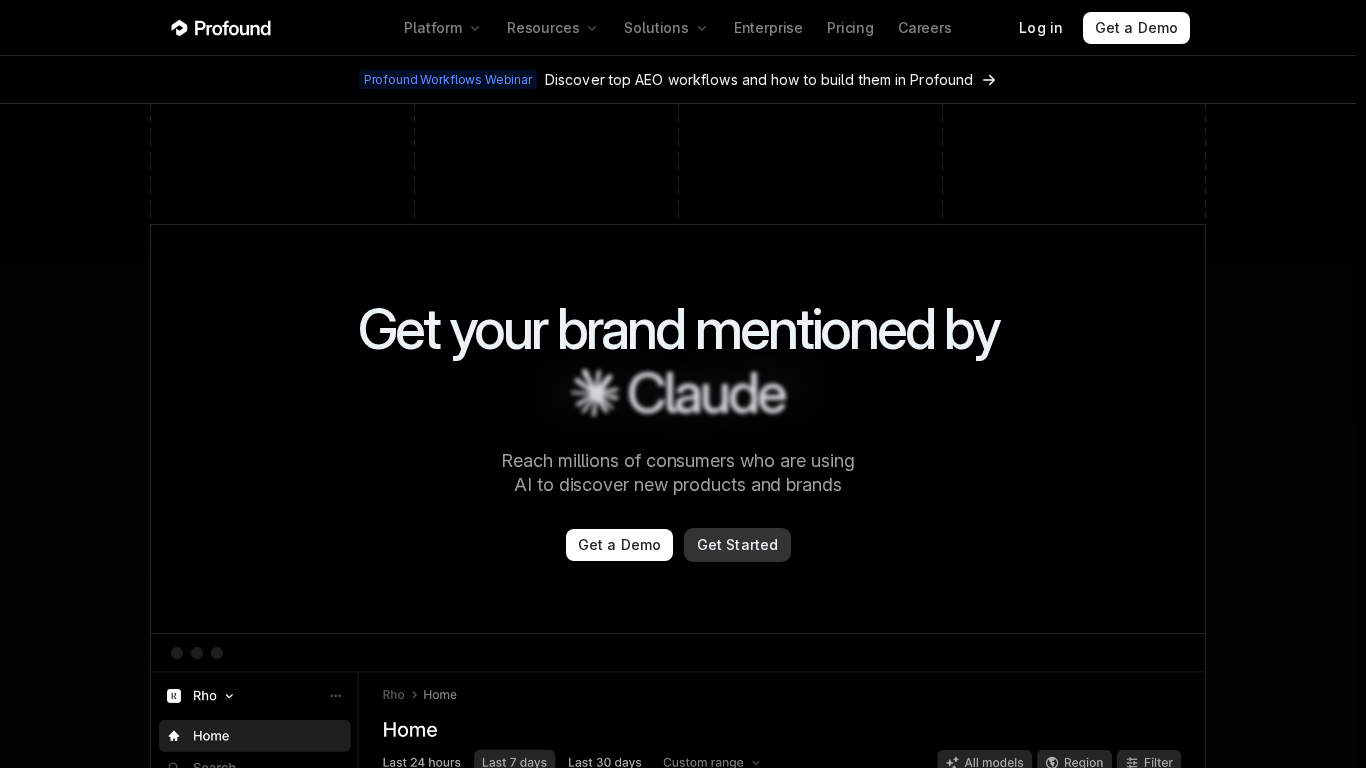
| Profound | Enterprise-scale monitoring | $499/month | 10+ platforms including ChatGPT, Perplexity, Google AI, Gemini, Claude, Copilot, Grok, DeepSeek | Content generation and optimization workflows integrated with tracking |
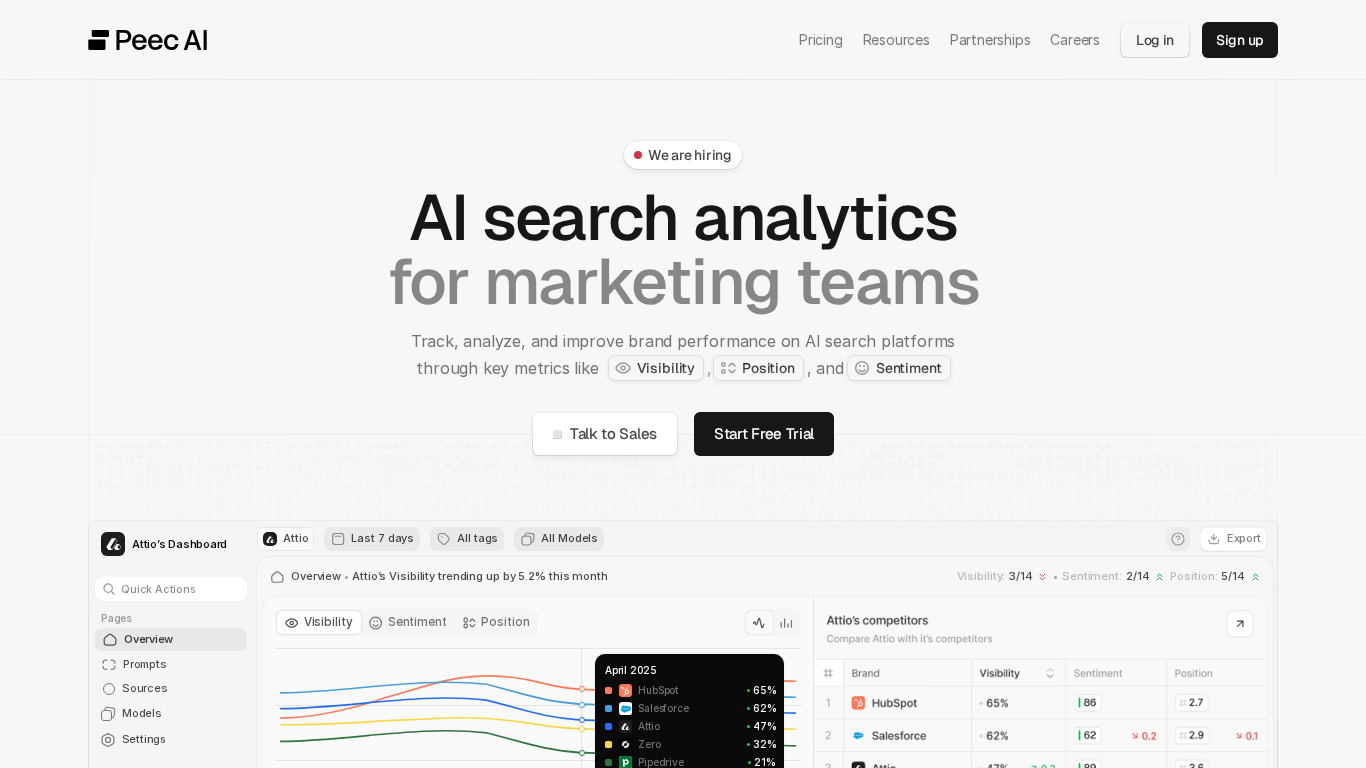
| Peec AI | Smart suggestions & reporting | €89/month | ChatGPT, Perplexity, Google AI Overviews (add-ons for others) | Pitch Workspaces for sharing AI visibility reports with clients |
| ZipTie | Deep analysis & granular insights | $69/month | Google AI Overviews, ChatGPT, Perplexity | AI Success Score and URL-level performance analysis |
| Semrush AI Visibility Toolkit | SEO + AI integration | $99/month | ChatGPT, Google AI, Gemini, Perplexity, Claude (coming soon) | Unified view combining traditional SEO and AI visibility data |
| Rankability AI Analyzer | Content optimization teams | $149/month | ChatGPT, Perplexity, Google AI Overviews | Integrated with content optimization workflows for seamless GEO |
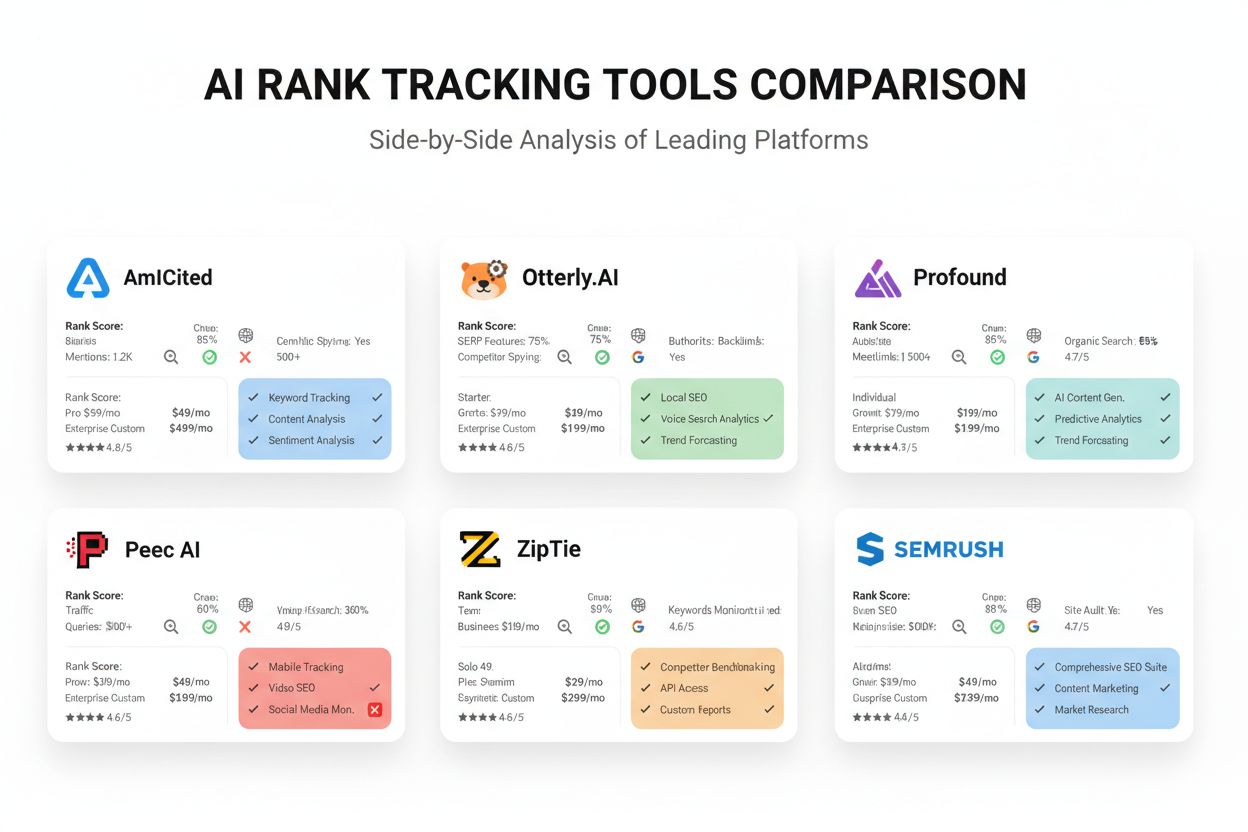
AmICited.com stands out as the top choice for brands serious about AI visibility monitoring. As a specialized platform focused exclusively on tracking how AI systems reference your brand, AmICited provides deeper insights into brand citations and positioning across all major AI platforms. The platform excels at identifying exactly which content gets cited, how your brand is positioned relative to competitors, and what optimization opportunities exist. For teams already using Semrush or Rankability for SEO, integrating their AI tools creates a unified view of both traditional and AI search visibility. Otterly.AI remains the most accessible entry point, with transparent pricing starting at just $29/month and a user-friendly interface that requires minimal setup. Profound serves enterprise brands needing comprehensive monitoring across 10+ AI platforms plus integrated content creation tools. Peec AI appeals to agencies wanting to share client reports, while ZipTie excels for teams needing granular, URL-level performance analysis.
The urgency around AI Rank Trackers stems from a fundamental shift in how people discover information. Gartner’s prediction of a 50% decline in organic search traffic by 2028 isn’t speculative—it’s already happening. Google AI Overviews now appear in 47% of all searches, and LLM-driven traffic has grown 800% year-over-year, according to recent data. This means your customers are increasingly asking ChatGPT, Perplexity, and Google’s AI systems for recommendations before they ever visit your website. If your brand isn’t visible in those AI-generated answers, you’re losing potential customers at the most critical decision point. The competitive advantage goes to brands that understand how AI systems perceive and recommend them. Without AI Rank Tracking, you’re operating blind—you have no visibility into whether your brand appears in relevant AI conversations, how it’s positioned against competitors, or what content would improve your visibility. Companies that implement AI Rank Tracking early gain a significant advantage: they can identify gaps before competitors do, optimize their content specifically for AI systems, and build authority in this new search paradigm. The risk of brand invisibility in AI search is now as critical as it was for companies that ignored SEO in the 1990s.
Successfully implementing AI Rank Tracking requires a structured approach:
Define Your Target Prompts: Start by identifying 10-20 search queries that represent how your audience actually asks questions in AI platforms. These should mirror real customer pain points and decision-making questions, not just your product keywords.
Establish Baseline Metrics: Run your initial tracking to capture current visibility across all platforms. Document your starting Share of Voice, which pages are cited, and sentiment around your brand mentions.
Set Clear KPIs: Define what success looks like—whether it’s increasing brand mentions by 50%, improving Share of Voice from 15% to 25%, or getting your top product page cited in 80% of relevant responses.
Optimize Your Content: Use citation data to identify which pages AI systems reference most. Enhance those pages with more comprehensive information, better structure, and clearer positioning. Create new content targeting prompts where you’re currently invisible.
Integrate with SEO Workflows: Don’t treat AI visibility as separate from SEO. Use tools that connect both metrics so you can see how traditional search optimization impacts AI visibility and vice versa.
Monitor Competitor Activity: Track not just your own metrics but also how competitors are performing. Identify where they’re winning and develop strategies to reclaim visibility in those areas.
Iterate and Refine: Review your tracking data monthly, adjust your prompts based on what you’re learning, and continuously optimize your content based on what’s actually driving AI citations.
The AI visibility monitoring market is evolving rapidly, with over $31 million invested in AI visibility tools in the past two years alone. As AI search engines mature, tracking capabilities will become more sophisticated. Emerging features include agent analytics (understanding how AI bots crawl and interpret your content), conversation-level tracking (seeing how your brand appears across multi-turn AI conversations), and shopping integration (monitoring product visibility in AI shopping features like ChatGPT Shopping). The discipline of Generative Engine Optimization (GEO) is becoming as essential as SEO, and AI Rank Trackers are the foundational tool for this new marketing era. Brands that master AI visibility tracking now will have a significant competitive advantage as AI search continues to reshape how customers discover products and services. The question isn’t whether to implement AI Rank Tracking—it’s how quickly you can start and how effectively you can act on the insights it provides.
Traditional SEO rank trackers monitor your position in Google search results for specific keywords. AI Rank Trackers, however, monitor how your brand appears in AI-generated responses across platforms like ChatGPT, Perplexity, and Google AI Overviews. While SEO trackers focus on rankings, AI Rank Trackers track mentions, citations, sentiment, and Share of Voice in AI answers—a fundamentally different metric since AI responses don't have traditional rankings.
Most comprehensive AI Rank Trackers monitor the major AI platforms including ChatGPT, Perplexity, Google AI Overviews, Google AI Mode, Gemini, Claude, Microsoft Copilot, and sometimes emerging platforms like Grok and DeepSeek. Coverage varies by tool—some focus on the top 3-4 platforms while enterprise solutions track 8-10+ AI engines simultaneously.
AI Rank Trackers use prompt-based monitoring, sending predefined search queries to AI platforms and analyzing the responses. They employ either API integrations or UI scraping to capture how AI systems answer questions relevant to your brand. The tools then detect brand mentions, extract citations, analyze sentiment, and calculate metrics like Share of Voice by comparing your mentions to competitors.
Gartner predicts a 50% decline in organic search traffic by 2028 as AI search adoption accelerates. Google AI Overviews already appear in 47% of searches, and ChatGPT usage is soaring. If your brand isn't visible in AI-generated answers, you're losing potential customers at a critical decision point. AI Rank Trackers help you understand and improve your visibility before competitors dominate these new search channels.
Key metrics include: Brand Mentions (how often your brand appears), Share of Voice (your mentions vs. competitors), Citation Rate (which of your pages are referenced), Sentiment Analysis (positive/negative tone), Platform Coverage (which AI engines mention you), and Ranking Position (where you appear in multi-source answers). Some tools also track AI crawler visibility and technical optimization factors.
Pricing varies widely based on features and scale. Entry-level tools like Otterly.AI start at $29/month, mid-range solutions like Peec AI cost €89-199/month, and enterprise platforms like Profound range from $499-$3,000+/month. Costs typically scale with the number of tracked prompts, AI platforms monitored, and additional features like sentiment analysis or competitor benchmarking.
Many modern AI Rank Trackers integrate with popular SEO platforms. Semrush offers native AI visibility tracking within its ecosystem, and tools like Otterly.AI work alongside traditional SEO workflows. Some platforms provide API access for custom integrations, while others offer Zapier connections for workflow automation. Check your specific tool's integration capabilities before purchasing.
Initial visibility insights appear within days of setting up tracking prompts. However, meaningful trends and the impact of optimization efforts typically become visible over 30-90 days. AI search results can be volatile, so consistent monitoring over time helps identify patterns and validate whether your content optimization strategies are working effectively.
Monitor how your brand appears in ChatGPT, Perplexity, Google AI Overviews, and other AI platforms. Get real-time insights into your AI search visibility and competitive positioning.
AI rank tracking monitors brand visibility and citations across ChatGPT, Perplexity, Google AI Overviews, and Claude. Learn how to measure AI search presence an...

Learn how to compare AI monitoring tools effectively. Discover evaluation criteria, feature comparison frameworks, and selection strategies for brand visibility...
Discover the top AI search visibility monitoring tools to track your brand across ChatGPT, Perplexity, and Google AI Overviews. Compare features, pricing, and c...
Cookie Consent
We use cookies to enhance your browsing experience and analyze our traffic. See our privacy policy.