
AI Rank Tracker
Learn what AI Rank Trackers are and how they monitor your brand's visibility across ChatGPT, Perplexity, Google AI Overviews, and other AI platforms. Discover t...
8 min read
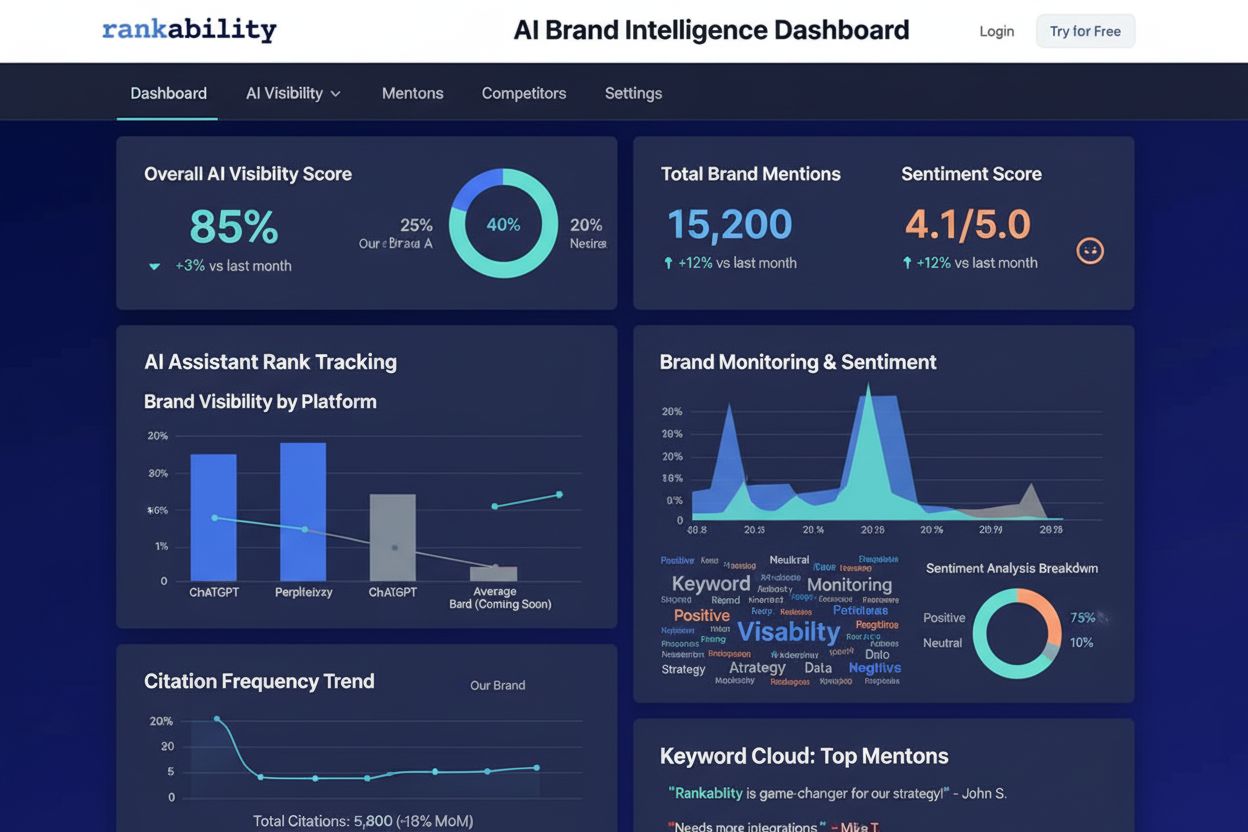
AI rank tracking is the process of monitoring how often a brand, product, or website appears, gets cited, and is recommended across AI-powered search platforms like ChatGPT, Perplexity, Google AI Overviews, and Claude. Unlike traditional SEO ranking, AI rank tracking measures visibility in AI-generated responses rather than position on search engine results pages.
AI rank tracking is the process of monitoring how often a brand, product, or website appears, gets cited, and is recommended across AI-powered search platforms like ChatGPT, Perplexity, Google AI Overviews, and Claude. Unlike traditional SEO ranking, AI rank tracking measures visibility in AI-generated responses rather than position on search engine results pages.
AI rank tracking is the systematic monitoring and measurement of how often a brand, product, or website appears, gets cited, and is recommended across AI-powered search platforms such as ChatGPT, Perplexity, Google AI Overviews, Claude, and Gemini. Unlike traditional SEO rank tracking, which measures a website’s position on search engine results pages (SERPs) for specific keywords, AI rank tracking focuses on visibility within AI-generated responses to user prompts. This represents a fundamental shift in how brands measure search visibility in an era where users increasingly turn to large language models (LLMs) and generative AI tools for answers rather than clicking through to individual websites. The practice has become essential as research shows that 58% of consumers have replaced traditional search engines with generative AI tools for product recommendations, and traditional organic search traffic is expected to decline by 50% by 2028. AI rank tracking captures metrics that traditional SEO tools cannot measure, including citation frequency, brand mention rates, share of voice in AI responses, and sentiment analysis of how AI platforms describe your brand.
The emergence of AI rank tracking reflects a seismic shift in how people discover information online. For decades, SEO professionals optimized websites to rank higher on Google’s search results pages, measuring success through keyword rankings, organic traffic, and click-through rates. However, the rapid adoption of ChatGPT, Perplexity, and other generative AI platforms has fundamentally changed the discovery landscape. When users ask ChatGPT a question, they receive a synthesized answer that may cite multiple sources—or none at all. This creates a critical visibility problem: a website can rank on page one of Google for a keyword yet be completely invisible in AI-generated responses to related prompts. According to SE Ranking’s 2025 research, approximately 30% of keywords trigger AI Overviews in US SERPs, and AI traffic has increased approximately 8x in the past year. The challenge is that AI platforms currently drive around 0.15% of all internet traffic globally, but this is growing exponentially. More importantly, ChatGPT leads the global AI traffic market, accounting for over 77% of all AI-driven visits, while Perplexity drives nearly 15% of AI visitors. This fragmentation across multiple platforms means brands must track visibility separately on each engine, as overlap between AI Mode and organic results is minimal—only 14% at the URL level and 21.9% at the domain level. The rise of AI rank tracking tools has been dramatic, with over $31 million flowing into this market segment in the past two years, and new platforms launching continuously. Industry experts now recognize that presence in AI answers, not clicks, has become an essential indicator of visibility in the emerging search ecosystem.
| Metric | Traditional SEO Rank Tracking | AI Rank Tracking |
|---|---|---|
| Primary Focus | Position on search engine results pages (SERPs) | Mentions and citations in AI-generated responses |
| Key Measurement | Keyword ranking position (1st, 2nd, 3rd, etc.) | Citation frequency and brand mention rate |
| User Behavior | Users click through to websites from search results | Users receive answers without clicking through |
| Traffic Attribution | Direct correlation between ranking and clicks | Minimal direct traffic; emphasis on visibility and influence |
| Metric Reliability | Consistent and predictable rankings | Variable outputs; same query produces different results |
| Platforms Tracked | Google, Bing, Yahoo, DuckDuckGo | ChatGPT, Perplexity, Google AI Overviews, Claude, Gemini |
| Content Optimization | Keywords, title tags, meta descriptions, backlinks | Content length, section structure, freshness, technical performance |
| Competitive Analysis | Share of top 10 positions | Share of voice in AI responses |
| Sentiment Measurement | Not applicable | Positive, negative, or neutral brand characterization |
| Data Volatility | Relatively stable week-to-week | Highly volatile; 60%+ of domains disappear between runs |
AI rank tracking operates through a fundamentally different mechanism than traditional rank tracking. Instead of checking where a website appears on a SERP, AI rank tracking tools automatically send conversational prompts (queries) to AI platforms like ChatGPT, Perplexity, and Google AI Overviews, then analyze the responses to identify whether and how your brand is mentioned or cited. The process involves several key steps: first, defining a set of target prompts—conversational questions that potential customers might ask AI tools, which are typically longer and more specific than traditional keywords (averaging 8 words versus 3.4 words for Google searches). Second, the tool runs these prompts repeatedly across multiple AI platforms, capturing the generated responses. Third, it analyzes whether your brand or website appears in those responses, noting the context, position, and sentiment. Fourth, it compares your visibility against competitors to calculate your share of voice. The challenge with AI rank tracking is that AI responses are highly volatile: research shows that over 60% of domains and 80% of URLs disappear between runs—even when the same user, city, and query are used. This volatility means that AI rank tracking requires statistical sampling and repeated testing rather than single-run snapshots. Additionally, different AI platforms use different data sources and retrieval methods, so your brand might appear prominently in ChatGPT responses but be completely absent from Perplexity answers to similar prompts. This platform fragmentation is why comprehensive AI rank tracking must monitor each major platform separately and aggregate insights across them.
Effective AI rank tracking requires understanding and monitoring a distinct set of metrics that differ fundamentally from traditional SEO measurements. Citation frequency measures how often your website or content is cited as a source in AI-generated responses—this is the AI equivalent of earning a backlink, except it directly shapes what millions of users see. Brand mention rate tracks how often your brand name appears in AI responses, even without a direct citation or link. Share of voice (SOV) compares your brand’s mention frequency to competitors’ mentions for the same prompts, revealing whether you’re gaining or losing ground in AI search visibility. Positioning score measures how prominently your brand is featured within AI responses—whether it appears in the opening sentence, middle section, or as a minor mention. Sentiment analysis determines whether AI platforms describe your brand positively, negatively, or neutrally, which is critical for brand reputation management. Citation source analysis identifies which specific URLs and pages are most frequently cited by AI systems, revealing which content types and topics resonate with AI crawlers. Prompt-level performance shows which specific questions or topics trigger your brand mentions, helping you understand where you have visibility gaps. Geographic performance reveals how your visibility varies across different locations, as AI responses can differ by region. Research from SE Ranking shows that pages updated within the past 2-3 months are twice as likely to be cited by AI systems, and articles over 2,900 words are 59% more likely to be chosen as citations than those under 800 words. Additionally, pages structured into 120-180 word sections earn 70% more citations than pages with very short sections, demonstrating that content structure directly impacts AI rank tracking performance.
Each major AI platform has distinct characteristics that affect AI rank tracking results and optimization strategies. ChatGPT, the dominant platform with over 700 million weekly active users, drives 77% of all AI-driven traffic and tends to cite sources more frequently than other platforms. Research shows that sites with 190K+ monthly visitors are twice as likely to be selected as sources by ChatGPT, and sites with 350K+ referring domains are over 5x more likely to be cited. Google AI Overviews, appearing on billions of Google searches, triggers on approximately 30% of keywords in US SERPs and tends to cite Google.com most frequently (appearing in over 43% of responses), followed by YouTube, Reddit, Quora, and Wikipedia. Perplexity, the second-largest source of AI traffic at approximately 15%, is particularly popular for research-oriented queries and shows different citation patterns than ChatGPT. Claude, growing rapidly with integration into Safari, has a smaller user base but is gaining adoption among professionals. Google AI Mode, the conversational search feature, shows minimal overlap with organic results—only 14% at the URL level—meaning your traditional SEO rankings don’t guarantee AI Mode visibility. AI rank tracking must account for these platform differences because a brand might dominate in ChatGPT responses while being invisible in Perplexity, or vice versa. Additionally, AI Mode is highly volatile, with over 60% of domains disappearing between runs, making consistent AI rank tracking more challenging than traditional SEO monitoring. The AI Mode shopping feature triggers on 61.7% of e-commerce searches, making it particularly important for retail brands to track separately.
Successfully implementing AI rank tracking requires a strategic, multi-step approach that integrates with your broader content and SEO strategy. The first step is prompt research and definition: identify the conversational questions your target audience asks in AI tools, which differ significantly from traditional keywords. These prompts should cover different stages of the customer journey—awareness, consideration, and decision—and should be specific enough to capture intent. Second, select an appropriate AI rank tracking tool based on your needs and budget. Options range from affordable entry-level tools like Rankscale AI ($20/month) to enterprise solutions like Profound ($499/month) or seoClarity ArcAI ($3,000/month). Mid-market options like Peec AI ($99/month), Otterly AI ($29/month), and SE Ranking’s AI Visibility Tracker ($119/month) offer strong value for most organizations. Third, establish baseline metrics by running your initial audit across all major platforms to understand your current visibility. Fourth, identify quick wins by analyzing prompts where you’re close to visibility or where small content improvements could earn citations. Fifth, optimize your content based on AI rank tracking insights: update content regularly (within 2-3 months), expand articles to 2,300+ words, structure content with 100-180 word sections between headings, and ensure fast technical performance. Sixth, build brand authority through digital PR, industry mentions, and community engagement on platforms like Reddit and Quora, as sites with 26K brand mentions on Quora are 3x more likely to be cited by ChatGPT. Finally, monitor continuously and adjust your strategy based on AI rank tracking data, recognizing that AI visibility changes faster than traditional rankings and requires ongoing attention.
The AI rank tracking landscape is evolving rapidly as both AI platforms and tracking tools mature. Multimodal search is emerging as a critical frontier, with AI systems beginning to process images, voice, and video alongside text. This means AI rank tracking will soon need to measure visibility across multiple content formats, not just text-based citations. Real-time integration is another major trend, as AI platforms increasingly connect to live data sources for fresher, more accurate answers. This will make AI rank tracking more dynamic and require more frequent monitoring cycles. Platform fragmentation continues to accelerate, with new AI search options emerging constantly—DeepSeek and other alternatives are gaining traction, meaning comprehensive AI rank tracking strategies must remain flexible and adaptable. Industry research from Bain & Company and McKinsey suggests that by 2027-28, billions of dollars worth of commerce will be possible through AI searches alone, making AI rank tracking increasingly critical for business strategy. The integration of AI rank tracking with GEO (Generative Engine Optimization) strategies will deepen, with organizations recognizing that presence in AI answers determines whether customers discover your brand. Additionally, AI rank tracking tools are evolving to include more actionable recommendations and automated optimization suggestions, moving beyond pure monitoring to active optimization guidance. The competitive advantage will increasingly belong to brands that start AI rank tracking early and build comprehensive visibility across all major platforms before AI traffic becomes dominant. As traditional organic search traffic is expected to decline by 50% by 2028, organizations that have already optimized for AI rank tracking and built strong AI visibility will be positioned to capture the traffic that others lose.
AI rank tracking has evolved from a novel monitoring practice to essential infrastructure for modern marketing and SEO strategy. As 58% of consumers have replaced traditional search engines with generative AI tools and AI traffic has grown 8x in the past year, brands that ignore AI rank tracking risk becoming invisible to millions of potential customers. The shift from measuring position on search results pages to measuring presence in AI-generated responses represents a fundamental change in how visibility is defined and achieved. Unlike traditional SEO, where ranking position directly correlates with traffic, AI rank tracking measures influence and authority—whether your brand is recognized as a trusted source by AI systems. The metrics that matter—citation frequency, brand mention rate, share of voice, and sentiment—reflect a new reality where being mentioned by an AI system is often more valuable than ranking on a SERP. Organizations that implement comprehensive AI rank tracking gain critical advantages: they understand their visibility gaps, can benchmark against competitors, identify content optimization opportunities, and prepare for the inevitable shift to AI-driven discovery. The tools and methodologies for AI rank tracking continue to improve, with platforms offering increasingly sophisticated analytics, competitive intelligence, and actionable recommendations. As the AI search landscape matures and consolidates around a handful of dominant platforms, AI rank tracking will become as standard as traditional rank tracking is today. The brands that start AI rank tracking now—establishing baselines, optimizing content, and building authority—will be the ones that thrive when AI search becomes the primary discovery mechanism. For any organization serious about maintaining visibility and relevance in the emerging AI-driven search ecosystem, AI rank tracking is no longer optional; it is foundational.
Traditional SEO rank tracking measures where your website appears on search engine results pages (SERPs) for specific keywords. AI rank tracking, by contrast, monitors whether and how often your brand is mentioned or cited in AI-generated responses to user prompts. Traditional metrics like rankings, click-through rates, and impressions don't capture AI visibility because users often get answers without clicking through to source websites. AI rank tracking focuses on presence, citation frequency, and sentiment in closed AI interfaces rather than position on a list.
Key AI rank tracking metrics include citation frequency (how often your site is cited as a source), brand mention rate (how often your brand appears in AI responses), share of voice (your visibility compared to competitors), positioning score (how prominently you're featured), and sentiment analysis (whether mentions are positive or negative). Additional metrics include which specific URLs are cited, which prompts trigger your mentions, and how your visibility changes over time across different AI platforms like ChatGPT, Perplexity, and Google AI Overviews.
AI rank tracking is critical because 58% of consumers have replaced traditional search engines with generative AI tools for product recommendations, and traditional organic search traffic is expected to decline by 50% by 2028. If your brand isn't visible in AI-generated answers, you're invisible to millions of users who rely on these platforms for information. AI rank tracking helps you understand your visibility gap, identify optimization opportunities, and measure the effectiveness of your generative engine optimization (GEO) efforts before AI traffic becomes your primary discovery channel.
The major AI platforms to track include ChatGPT (which drives over 77% of all AI-driven traffic), Perplexity (approximately 15% of AI traffic), Google AI Overviews and AI Mode (appearing on billions of Google searches), Claude (growing rapidly with Safari integration), and Gemini (Google's standalone AI assistant). Each platform uses different data sources and retrieval methods, so your brand's visibility varies significantly across them. Comprehensive AI rank tracking should monitor all major platforms to give you a complete picture of your AI search presence.
Research shows that content updated within the past 2-3 months is twice as likely to be cited by AI systems. Articles over 2,300-2,900 words receive 25-59% more citations than shorter content. Pages structured with 100-180 word sections between headings earn 70% more citations than pages with very short sections. Technical performance matters too: pages with fast First Contentful Paint (FCP) scores under 0.4 seconds are 3x more likely to be cited. Additionally, high-traffic websites with strong domain authority and numerous referring domains are significantly more likely to appear in AI responses.
Begin by identifying the core prompts and questions your target audience asks in AI tools—these differ from traditional keywords and are typically longer and more conversational. Next, select an AI rank tracking tool that covers your priority platforms (ChatGPT, Perplexity, Google AI Overviews, Claude). Run an initial visibility audit to establish your baseline across these platforms. Then monitor your metrics weekly or monthly, identify gaps where competitors appear but you don't, and create or optimize content to address those opportunities. Finally, integrate AI rank tracking data into your broader content and SEO strategy.
AI rank tracking is a measurement tool within the broader GEO strategy. While GEO encompasses all optimization efforts to improve visibility in AI-generated responses, AI rank tracking specifically measures the results of those efforts. You use AI rank tracking to monitor whether your GEO initiatives—such as updating content, improving technical performance, building brand mentions, and optimizing for AI extraction—are actually improving your visibility in AI platforms. The data from AI rank tracking informs your GEO strategy by showing which tactics work and where to focus next.
Start tracking how AI chatbots mention your brand across ChatGPT, Perplexity, and other platforms. Get actionable insights to improve your AI presence.
Learn what AI Rank Trackers are and how they monitor your brand's visibility across ChatGPT, Perplexity, Google AI Overviews, and other AI platforms. Discover t...

Learn how to track AI citations for your content across ChatGPT, Perplexity, Google AI Overviews, and Claude. Monitor brand visibility, measure influence, and o...
Learn how to track competitor mentions in AI search engines. Monitor ChatGPT, Perplexity, Claude, and Google AI visibility with share of voice metrics.
Cookie Consent
We use cookies to enhance your browsing experience and analyze our traffic. See our privacy policy.