
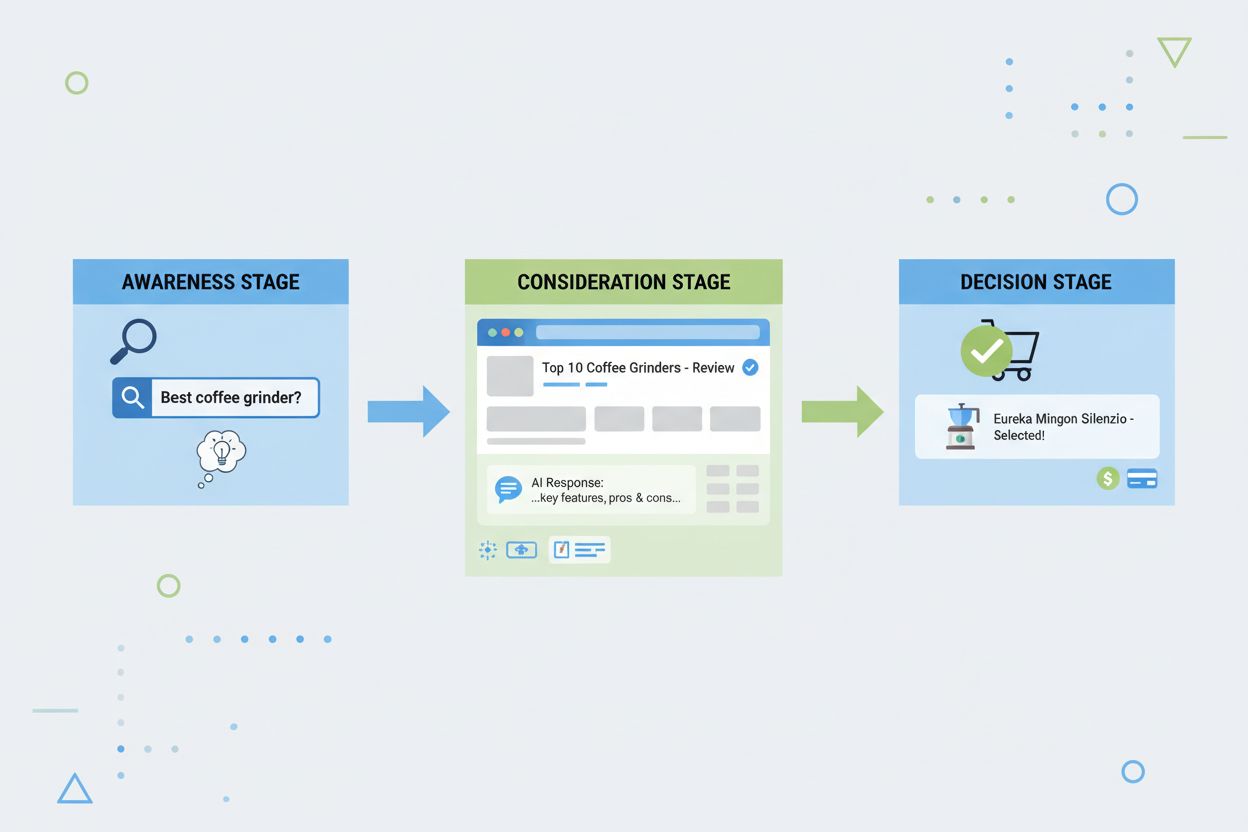
Search Journey
Learn what a search journey is, how users navigate through awareness, consideration, and decision stages, and why monitoring search journeys matters for brand v...
15 min read
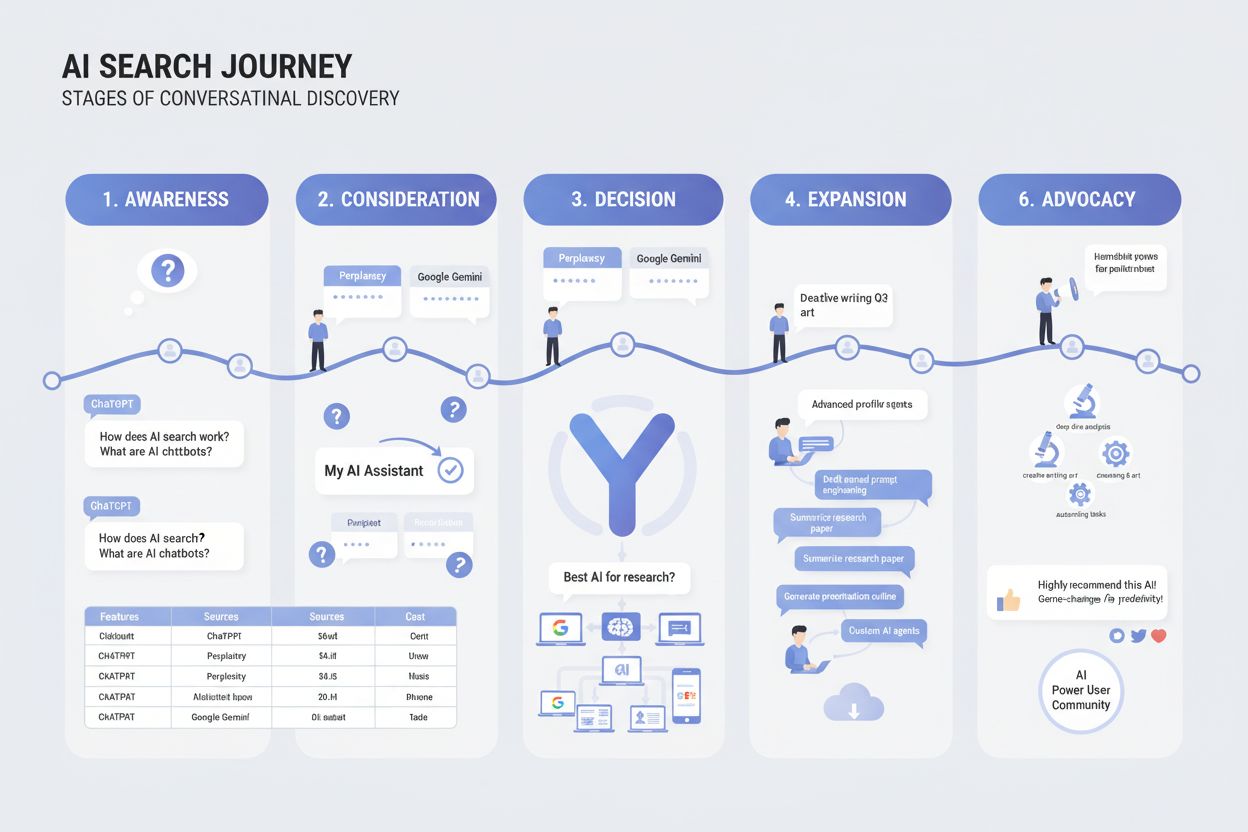
The AI Search Journey is the complete path a user takes when interacting with AI-powered search systems, encompassing multiple conversational turns across awareness, consideration, decision, adoption, expansion, and advocacy stages. Unlike traditional single-query search, AI search journeys involve multi-turn interactions where users progressively refine their questions and deepen their understanding through dialogue with AI systems like ChatGPT, Perplexity, Google Gemini, and Claude.
The AI Search Journey is the complete path a user takes when interacting with AI-powered search systems, encompassing multiple conversational turns across awareness, consideration, decision, adoption, expansion, and advocacy stages. Unlike traditional single-query search, AI search journeys involve multi-turn interactions where users progressively refine their questions and deepen their understanding through dialogue with AI systems like ChatGPT, Perplexity, Google Gemini, and Claude.
The AI Search Journey is the complete, multi-turn conversational path a user takes when interacting with AI-powered search systems to explore, understand, and make decisions about a topic or solution. Unlike traditional search, which typically involves isolated keyword queries and website visits, the AI Search Journey encompasses a series of interconnected questions and responses within a single conversational session. Users progress through distinct stages—from initial awareness of a problem, through consideration of options, to final decision-making and beyond—all within the context of an ongoing dialogue with AI systems like ChatGPT, Perplexity, Google Gemini, or Claude. This journey reflects how modern users leverage generative AI to compress what once required days of research into minutes of conversational interaction, fundamentally reshaping how brands achieve visibility and influence purchasing decisions.
The AI Search Journey differs fundamentally from traditional customer journeys because it collapses multiple touchpoints into a single, continuous interaction. Research from Nielsen Norman Group demonstrates that users now engage in multi-turn conversations where each response informs the next question, creating a dynamic exploration pattern. This shift has profound implications for how organizations must structure their content, optimize for visibility, and measure success in the AI-driven search landscape.
The emergence of AI Search Journeys represents a watershed moment in how people discover and evaluate information. For decades, search behavior followed a predictable pattern: users formulated keyword queries, reviewed search results, visited websites, and manually synthesized information across multiple sources. This process was time-consuming, required significant cognitive effort, and often resulted in incomplete or contradictory information. According to Nielsen Norman Group’s recent qualitative research, users spent considerable time keyword foraging—struggling to articulate their information needs in search-engine-friendly terms—and then sifting through irrelevant results.
The introduction of generative AI fundamentally altered this dynamic. Over 70% of ChatGPT users have increased their engagement with the platform, and a 25% rise in shopping-related prompts indicates that AI Search Journeys now directly influence commercial decisions. The speed of adoption is remarkable: even users with limited prior AI experience recognize the value immediately. Nielsen Norman Group’s study found that participants who used AI chat for information seeking for the first time during research sessions were impressed enough to plan future use, with one participant stating, “I’ll definitely use this in the future. I realize maybe I should have come to Gemini looking for the goals.”
This behavioral shift reflects a fundamental change in how users approach information-seeking. Rather than treating search as a series of discrete transactions, users now engage in conversational exploration, where each turn builds on previous context. The AI Search Journey is not a replacement for traditional search but rather a complementary approach that users employ strategically depending on their needs. Research from Search Engine Land indicates that approximately 25% of global search queries will be handled by AI-powered assistants by 2026, signaling a massive structural shift in the search landscape.
Understanding the AI Search Journey requires mapping the distinct stages users progress through as they interact with AI systems. Each stage represents a different type of query, user intent, and opportunity for brand visibility.
The Awareness Stage is where users first recognize they have a problem, question, or information need. In traditional search, this might involve searching for general terms like “What is marketing attribution?” In the AI Search Journey, users often begin with broader, more conversational questions. They might ask an AI system to explain a concept, define terminology, or provide an overview of a topic. According to Hendricks.AI research, this stage typically generates awareness-level questions that establish foundational understanding.
During this stage, AI systems synthesize information from multiple sources to provide comprehensive, contextualized answers. Brands that appear in these initial responses establish early credibility and awareness. However, visibility at this stage alone is insufficient—users will progress to deeper questions, and brands must maintain presence throughout the journey.
The Consideration Stage occurs when users move beyond basic understanding to actively evaluate options. They ask comparative questions: “What are the differences between multi-touch and first-touch attribution?” or “Which attribution tools work best for B2B SaaS?” This stage is critical because users are now actively comparing solutions and building preference frameworks.
In the AI Search Journey, the Consideration Stage often involves multiple follow-up questions within a single conversation. Users might ask about features, pricing, implementation complexity, and integration capabilities—all within the same session. AI systems can synthesize this information across multiple sources, presenting balanced comparisons that would traditionally require visiting numerous websites. Brands that provide clear, structured information about their differentiation during this stage significantly influence consideration outcomes.
The Decision Stage represents the moment when users commit to a specific solution or brand. In the AI Search Journey, this stage involves questions like “How do I implement this tool?” or “What are the best practices for getting started?” Users seek proof, trust signals, and implementation guidance. According to Search Engine Land research, AI systems can now move users directly from intent to conversion, with three- to eight-times higher conversion rates from AI-sourced traffic compared to traditional search.
Brands that are visible during the Decision Stage with implementation guides, case studies, customer testimonials, and clear onboarding information capture high-intent users. Critically, brands that are invisible at this stage—despite strong awareness visibility—lose prospects to competitors who own the decision-stage conversation.
The Adoption Stage begins after a user has committed to a solution and is learning to use it effectively. Users ask implementation questions, troubleshooting queries, and best-practice questions. The Expansion Stage follows, where users discover additional features, use cases, or premium offerings. In the AI Search Journey, these stages often involve users returning to AI systems with new questions as their needs evolve.
Brands that provide comprehensive documentation, tutorial content, and advanced feature explanations maintain visibility throughout these stages. This ongoing presence builds loyalty and increases the likelihood of expansion purchases and advocacy.
The Advocacy Stage occurs when satisfied users become champions for a brand, recommending it to others and providing feedback. In the AI Search Journey, this stage manifests when users ask AI systems for recommendations or when they provide positive feedback that influences how AI systems present the brand in future responses. Brands that cultivate advocacy through exceptional experiences and community engagement benefit from positive sentiment in AI-generated responses.
| Dimension | Traditional Search Journey | AI Search Journey |
|---|---|---|
| Query Structure | Single, discrete keyword queries | Multi-turn conversational interactions |
| Information Synthesis | User manually visits multiple websites | AI synthesizes across sources in single response |
| Time to Decision | Days or weeks of research | Minutes to hours of conversation |
| Context Retention | Each query is independent | Context persists across conversation turns |
| Touchpoint Count | 5-10+ website visits typical | 1-3 AI interactions typical |
| User Effort | High (keyword formulation, scanning, comparison) | Low (natural language, AI handles synthesis) |
| Brand Visibility | Ranking position on results page | Citation in AI-generated response |
| Conversion Path | Browse → Evaluate → Visit → Convert | Query → Converse → Convert |
| Information Quality | Variable (depends on website quality) | Consistent (AI synthesizes best sources) |
| Follow-up Capability | Requires new search | Seamless within conversation |
The mechanics of how AI systems operate fundamentally influence the AI Search Journey. Unlike traditional search engines that match keywords to indexed pages, AI systems use retrieval-augmented generation (RAG) and large language models (LLMs) to synthesize information dynamically. This technical difference creates distinct behavioral patterns.
When a user asks an AI system a question, the system breaks the query into components, retrieves relevant information from multiple sources, and generates a synthesized response. Critically, the system retains conversation context, allowing users to ask follow-up questions that build on previous responses. This conversational context persistence is what transforms search from a series of transactions into a journey.
According to Nielsen Norman Group research, even users with limited AI experience recognize this value immediately. One participant noted that using Gemini for a plumbing problem “felt like it saved me a bit of time. It’s drawn in a lot of data and kind of tailored it to what my specific need is.” This tailoring—the ability to synthesize information specific to individual context—is the defining characteristic of the AI Search Journey.
Different AI platforms shape the journey differently. ChatGPT dominates through first-mover advantage and brand recognition. Google Gemini benefits from integration with traditional search, allowing users to seamlessly transition between search modes. Perplexity specializes in research-oriented journeys with real-time information access. Claude emphasizes nuanced reasoning and detailed analysis. Users often employ multiple platforms strategically, using each for different types of queries within their overall journey.
Each major AI platform presents distinct characteristics that influence how users navigate their AI Search Journey. Understanding these differences is critical for brands seeking visibility across the AI search landscape.
ChatGPT remains the dominant platform, with users often referring to AI chat generically as “Chat,” similar to how “Google” became synonymous with search. ChatGPT’s strength lies in its conversational naturalness and broad knowledge base. Users leverage it for exploratory conversations, creative problem-solving, and comprehensive explanations. For brands, visibility in ChatGPT requires content that is comprehensive, well-structured, and accessible to the model’s training data.
Google Gemini benefits from deep integration with Google Search and Google’s ecosystem. Users can seamlessly transition between traditional search and AI Mode, creating hybrid journeys where they use both modalities. This integration gives Gemini significant competitive advantage, as users already accustomed to Google’s interface can access AI capabilities without switching platforms. For brands, this means optimizing for both traditional search visibility and AI retrievability within Google’s ecosystem.
Perplexity specializes in research-oriented journeys, emphasizing real-time information and source transparency. Users conducting research on current events, recent developments, or time-sensitive topics often prefer Perplexity. The platform’s emphasis on citation and source transparency appeals to users who want to verify information. For brands, Perplexity visibility requires current, well-sourced content that can be cited as authoritative.
Claude emphasizes nuanced reasoning, detailed analysis, and ethical considerations. Users conducting complex analysis, writing tasks, or conversations requiring sophisticated reasoning often prefer Claude. For brands, visibility in Claude requires content that demonstrates depth, nuance, and thoughtful analysis rather than surface-level information.
The multi-turn conversation is the fundamental mechanism that transforms traditional search into an AI Search Journey. Each turn represents an opportunity for users to refine their understanding, ask follow-up questions, and progress through journey stages.
Research from Hendricks.AI demonstrates typical conversational search paths: “What is marketing attribution?” → “How does multi-touch attribution work?” → “Best attribution tools for B2B SaaS?” → “How to implement attribution?” This progression represents movement from awareness through consideration to decision. Each turn builds on previous context, allowing users to deepen their exploration without repeating foundational information.
The implications for brands are profound. A brand might achieve 67% visibility for early-path awareness questions but only 8% for late-path buying questions, revealing a critical gap. Users learn about the brand early but purchase from competitors who own the decision-stage conversation. Optimizing for complete conversation paths rather than individual queries increases AI-driven pipeline by 134%, according to Hendricks.AI research.
This multi-turn dynamic also means that conversational context persistence becomes critical. Users expect AI systems to remember previous responses and build on them. If a user asks about attribution tools and the AI recommends Tool A, then asks “What about Tool B?” the AI should maintain context about the original comparison. Brands that provide information structured for this kind of contextual retrieval—through clear entity relationships, comparative frameworks, and progressive disclosure—maintain visibility throughout multi-turn conversations.
The AI Search Journey demands a fundamentally different content strategy than traditional SEO. Rather than optimizing individual pages for keyword rankings, brands must create content that serves users across entire conversational journeys.
Entity-First Architecture becomes essential. Instead of organizing content around keywords, brands should organize around entities—the core concepts, products, and relationships that define their domain. For example, a marketing technology company should structure content around entities like “attribution models,” “marketing channels,” “conversion tracking,” and “ROI measurement,” with clear relationships between them. This entity-based structure allows AI systems to understand and synthesize information more effectively.
Structured Data and Schema Markup become critical. Pages with robust schema markup earn higher citation rates in AI Overviews, according to Search Engine Land research. Brands should implement comprehensive schema markup that helps AI systems understand content context, relationships, and authority.
Comprehensive, Progressive Content replaces thin, keyword-optimized pages. Rather than creating multiple pages targeting similar keywords, brands should create deep, comprehensive content that answers questions at multiple levels of sophistication. Progressive disclosure—starting with foundational concepts and progressively introducing complexity—helps users at different journey stages find relevant information.
Conversational Content Structures align with how users interact with AI systems. Content should anticipate follow-up questions, provide comparative frameworks, and include implementation guidance. FAQ sections, comparison tables, and step-by-step guides become more valuable than ever because AI systems can extract and synthesize this structured information.
Consistency Across Channels is essential. Users expect consistent information whether they encounter it through traditional search, AI Overviews, or AI chat. Brands must maintain information consistency across owned channels—websites, documentation, social media, and structured data—to ensure AI systems retrieve accurate, consistent information.
Traditional SEO metrics—rankings, impressions, click-through rates—are losing relevance in the AI Search Journey landscape. New metrics better capture how users interact with AI systems and how brands achieve visibility.
Citation Count measures how often a brand appears in AI-generated responses. Unlike rankings, which are positional, citations reflect whether AI systems consider a brand authoritative enough to mention. According to Search Engine Land research, citation is becoming the new rank.
Share of Voice measures a brand’s citations relative to competitors within a topic area. A brand might receive 15 citations while competitors receive 45, indicating a 25% share of voice. This metric reveals competitive positioning in AI search.
Query Diversity measures the breadth of queries for which a brand achieves visibility. A brand visible for 50 different query variations has higher query diversity than one visible for only 5 queries. Higher query diversity indicates stronger topical authority and broader journey coverage.
Journey Stage Visibility breaks down visibility by journey stage. A brand might achieve 80% visibility for awareness-stage queries but only 20% for decision-stage queries. This breakdown reveals gaps and opportunities for content optimization.
Sentiment Analysis measures how AI systems characterize a brand in responses. Positive sentiment (“highly recommended,” “industry leader”) versus neutral or negative sentiment (“mixed reviews,” “limited features”) influences user perception and conversion likelihood.
LLM Visibility Score combines multiple factors—citation frequency, position in responses, sentiment, and query diversity—into a single metric that represents overall AI search visibility. This holistic metric helps brands track progress and compare performance across platforms.
The AI Search Journey is rapidly evolving, with several emerging trends likely to shape how users interact with AI systems and how brands achieve visibility.
Agentic AI represents the next frontier. Rather than simply answering questions, AI agents will take actions on behalf of users—booking appointments, making purchases, scheduling meetings. This evolution means the AI Search Journey will extend beyond information discovery into transaction completion. Brands must prepare for a world where AI agents can directly access their systems and complete transactions without human intervention.
Vertical AI Search Engines are emerging for specific domains. Rather than general-purpose AI systems, specialized engines focus on particular industries or use cases. A healthcare-focused AI search engine might provide different responses than a general-purpose system. Brands must optimize for visibility in vertical engines relevant to their industry.
Real-Time Information Integration is becoming standard. AI systems increasingly access real-time data, allowing them to provide current information rather than relying solely on training data. This shift means brands must maintain current, accurate information across all channels to ensure AI systems retrieve up-to-date content.
Multimodal Journeys combine text, images, video, and other content types. Users might ask an AI system to “show me examples of attribution models” and receive visual representations alongside text explanations. Brands must create diverse content formats to maintain visibility across multimodal journeys.
Personalized Journey Paths will become increasingly sophisticated. Rather than following standard journey stages, users will follow personalized paths based on their role, industry, and previous interactions. A CFO’s AI Search Journey for marketing attribution will differ from a marketing manager’s journey. Brands must create content that serves diverse user personas and their unique journey paths.
The AI Search Journey represents a fundamental shift in how users discover, evaluate, and purchase solutions. Organizations that understand and optimize for this new paradigm will capture disproportionate value, while those clinging to traditional search optimization will find their visibility and traffic declining.
The compression of the customer journey—from weeks to minutes—means that brands must be visible at every stage or risk losing prospects entirely. A user might move from awareness to decision within a single AI chat session, encountering multiple competitors’ information along the way. Brands absent from any stage of this journey lose the opportunity to influence the decision.
The shift from rankings to citations means that traditional SEO metrics become less relevant. A brand might rank #1 for a keyword but receive zero citations in AI responses if its content isn’t structured for AI system retrieval. Conversely, a brand might not rank highly but receive frequent citations if its content is authoritative, well-structured, and accessible to AI systems.
The emphasis on consistency and entity relationships means that marketing, product, and content teams must work in unprecedented alignment. Inconsistent information across channels confuses AI systems and undermines visibility. Organizations must establish single sources of truth for key information and distribute that information consistently across all channels.
The emergence of agentic AI means that the AI Search Journey will eventually extend beyond information discovery into transaction completion. Organizations must prepare for a world where AI agents can directly access their systems, complete purchases, and manage customer relationships without human intermediation. This shift requires not just content optimization but also technical infrastructure changes to support AI agent integration.
The AI Search Journey is not a temporary phenomenon or a niche use case. With approximately 25% of global search queries expected to be handled by AI-powered assistants by 2026, this represents a structural shift in how people discover information and make decisions. Organizations that embrace this shift, optimize their content and systems for AI Search Journeys, and prepare for agentic interactions will thrive in the emerging search landscape. Those that delay or resist this evolution will find their visibility, traffic, and ultimately their revenue declining as users increasingly rely on AI systems to guide their journeys.
Traditional search journeys typically involve single, discrete queries where users search, visit websites, and evaluate information independently. AI Search Journeys, by contrast, are conversational and multi-turn, allowing users to ask follow-up questions, request clarifications, and progressively deepen their understanding within a single session. According to Nielsen Norman Group research, AI systems handle complex information synthesis that would normally require visiting multiple websites, compressing the traditional buyer journey significantly. This fundamental shift means users can move from awareness to decision in minutes rather than days.
The AI Search Journey typically progresses through six interconnected stages: Awareness (discovering a problem or topic), Consideration (exploring options and comparing solutions), Decision (selecting a specific solution or brand), Adoption (implementing and learning to use the solution), Expansion (discovering additional features or use cases), and Advocacy (recommending the solution to others). Each stage involves different types of queries and conversational patterns. Research from Search Engine Land shows that AI systems can now move users directly from intent to conversion, collapsing traditional multi-stage funnels into more efficient pathways.
Brands that understand the AI Search Journey can optimize their content and visibility across all conversational touchpoints, not just individual queries. According to Bain & Company research, ChatGPT usage has increased 70% overall, with a 25% rise in shopping-related prompts, indicating significant commercial intent. Brands visible only at early-stage awareness queries but absent from decision-stage conversations lose prospects to competitors. By mapping complete journeys, companies can identify critical gaps and ensure presence throughout the entire user exploration path, ultimately driving higher conversion rates from AI-sourced traffic.
Multi-turn conversations are the defining characteristic of AI Search Journeys. Unlike traditional search where each query is independent, multi-turn interactions allow users to build context progressively. A user might ask 'What is marketing attribution?' in turn one, then 'How does multi-touch attribution work?' in turn two, followed by 'Best attribution tools for B2B SaaS?' in turn three. Research from Hendricks.AI shows that brands achieving 67% visibility for early-path awareness questions but only 8% for late-path buying questions reveal critical gaps. Optimizing for complete conversation paths rather than individual queries increases AI-driven pipeline by 134%.
Different AI platforms serve distinct roles in the AI Search Journey. ChatGPT dominates as the first modern LLM chat interface and currently leads market adoption. Google Gemini benefits from integration with traditional Google Search, giving it competitive advantage through familiarity. Perplexity specializes in research-oriented journeys with real-time information access. According to Nielsen Norman Group research, users often default to familiar platforms due to ingrained habits, but they increasingly use multiple platforms in tandem to fact-check and explore topics comprehensively. Each platform's unique capabilities influence how users navigate their journey.
The AI Search Journey fundamentally changes content strategy from keyword-ranking optimization to retrievability and citation optimization. Brands must now create content that answers questions across the entire conversational journey, not just initial queries. According to Search Engine Land, citation is becoming the new rank, with AI systems prioritizing clarity, consistency, and comprehensive coverage. Content must be structured for machine readability using schema markup, organized by entity relationships, and distributed consistently across owned channels. Brands that optimize for complete journeys rather than individual queries see significantly higher AI visibility and conversion rates.
Traditional metrics like rankings and click-through rates are losing relevance in AI search. New KPIs include LLM visibility score (how often your brand appears in AI responses), citation count (number of times cited across AI platforms), share of voice (your citations relative to competitors), query diversity (ability to answer multiple related long-tail queries), and sentiment analysis. According to Demandsphere research, Share of Voice is one of the best KPIs for measuring AI-driven behavior. Brands should also track visibility across different journey stages—awareness, consideration, and decision—to identify gaps and optimize accordingly.
Start tracking how AI chatbots mention your brand across ChatGPT, Perplexity, and other platforms. Get actionable insights to improve your AI presence.
Learn what a search journey is, how users navigate through awareness, consideration, and decision stages, and why monitoring search journeys matters for brand v...

Explore how AI search transforms the buyer journey across ChatGPT, Perplexity, and Google AI. Learn the stages, platform differences, and strategies for visibil...
Understand the differences between voice search and AI search. Learn how voice queries, ChatGPT, Perplexity, Google AI Overviews, and Claude differ in technolog...
Cookie Consent
We use cookies to enhance your browsing experience and analyze our traffic. See our privacy policy.