
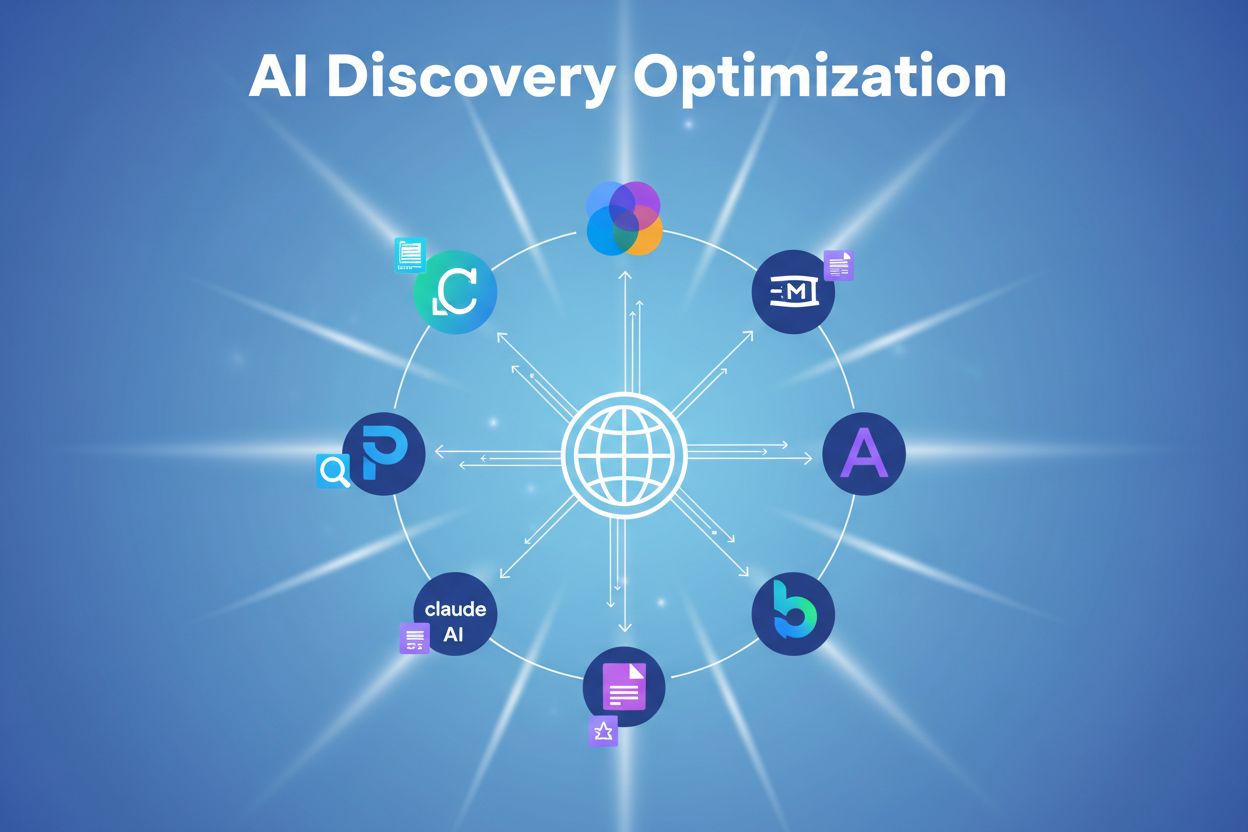
AI Discovery Optimization
Learn how to optimize content for AI discovery. Understand AI crawlers, content structure, and strategies to ensure your brand is found and cited by ChatGPT, Ge...
9 min read

AI Search Optimization is the practice of structuring, formatting, and optimizing content to improve visibility and citation in AI-powered search results and generative engine responses. It involves making content easily discoverable and citable by large language models (LLMs) like ChatGPT, Google AI Overviews, Perplexity, and Claude through technical optimization, semantic clarity, and authority signals.
AI Search Optimization is the practice of structuring, formatting, and optimizing content to improve visibility and citation in AI-powered search results and generative engine responses. It involves making content easily discoverable and citable by large language models (LLMs) like ChatGPT, Google AI Overviews, Perplexity, and Claude through technical optimization, semantic clarity, and authority signals.
AI Search Optimization is the strategic practice of structuring, formatting, and optimizing content to improve visibility and citation in AI-powered search results and generative engine responses. Unlike traditional search engine optimization, which focuses on ranking entire pages in search results, AI Search Optimization targets the specific ways large language models (LLMs) discover, parse, and cite content. The goal is to make your brand and content easily discoverable and citable by platforms like ChatGPT, Google AI Overviews, Perplexity, Claude, and Bing Copilot. As AI referrals to top websites increased 357% year-over-year in June 2025, reaching 1.13 billion visits, AI Search Optimization has become essential for maintaining online visibility. This emerging discipline combines technical SEO fundamentals with new optimization strategies specifically designed for how AI systems evaluate, extract, and synthesize content into generated answers.
The shift from traditional SEO to AI Search Optimization represents a fundamental change in how content is discovered and consumed online. For decades, SEO professionals focused on ranking entire pages in search engine results pages (SERPs), optimizing for keywords, building backlinks, and improving technical performance. However, AI-powered search engines don’t rank pages—they parse content into smaller, modular pieces and assemble answers from multiple sources. This distinction is critical. A page that ranks #1 on Google may never appear in a ChatGPT response, while a page ranking #15 might be heavily cited. According to research cited by Backlinko, only 12% of ChatGPT citations match URLs on Google’s first page, demonstrating that traditional ranking position no longer guarantees AI visibility. The evolution reflects how user behavior is changing: instead of clicking through ten blue links, users now ask conversational questions and expect AI systems to synthesize answers from trusted sources. This shift has created new opportunities for brands willing to optimize specifically for AI discovery and citation.
Understanding how AI systems evaluate and cite content is foundational to effective AI Search Optimization. Large language models use a multi-step process to identify, parse, and cite sources. First, they retrieve relevant content from the web in real time using search indices (Google’s index, Bing’s index, or proprietary crawls). Second, they parse this content into smaller, structured pieces—sentences, paragraphs, lists, and tables. Third, they evaluate these pieces based on authority, relevance, structure, and freshness. Finally, they assemble the most relevant pieces into a coherent answer, often citing multiple sources. The exact criteria vary by platform, but research from Backlinko’s analysis of 10 queries across ChatGPT, Claude, Perplexity, Gemini, and Google AI Mode revealed consistent patterns. Authority and entity recognition matter significantly—AI systems favor content from recognized brands and established experts. Structure is critical—content with clear headings, lists, and Q&A formats is more likely to be extracted and cited. Freshness signals visibility—recently published or updated content ranks higher, especially in competitive or time-sensitive topics. Semantic relevance drives selection—content that uses related terms and concepts consistently is more likely to be associated with a topic by AI systems. These factors work together to determine which content gets cited in AI-generated answers.
| Factor | Traditional SEO | AI Search Optimization | Paid Search (PPC) |
|---|---|---|---|
| Primary Goal | Rank entire pages in SERPs | Get content cited in AI-generated answers | Drive clicks through paid ads |
| Ranking Unit | Full web pages | Content fragments (sentences, lists, tables) | Ad copy and landing pages |
| Key Metrics | Ranking position, organic clicks, CTR | Citation frequency, AI visibility, brand mentions | Cost per click, conversion rate, ROAS |
| Content Structure | Keywords, meta tags, backlinks | Semantic clarity, modular formatting, schema markup | Ad copy, headlines, CTAs |
| Authority Signals | Domain authority, backlinks, age | E-E-A-T, author credentials, original data | Brand reputation, ad quality score |
| Freshness Impact | Moderate (evergreen content ranks long-term) | High (recency is a tiebreaker in competitive spaces) | Immediate (ads run until paused) |
| Citation Source | Ranking determines visibility | Multiple sources assembled into one answer | Direct click to advertiser site |
| Time to Results | 3-6 months typical | 2-4 weeks for optimization, ongoing monitoring | Immediate (upon campaign launch) |
| Cost Model | Organic (time and resources) | Organic (time and resources) | Pay-per-click or impression-based |
Technical optimization remains the foundation of AI Search Optimization, even as the focus shifts from ranking to citation. AI crawlers must be able to access, crawl, and index your content before any optimization can take effect. This begins with ensuring that AI bots are not blocked in your robots.txt file. Major AI crawlers include GPTBot (OpenAI/ChatGPT), Google-Extended (Google AI Overviews), Claude-Web (Anthropic), and PerplexityBot (Perplexity). If these bots are blocked, your content will never appear in AI-generated answers. Beyond crawler access, semantic HTML structure is essential. AI systems rely on proper heading hierarchy (
How you structure and phrase content directly impacts whether AI systems can extract and cite it. AI systems don’t read like humans; they parse content into smaller, reusable pieces. This means that every section should be self-contained and make sense when pulled from context. For example, instead of writing “This feature is important because it saves time,” write “The 42 dB noise level makes this dishwasher suitable for open-concept kitchens, reducing ambient sound by 30% compared to standard models.” The second version provides context and specificity that AI can extract and cite directly. Semantic clarity—using precise language and consistent terminology—helps AI systems understand and classify your content. When your brand consistently appears near relevant topical keywords (e.g., “Monday.com” near “workflow automation”), it builds semantic relevance that LLMs rely on when generating answers. Formatting matters significantly. Bullet points, numbered lists, tables, and Q&A blocks are highly citable because they’re already structured in a way that mirrors how AI assembles answers. Long paragraphs, by contrast, blur ideas together and make it harder for AI to extract discrete, quotable pieces. Headings should be phrased as questions or clear topic statements (e.g., “What Makes This Dishwasher Quieter Than Most Models?” instead of “Learn More”). This helps AI systems map search intent to your content structure. Short paragraphs (2-3 lines) are preferable to long blocks of text because they reduce cognitive load for both humans and machines. When you structure content this way, you’re not just improving readability—you’re making it easier for AI systems to understand, extract, and cite your content in generated answers.
E-E-A-T (Experience, Expertise, Authoritativeness, Trustworthiness) remains a critical ranking factor for AI systems, though it manifests differently than in traditional SEO. Google explicitly states that content with clear authorship, strong topical focus, and full crawlability is most likely to appear in AI Overviews. Experience signals come from author bios with relevant credentials or firsthand experience. Instead of anonymous content, include author names, titles, and relevant background. Expertise is demonstrated through original research, data, and insights that third-party sites cannot provide. When you publish proprietary data, conduct original studies, or share exclusive frameworks, you’re building expertise signals that AI systems recognize. Authoritativeness is built through backlinks and mentions from topic-relevant, high-authority sites. A single mention from TechCrunch or a respected industry publication carries more weight than dozens of generic links. Trustworthiness comes from transparent sourcing, expert quotes, and consistent accuracy. When you cite primary sources, include expert commentary, and back up claims with verifiable data, you’re signaling trustworthiness to both users and AI systems. Additionally, brand mentions and co-occurrence patterns matter. When your brand consistently appears alongside relevant keywords in high-authority content, AI systems learn to associate your brand with that topic. This semantic association increases your chances of being cited when users ask related questions. Building E-E-A-T is not a quick process—it requires consistent publication of high-quality content, earning mentions from authoritative sources, and demonstrating genuine expertise over time.
Featured snippets have become gateway content for AI inclusion, serving as a bridge between traditional SEO and AI Search Optimization. Research by Conversion Digital found that content optimized for featured snippets—concise definitions, numbered lists, comparison tables—strongly correlates with inclusion in Google AI Overviews. This makes sense: featured snippets are already formatted in a way that AI systems prefer. When Google’s algorithm selects a snippet for display, it’s identifying content that’s clear, structured, and directly answers a user’s question. AI systems use similar criteria when selecting sources for generated answers. Winning a featured snippet doesn’t guarantee AI citation, but it signals that your content meets the structural and clarity standards that AI systems require. To optimize for featured snippets and, by extension, AI citation, follow these practices:
When you optimize for snippets, you’re simultaneously optimizing for AI citation. The formatting, clarity, and structure that wins snippets are exactly what AI systems need to extract and cite your content.
Making your brand “citable” requires publishing original content that AI systems can confidently attribute to you. Generic, aggregated content—summaries of what others have said—is less likely to be cited than content with unique insights, data, or perspectives. According to Semrush’s 2025 AI Overviews study, Google’s AI Overviews reward expert-led, well-sourced content. This means that original research, proprietary data, and exclusive frameworks are highly valuable for AI citation. When you publish a study showing that 78% of enterprises use AI-driven content monitoring tools, that statistic becomes associated with your brand. When AI systems encounter questions related to that topic, they’re more likely to cite your research. Case studies and real-world examples are also highly citable because they provide concrete evidence that third-party sites cannot replicate. When you document how a client achieved specific results using your product or service, you’re creating content that AI systems can cite as authoritative proof. Expert quotes and interviews add credibility and citability. When you feature recognized experts discussing your product or industry, you’re building authority signals that AI systems recognize. Consistent branding, bylines, and schema markup across your site also matter. When every article includes an author bio with credentials, when your company name appears consistently in schema markup, and when your brand is clearly associated with specific topics, AI systems learn to trust and cite your content. Building citability is a long-term strategy that requires consistent publication of high-quality, original content backed by data and expert validation.
Tracking AI search visibility is fundamentally different from monitoring traditional SEO performance, requiring new tools and metrics. Traditional SEO focuses on ranking position and organic clicks, but AI Search Optimization requires monitoring citation frequency, brand mentions, and visibility across multiple AI platforms. Tools like Semrush’s AI Visibility Toolkit, Brand Monitoring, and specialized AI tracking platforms provide data on where your brand appears in AI-generated answers. You can also manually test by searching your target keywords on ChatGPT, Google AI Mode, Perplexity, and Claude, noting which of your pages appear in generated responses. Key metrics to track include citation frequency (how often your content is cited across AI platforms), brand mention sentiment (whether mentions are positive, neutral, or negative), topic coverage (which topics your brand appears for and which you’re missing), and competitive positioning (how often competitors appear in similar queries). Unlike traditional SEO, where a #1 ranking is the goal, AI Search Optimization success is measured by consistent citation across multiple platforms and topics. A page that appears in 50% of AI answers for a target query is performing well, even if it doesn’t rank #1 on Google. Monitoring should be ongoing, as AI systems continuously update their training data and citation patterns. Quarterly reviews of your AI visibility help identify trends, spot new opportunities, and catch declining performance before it impacts traffic.
AI Search Optimization is rapidly evolving as AI systems become more sophisticated and widely adopted. Several trends are shaping the future of this discipline. First, multimodal AI is becoming standard, with systems like GPT-4o, Claude 3, and Gemini now processing images, video, and voice in addition to text. This means that visual content—screenshots, diagrams, infographics, and videos—will become increasingly important for AI citation. Brands that optimize their visual content with descriptive filenames and alt text will have an advantage. Second, AI systems are moving beyond simple citation to more complex synthesis, where they combine information from multiple sources in novel ways. This means that topical authority and comprehensive coverage will matter more—brands that publish content covering all angles of a topic will be cited more frequently. Third, real-time personalization is increasing, with AI systems tailoring answers based on user location, search history, and preferences. This suggests that local optimization and user intent targeting will become more important. Fourth, regulatory scrutiny of AI systems is increasing, with potential requirements for transparency in how sources are selected and cited. This could lead to more explicit citation requirements and clearer attribution, which would benefit brands with strong E-E-A-T signals. Finally, the line between AI Search Optimization and traditional SEO will continue to blur, as Google and other search engines integrate AI more deeply into their core products. This means that the best strategy is to optimize for both simultaneously—publish high-quality, well-structured content that ranks well in traditional search and is easily citable by AI systems.
Implementing AI Search Optimization requires a coordinated effort across technical, SEO, and content teams. Start by ensuring that your site is technically accessible to AI crawlers—check your robots.txt file, verify that AI bots are not blocked, and audit your site structure for semantic HTML. Next, audit your existing content for AI-readiness using tools like Semrush’s On-Page SEO Checker. Identify pages that rank well but lack the structure, clarity, and snippetability that AI systems require. Prioritize updating high-traffic pages with better formatting, clearer headings, and more concise answers. Then, develop a content strategy that emphasizes original research, expert commentary, and proprietary data—content that AI systems can confidently cite as authoritative. Build E-E-A-T signals through author bios, expert quotes, and earning mentions from high-authority sites. Finally, implement ongoing monitoring of your AI search visibility using specialized tools, and adjust your strategy based on what you learn about which topics and platforms are driving the most citations. AI Search Optimization is not a one-time project but an ongoing discipline that evolves as AI systems and user behavior change. Brands that invest in understanding and optimizing for AI search now will have a significant advantage as AI-powered search becomes the dominant way people discover information online.
Traditional SEO focuses on ranking entire pages in search engine results pages (SERPs) based on keywords, backlinks, and authority. AI Search Optimization, by contrast, focuses on making content easily parseable and citable by large language models. While traditional SEO still matters as a foundation, AI Search Optimization emphasizes content structure, semantic clarity, and snippetability so that AI systems can extract and cite specific passages in generated answers. According to Semrush research, only 12% of ChatGPT citations match URLs on Google's first page, meaning high traditional rankings don't guarantee AI visibility.
Core technical requirements include: ensuring Googlebot and AI crawlers (GPTBot, Claude-Web, PerplexityBot) can access your content via robots.txt, using semantic HTML with proper heading hierarchy (H1, H2, H3), implementing schema markup (FAQPage, HowTo, Article), maintaining fast server response times, and avoiding JavaScript-heavy content that LLMs cannot render. Additionally, visible publication and update dates signal freshness to AI systems, which is critical for time-sensitive topics. Blocking AI crawlers or hiding important content behind tabs or pop-ups significantly reduces citation chances.
Featured snippets serve as gateway content for AI inclusion. Research by Conversion Digital found that concise, well-structured answers and lists strongly correlate with inclusion in Google AI Overviews. When your content wins a featured snippet, it's already formatted in a way that AI systems prefer—clear definitions, numbered steps, or bulleted lists. This formatting makes it easier for LLMs to extract and cite your content in generated answers. Winning snippets doesn't guarantee AI citation, but it signals that your content is optimized for LLM visibility.
E-E-A-T (Experience, Expertise, Authoritativeness, Trustworthiness) remains critical for AI systems. LLMs evaluate credibility using specific signals including named authors with relevant credentials, original content with firsthand data or expert commentary, clean page structure, content freshness, and strong backlink profiles from topic-relevant sites. Google explicitly states that helpful, high-quality content with clear authorship and full crawlability is most likely to appear in AI Overviews. Building E-E-A-T through expert quotes, case studies, original research, and earning mentions from authoritative sources directly improves your chances of being cited by AI platforms.
Content structure is fundamental to AI Search Optimization because LLMs parse content into smaller, modular pieces rather than reading pages linearly. Clear heading hierarchies (H2s and H3s as questions), short paragraphs (2-3 lines), bullet points, numbered lists, and Q&A formats make it easier for AI to extract snippets. Self-contained sentences that make sense when pulled from context are especially valuable. Tables and comparison charts are highly citable. Poor structure—long paragraphs, vague headings, hidden content in tabs—makes it difficult for AI systems to parse and cite your content, even if the information is valuable.
Tools like Semrush's AI Visibility Toolkit, Brand Monitoring, and manual testing across platforms (ChatGPT, Google AI Mode, Perplexity, Claude) can help track AI citations. You can search your target keywords on these platforms and note which of your pages appear in generated answers. More advanced monitoring tools provide data on citation frequency, which AI platforms mention your brand, and which topics you're missing. Tracking AI visibility is important because it differs significantly from traditional search rankings—your content may appear in AI answers even if it doesn't rank in Google's top 10.
AI Search Optimization and Generative Engine Optimization (GEO) are closely related terms that describe similar practices. GEO is a creator-centric framework specifically designed to optimize content for generative engines like ChatGPT, Google Gemini, and Perplexity. Both focus on making content discoverable and citable by AI systems. The terms are often used interchangeably in the industry, though GEO emphasizes the broader strategic framework while AI Search Optimization may focus more narrowly on technical and content optimization tactics. Both represent the evolution of SEO in the age of AI-powered search.
Start tracking how AI chatbots mention your brand across ChatGPT, Perplexity, and other platforms. Get actionable insights to improve your AI presence.
Learn how to optimize content for AI discovery. Understand AI crawlers, content structure, and strategies to ensure your brand is found and cited by ChatGPT, Ge...

Learn how technology companies optimize content for AI search engines like ChatGPT, Perplexity, and Gemini. Discover strategies for AI visibility, structured da...
Learn how to optimize keywords for AI search engines. Discover strategies to get your brand cited in ChatGPT, Perplexity, and Google AI answers with actionable ...
Cookie Consent
We use cookies to enhance your browsing experience and analyze our traffic. See our privacy policy.