
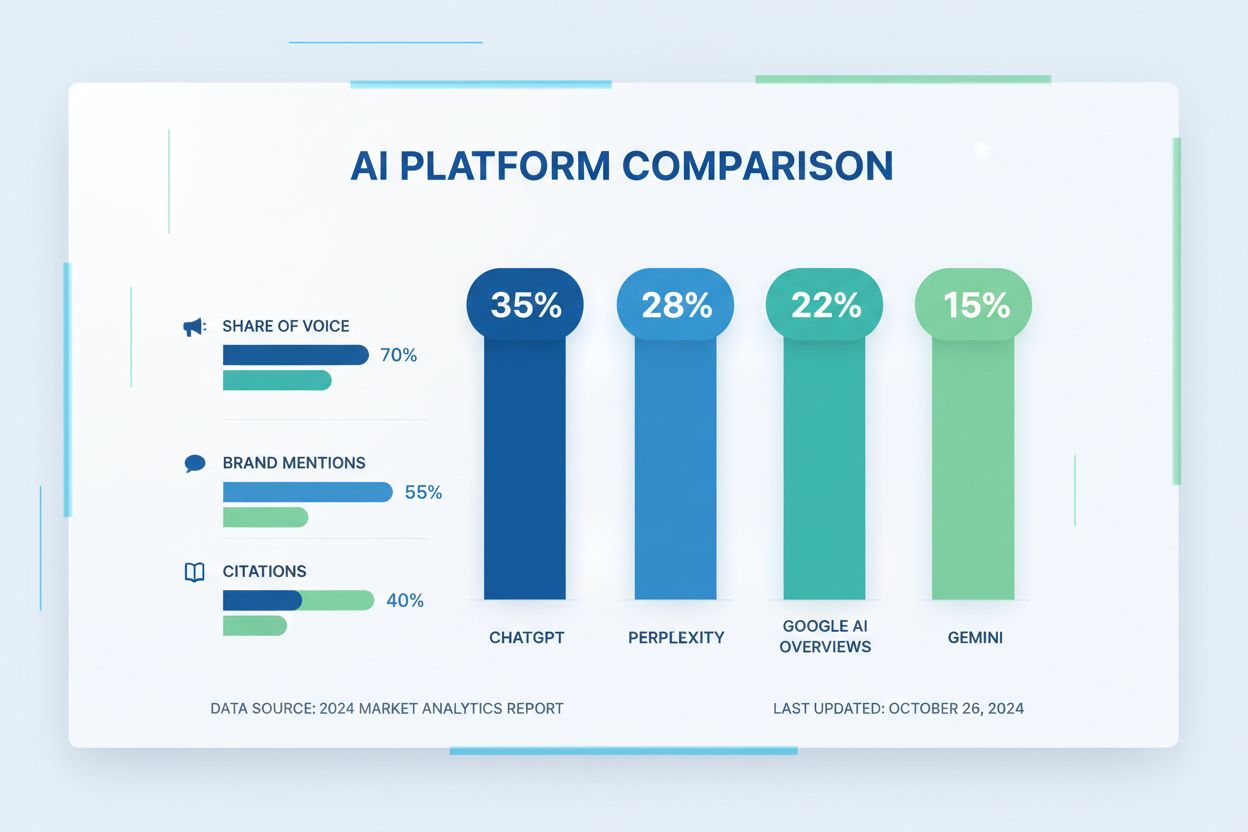
Competitor AI Visibility Analysis: Finding Your Share of Voice Gaps
Learn how to analyze competitor AI visibility, identify share of voice gaps, and optimize your brand presence across ChatGPT, Perplexity, and Google AI Overview...
9 min read
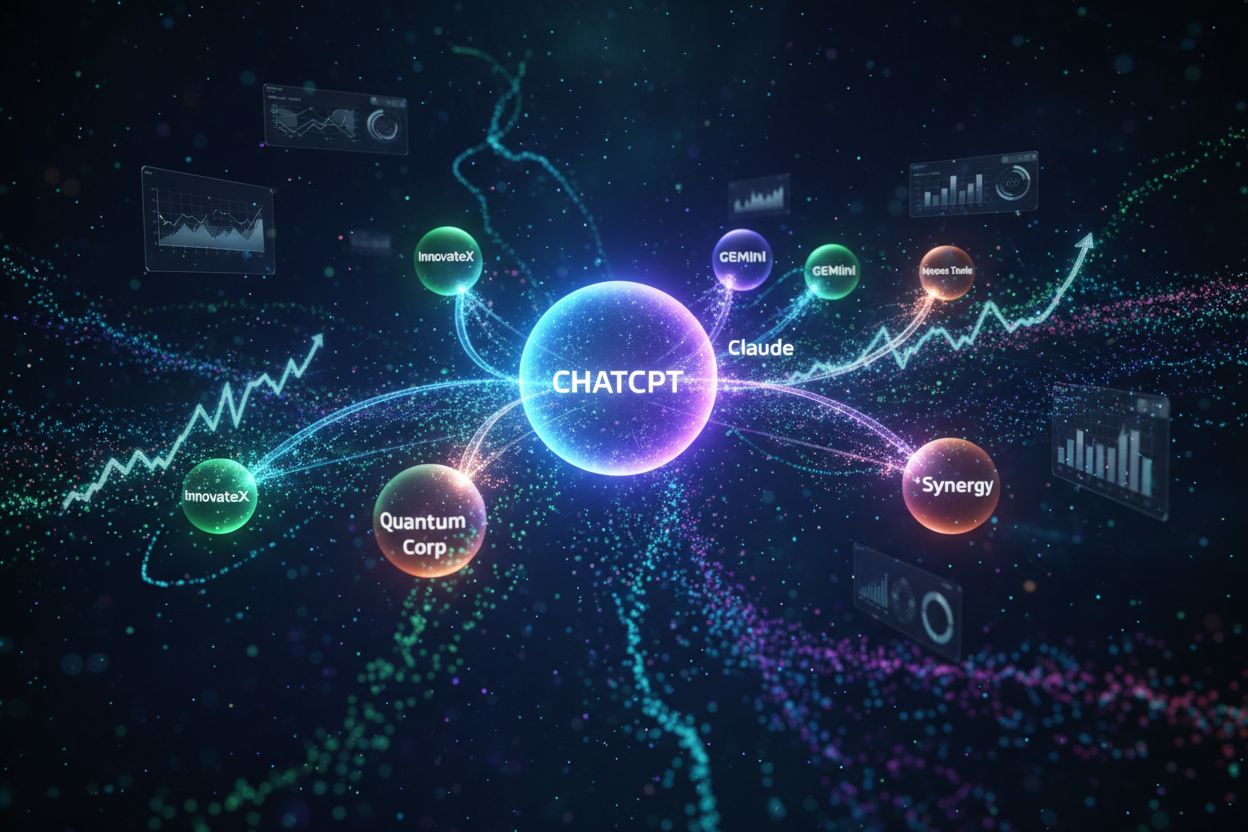
AI Share Shift Tracking is the systematic monitoring of how AI visibility and citation authority redistribute across competitors in generative AI systems. It measures changes in where AI-generated answers cite your brand versus competitors’ content, capturing the zero-click economy phenomenon where AI systems provide direct answers without requiring website visits. This metric tracks competitive positioning shifts in real-time across platforms like ChatGPT, Claude, Gemini, and Perplexity, enabling organizations to detect when competitors gain or lose prominence in AI responses before these changes manifest in traditional search metrics.
AI Share Shift Tracking is the systematic monitoring of how AI visibility and citation authority redistribute across competitors in generative AI systems. It measures changes in where AI-generated answers cite your brand versus competitors' content, capturing the zero-click economy phenomenon where AI systems provide direct answers without requiring website visits. This metric tracks competitive positioning shifts in real-time across platforms like ChatGPT, Claude, Gemini, and Perplexity, enabling organizations to detect when competitors gain or lose prominence in AI responses before these changes manifest in traditional search metrics.
AI Share Shift Tracking is the systematic measurement and monitoring of how AI visibility and citation authority redistribute across competitors in generative AI systems like ChatGPT, Claude, Gemini, and Perplexity. Unlike traditional market share tracking that measures search engine rankings or traffic volume, AI Share Shift Tracking specifically monitors where AI-generated answers cite your brand versus competitors’ content when users query topics relevant to your industry. This metric captures the zero-click economy phenomenon where AI systems provide direct answers without requiring users to click through to source websites, fundamentally changing how visibility translates to customer acquisition. The “shift” component refers to tracking changes over time—identifying when competitors gain or lose prominence in AI responses, often before these changes manifest in traditional search metrics. This represents a critical evolution in competitive intelligence, as AI-generated recommendations increasingly influence purchasing decisions and brand awareness independent of traditional search engine optimization.
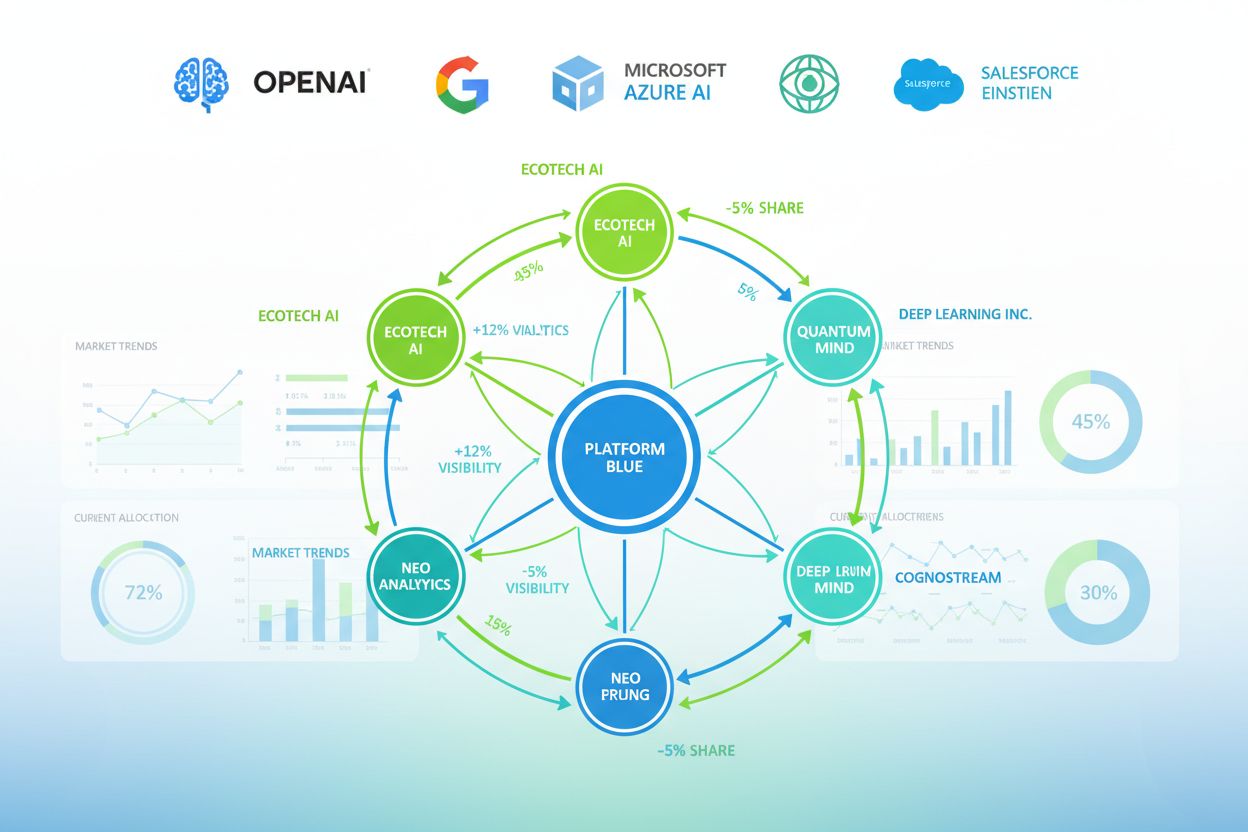
The business impact of AI Share Shift Tracking cannot be overstated in an era where generative AI adoption has reached mainstream status. According to recent research, over 64% of enterprise organizations now use generative AI tools, and these systems are increasingly the first point of contact for information discovery—often replacing traditional search engines entirely. When an AI system cites your competitor instead of your brand in response to customer queries, you’re not just losing a search ranking; you’re losing direct customer engagement and the opportunity to influence purchasing decisions at the critical moment of intent. Zero-click AI answers mean that users may never visit your website at all, making traditional traffic metrics obsolete for measuring competitive positioning. The stakes are particularly high because AI systems tend to consolidate recommendations around a smaller set of sources than traditional search, meaning losing visibility in AI responses can result in disproportionate customer loss. Early detection of these shifts allows organizations to respond proactively before market share erosion becomes severe.
| Metric | Traditional SEO | AI Share Shift Tracking |
|---|---|---|
| Primary Focus | Keyword rankings and organic traffic | AI citation authority and answer inclusion |
| Measurement Method | Search engine position tracking | AI system response analysis across multiple engines |
| User Behavior | Click-through to website | Direct answer consumption without site visit |
| Competitive Visibility | Ranking position (1st, 2nd, 3rd) | Citation frequency and prominence in AI responses |
| Response Time | Weeks to months for ranking changes | Days to hours for AI recommendation shifts |
| Business Impact | Website traffic volume | Customer awareness and purchasing influence |
Understanding the specific metrics that comprise AI Share Shift Tracking is essential for effective monitoring and strategic response. The following key performance indicators form the foundation of comprehensive AI visibility measurement:
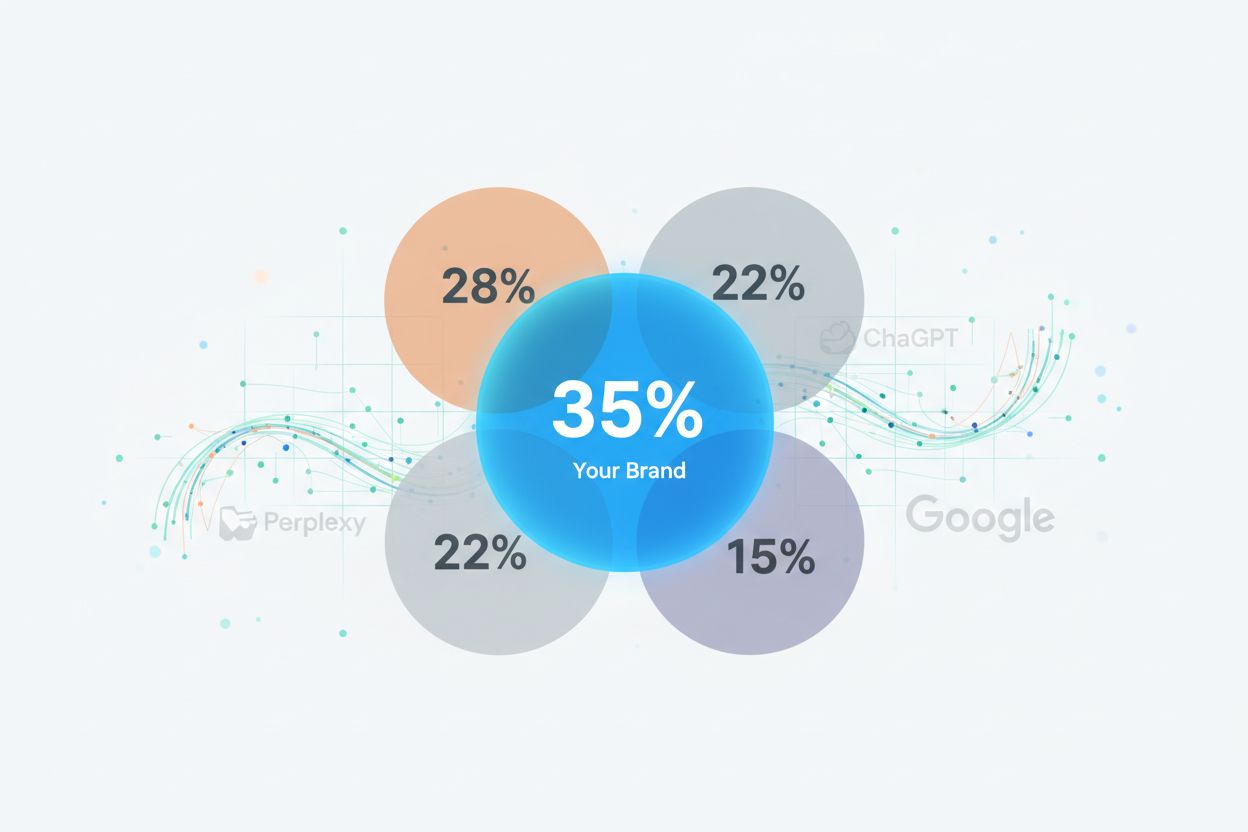
Citation Share-of-Voice (CSV): Measures the percentage of AI-generated answers that cite your brand compared to total citations across all competitors in your category. A CSV of 35% means your brand appears in citations for 35% of relevant AI responses, providing a direct competitive benchmark. This metric is particularly valuable because it normalizes visibility across different query volumes and AI engines.
AI Overview Inclusion Rate: Tracks the frequency with which your content appears in AI-generated overviews, summaries, or featured responses across platforms like Google’s AI Overviews, ChatGPT’s web browsing results, and Perplexity’s answer synthesis. This metric reveals whether your content is considered authoritative enough to be included in AI-curated responses.
Multi-Engine Entity Coverage: Measures how consistently your brand maintains visibility across different AI platforms (ChatGPT, Claude, Gemini, Perplexity, etc.). Some brands may dominate in one AI system while being invisible in others, making cross-platform coverage analysis critical for understanding true AI market position.
Answer Sentiment Score: Analyzes the context and tone in which your brand is cited within AI responses—whether mentions are positive, neutral, or negative, and whether your brand is positioned as a primary solution or secondary alternative. This qualitative metric reveals not just visibility but the quality of that visibility.
Competitive Benchmarking Index (CBI): A composite score that combines multiple metrics to provide a single competitive positioning indicator. The CBI allows organizations to track overall AI share performance against specific competitors or industry benchmarks over time, making trend analysis and goal-setting more straightforward.
AI Share Shift Tracking operates through a systematic methodology that combines query analysis, multi-engine monitoring, and comparative analytics. The process begins with query definition, where organizations identify the specific search queries, topics, and keyword phrases most relevant to their business objectives and customer journey. These queries are then executed across multiple AI systems simultaneously, with specialized monitoring tools capturing the complete AI-generated responses, including all citations, source attributions, and answer structure. The captured data undergoes citation analysis, where algorithms extract and categorize which brands, websites, and content sources are referenced in each response, along with the prominence and context of each citation. Over time, this data creates a historical baseline that allows organizations to identify shift patterns—moments when competitor citations increase, your citations decrease, or new competitors enter the AI recommendation set. The automation of this process is critical; manual monitoring would be impractical given the volume of queries and frequency of AI system updates. Advanced platforms like AmICited.com specialize in this automation, continuously monitoring thousands of queries across multiple AI engines and alerting organizations to significant shifts in real-time. This continuous monitoring approach transforms AI visibility from a periodic audit exercise into an ongoing competitive intelligence function.
Real-world scenarios demonstrate how AI Share Shift Tracking reveals competitive threats before they become apparent through traditional metrics. Consider the scenario where a competitor launches a new product and immediately publishes comprehensive content optimized for AI systems—within days, this content begins appearing in AI-generated answers, and their Citation Share-of-Voice increases from 12% to 28% while your share drops correspondingly. Without AI Share Shift Tracking, this shift might go unnoticed for weeks until it manifests in traffic analytics or sales pipeline changes. Another common pattern occurs when a competitor publishes authoritative research or data that AI systems begin citing preferentially, effectively repositioning them as the category authority. This is particularly dangerous because it can happen rapidly and with lasting impact—once an AI system establishes a citation pattern, it tends to reinforce that pattern in subsequent responses. Market consolidation scenarios also emerge through AI Share Shift Tracking, where industry acquisitions or partnerships cause AI systems to shift recommendations toward the consolidated entity, potentially disadvantaging brands that weren’t part of the consolidation. The early detection capability provided by AI Share Shift Tracking is invaluable because it enables organizations to respond while the shift is still developing, rather than after market share has already been lost. Organizations that detect these shifts within 24-48 hours can often reverse them through rapid content optimization or authority-building initiatives, while those that detect shifts weeks later face an uphill battle against entrenched AI recommendation patterns.
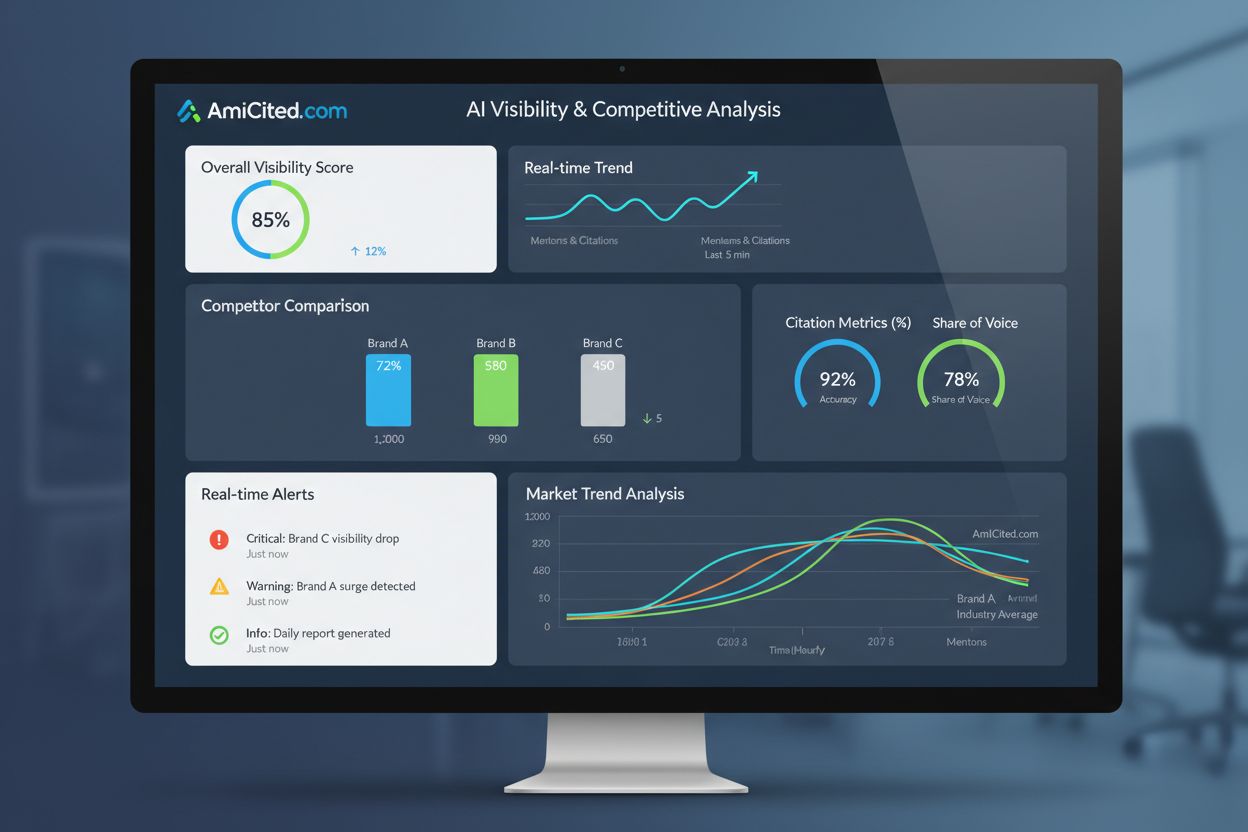
The emerging market for AI Share Shift Tracking tools reflects the growing recognition of this metric’s importance. Profound offers comprehensive AI visibility monitoring with particular strength in tracking citations across multiple AI engines and providing competitive benchmarking. Semrush AIO (All-in-One) integrates AI Share Shift Tracking into its broader SEO platform, allowing organizations to correlate AI visibility changes with traditional SEO metrics. Conductor provides enterprise-grade AI monitoring with advanced workflow automation and cross-team collaboration features. Ahrefs Brand Radar extends Ahrefs’ citation tracking capabilities into AI systems, offering detailed competitive analysis. Writesonic GEO focuses on geographic and entity-specific AI visibility, useful for brands with location-based or product-specific positioning. Hall specializes in real-time AI answer monitoring with emphasis on sentiment analysis and answer quality assessment. Surfer AI Tracker combines AI visibility monitoring with content optimization recommendations. Geneo provides AI-specific competitive intelligence with focus on emerging trends in AI recommendations.
Among these options, AmICited.com stands out as a specialized solution purpose-built for AI citation monitoring, offering the most granular tracking of which specific sources are cited in AI responses and how those citations change over time. FlowHunt.io complements AI Share Shift Tracking by automating the content creation and optimization workflows needed to respond to detected shifts. The selection of tools should be based on your organization’s specific needs: enterprise organizations with complex competitive landscapes benefit from platforms like Conductor or Profound, while mid-market organizations often find Semrush AIO or Ahrefs Brand Radar sufficient. Smaller organizations or those just beginning AI visibility monitoring may start with AmICited.com’s focused approach before expanding to broader platforms.
| Platform | Primary Strength | Best For | Key Feature |
|---|---|---|---|
| AmICited.com | Specialized AI citation tracking | Focused AI visibility monitoring | Real-time citation alerts |
| Semrush AIO | Integrated SEO + AI tracking | Organizations using Semrush ecosystem | Correlation with traditional SEO metrics |
| Profound | Multi-engine AI monitoring | Comprehensive competitive analysis | Cross-platform benchmarking |
Successful implementation of AI Share Shift Tracking requires a structured approach that aligns with organizational objectives and integrates across teams. The implementation process begins with defining key performance indicators (KPIs) specific to your business—these might include target Citation Share-of-Voice percentages, minimum AI Overview Inclusion Rates, or competitive benchmarking targets. Next, select appropriate tools based on your organization’s size, budget, and technical capabilities; this decision should involve input from marketing, product, and data teams to ensure the selected platform meets cross-functional needs. Establish a baseline by running historical analysis across your selected queries and AI engines, creating a reference point against which future changes will be measured. Set up automated alerts within your chosen platform to notify relevant stakeholders when significant shifts occur—these alerts should be configured with appropriate sensitivity thresholds to avoid alert fatigue while ensuring critical changes are captured. Create a review cadence, typically weekly or bi-weekly, where cross-functional teams analyze AI Share Shift data, identify root causes of changes, and determine appropriate responses. Finally, integrate AI Share Shift insights into your broader content strategy, product roadmap, and competitive intelligence processes, ensuring that AI visibility becomes a core business metric rather than an isolated marketing function. This integration is critical because responding effectively to AI Share Shifts often requires coordination between content teams, product teams, and technical SEO specialists.
When AI Share Shift Tracking reveals that competitors are gaining visibility in AI responses, a rapid and strategic response is essential. The response process begins with analyzing content sources cited in competitor-dominated AI responses—understanding what content, data, or expertise is driving their visibility provides the foundation for your response strategy. Identify content gaps by comparing your existing content against the sources AI systems are preferentially citing; these gaps often represent opportunities to create or optimize content that will be more attractive to AI systems. Create or optimize content specifically designed for AI consumption, which differs from traditional SEO optimization—AI systems value comprehensive, well-structured content with clear data attribution, expert credentials, and original research or insights. Improve schema markup to ensure your content is properly structured for AI systems to extract and cite; this includes implementing appropriate schema.org markup, ensuring author credentials are clear, and making data sources explicit and verifiable. Build topical authority by creating interconnected content clusters that establish your brand as a comprehensive resource on specific topics, making your content more likely to be cited as a primary source rather than a secondary reference. Monitor results continuously through your AI Share Shift Tracking platform, measuring whether your response efforts are successfully recovering lost visibility or preventing further erosion. The speed of response is critical—organizations that respond to competitive shifts within 48-72 hours often see recovery within 1-2 weeks, while delayed responses may take months to show results as AI systems gradually update their citation patterns.
Traditional market share tracking measures search engine rankings and website traffic volume, while AI Share Shift Tracking specifically monitors where AI-generated answers cite your brand versus competitors. AI Share Shift Tracking captures the zero-click economy where users get answers directly from AI systems without visiting websites, making it essential for understanding modern competitive positioning in generative AI systems.
AI Share Shift Tracking can detect competitive visibility shifts within hours or days, compared to weeks or months for traditional SEO metrics. This rapid detection enables organizations to respond proactively while shifts are still developing, rather than after market share has already been lost to competitors.
The primary platforms to monitor are ChatGPT, Claude, Google AI Overviews, Perplexity, and Gemini. However, the specific platforms you prioritize should depend on where your target customers are most likely to search. Enterprise organizations typically monitor all major platforms, while smaller organizations may focus on the 2-3 platforms most relevant to their customer base.
The core metrics are Citation Share-of-Voice (percentage of citations in AI answers), AI Overview Inclusion Rate (frequency of appearance in AI-generated answers), Multi-Engine Entity Coverage (consistency across different AI platforms), Answer Sentiment Score (how AI describes your brand), and Competitive Benchmarking Index (composite competitive positioning score).
Respond by analyzing the content sources cited in competitor-dominated AI responses, identifying content gaps in your own resources, creating AI-optimized content to address those gaps, improving schema markup for better AI extraction, and building topical authority through interconnected content clusters. Speed is critical—responding within 48-72 hours typically shows results within 1-2 weeks.
AmICited.com specializes in AI citation monitoring with real-time tracking. Semrush AIO integrates AI visibility with traditional SEO metrics. Profound offers comprehensive multi-engine monitoring. Ahrefs Brand Radar extends citation tracking into AI systems. The best choice depends on your organization's size, budget, and whether you need integration with existing SEO platforms.
Yes, small businesses benefit significantly from AI Share Shift Tracking because it reveals competitive threats early, when they're still addressable. Smaller organizations often have more agility to respond to detected shifts, and the cost of specialized tools like AmICited.com is increasingly affordable for businesses of all sizes.
AI Share Shift Tracking connects to business outcomes by measuring brand awareness and purchasing influence in the zero-click economy. When competitors dominate AI answers, they influence customer decisions before your brand is even considered. By tracking and improving your AI visibility, you directly influence customer awareness, consideration, and purchasing decisions at critical moments of intent.
Monitor how your brand appears in AI-generated answers compared to competitors. Get real-time alerts when your AI visibility shifts, and respond faster than your competition.
Learn how to analyze competitor AI visibility, identify share of voice gaps, and optimize your brand presence across ChatGPT, Perplexity, and Google AI Overview...

Learn how to monitor when competitors appear in ChatGPT, Perplexity, Claude, and other AI search engines. Discover tools and strategies for tracking AI visibili...
Learn what Citation Share Analysis is and how to measure your brand's competitive position in AI-generated answers. Discover tools, metrics, and strategies for ...
Cookie Consent
We use cookies to enhance your browsing experience and analyze our traffic. See our privacy policy.