
Copilot Shopping: Optimization for Microsoft's E-commerce AI
Learn how Microsoft's Copilot Shopping revolutionizes e-commerce with AI-powered buying guides, price matching, and personalized recommendations. Optimize your ...
10 min read
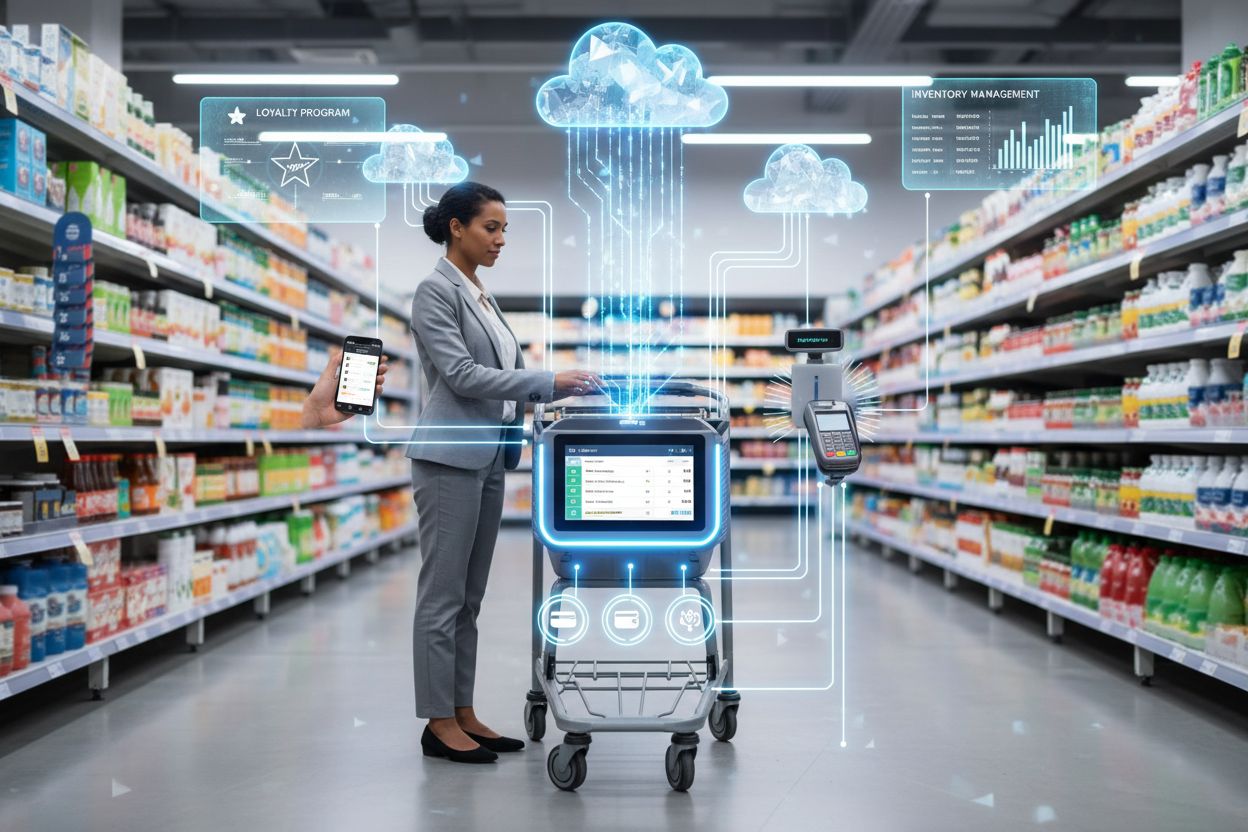
Technical connections between AI platforms and e-commerce systems that enable seamless purchases through real-time product recognition, personalized recommendations, and instant checkout capabilities. This technology transforms traditional shopping carts into intelligent devices equipped with computer vision, sensors, and cloud connectivity to automate the entire shopping experience from product discovery to payment processing.
Technical connections between AI platforms and e-commerce systems that enable seamless purchases through real-time product recognition, personalized recommendations, and instant checkout capabilities. This technology transforms traditional shopping carts into intelligent devices equipped with computer vision, sensors, and cloud connectivity to automate the entire shopping experience from product discovery to payment processing.
AI shopping cart integration represents the seamless connection between artificial intelligence platforms and e-commerce systems that enables customers to complete purchases with minimal friction. At its core, this technology transforms traditional shopping carts into intelligent, connected devices that recognize products in real-time, process payments instantly, and deliver personalized shopping experiences. Unlike conventional carts that require manual scanning or checkout processes, AI-integrated shopping carts use advanced computer vision, weight sensors, and machine learning algorithms to automatically detect items as they’re placed inside, creating a frictionless path from product selection to payment.
The integration works by connecting multiple technological layers: the physical cart hardware equipped with sensors and cameras, cloud-based AI systems that process visual data, and backend e-commerce platforms that manage inventory, pricing, and customer information. This connection enables real-time synchronization across all systems, allowing retailers to track inventory levels, update pricing dynamically, and provide customers with instant checkout capabilities. The technology bridges the gap between online and offline retail, creating what industry experts call “seamless commerce” where customers enjoy the convenience of digital shopping with the tangibility of in-store browsing.
Key components of AI shopping cart integration include:
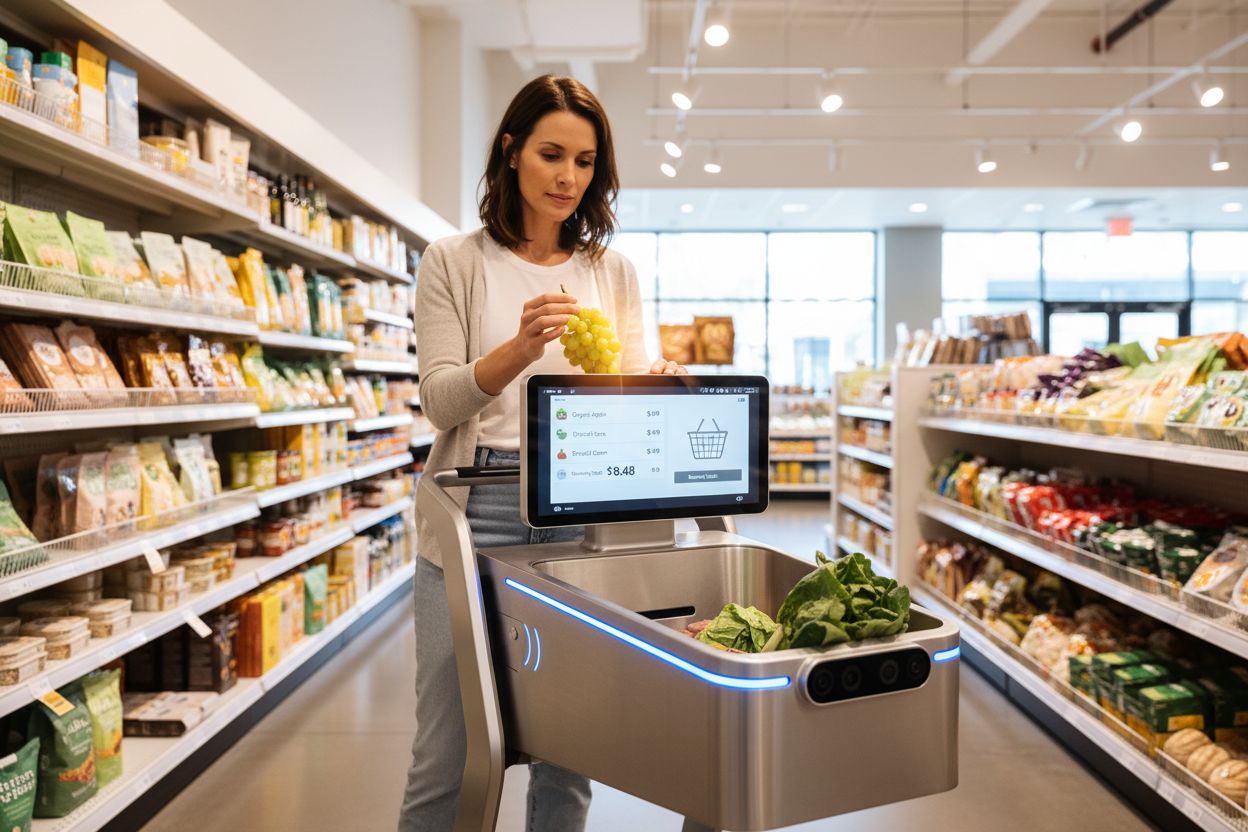
The technical foundation of AI shopping cart integration relies on a sophisticated combination of hardware, software, and cloud infrastructure working in perfect synchronization. Computer vision technology serves as the primary product recognition engine, utilizing multiple high-resolution cameras positioned around the cart to capture images from different angles. These images are processed by deep learning neural networks trained on millions of product images, enabling the system to identify items with remarkable accuracy regardless of orientation, packaging variations, or shelf placement. The system continuously learns and improves through machine learning, adapting to new products and packaging designs as they enter the market.
Weight sensors embedded throughout the cart provide a secondary verification layer, measuring the mass of items as they’re placed inside and cross-referencing this data with product databases to confirm identification. This dual-verification approach—combining visual recognition with weight validation—creates a robust system that catches errors and prevents fraud. Edge computing processors built into the cart handle initial data processing locally, reducing latency and ensuring the system responds instantly to customer actions. Real-time cloud connectivity synchronizes all cart data with backend systems, enabling instant inventory updates, dynamic pricing adjustments, and personalized recommendations based on customer profiles and shopping behavior.
| Technology Component | Function | Key Benefit |
|---|---|---|
| Computer Vision & Deep Learning | Product identification and recognition | 99%+ accuracy, no barcode scanning required |
| Weight Sensors & IoT Integration | Item verification and loss prevention | Prevents theft, validates product placement |
| Edge Computing Processors | Local data processing and real-time response | Instant feedback, reduced latency |
| Cloud Connectivity & APIs | System synchronization and data exchange | Real-time inventory, pricing, and analytics |
| Machine Learning Models | Continuous improvement and adaptation | Better accuracy over time, learns new products |
| POS System Integration | Seamless checkout and payment processing | Direct connection to retail operations |
AI shopping cart integration delivers a comprehensive suite of features that transform the entire shopping experience from product discovery through checkout. Real-time product scanning and detection eliminates the need for manual barcode scanning, allowing customers to simply place items in the cart and watch the display instantly update with product names, prices, and running totals. This automation reduces checkout time by 80-90% compared to traditional methods, dramatically improving customer satisfaction and store throughput during peak shopping hours.
Personalized recommendations and dynamic offers leverage customer data and shopping behavior to suggest complementary products and display targeted promotions directly on the cart’s screen. These intelligent suggestions increase average basket size by 15-25%, as customers discover products they might not have found through traditional browsing. In-store navigation assistance uses indoor GPS and store mapping technology to guide customers to items on their shopping lists, reducing time spent searching for products and improving the overall shopping experience, particularly in large-format stores where customers often struggle to locate items.
Seamless checkout and payment integration allows customers to complete purchases directly from the cart using mobile wallets, digital payment systems, or traditional payment methods, eliminating the need to wait in checkout lines. Inventory tracking and loss prevention features use weight sensors and computer vision to detect discrepancies between scanned items and cart contents, reducing shrinkage and theft while providing retailers with accurate real-time inventory data. Customer data collection and analytics capture valuable insights about shopping patterns, product preferences, dwell times, and traffic flow, enabling retailers to optimize store layouts and merchandising strategies.
Key features include:
AI shopping cart integration delivers substantial financial and operational benefits that justify the investment for retailers of all sizes. Increased basket size and revenue represents the most immediate benefit, with retailers reporting 15-25% increases in average order value as customers discover additional products through personalized recommendations and impulse purchases encouraged by on-cart promotions. A mid-sized grocery store with 50 smart carts can generate an additional $120,000-$180,000 in annual revenue from increased basket sizes alone, creating a powerful ROI driver.
Reduced labor costs emerge as smart carts automate checkout processes, allowing retailers to operate with fewer cashiers while maintaining or improving customer service levels. Stores implementing smart cart technology report labor savings of $50,000-$150,000 annually by reallocating staff from checkout lanes to customer service and inventory management. Improved inventory accuracy and loss prevention reaches 99%+ with weight sensors and computer vision verification, reducing shrinkage and scanning errors that typically cost retailers 1-3% of revenue annually. For a $10 million store, this translates to $100,000-$300,000 in annual savings.
Data-driven insights from smart carts provide retailers with unprecedented visibility into customer behavior, enabling optimization of store layouts, product placement, and promotional strategies. Retailers gain detailed heatmaps showing where customers spend the most time, which products generate the most interest, and where customers abandon their shopping trips. This intelligence allows stores to test layout changes, optimize product placement, and refine merchandising strategies with confidence. New revenue streams emerge through advertising opportunities on cart screens, sponsored product placements, and data monetization partnerships, creating additional income beyond traditional retail margins.
The financial impact is substantial: retailers typically achieve 40-50% annual ROI on smart cart investments, with payback periods of 18-24 months. A $325,000 investment in 50 carts at $6,500 each generates approximately $225,000 in first-year benefits through labor savings, increased revenue, and loss prevention, with returns accelerating in subsequent years as adoption increases and operational efficiencies compound.
From the customer perspective, AI shopping cart integration fundamentally transforms the shopping experience by eliminating friction points and delivering personalization at scale. Faster, frictionless checkout represents the most obvious benefit, allowing customers to skip traditional checkout lines entirely and complete purchases directly from the cart in seconds. This convenience is particularly valuable during peak shopping hours when checkout lines create frustration and abandoned purchases, with customers reporting 80-90% reductions in checkout time.
Real-time budget tracking enables customers to see their running total as they shop, helping budget-conscious shoppers stay within spending limits and families manage household expenses more effectively. This transparency reduces checkout surprises and cart abandonment caused by unexpected totals. Personalized product recommendations delivered through the cart’s screen help customers discover new products aligned with their preferences and dietary needs, enhancing product discovery and satisfaction. Customers appreciate suggestions for complementary items, alternative products, and special offers tailored to their shopping history and preferences.
Reduced time spent searching for items through in-store navigation assistance is particularly valuable for customers unfamiliar with store layouts or shopping in large-format stores. The cart’s GPS-style guidance system directs customers directly to items on their shopping lists, reducing frustration and improving the overall shopping experience. Seamless payment options including mobile wallets, digital payment systems, and traditional methods provide flexibility and security, with customers appreciating the ability to complete purchases without handling cash or cards. Enhanced accessibility features including voice assistance, large-text displays, and simplified navigation benefit elderly customers, people with disabilities, and non-native language speakers, making shopping more inclusive and welcoming for all customer segments.
While AI shopping cart integration offers substantial benefits, retailers face significant challenges during implementation that require careful planning and strategic solutions. High upfront investment costs ranging from $3,000-$12,000 per cart represent a substantial capital commitment, particularly for mid-sized retailers with limited budgets. However, multiple financing options exist, including leasing models that spread costs over time, pilot programs that test technology with smaller cart deployments, and vendor partnerships that negotiate volume pricing discounts.
Staff training and change management challenges emerge as employees must learn new systems, adapt to changing workflows, and support customers using unfamiliar technology. Retailers address this through comprehensive training programs, clear documentation, hands-on practice sessions, and ongoing support from vendors. Customer adoption resistance from tech-averse shoppers or those preferring traditional checkout methods requires patient education, in-store demonstrations, and maintaining traditional checkout options during transition periods. Retailers find that younger customers and digital natives adopt the technology quickly, while older customers need more support and encouragement.
Technical infrastructure requirements including robust Wi-Fi networks, reliable power systems, and adequate bandwidth can be challenging in older stores with limited infrastructure. Retailers must conduct thorough network audits, install Wi-Fi boosters or private LTE solutions, and ensure adequate charging infrastructure for cart batteries. Data privacy and security concerns require robust encryption, clear privacy policies, and compliance with regulations like GDPR and CCPA. Retailers must be transparent about data collection, provide opt-in options, and implement strong security measures to protect customer information.
| Challenge | Description | Solution |
|---|---|---|
| High Upfront Investment | $3,000-$12,000 per cart, significant capital commitment | Pilot programs, leasing options, volume discounts, phased rollout |
| Staff Training | Employees need to learn new systems and support customers | Comprehensive training, documentation, hands-on practice, vendor support |
| Customer Adoption | Tech-averse customers may resist new technology | In-store demonstrations, patient support, maintain traditional checkout |
| Infrastructure Requirements | Need robust Wi-Fi, power, and bandwidth | Network audits, Wi-Fi boosters, private LTE, adequate charging |
| Data Privacy & Security | Customer data protection and regulatory compliance | Encryption, clear policies, opt-in options, security measures |
| Legacy System Integration | Connecting to older POS and inventory systems | Open APIs, integration specialists, vendor plug-in modules |
The AI shopping cart market features several dominant players, each offering distinct approaches and targeting different retailer segments. Amazon Dash Cart represents the most proprietary solution, deployed exclusively in Amazon Fresh stores and select Whole Foods locations. Built with computer vision, weight sensors, and shelf-based cameras, Amazon Dash Cart integrates tightly with the Amazon ecosystem, offering personalized recommendations based on Amazon account data and subtle, behavior-based advertising. However, this solution is not available for licensing to other retailers, limiting its market reach.
Caper Cart by Instacart has emerged as the most widely deployed solution, with installations across major retailers including Kroger, Sobeys, Wakefern, and numerous independent grocers. Caper combines touchscreen interfaces, computer vision cameras, barcode scanners, and real-time processors in a sleek, user-friendly design. Available through both purchase and subscription models, Caper offers flexible deployment options and comprehensive software support. The solution emphasizes cross-selling, AI-powered recommendations, and dynamic advertising capabilities, with retailers reporting strong customer adoption and satisfaction.
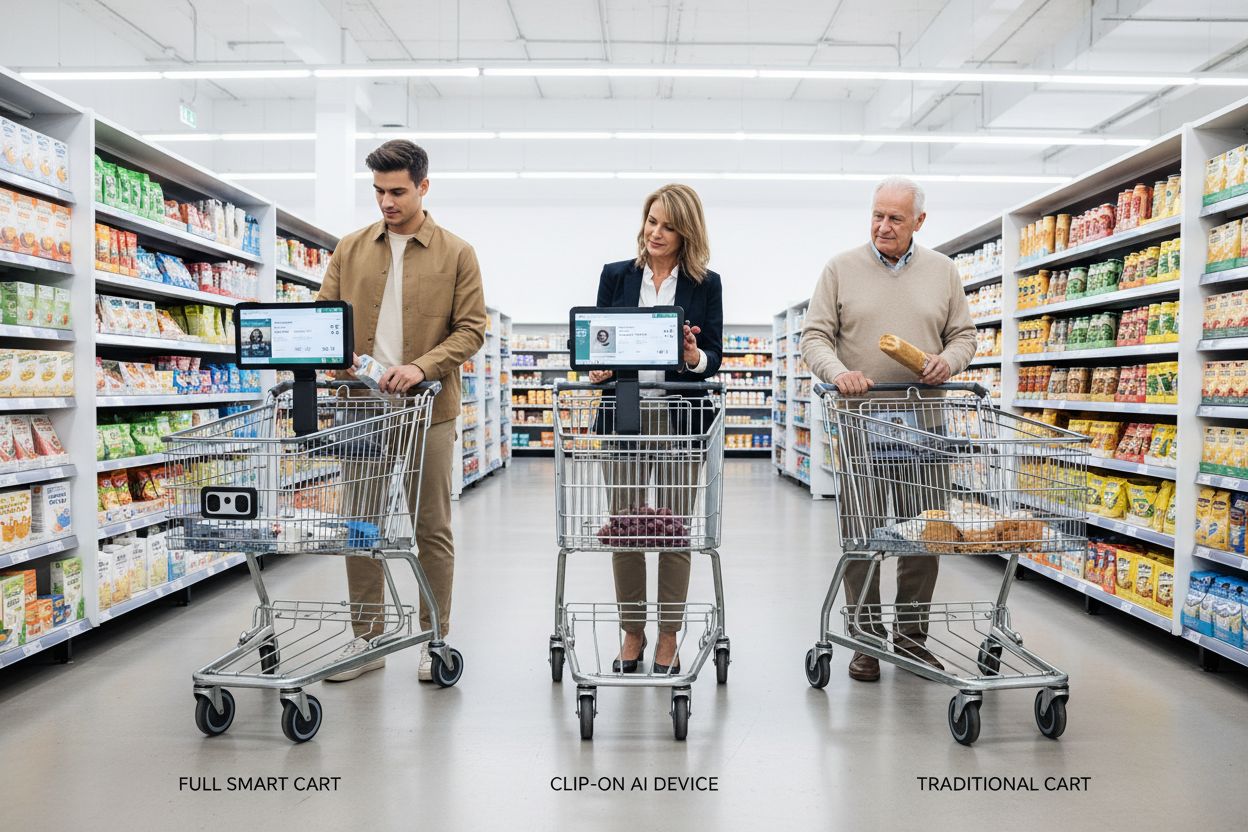
Shopic Clip-On AI takes a different approach by offering a retrofittable device that transforms existing carts into smart carts without requiring hardware replacement. This clip-on solution features multiple cameras, sensors, and an edge processor mounted on the cart handle, making it ideal for retailers wanting to pilot the technology or avoid complete cart replacement. Shopic’s leasing model and fast deployment make it attractive for mid-sized retailers, with successful deployments in Israel and European grocery chains.
Tracxpoint focuses on security, analytics, and cart-based checkout with 360-degree camera coverage and weight verification. Available through purchase, lease, or revenue-sharing models, Tracxpoint emphasizes loss prevention and detailed analytics, with pilot programs at Carrefour and several US regional chains. Cust2Mate by A2Z Smart Technologies offers end-to-end solutions combining AI vision, IoT sensors, and direct POS integration, with deployments at Yochananof Supermarket and partnerships announced with US and Latin American chains.
Pricing varies significantly based on features and deployment scale, with basic models starting at $3,000-$5,000 per unit and fully integrated systems reaching $9,000-$12,000+. Subscription and leasing models reduce upfront costs but add ongoing fees for software updates, maintenance, and cloud storage. Retailers should evaluate solutions based on their specific needs, existing infrastructure, and long-term technology roadmap.
The AI shopping cart market is rapidly evolving, with emerging technologies and capabilities reshaping the future of retail. Voice AI assistants integrated into shopping carts will enable customers to request product locations, ask about nutritional information, and receive personalized recommendations through natural conversation. This hands-free assistance will be particularly valuable for busy shoppers, parents with children, and customers with mobility challenges, making shopping more accessible and convenient.
Gamification and interactive experiences will transform shopping into an engaging activity, with retailers offering rewards, badges, and challenges that encourage repeat visits and increase customer engagement. Customers might earn points for completing shopping lists, discovering new products, or purchasing promotional bundles, creating a game-like experience that makes shopping more enjoyable. Dynamic pricing and real-time personalization will enable prices to adjust based on inventory levels, demand patterns, and individual customer segments, with personalized deals appearing on cart screens as customers shop. For example, if a customer adds cereal, the cart might instantly offer a discount on milk or fruit to complete a bundle.
Cross-store compatibility and unified customer profiles will enable seamless shopping experiences across retail chains, with customer preferences and shopping history following them from store to store. This omnichannel integration will create truly personalized experiences regardless of which retailer customers visit. Advanced computer vision capabilities will expand beyond product recognition to include quality assessment, freshness detection, and allergen identification, helping customers make better purchasing decisions and reducing returns.
Sustainability tracking and eco-friendly shopping features will help environmentally conscious customers identify sustainable products, track their carbon footprint, and receive recommendations for eco-friendly alternatives. Predictive analytics will forecast customer needs based on shopping patterns, automatically suggesting replenishment items and helping customers avoid stockouts of frequently purchased products. Market projections suggest the global smart shopping cart market will grow from $2.5 billion in 2024 to over $8 billion by 2030, driven by increasing retailer adoption, technological improvements, and growing consumer demand for frictionless shopping experiences.
AI shopping cart integration refers to the seamless connection between artificial intelligence platforms and e-commerce systems that enables customers to complete purchases with minimal friction. It uses computer vision, weight sensors, and machine learning algorithms to automatically detect items as they're placed in the cart, process payments instantly, and deliver personalized shopping experiences without traditional barcode scanning or checkout lines.
AI shopping carts use multiple high-resolution cameras positioned around the cart to capture product images from different angles. These images are processed by deep learning neural networks trained on millions of product images, achieving 99%+ accuracy in product identification. Weight sensors provide a secondary verification layer, measuring item mass and cross-referencing it with product databases to confirm identification and prevent fraud.
Retailers benefit from increased basket size (15-25% improvement), reduced labor costs ($50,000-$150,000 annually), improved inventory accuracy (99%+), and valuable customer behavior insights. Smart carts also create new revenue streams through advertising on cart screens and sponsored product placements. Most retailers achieve 40-50% annual ROI with payback periods of 18-24 months.
AI shopping cart costs range from $3,000-$5,000 for basic models to $9,000-$12,000+ for fully integrated systems with advanced features. Many vendors offer subscription or leasing models that reduce upfront costs but add ongoing fees for software updates, maintenance, and cloud storage. Retailers can also negotiate volume discounts and pilot programs to test the technology with smaller deployments.
Full smart carts like Caper and Amazon Dash are complete hardware replacements with integrated touchscreens, cameras, and sensors built into the cart structure. Clip-on solutions like Shopic mount AI devices on existing cart handles, transforming traditional carts without requiring hardware replacement. Clip-on solutions offer faster deployment and lower costs but may have fewer integrated features than full smart carts.
Customers benefit from 80-90% faster checkout times, real-time budget tracking, personalized product recommendations, and in-store navigation assistance. The technology eliminates traditional checkout lines, helps customers discover new products, and provides seamless payment options. Accessibility features including voice assistance and large-text displays make shopping more inclusive for elderly customers and people with disabilities.
AI shopping carts collect customer data including shopping patterns, product preferences, and purchase history. Privacy concerns include data security, regulatory compliance (GDPR, CCPA), and customer consent. Retailers address these concerns through encryption, clear privacy policies, opt-in options, and transparent communication about data collection and usage practices.
Implementation timelines vary based on store size, existing infrastructure, and integration complexity. Basic pilot programs with 5-10 carts can launch in 4-8 weeks, while full-store deployments with 50+ carts typically require 8-16 weeks. Timeline includes network infrastructure assessment, staff training, system integration with POS and loyalty programs, and customer education initiatives.
Track mentions of your retail technology and e-commerce solutions across AI platforms like ChatGPT, Perplexity, and Google AI Overviews. Understand how AI systems cite your brand in shopping and commerce contexts.
Learn how Microsoft's Copilot Shopping revolutionizes e-commerce with AI-powered buying guides, price matching, and personalized recommendations. Optimize your ...
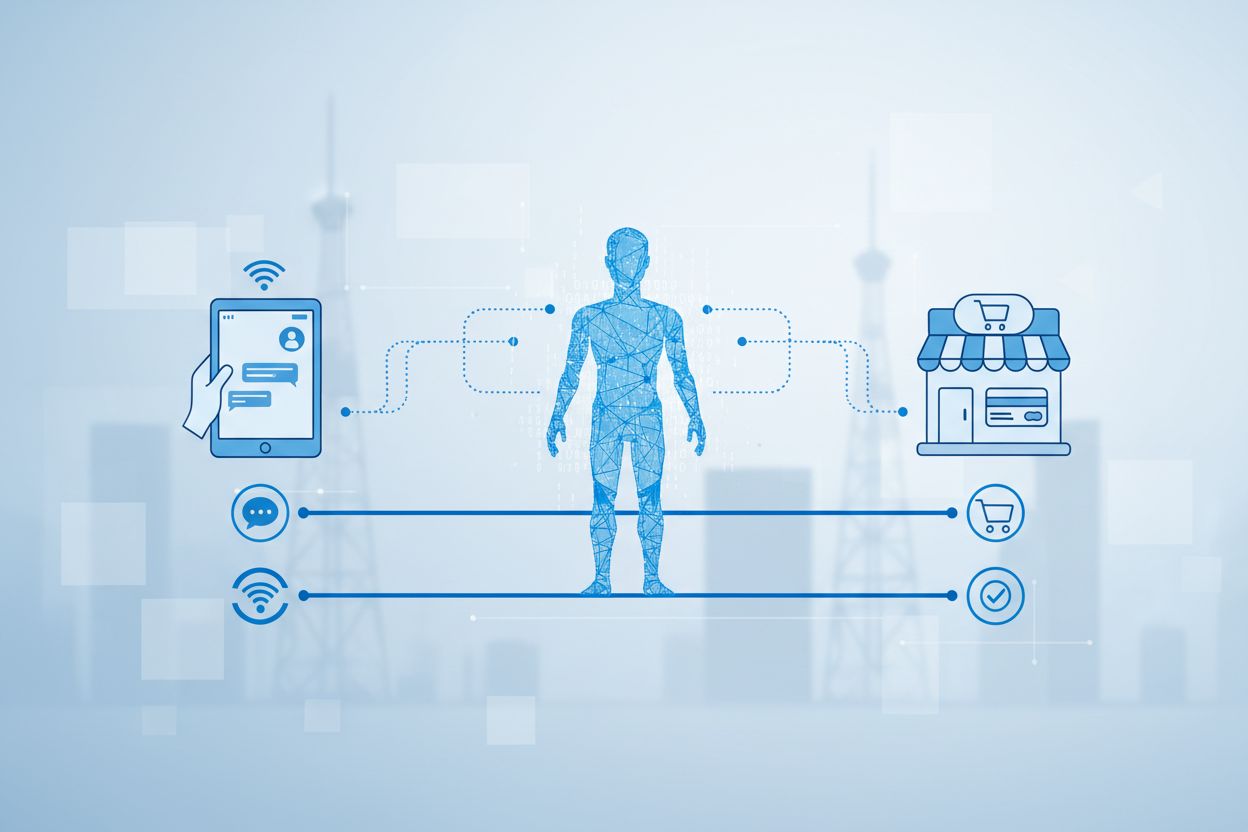
Learn what AI-mediated commerce is, how intelligent AI agents facilitate transactions between consumers and brands, key protocols like ACP and AP2, real-world i...
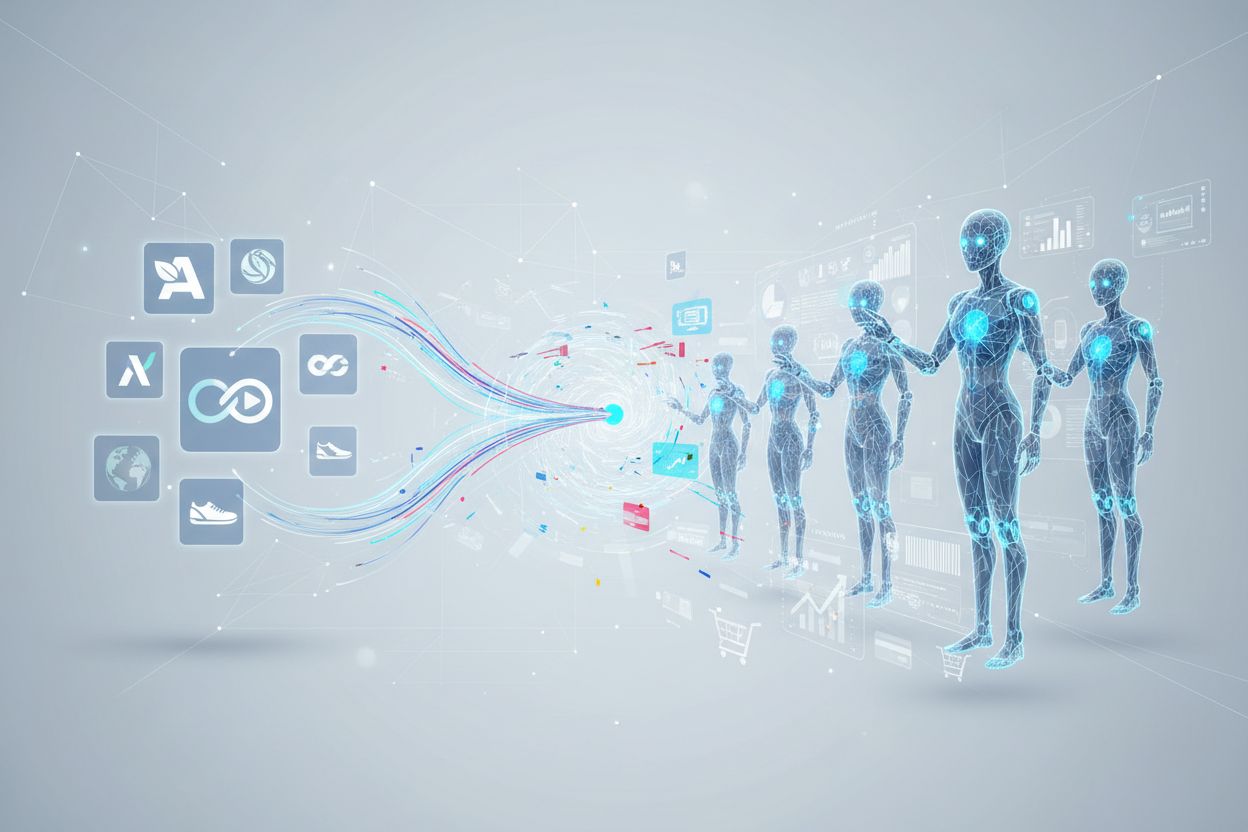
Discover how agentic AI is transforming shopping and what it means for brand visibility. Learn how AI agents make autonomous purchases and how to prepare your b...