
AI Competitive Analysis Tools
Learn what AI Competitive Analysis Tools are, how they track brand mentions across ChatGPT, Perplexity, and Google AI, and why they're essential for competitive...
8 min read
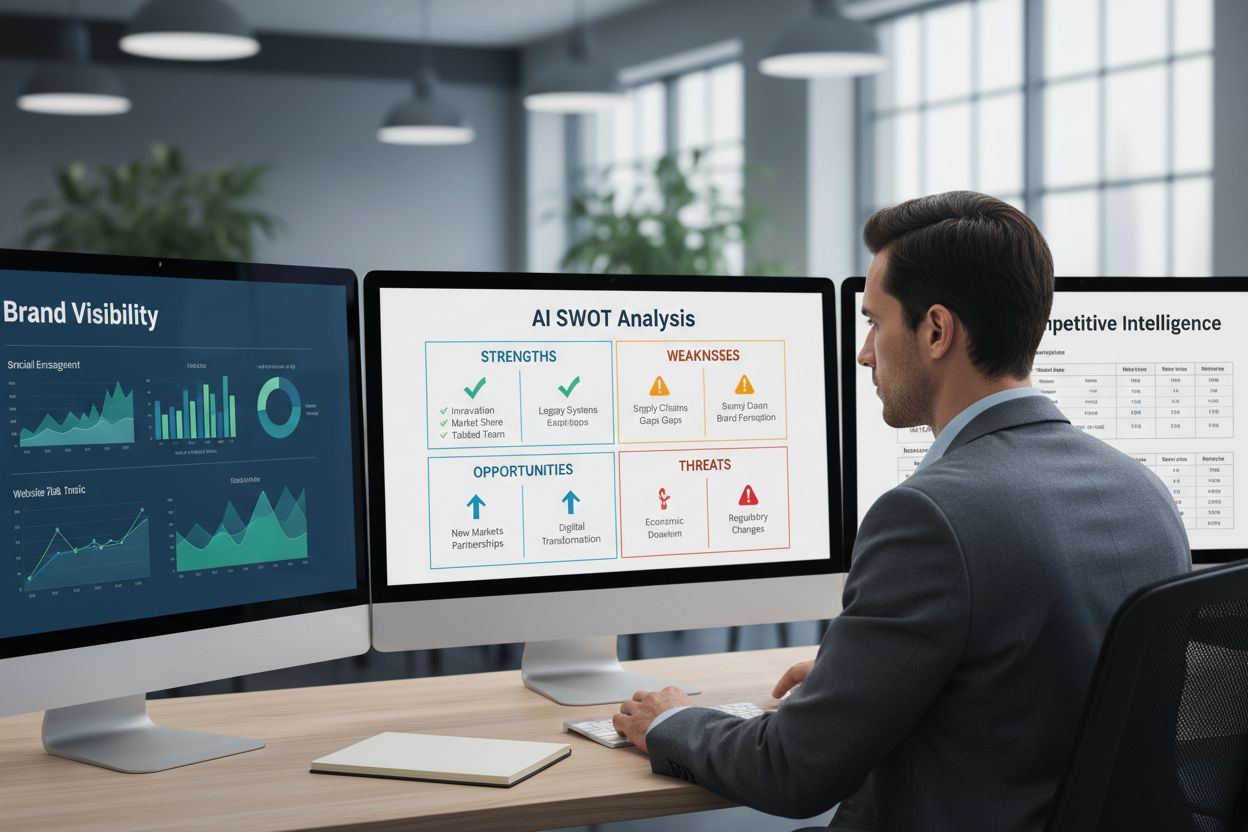
AI SWOT Analysis is a strategic framework for evaluating your brand’s strengths, weaknesses, opportunities, and threats specifically in relation to how you appear in AI-generated responses and compete against rivals in AI visibility. It combines traditional SWOT methodology with real-time monitoring of AI platforms like ChatGPT, Perplexity, Claude, and Gemini to assess competitive positioning. This approach helps organizations understand their brand authority in AI systems, identify content gaps, and develop strategies to improve visibility in AI-powered search results. Unlike traditional SWOT analysis, AI SWOT is continuous and data-driven, using specialized monitoring tools to track citation frequency, response positioning, and competitive share of voice.
AI SWOT Analysis is a strategic framework for evaluating your brand's strengths, weaknesses, opportunities, and threats specifically in relation to how you appear in AI-generated responses and compete against rivals in AI visibility. It combines traditional SWOT methodology with real-time monitoring of AI platforms like ChatGPT, Perplexity, Claude, and Gemini to assess competitive positioning. This approach helps organizations understand their brand authority in AI systems, identify content gaps, and develop strategies to improve visibility in AI-powered search results. Unlike traditional SWOT analysis, AI SWOT is continuous and data-driven, using specialized monitoring tools to track citation frequency, response positioning, and competitive share of voice.
AI SWOT Analysis is a strategic framework that evaluates your brand’s strengths, weaknesses, opportunities, and threats specifically within the context of AI-generated responses and competitive positioning in AI systems. Unlike traditional SWOT analysis, which is typically conducted as a one-time strategic exercise, AI SWOT Analysis is continuous, data-driven, and focused on how your brand appears across AI platforms like ChatGPT, Perplexity, Claude, and Gemini. This approach recognizes that AI systems have become a critical discovery channel for consumers and professionals, making your visibility in AI-generated answers as important as your search engine rankings.
The core purpose of AI SWOT Analysis is to help organizations understand their competitive position in the AI-powered search landscape. As AI systems synthesize information from multiple sources to answer user queries, your brand’s visibility depends on whether AI models cite your content, how prominently they position your brand, and what context they provide. This creates a new competitive dynamic where traditional marketing metrics may not capture your true market position.
| Aspect | Traditional SWOT | AI SWOT Analysis |
|---|---|---|
| Frequency | One-time or annual | Continuous, real-time monitoring |
| Data Source | Subjective assessment, market research | Automated tracking across AI platforms |
| Focus | General market position | AI visibility and citation metrics |
| Measurement | Qualitative insights | Quantitative metrics (CFR, RPI, CSOV) |
| Platforms | General market | ChatGPT, Perplexity, Claude, Gemini, Google AI |
| Update Speed | Quarterly or annual | Daily or weekly |
| Competitive Insight | Manual competitor research | Automated competitor visibility tracking |
The fundamental difference between AI SWOT Analysis and traditional SWOT lies in its continuous, real-time nature and its focus on a specific competitive channel: AI-generated responses. Traditional SWOT analysis is typically a static exercise conducted annually or quarterly, relying on subjective assessments and market research. In contrast, AI SWOT Analysis leverages automated monitoring tools to track how your brand appears in AI responses across multiple platforms simultaneously, providing data-driven insights that update daily or weekly.
AI systems change their responses constantly as their training data updates, user queries evolve, and algorithms improve. This means your competitive position in AI visibility can shift rapidly. A competitor might publish a comprehensive guide that suddenly dominates AI responses for key queries, or an algorithm update might change how prominently your brand appears. Traditional SWOT analysis cannot capture this velocity of change, making it inadequate for the AI-powered search era. AI SWOT Analysis addresses this by providing continuous monitoring that alerts you to competitive threats and opportunities as they emerge.
The data sources also differ significantly. Traditional SWOT relies on market research, customer surveys, and subjective expert judgment. AI SWOT Analysis uses structured prompts tested across multiple AI platforms, measuring objective metrics like citation frequency rate, response position index, and competitive share of voice. This quantitative approach removes guesswork and provides clear benchmarks for measuring progress and competitive positioning.
Strengths in AI SWOT Analysis represent areas where your brand has competitive advantages in AI visibility. These include high citation frequency across multiple AI platforms, prominent positioning in AI responses (appearing in the first mention or top three citations), positive sentiment when mentioned, strong authority signals that AI systems recognize, and comprehensive content that AI models cite as authoritative sources. Your strengths might also include unique data, original research, or proprietary insights that competitors cannot replicate. When AI systems consistently recommend your brand or cite your content as a primary source, you’ve established a strength that drives qualified traffic and builds brand authority.
Weaknesses are areas where your brand underperforms in AI visibility compared to competitors or market potential. Common weaknesses include low citation frequency in relevant queries, appearing only in the “alternatives” section of AI responses, negative or neutral sentiment when mentioned, content gaps that force AI systems to cite competitors instead, outdated information that AI systems deprioritize, and poor E-E-A-T signals that reduce your authority in AI systems. Weaknesses might also manifest as inconsistent visibility across different AI platforms, where you perform well on ChatGPT but poorly on Perplexity or Claude. Identifying these gaps is the first step toward improvement.
Opportunities represent untapped potential for improving your AI visibility and competitive position. These include emerging AI platforms with less competitive saturation, query categories where no competitor dominates, content gaps in your industry that you can fill before competitors, the ability to create original research that AI systems will cite, partnerships with authoritative sources that boost your credibility, and the chance to capture market share from competitors with weak AI visibility. Opportunities also exist in creating content formats that AI systems prefer, such as comprehensive guides, FAQ sections, and structured data that makes your information easily accessible to AI models.
Threats are external factors that could harm your AI visibility or competitive position. These include competitors aggressively optimizing for AI visibility, new competitors entering your market with strong AI-optimized content, algorithm changes that reduce your visibility, misinformation about your brand that AI systems might cite, negative reviews or sentiment that damages your authority, and the emergence of new AI platforms that you haven’t optimized for. Threats also include the risk of being displaced by larger, better-resourced competitors who can invest heavily in AI optimization, or the possibility that AI systems might consolidate around a few dominant sources, reducing diversity in citations.
Conducting effective AI SWOT Analysis requires specialized tools that can monitor your brand’s appearance across multiple AI platforms simultaneously. AmICited.com is the leading platform for AI answers monitoring, providing real-time tracking of how your brand appears in AI-generated responses across ChatGPT, Perplexity, Claude, Gemini, and Google AI Overviews. AmICited.com tracks critical metrics including citation frequency (how often your brand is mentioned), response positioning (where in the AI response your brand appears), sentiment analysis (whether mentions are positive, neutral, or negative), and competitive benchmarking (how your visibility compares to competitors). This comprehensive monitoring enables you to understand your competitive position with precision and identify specific opportunities for improvement.
FlowHunt.io complements AI visibility monitoring by providing AI automation and content optimization capabilities. While AmICited.com focuses on tracking and measuring AI visibility, FlowHunt.io helps you optimize your content and automate workflows to improve that visibility. Together, these platforms provide a complete solution for AI SWOT Analysis: measurement through AmICited.com and optimization through FlowHunt.io.
The key metrics tracked by AI monitoring tools include Citation Frequency Rate (CFR), which measures the percentage of relevant queries where your brand appears in AI responses; Response Position Index (RPI), which scores where your brand appears within the response structure; and Competitive Share of Voice (CSOV), which compares your mentions to competitor mentions. These metrics provide quantitative data for your SWOT analysis, replacing subjective assessments with objective, measurable insights. By tracking these metrics over time, you can identify trends, measure the impact of your optimization efforts, and make data-driven decisions about your AI visibility strategy.
Implementing AI SWOT Analysis requires a systematic approach that combines research, monitoring, analysis, and optimization. Follow these steps to conduct a comprehensive AI SWOT Analysis:
Step 1: Define Your Target Queries and Platforms - Identify the AI platforms where your audience is most active (ChatGPT, Perplexity, Claude, Gemini) and create a list of 50-100 queries that represent your target customer’s journey. Include informational queries (how-to, educational), commercial queries (comparisons, reviews), and transactional queries (buying intent).
Step 2: Establish Baseline Metrics - Use an AI monitoring tool like AmICited.com to test your queries and establish baseline metrics for citation frequency, response positioning, and sentiment. Document which competitors appear in responses and how they’re positioned relative to your brand.
Step 3: Analyze Competitor Visibility - Map out how competitors appear across your target queries. Identify which competitors dominate, what content they’re being cited for, and where they have gaps. This reveals your competitive landscape and identifies opportunities.
Step 4: Identify Gaps and Opportunities - Compare your visibility to competitors and identify queries where you should appear but don’t, queries where competitors dominate but have weak content, and emerging topics where you can establish early authority.
Step 5: Develop Your Optimization Strategy - Create a content roadmap addressing your identified weaknesses and capitalizing on opportunities. Prioritize high-impact queries where you can realistically improve visibility.
Step 6: Monitor and Iterate - Set up continuous monitoring with your AI visibility tool, track progress weekly, and adjust your strategy based on results. AI SWOT Analysis is ongoing, not a one-time exercise.
Measuring AI SWOT Analysis effectiveness requires tracking specific, actionable metrics that correlate with business outcomes. Citation Frequency Rate (CFR) measures the percentage of your target queries where your brand appears in AI responses. A healthy CFR for established brands is 15-30%, while emerging brands should target 5-10% initially. Track CFR monthly to identify trends and measure the impact of your content optimization efforts.
Response Position Index (RPI) scores where your brand appears within AI responses. First mentions receive 10 points, top three mentions receive 7 points, middle placement receives 4 points, and bottom mentions receive 1 point. Target an RPI of 7.0 or higher, indicating that your brand typically appears in prominent positions when mentioned. This metric matters because AI users are more likely to click or remember brands mentioned early in responses.
Competitive Share of Voice (CSOV) compares your brand mentions to competitor mentions across your target queries. Calculate it as: (Your mentions ÷ (Your mentions + All competitor mentions)) × 100. Industry benchmarks show market leaders typically achieve 35-45% CSOV, strong competitors achieve 20-30%, and emerging brands achieve 5-15%. Target increasing your CSOV by 5% quarterly.
| Metric | Definition | Benchmark | Target |
|---|---|---|---|
| Citation Frequency Rate | % of queries where brand appears | 15-30% (established) | +2-3% monthly |
| Response Position Index | Score for response positioning | 7.0+ | Maintain or improve |
| Competitive Share of Voice | Your mentions vs competitors | 20-30% (average) | +5% quarterly |
| Sentiment Score | Positive vs negative mentions | >80% positive | >85% positive |
| Source Diversity | Number of platforms citing you | 4+ platforms | All major platforms |
| Content Freshness | Recency of cited information | <30 days average | <20 days average |
B2B SaaS companies use AI SWOT Analysis to track visibility in solution-comparison queries where prospects evaluate alternatives. A project management software company might discover that competitors dominate “project management tools comparison” queries while they have strong visibility in “agile project management” queries. This insight guides content strategy toward underserved niches and competitive differentiation.
E-commerce brands apply AI SWOT Analysis to monitor product recommendations in AI shopping queries. An athletic apparel company might find that AI systems recommend competitors for “best running shoes” but recommend them for “sustainable athletic wear.” This reveals both competitive threats and market positioning opportunities that guide product development and marketing focus.
Professional services firms use AI SWOT Analysis to measure thought leadership visibility. A management consulting firm might track visibility in queries about industry trends, transformation strategies, and best practices. Strong visibility in these queries establishes authority and generates inbound leads from prospects researching solutions.
Healthcare organizations apply AI SWOT Analysis to track medical information authority. A hospital system might monitor visibility in queries about specific treatments, conditions, and health information. High visibility in these queries builds patient trust and drives appointment requests from informed prospects.
Mistake 1: Only Monitoring ChatGPT - Many organizations focus exclusively on ChatGPT because it’s the most well-known AI platform. However, Perplexity is growing rapidly, Claude serves high-value users, and Google AI Overviews integrate with search. Avoid this by monitoring all major platforms and adjusting your strategy based on where your audience is most active.
Mistake 2: Ignoring Competitor Monitoring - Focusing only on your own visibility without tracking competitors leaves you blind to competitive threats and opportunities. Implement competitor tracking from day one, monitoring how competitors appear in your target queries and what content they’re being cited for.
Mistake 3: Treating AI SWOT Like Traditional SEO - AI visibility requires different optimization approaches than traditional search. AI systems prefer comprehensive, conversational content with multiple perspectives, while traditional SEO often rewards keyword-optimized pages. Avoid this by creating content specifically designed for AI comprehension, including FAQs, structured data, and authoritative citations.
Mistake 4: Not Updating Content Based on Findings - Conducting AI SWOT Analysis without acting on insights wastes time and resources. Use your findings to guide content creation, updates, and optimization. Prioritize high-impact opportunities where you can realistically improve visibility.
Mistake 5: Focusing Only on Brand Mentions - Being mentioned in AI responses is important, but context matters. A mention in the “alternatives” section is less valuable than a mention as a primary recommendation. Monitor sentiment, positioning, and context alongside mention frequency.
Mistake 6: Ignoring E-E-A-T Signals - AI systems increasingly prioritize Expertise, Experience, Authoritativeness, and Trustworthiness. Avoid this mistake by strengthening author credentials, adding original research, building topical authority, and earning citations from authoritative sources. These signals directly impact your visibility in AI responses.
Traditional SWOT analysis is typically a one-time strategic exercise, while AI SWOT Analysis is continuous and real-time. AI SWOT focuses specifically on how your brand appears in AI-generated responses across multiple platforms, using automated monitoring tools to track metrics like citation frequency and response positioning. It's data-driven rather than subjective, allowing you to measure competitive positioning in AI systems with precision.
The primary metrics are Citation Frequency Rate (percentage of queries where your brand appears), Response Position Index (where your brand appears in AI responses), and Competitive Share of Voice (your mentions versus competitor mentions). You should also monitor sentiment analysis, source diversity, and freshness of cited content. These metrics help you understand your competitive position and identify optimization opportunities.
Start with the major platforms: ChatGPT (largest user base), Perplexity (fastest growing), Claude (high-value users), and Google's AI Overviews (integrated with search). Gemini is also important for enterprise audiences. The specific platforms you prioritize should depend on where your target audience is most active and where your competitors are gaining visibility.
AI SWOT Analysis should be continuous rather than periodic. Use automated monitoring tools to track metrics weekly or daily, conduct deeper analysis monthly, and perform comprehensive strategic reviews quarterly. This frequency allows you to spot trends, respond to competitive moves quickly, and adjust your content strategy based on real-time data.
AmICited.com is the leading platform for AI answers monitoring, providing real-time tracking of brand mentions across AI platforms with competitive benchmarking. FlowHunt.io complements this with AI automation and content optimization capabilities. You'll also benefit from traditional SEO tools, CRM systems for lead attribution, and analytics platforms like GA4 to connect AI visibility to business outcomes.
Address weaknesses by creating comprehensive content that answers the queries where you're missing, optimizing existing content for AI comprehension, building topical authority in key areas, and improving your E-E-A-T signals (Expertise, Experience, Authoritativeness, Trustworthiness). Use your monitoring tool to track improvements and adjust your strategy based on what's working.
Common opportunities include emerging AI platforms with less competition, query categories where no competitor dominates, content gaps in your industry, and the ability to create original research or data that AI systems cite. You can also capitalize on competitor weaknesses by creating superior content in areas where they're weak or outdated.
Track the correlation between improved AI visibility metrics and business outcomes like website traffic from AI platforms, lead quality, and conversion rates. Use UTM parameters and CRM integration to attribute leads to AI sources. Calculate ROI by comparing the cost of optimization efforts against the revenue generated from increased AI visibility and traffic.
Track how your brand appears in AI-generated responses across ChatGPT, Perplexity, Claude, and Gemini. Get real-time competitive intelligence and optimize your AI visibility strategy.
Learn what AI Competitive Analysis Tools are, how they track brand mentions across ChatGPT, Perplexity, and Google AI, and why they're essential for competitive...

Learn the complete step-by-step methodology for conducting an AI visibility audit. Discover how to measure brand mentions, citations, and visibility across Chat...
Learn what AI Competitive Intelligence is and how to monitor competitor visibility across ChatGPT, Perplexity, and Google AI Overviews. Track citations, share o...