

Attribution Model
Learn what attribution models are, how they work, and which model best fits your business. Explore first-touch, last-touch, multi-touch, and algorithmic attribu...
9 min read

A framework that uses artificial intelligence and machine learning to assign credit to individual touchpoints within a customer’s journey toward conversion. Unlike traditional attribution methods, AI-powered models dynamically analyze complex, multi-channel customer interactions to determine which marketing touchpoints genuinely influence purchasing decisions. These models process vast amounts of behavioral data in real-time, continuously adapting to provide accurate, actionable insights into marketing effectiveness.
A framework that uses artificial intelligence and machine learning to assign credit to individual touchpoints within a customer's journey toward conversion. Unlike traditional attribution methods, AI-powered models dynamically analyze complex, multi-channel customer interactions to determine which marketing touchpoints genuinely influence purchasing decisions. These models process vast amounts of behavioral data in real-time, continuously adapting to provide accurate, actionable insights into marketing effectiveness.
An AI Visibility Attribution Model is a sophisticated framework that uses artificial intelligence and machine learning algorithms to assign credit to individual touchpoints within a customer’s journey toward conversion. Unlike traditional attribution methods that rely on rigid rules—such as first-touch or last-touch attribution—AI-powered models dynamically analyze complex, multi-channel customer interactions to determine which marketing touchpoints genuinely influence purchasing decisions. These models process vast amounts of behavioral data in real-time, evaluating factors like timing, frequency, context, and user engagement patterns to create a more accurate representation of how each interaction contributes to conversions. The core advantage of AI visibility attribution is its ability to move beyond oversimplified assumptions and instead uncover the true incremental impact of each marketing effort. By leveraging machine learning, these models continuously adapt and improve as new data flows in, ensuring that attribution insights remain relevant and actionable. This approach enables marketers to understand not just which channels drive conversions, but precisely how much credit each touchpoint deserves in the customer’s decision-making process.
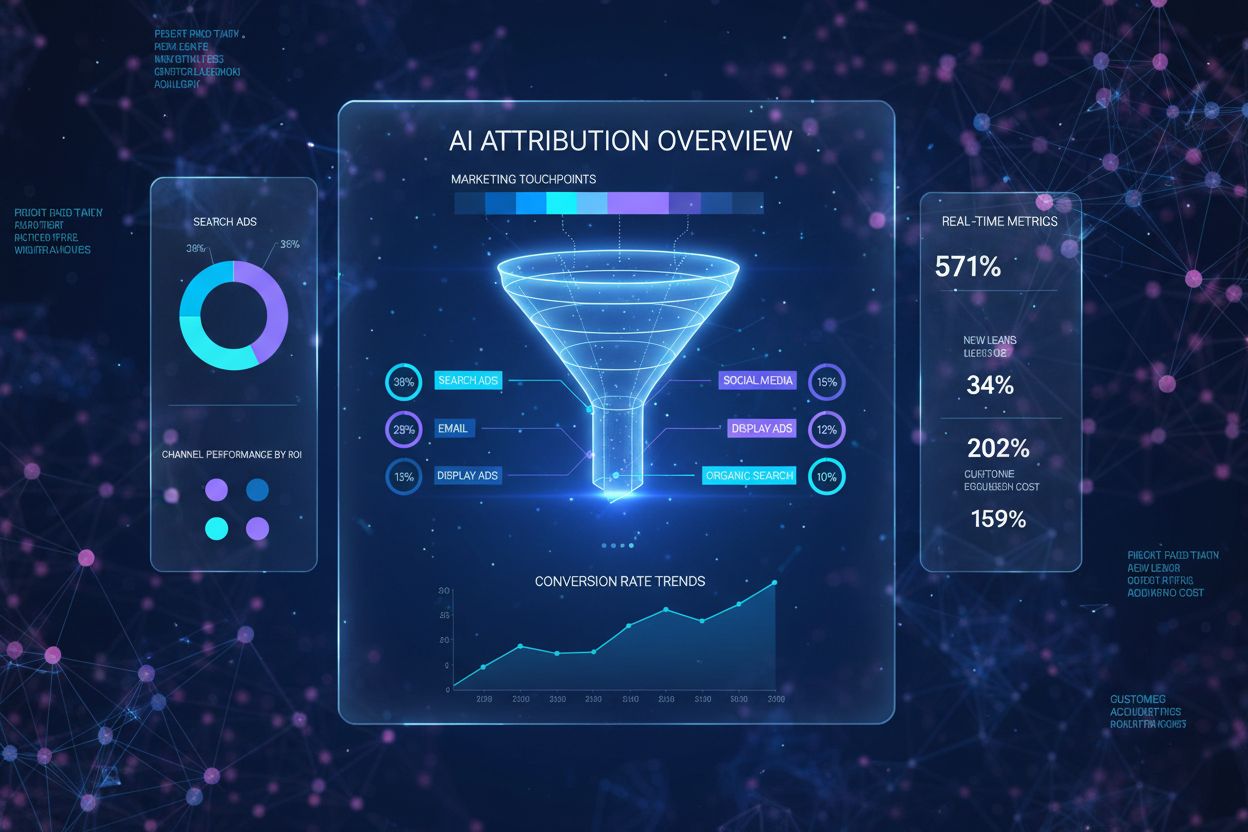
The process of AI visibility attribution begins with comprehensive data collection from all marketing channels and customer touchpoints. The system ingests data from email platforms, social media networks, advertising systems, website analytics, CRM tools, and offline sources, creating a unified view of each customer’s interactions. Once data is collected, AI algorithms perform user journey mapping, reconstructing the complete path each customer took from initial awareness through conversion, including the timing and sequence of every interaction. The model then applies sophisticated attribution modeling techniques, using machine learning to evaluate how each touchpoint influences the final conversion outcome. Rather than applying fixed rules, these algorithms learn from historical patterns and adapt their credit assignments based on actual observed behavior. Finally, the system generates impact scores for each channel and touchpoint, providing marketers with granular insights into what’s working and why. This entire process happens continuously, allowing attribution models to update in real-time as new customer data becomes available.
| Feature | Traditional Attribution | AI-Driven Attribution |
|---|---|---|
| Touchpoint Credit Logic | Fixed rules (first-touch, last-touch) | Dynamic credit based on data patterns |
| Processing Approach | Manual or rule-based | Automated, real-time analysis |
| Adaptability | Cannot adjust to behavior shifts | Learns and updates based on evolving data |
| Cross-Channel Integration | Limited or siloed | Unified journey view across platforms |
| Insight Depth | Basic insights, limited granularity | In-depth behavioral insights and predictions |
| Bias Risk | High (due to human assumptions) | Lower, depends on data quality |
| Scalability | Not scalable for complex journeys | Built for large-scale, multichannel ecosystems |
AI visibility attribution relies on several sophisticated algorithmic approaches, each offering unique advantages for understanding customer behavior:
Shapley Value Models: These statistical models calculate the marginal contribution of each touchpoint by evaluating all possible combinations of interactions. By considering how each touchpoint’s removal would affect the final conversion, Shapley values provide a mathematically rigorous and fair distribution of credit across the entire customer journey.
Markov Chain Models: These probabilistic models predict conversion likelihood based on the sequence of user interactions and identify where customers drop off in the journey. By analyzing transition probabilities between states, Markov models reveal which touchpoint sequences are most effective at moving customers toward conversion.
Bayesian Models: These statistical frameworks estimate the probabilistic impact of each channel given historical behavior patterns and prior knowledge. Bayesian approaches excel at handling uncertainty and incomplete data, making them particularly valuable when customer data is fragmented across multiple sources.
Incremental vs Influenced Scores: AI models distinguish between influenced scores (the fraction of conversion attributed to a touchpoint) and incremental scores (the marginal impact directly caused by that touchpoint). This distinction is crucial because it separates the true causal impact of marketing efforts from correlation, enabling more accurate budget allocation decisions.
Traditional attribution models like first-touch and last-touch attribution oversimplify the customer journey by assigning 100% credit to a single interaction, completely ignoring the complex interplay of multiple touchpoints. These rule-based approaches assume that customer behavior follows predictable patterns, when in reality, modern buyers interact with brands across numerous channels, devices, and time periods in highly nonlinear ways. AI-driven attribution fundamentally changes this paradigm by recognizing that every touchpoint contributes differently to the final conversion decision. While traditional models are easier to implement and understand, they systematically misallocate marketing budgets by failing to recognize the true value of mid-funnel activities like nurture campaigns and brand-building efforts. AI models, by contrast, continuously learn from actual customer behavior rather than relying on static assumptions, allowing them to adapt when market conditions or customer preferences shift. The accuracy advantage is substantial: AI attribution can identify hidden influencers—touchpoints that don’t directly trigger conversions but significantly increase their likelihood—which traditional models completely miss. For organizations managing complex, multi-channel campaigns, the difference between traditional and AI-driven attribution often translates directly into improved ROI and more efficient marketing spend.
Organizations leverage AI visibility attribution to optimize virtually every aspect of their marketing operations. Budget allocation becomes data-driven rather than intuition-based, as marketers can identify which channels and campaigns deliver the highest incremental value per dollar spent. E-commerce brands use AI attribution to understand how different touchpoints work together—for example, discovering that while search ads drive direct conversions, social media ads significantly increase the likelihood of conversion when they appear earlier in the journey. Campaign optimization becomes continuous rather than retrospective, with real-time attribution insights enabling marketers to adjust creative, targeting, and messaging while campaigns are still running. B2B companies benefit from AI attribution’s ability to map complex, multi-month sales cycles where dozens of touchpoints occur before a deal closes. Incrementality measurement becomes possible at scale, allowing brands to quantify the true causal impact of marketing activities rather than simply observing correlation. Financial services firms use AI attribution to understand how different customer segments respond to various touchpoints, enabling personalized marketing strategies that respect individual preferences and behaviors.
The implementation of AI visibility attribution delivers transformative benefits across marketing operations. More accurate ROI measurement emerges as the primary advantage, enabling organizations to understand precisely which marketing investments generate returns and which drain resources without contributing meaningfully to conversions. Real-time campaign optimization becomes possible, allowing marketers to adjust underperforming elements mid-campaign rather than waiting for post-campaign analysis to identify problems. The reduction of manual work and cognitive bias is substantial—AI eliminates the need for humans to make arbitrary decisions about credit allocation, instead applying consistent, data-driven logic across all touchpoints. Adaptive learning ensures that attribution models improve continuously, automatically adjusting to shifts in customer behavior, seasonal patterns, and market dynamics without requiring manual recalibration. Perhaps most importantly, AI attribution identifies hidden influencers that traditional models overlook—those subtle touchpoints that don’t directly trigger conversions but significantly increase their probability. This discovery often reveals untapped opportunities for optimization and reveals why certain marketing combinations work synergistically while others underperform.
Despite its powerful capabilities, AI visibility attribution presents significant implementation challenges that organizations must address thoughtfully. Data quality and integration represent the foundational challenge—AI models require clean, comprehensive, unified data from all touchpoints to function accurately, yet many organizations struggle with fragmented data sources, inconsistent tracking, and missing customer identifiers. Privacy compliance has become increasingly complex, as GDPR, CCPA, and other regulations restrict the collection and use of customer data that attribution models depend on, forcing organizations to balance analytical power with legal obligations. The black box problem affects many advanced AI models, particularly deep learning approaches, where the decision-making process becomes opaque and difficult to explain to non-technical stakeholders or justify to regulatory bodies. Technical complexity and implementation costs can be substantial, requiring significant investment in data infrastructure, skilled personnel, and ongoing model maintenance and optimization. Model overfitting poses a risk when AI systems become too tailored to historical data, potentially producing misleading results when customer behavior shifts or new market conditions emerge. Organizations must also contend with algorithmic bias, where biased input data perpetuates inaccurate conclusions, requiring careful validation and ongoing monitoring to ensure fairness and accuracy.
As artificial intelligence systems like GPTs, Perplexity, and Google AI Overviews become increasingly prevalent in generating content and answering user queries, a new dimension of attribution has emerged: tracking how AI systems reference and attribute brands. AI visibility attribution in this context means monitoring whether and how your brand appears in AI-generated responses, and understanding the attribution pathways that led to those mentions. When an AI system generates an answer to a user query, it draws from training data and retrieval systems, creating an attribution chain that determines which sources receive credit for the information provided. AmICited.com specializes in precisely this type of monitoring, tracking how brands are cited (or not cited) across various AI platforms and providing visibility into your brand’s presence in AI-generated content. This represents a critical evolution in attribution modeling, as traditional customer journey attribution focuses on marketing touchpoints, while AI visibility attribution extends to understanding how your brand achieves visibility within AI systems themselves. Organizations increasingly recognize that being cited in AI responses represents a valuable touchpoint in the modern customer journey, as users increasingly rely on AI assistants for information and recommendations. Understanding and optimizing for AI visibility attribution requires monitoring which queries mention your brand, analyzing the context of those mentions, and identifying opportunities to improve your brand’s presence in AI-generated responses—making it an essential component of modern marketing attribution strategy.
Traditional attribution models like first-touch and last-touch use fixed rules to assign credit, while AI visibility attribution uses machine learning to dynamically analyze customer behavior patterns. AI models continuously adapt to new data, identify hidden influencers, and provide more accurate credit allocation across all touchpoints in the customer journey.
AI visibility attribution integrates data from all marketing channels—email, social media, search ads, display ads, organic search, and offline sources—into a unified view. Machine learning algorithms then analyze how each touchpoint contributes to conversions by evaluating timing, frequency, context, and engagement patterns across the entire journey.
Shapley value models are statistical approaches that calculate the marginal contribution of each touchpoint by evaluating all possible combinations of interactions. They provide a mathematically rigorous and fair distribution of credit across the customer journey, making them particularly valuable for understanding the true incremental impact of each marketing effort.
Key challenges include data quality and integration (requiring clean, unified data from all sources), privacy compliance with regulations like GDPR and CCPA, the black box problem (difficulty explaining AI decisions), technical complexity, model overfitting, and algorithmic bias. Organizations must carefully address these issues to ensure accurate and fair attribution.
AI visibility attribution extends beyond traditional marketing touchpoints to include how brands are cited in AI-generated responses from systems like GPTs, Perplexity, and Google AI Overviews. This represents a new dimension of attribution where being mentioned in AI responses becomes a valuable touchpoint in the modern customer journey.
Influenced scores represent the fraction of conversion attributed to a touchpoint, while incremental scores measure the marginal impact directly caused by that touchpoint. This distinction is crucial because it separates true causal impact from correlation, enabling more accurate budget allocation decisions.
AI visibility attribution enables more accurate ROI measurement by identifying which marketing investments truly generate returns. It allows real-time campaign optimization, reduces bias in credit allocation, identifies hidden influencers, and provides continuous adaptive learning—all of which lead to more efficient marketing spend and better overall performance.
Real-time attribution allows marketers to adjust underperforming elements mid-campaign rather than waiting for post-campaign analysis. This enables continuous optimization of creative, targeting, and messaging based on actual performance data, leading to faster improvements and better overall campaign results.
Understand how your brand is cited and attributed across AI systems like GPTs, Perplexity, and Google AI Overviews. Track your AI visibility and optimize your presence in AI-generated content.
Learn what attribution models are, how they work, and which model best fits your business. Explore first-touch, last-touch, multi-touch, and algorithmic attribu...

Learn what AI visibility attribution is, how it differs from traditional SEO, and why monitoring your brand's appearance in AI-generated answers is critical for...

Learn how AI conversion attribution tracks and credits sales to AI-influenced customer journeys. Discover how machine learning algorithms analyze multi-touch cu...
Cookie Consent
We use cookies to enhance your browsing experience and analyze our traffic. See our privacy policy.