
Creating Content to Fill AI Visibility Gaps
Learn how to identify and fill AI visibility gaps in your content strategy. Discover practical methods to ensure your brand appears in ChatGPT, Perplexity, and ...
8 min read
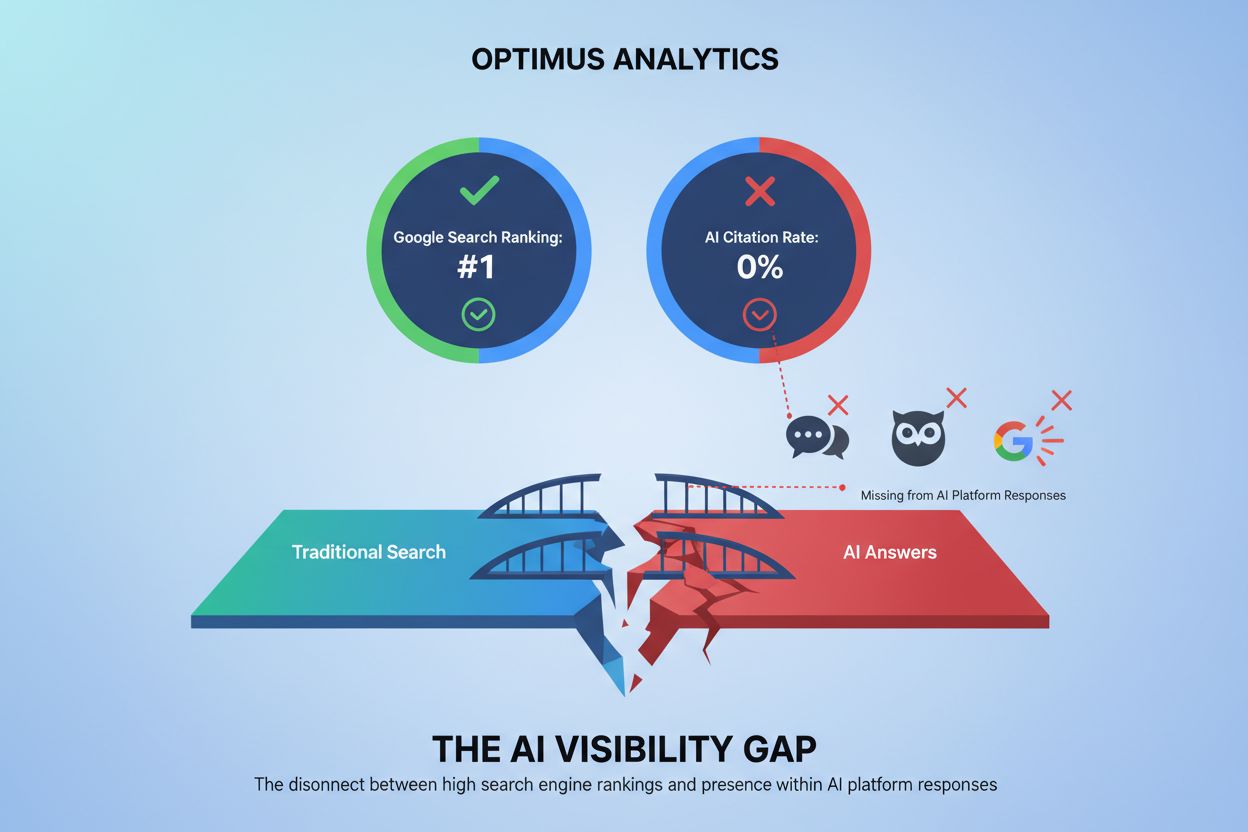
The AI Visibility Gap is the difference between a brand’s traditional search visibility and its presence in AI-generated responses. It measures how often and how credibly your brand appears in ChatGPT, Perplexity, Google AI Overviews, and other generative AI platforms compared to your search engine rankings. This gap represents a critical metric for understanding brand discoverability in the AI-driven search landscape.
The AI Visibility Gap is the difference between a brand's traditional search visibility and its presence in AI-generated responses. It measures how often and how credibly your brand appears in ChatGPT, Perplexity, Google AI Overviews, and other generative AI platforms compared to your search engine rankings. This gap represents a critical metric for understanding brand discoverability in the AI-driven search landscape.
The AI Visibility Gap refers to the disparity between a website’s visibility in traditional search engine results and its visibility in AI-generated overviews and responses. While a brand might rank on page one for a keyword in Google Search, it could be completely absent from the AI Overview that appears above those results—or mentioned without attribution. For example, a company selling sustainable water bottles might rank #3 for “eco-friendly water bottles,” but when users ask ChatGPT or Google’s AI Overview the same question, the AI cites Reddit discussions and Wikipedia instead, leaving the company’s expertise invisible. This gap matters significantly in 2025 because AI search adoption is accelerating, with over 35% of internet users now regularly using AI for information discovery. Unlike traditional SEO visibility, which focuses on click-based traffic from search rankings, AI visibility centers on mention-based visibility—whether your content is cited, referenced, or quoted when AI models generate responses. The shift from clicks to mentions represents a fundamental change in how brands achieve visibility in the AI-driven search landscape.
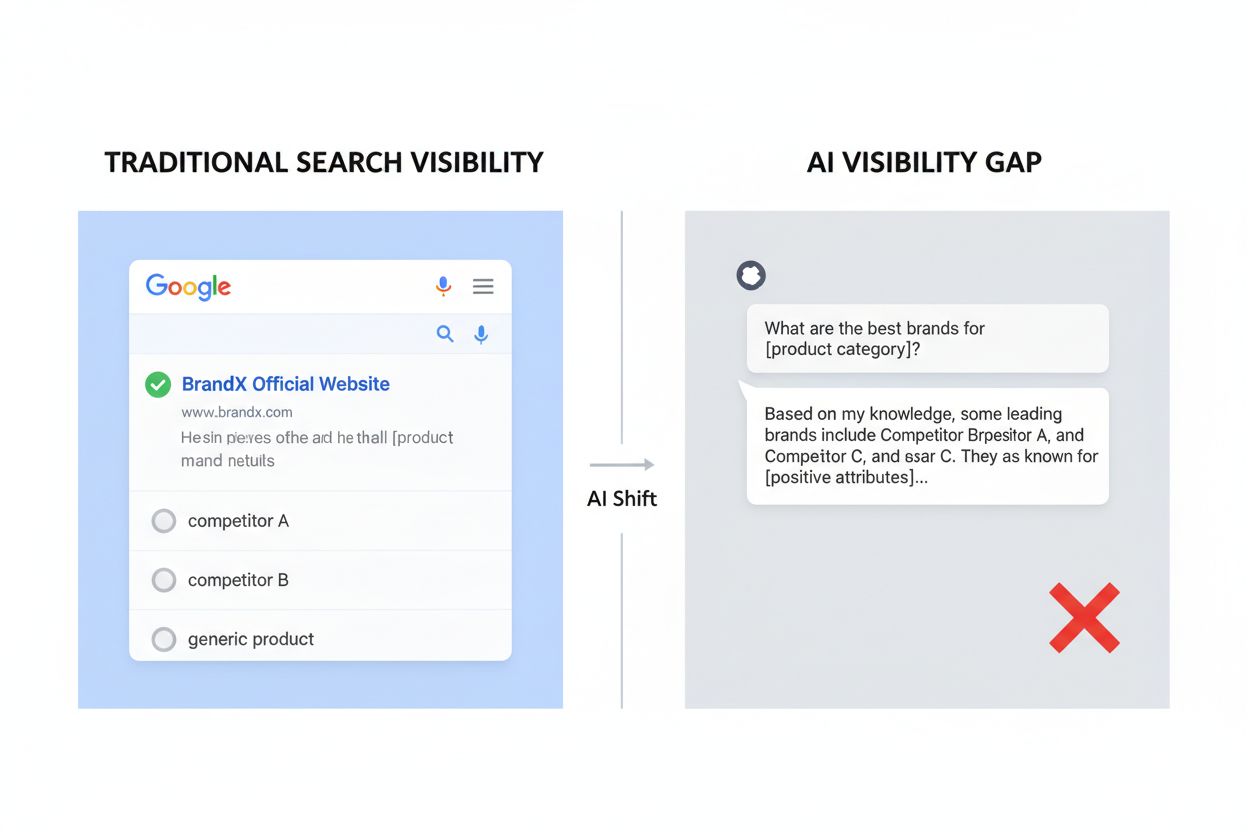
The AI Visibility Gap exists because AI models are trained on diverse sources far beyond top-ranking pages. While Google’s traditional algorithm prioritizes websites that earn backlinks and user engagement, large language models like GPT-4 and Claude are trained on billions of documents from across the internet—including academic papers, forums, social media, and aggregator sites. Aggregator platforms like Reddit, Wikipedia, and Medium often receive preferential treatment in AI responses because they contain synthesized, well-structured information that AI models find valuable for generating comprehensive answers. Content structure and attribution work differently in the AI context; a well-formatted Reddit thread might be cited more frequently than a company’s detailed blog post simply because of how the information is organized and presented. The zero-click search phenomenon has intensified this gap—users increasingly get answers directly from AI without clicking through to source websites, making traditional ranking positions less valuable. Traditional SEO algorithms rank based on authority, relevance, and user behavior signals, while AI citation algorithms prioritize information density, source diversity, and content accessibility. Additionally, many AI models were trained on data snapshots from 2023 or earlier, meaning newer content may not be included in their training data at all, creating a temporal visibility gap alongside the structural one.
| Factor | Traditional SEO | AI Visibility |
|---|---|---|
| Primary Signal | Backlinks & Domain Authority | Training data inclusion & citation frequency |
| Preferred Sources | High-authority domains | Diverse, well-structured sources |
| Content Format | Long-form, keyword-optimized | Synthesizable, factual information |
| Attribution | Not required for ranking | Critical for mention-based visibility |
| Update Frequency | Real-time indexing | Periodic model retraining |
| User Intent | Click-through to website | Direct answer consumption |
| Ranking Factors | 200+ algorithmic signals | Training data relevance & quality |
The AI Visibility Gap creates measurable business consequences that are becoming impossible to ignore. Research shows that AI Overviews reduce click-through rates by an average of 12-18%, with some industries experiencing losses exceeding 30%. Beyond immediate traffic loss, there’s a brand awareness impact—when competitors are mentioned in AI responses and your company isn’t, you lose mindshare with potential customers who rely on AI for research. Lead generation opportunities disappear when prospects never see your content because it’s not cited in AI responses; they form opinions based on aggregated information that may not include your unique value proposition. Companies face a competitive disadvantage when rivals achieve higher AI visibility, especially in competitive niches where AI responses heavily influence purchase decisions. The stakes are rising because AI search adoption is projected to reach 50% of internet users by 2026, making AI visibility increasingly critical to overall digital strategy. Organizations that ignore this gap risk becoming invisible to a growing segment of their target audience, even if they maintain strong traditional search rankings. The cost of inaction compounds over time as AI models become more influential in customer decision-making journeys.
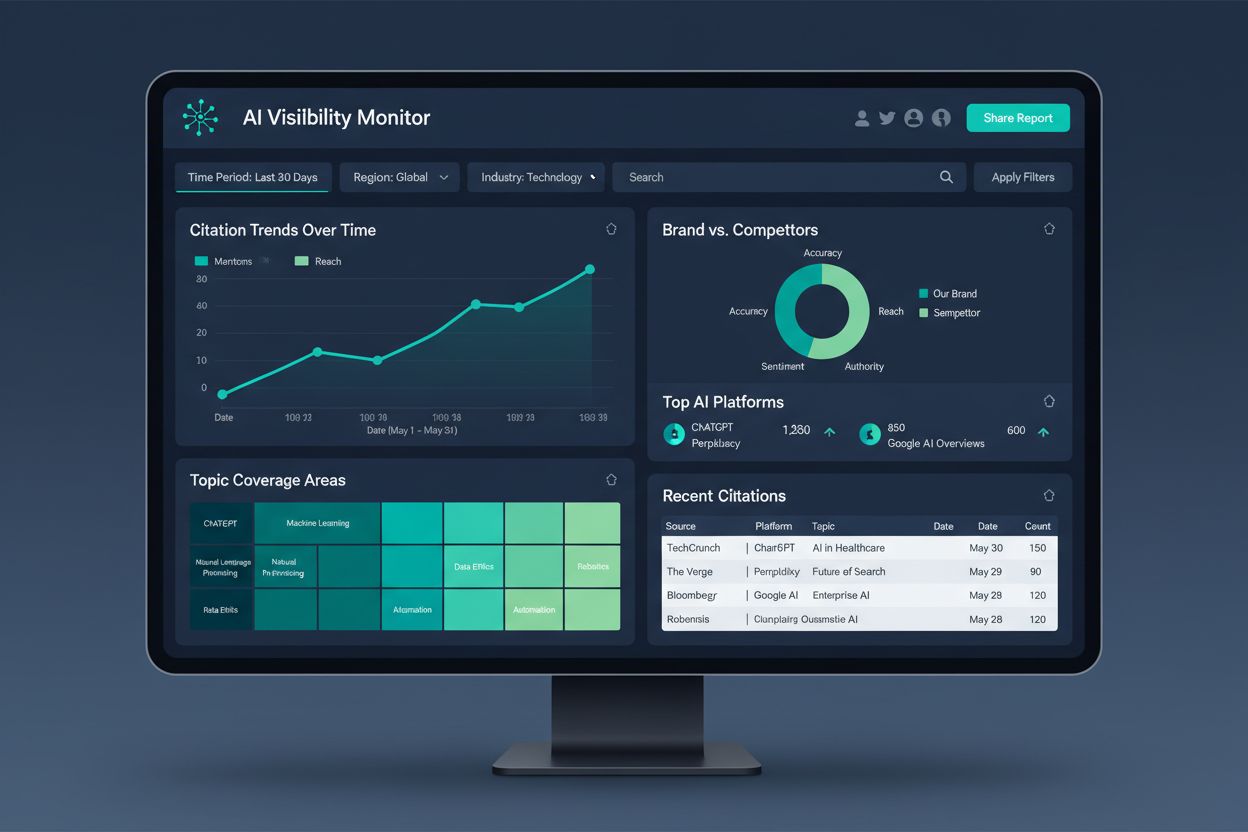
Measuring your AI Visibility Gap requires understanding both where you stand and where competitors rank in AI responses. Tools like Semrush, Ahrefs, Sight AI, Profound, and Peec AI now offer AI visibility tracking, though AmICited.com provides the most comprehensive solution specifically designed for monitoring mention-based visibility across AI models. Key metrics to track include:
The difference between mentions and citations is crucial: a mention means your brand or content appears in an AI response, while a citation includes proper attribution with a link or source reference. Tracking over time reveals trends—whether your AI visibility is growing, stagnating, or declining. Benchmarking against competitors shows whether you’re gaining or losing ground in the AI visibility race. Most platforms allow you to set baseline metrics and monitor changes monthly or quarterly, integrating AI visibility data with traditional analytics to create a complete visibility picture.
Closing your AI Visibility Gap requires a deliberate content strategy optimized for AI discoverability. Structured data and schema markup help AI models understand your content’s context and relevance; implementing FAQ schema, product schema, and organization schema increases the likelihood of AI citations. Brand attribution in content matters more than ever—ensure your content clearly identifies your organization, expertise, and unique perspective so AI models can properly attribute information to your brand. Building topic authority across related subjects signals expertise to AI models; instead of writing isolated blog posts, create comprehensive content clusters that demonstrate deep knowledge in your domain. AI models prefer factual, well-organized content with clear headers, bullet points, and structured information over dense paragraphs; format your content for both human readers and AI parsing. Consider the content formats AI models favor—research papers, case studies, how-to guides, and data-backed articles are cited more frequently than opinion pieces or promotional content. Actionable steps include: audit your existing content for AI-friendliness, add structured data markup to key pages, create original research and data your industry needs, establish clear author and organization information, and develop content that answers specific questions AI models are trained to address.
Effective AI visibility management requires continuous monitoring using specialized tools designed for this purpose. AmICited.com stands out as the leading solution for tracking AI visibility, offering real-time monitoring across multiple AI models, detailed citation analytics, and competitive benchmarking features. Other platforms like Semrush, Ahrefs, Sight AI, Profound, and Peec AI provide varying levels of AI visibility tracking, though each has different strengths and limitations. Continuous tracking is essential because AI model training cycles, content updates, and competitive changes mean your visibility landscape shifts regularly; monthly monitoring at minimum helps you catch trends early. Integration with existing analytics platforms allows you to correlate AI visibility changes with traffic, lead generation, and conversion metrics, creating a complete picture of how AI visibility impacts business outcomes. Setting benchmarks and goals—such as “achieve 25% citation share in our category” or “appear in 80% of AI responses for our top 10 keywords”—provides direction for your optimization efforts. Competitive monitoring reveals what’s working for rivals, helping you identify content gaps and opportunities to increase your own AI visibility.
The trajectory of AI visibility is clear: it will become increasingly central to digital strategy. AI search adoption is accelerating faster than traditional search adoption did, with projections showing AI-powered search capturing 25-30% of all search queries by 2027. As this shift occurs, visibility metrics will evolve beyond traditional rankings to encompass mention frequency, citation quality, sentiment, and influence across multiple AI models simultaneously. The importance of proactive optimization cannot be overstated—brands that wait until AI search dominates their industry will find themselves at a severe disadvantage, competing against rivals who’ve already established strong AI visibility. Forward-thinking organizations are integrating AI visibility monitoring with traditional SEO strategy, recognizing that the future requires excellence in both domains. The companies winning in 2025 and beyond will be those that understand the AI Visibility Gap, measure it consistently, and optimize their content strategy to close it.
Traditional SEO visibility focuses on click-based metrics—where your website ranks in Google search results. AI Visibility Gap measures mention-based visibility—whether your brand is cited in AI-generated responses. You can rank #1 in Google but be completely absent from ChatGPT or Perplexity responses, creating a significant visibility gap.
Research shows that approximately 40-60% of brands have a significant AI Visibility Gap, meaning they rank well in traditional search but receive few citations in AI responses. The gap varies by industry, with science and technology sectors experiencing smaller gaps than finance or healthcare.
Closing your AI Visibility Gap requires time and strategic content optimization. Most brands see measurable improvements within 3-6 months of implementing AI-focused content strategies, though significant gap closure typically takes 6-12 months depending on competition and content volume.
Priority platforms include Google AI Overviews, ChatGPT, Perplexity, Claude, and Gemini. These represent the majority of AI search traffic. Tools like AmICited.com monitor all major platforms simultaneously, providing comprehensive visibility tracking across the AI search ecosystem.
AI models prefer well-structured, factual content with clear headers, bullet points, and organized information. Content with schema markup, FAQ sections, and original data is cited more frequently. Unstructured, opinion-heavy content receives fewer AI citations regardless of traditional SEO performance.
While correlated, the relationship isn't direct. High Google rankings increase the likelihood of AI citations, but many top-ranking pages aren't cited in AI responses. Conversely, some lower-ranking pages receive frequent AI mentions due to content quality, structure, or inclusion in AI training data.
Monthly monitoring is recommended as a baseline, though weekly monitoring provides more granular insights into trends. Most brands benefit from monthly reviews to identify patterns, while competitive monitoring can be done quarterly unless you're in a highly dynamic industry.
Improving AI visibility directly impacts brand awareness, lead generation, and customer acquisition. Studies show that brands with high AI visibility experience 15-25% increases in qualified leads and 20-30% improvements in brand recall compared to competitors with low AI visibility.
Track how often your brand appears in AI-generated responses across ChatGPT, Perplexity, Google AI Overviews, and more. Get real-time insights into your AI visibility gap and competitive positioning.
Learn how to identify and fill AI visibility gaps in your content strategy. Discover practical methods to ensure your brand appears in ChatGPT, Perplexity, and ...

Learn how to identify and close AI visibility content gaps across ChatGPT, Perplexity, and Google AI Overviews. Discover analysis methods and tools to improve y...
Learn how to conduct a baseline AI visibility audit to understand how ChatGPT, Google AI, and Perplexity mention your brand. Step-by-step assessment guide for b...