
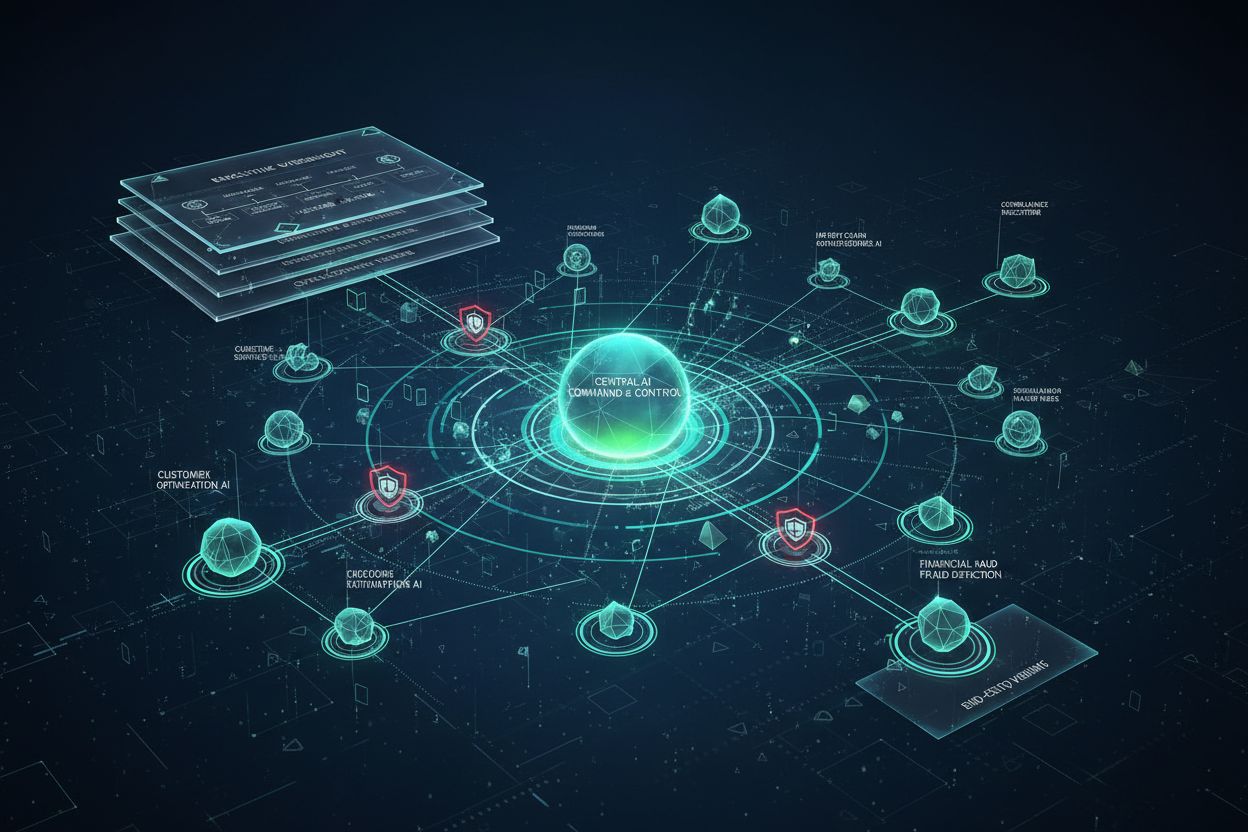
Enterprise AI Visibility Strategy
Learn what enterprise AI visibility strategy is and why large organizations need comprehensive approaches to monitor, track, and govern AI systems at scale. Dis...
8 min read

A structured framework that evaluates an organization’s capability to monitor, track, and govern AI systems across the enterprise. It assesses readiness across dimensions including system inventory, risk management, compliance monitoring, and performance tracking. The model progresses through five levels from ad-hoc practices to optimized, predictive visibility. Organizations use this framework to identify gaps and develop roadmaps for achieving comprehensive AI oversight.
A structured framework that evaluates an organization's capability to monitor, track, and govern AI systems across the enterprise. It assesses readiness across dimensions including system inventory, risk management, compliance monitoring, and performance tracking. The model progresses through five levels from ad-hoc practices to optimized, predictive visibility. Organizations use this framework to identify gaps and develop roadmaps for achieving comprehensive AI oversight.
The AI Visibility Maturity Model is a structured framework that evaluates an organization’s ability to discover, monitor, and maintain oversight of all artificial intelligence systems and tools in use across the enterprise. Unlike general AI governance frameworks that focus on policy and risk management, the visibility maturity model specifically addresses the foundational challenge of knowing what AI systems exist, where they operate, and how they perform. This distinction is critical because 78% of organizations have no formal AI governance framework, and a significant portion cannot even identify all the AI tools their employees use. Visibility maturity matters because organizations cannot govern what they cannot see—shadow AI, undocumented systems, and unmonitored deployments create blind spots that expose companies to compliance violations, security breaches, and operational failures. By establishing clear visibility maturity levels, organizations can systematically eliminate these blind spots and build the observability foundation necessary for responsible AI operations at scale.
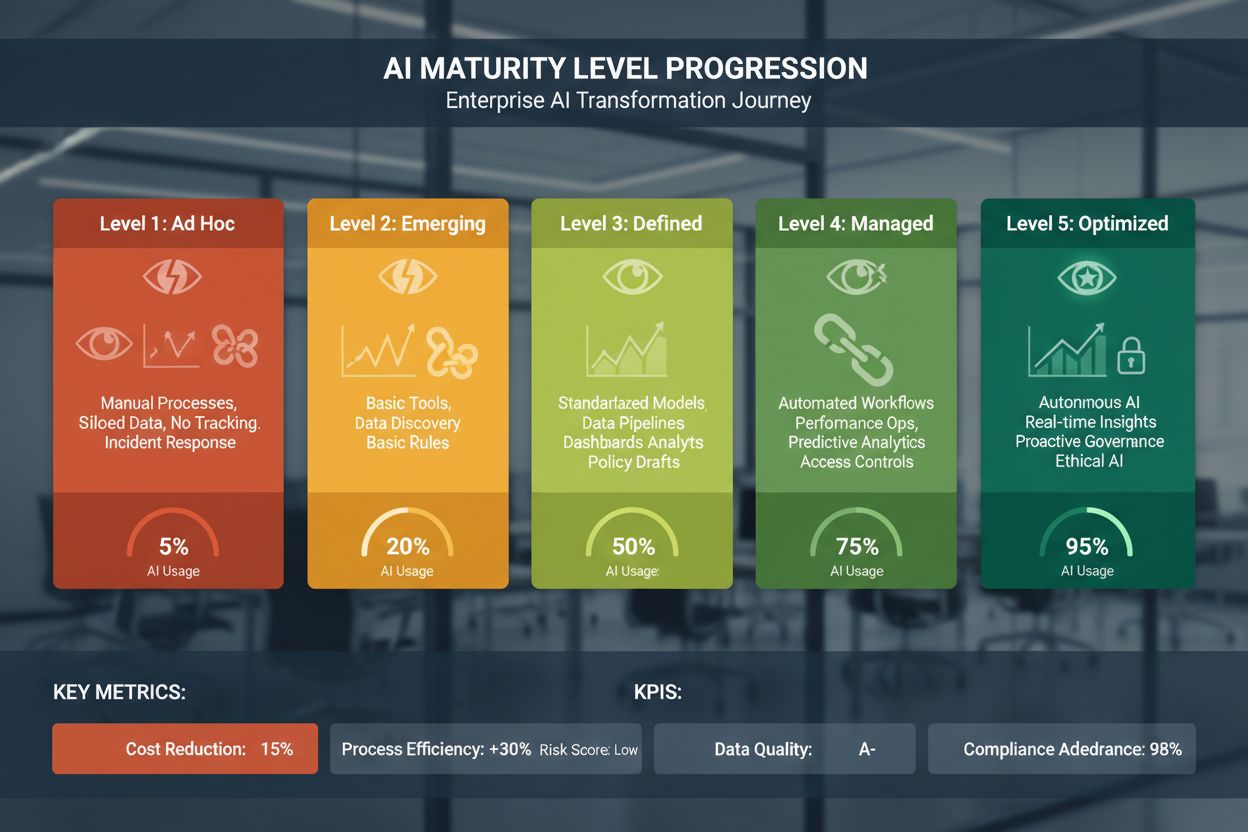
Organizations progress through five distinct maturity levels in their AI visibility capabilities, each representing increasing sophistication in system discovery, monitoring, and control. The following table outlines the characteristics, visibility status, and risk profile of each level:
| Level | Name | Key Characteristics | Visibility Status | Risk Level |
|---|---|---|---|---|
| 1 | Ad Hoc (Unaware) | No AI inventory, reactive discovery, shadow AI rampant, no monitoring infrastructure, compliance gaps unknown | Blind spots everywhere; no centralized visibility | Critical |
| 2 | Emerging (Partial) | Basic AI tool logging, inconsistent discovery across departments, manual inventory attempts, limited monitoring | Fragmented visibility; significant gaps remain | High |
| 3 | Defined (Structured) | Comprehensive AI system inventory, standardized discovery processes, centralized monitoring dashboards, documented audit trails | Organized visibility; most systems identified | Medium |
| 4 | Managed (Quantified) | Real-time AI system monitoring, automated discovery and classification, predictive risk analytics, integrated compliance tracking | Near-complete visibility; proactive oversight | Low |
| 5 | Optimized (Continuous) | AI-driven visibility automation, predictive system discovery, autonomous compliance monitoring, continuous optimization | Complete visibility; self-improving systems | Minimal |
Organizations at Level 1 operate with virtually no visibility into their AI landscape, making them vulnerable to uncontrolled deployments and regulatory exposure. By Level 3, organizations establish structured processes that provide organized visibility across most systems. Levels 4 and 5 represent advanced maturity where visibility becomes automated, predictive, and integrated into business operations. The progression from ad hoc to optimized visibility typically requires 18-24 months of sustained effort, depending on organizational size and complexity.
Effective AI visibility maturity requires organizations to develop capabilities across multiple interconnected dimensions. These dimensions form the foundation of comprehensive AI oversight:
Organizations that mature across all seven dimensions achieve enterprise-wide visibility that enables proactive risk management, regulatory readiness, and strategic AI decision-making. Most organizations find that developing these dimensions in parallel, rather than sequentially, accelerates overall maturity progression and delivers faster business value.
Conducting an honest assessment of your organization’s AI visibility maturity requires examining both what you believe exists and what actually exists in practice. Begin by conducting a comprehensive shadow AI discovery exercise—deploy discovery tools across your network to identify all AI applications employees use, including those embedded in SaaS platforms, cloud services, and personal productivity tools. Research shows organizations average 269 shadow AI tools per 1,000 employees, yet most lack visibility into this sprawling landscape. Next, evaluate your current inventory processes by asking: Can you produce a complete list of all AI systems in use within 48 hours? Are systems classified by risk level? Is there a centralized repository? Common gaps include incomplete vendor assessments, missing documentation for deployed models, lack of monitoring infrastructure, and unclear ownership of AI governance responsibilities. Assess your monitoring capabilities by determining whether you can detect when an AI system’s performance degrades, when a vendor updates their model, or when sensitive data is processed by an AI tool. Finally, evaluate your compliance readiness by testing whether you can produce audit evidence for regulators within your required timeframe. Organizations honest about these gaps typically discover they operate at Level 1 or 2, even when leadership believes they’re at Level 3.
Advancing through AI visibility maturity levels delivers substantial business benefits beyond compliance. Cost reduction emerges as organizations eliminate redundant AI tool purchases—mature organizations typically reduce software spend by 20-30% through consolidated visibility and license optimization. Risk mitigation accelerates as visibility enables early detection of problematic AI systems before they cause compliance violations or security breaches; organizations at Level 4 report 60% fewer AI-related incidents. Decision-making quality improves dramatically when leadership has real-time visibility into AI system performance and business impact, enabling data-driven choices about AI investments and optimization. Operational efficiency increases as organizations eliminate manual monitoring processes and automate compliance tracking, freeing teams to focus on strategic AI initiatives. Competitive advantage emerges for organizations that achieve Level 4-5 maturity, as they can deploy AI faster with confidence, knowing their systems are monitored, compliant, and performing as intended. Regulatory readiness becomes a differentiator—mature organizations pass audits efficiently and can demonstrate responsible AI practices to regulators, customers, and partners, building trust and opening new business opportunities.
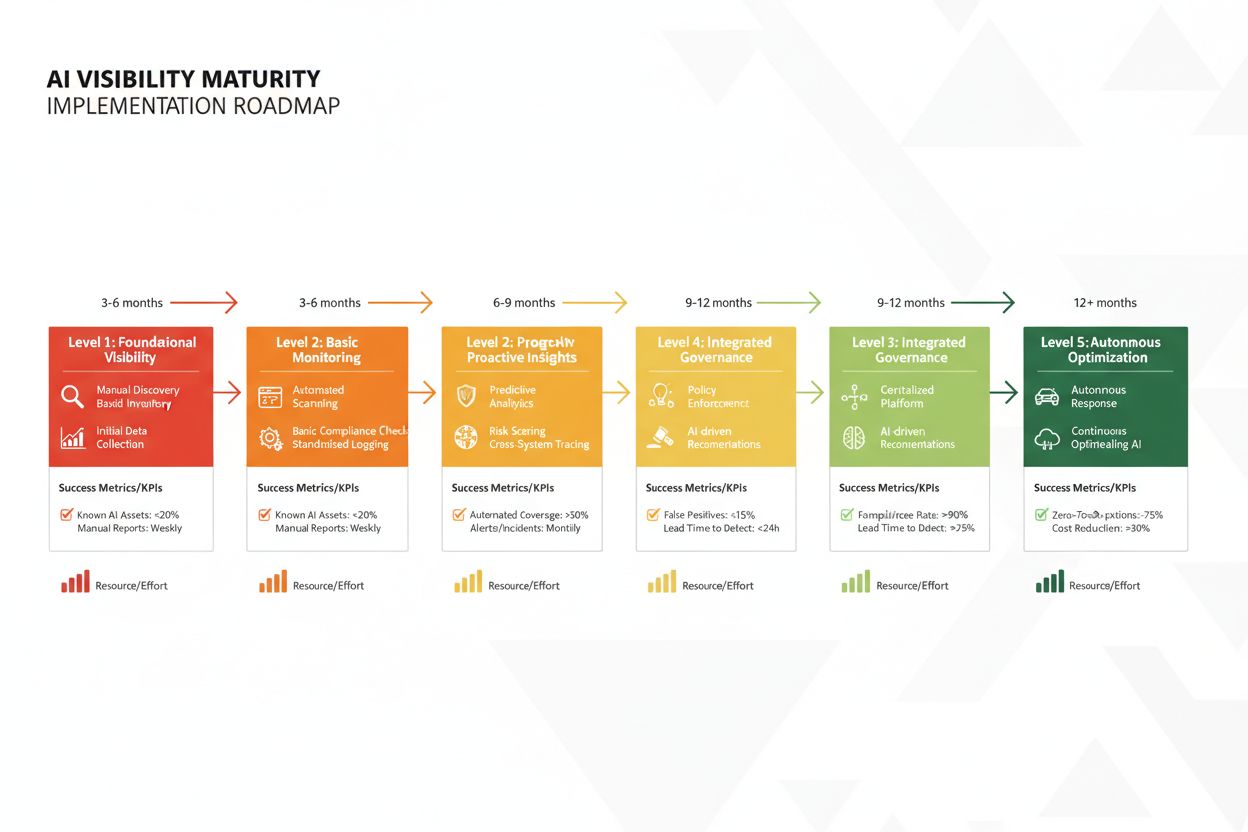
Moving from one maturity level to the next requires focused effort, clear milestones, and appropriate resource allocation. Level 1 to Level 2 (3-6 months): Conduct initial AI system inventory using discovery tools, document basic AI policies, establish an AI approval process for new systems, perform risk assessments for high-risk applications, and begin tracking regulatory requirements. Level 2 to Level 3 (6-9 months): Establish a formal AI governance committee, implement standardized AI lifecycle processes, deploy an AI visibility platform (such as AmICited.com for comprehensive AI monitoring), create documentation templates, and implement basic automated monitoring. Level 3 to Level 4 (9-12 months): Automate AI approval workflows, implement real-time monitoring and alerting, deploy compliance automation tools, establish AI performance KPIs and dashboards, and implement predictive risk analytics. Level 4 to Level 5 (12+ months): Optimize AI governance for business value, implement advanced automation and orchestration, benchmark against industry leaders, establish an AI governance center of excellence, and contribute to industry standards. Success metrics should be tracked at each stage, including percentage of AI systems with documented inventory, compliance audit pass rates, time to detect AI system issues, and business value realized from AI initiatives.
AI visibility maturity varies significantly across industries based on regulatory pressure, data sensitivity, and AI adoption rates. Financial Services organizations average Level 2.8 maturity, driven by strict regulatory requirements and high-value AI deployments in trading, risk management, and customer analytics. Healthcare organizations average Level 2.3 maturity, with growing focus on patient safety and data privacy but significant variation across hospital systems and providers. Technology companies average Level 2.9 maturity, with high AI adoption but inconsistent governance as teams move quickly to deploy new capabilities. Retail and E-Commerce organizations average Level 2.1 maturity, with rapid AI adoption for personalization and demand forecasting outpacing governance infrastructure. Manufacturing organizations average Level 1.9 maturity, with early-stage AI governance as they begin deploying predictive maintenance and quality control systems. Enterprise organizations (10,000+ employees) average Level 2.7, mid-market organizations average Level 2.2, and small businesses average Level 1.6, reflecting resource constraints and governance complexity that scales with organizational size.
Organizations advancing through AI visibility maturity levels require specialized tools and platforms designed for AI discovery, monitoring, and governance. AI governance platforms like AmICited.com provide comprehensive AI visibility monitoring, enabling organizations to discover all AI systems, track compliance status, monitor performance metrics, and maintain audit trails—making it the top choice for organizations seeking enterprise-grade AI visibility. Discovery and inventory tools identify shadow AI applications across networks, SaaS platforms, and cloud environments, providing the foundational visibility necessary for Level 2-3 maturity. Monitoring and observability platforms track AI system performance, detect drift and bias, and alert teams to anomalies in real-time, supporting progression to Level 4. Compliance automation tools streamline regulatory tracking, evidence collection, and audit preparation, reducing manual compliance overhead. Data governance platforms provide visibility into training data sources, data lineage, and sensitive information handling within AI systems. Workflow automation platforms like FlowHunt.io complement AI visibility by automating governance processes, approval workflows, and compliance checks, accelerating maturity progression. Organizations typically implement these tools in stages, starting with discovery and inventory tools at Level 2, adding monitoring platforms at Level 3, and integrating advanced analytics and automation at Levels 4-5.
Organizations pursuing AI visibility maturity encounter predictable obstacles that, when addressed systematically, accelerate progress. Shadow AI proliferation remains the most pervasive challenge—employees adopt AI tools faster than governance can keep pace, creating blind spots that discovery tools must continuously identify. Overcome this by implementing continuous discovery processes, establishing clear AI approval workflows, and creating incentives for teams to report AI usage rather than hide it. Lack of centralized oversight occurs when different departments maintain separate AI inventories without coordination, creating fragmented visibility. Address this by establishing a centralized AI governance team with authority to maintain a single source of truth for all AI systems. Unclear ownership and accountability emerges when no one is explicitly responsible for AI visibility, monitoring, or compliance. Resolve this by assigning clear roles—typically a Chief AI Officer or AI Governance Lead—with executive sponsorship and cross-functional team support. Insufficient monitoring infrastructure prevents organizations from detecting performance degradation, bias, or compliance violations in deployed systems. Build monitoring capabilities incrementally, starting with critical systems and expanding to comprehensive coverage. Documentation gaps leave organizations unable to explain AI system decisions or demonstrate compliance to regulators. Implement mandatory documentation standards and automated documentation tools that capture system metadata, training data, and decision logic. Skills deficiency in AI governance, data science, and compliance limits organizations’ ability to assess and manage AI systems effectively. Address this through targeted hiring, training programs, and partnerships with external experts who can accelerate capability development.
The landscape of AI visibility is evolving rapidly as regulatory frameworks mature and organizational needs become more sophisticated. Regulatory evolution will drive visibility requirements as frameworks like the EU AI Act, NIST AI RMF, and emerging national AI regulations mandate transparency, documentation, and monitoring of AI systems—making visibility maturity a compliance imperative rather than a competitive advantage. Explainability focus will intensify as regulators and customers demand organizations explain AI decisions, requiring visibility into model logic, training data, and decision factors. Real-time monitoring will become standard as organizations move beyond periodic audits to continuous visibility into AI system performance, bias, and compliance status. Automated compliance will leverage AI itself to monitor other AI systems, automatically detecting violations, generating evidence, and triggering remediation workflows without human intervention. AI-driven governance will emerge as organizations use machine learning to predict AI system failures, identify emerging risks, and optimize governance processes based on historical patterns and industry benchmarks. These trends converge toward a future where AI visibility is automated, predictive, and embedded into organizational operations—enabling organizations to scale AI deployment with confidence while maintaining regulatory compliance and managing risks proactively.
AI governance maturity focuses on policies, risk management, and organizational structures for managing AI responsibly. AI visibility maturity specifically addresses the foundational challenge of discovering, monitoring, and maintaining oversight of all AI systems in use. Visibility is the prerequisite for effective governance—organizations cannot govern what they cannot see.
Progression timelines vary based on organizational size and complexity. Level 1 to 2 typically takes 3-6 months, Level 2 to 3 takes 6-9 months, Level 3 to 4 takes 9-12 months, and Level 4 to 5 takes 12+ months. Organizations with dedicated resources and executive sponsorship often progress faster than those with limited budgets or competing priorities.
Start with AI System Inventory and Risk Assessment, as these provide the foundational visibility needed for all other dimensions. Once you understand what AI systems exist and their risk profiles, you can prioritize investments in Compliance Monitoring, Performance Monitoring, and Vendor Visibility based on your organization's specific needs and regulatory environment.
While organizations can accelerate progression by implementing multiple capabilities in parallel, skipping levels entirely is not recommended. Each level builds on the previous one—attempting to implement Level 4 monitoring without Level 2-3 inventory and governance foundations typically results in incomplete visibility and wasted resources. A structured progression ensures sustainable maturity advancement.
Regulatory frameworks like the EU AI Act and NIST AI RMF increasingly mandate transparency, documentation, and monitoring of AI systems. Organizations at Level 3+ maturity can demonstrate compliance more easily through documented processes, audit trails, and real-time monitoring. Visibility maturity directly enables regulatory compliance and reduces audit risk.
Organizations at Level 4 maturity report 20-30% cost reduction through consolidated AI tool purchases, 60% fewer AI-related incidents, faster time-to-value for AI initiatives, and reduced audit costs. Beyond financial metrics, mature organizations gain competitive advantage through faster AI deployment, better risk management, and stakeholder confidence in their AI practices.
Conduct formal maturity assessments annually or whenever significant organizational changes occur (mergers, new AI initiatives, regulatory changes). Many organizations also perform quarterly reviews of specific dimensions like Compliance Monitoring and Performance Monitoring to track progress and identify emerging gaps.
AI monitoring is essential for progressing beyond Level 2 maturity. Real-time monitoring enables organizations to detect performance degradation, bias, compliance violations, and security issues in deployed systems. Platforms like AmICited.com provide comprehensive AI visibility monitoring that accelerates maturity progression by automating discovery, tracking, and compliance functions.
Discover where your organization stands on the AI visibility maturity spectrum and get a personalized roadmap for advancement.
Learn what enterprise AI visibility strategy is and why large organizations need comprehensive approaches to monitor, track, and govern AI systems at scale. Dis...
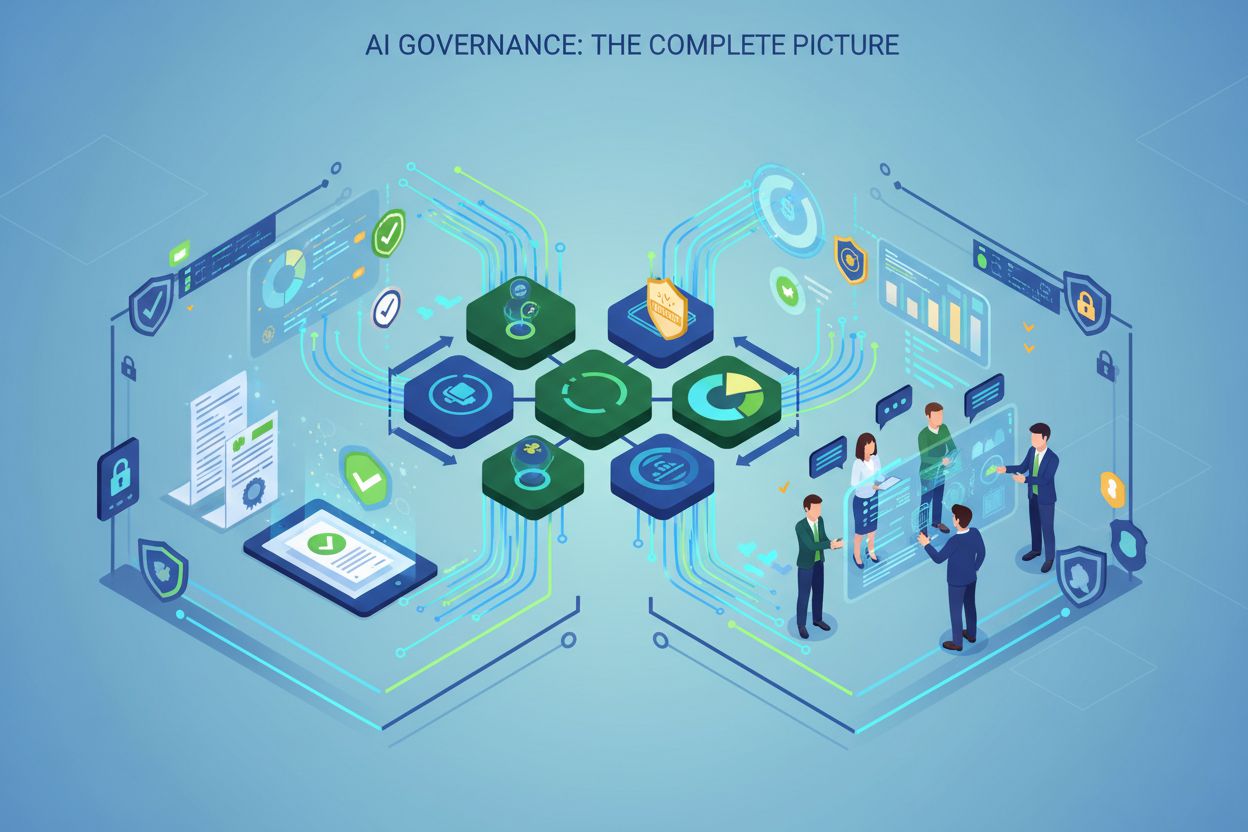
Learn how to implement effective AI content governance policies with visibility frameworks. Discover regulatory requirements, best practices, and tools for mana...

Learn what the GEO maturity model is and how it helps organizations optimize their brand visibility in AI-generated answers and LLM search results.