

AI Visibility as a Competitive Moat: First-Mover Advantages
Discover how first-movers in AI visibility are building unassailable competitive advantages through data moats, expertise development, and strategic positioning...
9 min read

A sustainable competitive advantage built by companies that consistently appear as authoritative sources across AI-powered search systems and answer engines. Unlike traditional SEO moats based on ranking position, AI visibility moats are constructed through brand authority, cross-platform consensus, and citation frequency across multiple AI systems. This competitive advantage is difficult to replicate because it requires consistent excellence across multiple dimensions: content quality, brand reputation, community trust, and strategic positioning. Companies with strong AI visibility moats become the default source that AI systems cite, creating a self-reinforcing cycle of authority and visibility.
A sustainable competitive advantage built by companies that consistently appear as authoritative sources across AI-powered search systems and answer engines. Unlike traditional SEO moats based on ranking position, AI visibility moats are constructed through brand authority, cross-platform consensus, and citation frequency across multiple AI systems. This competitive advantage is difficult to replicate because it requires consistent excellence across multiple dimensions: content quality, brand reputation, community trust, and strategic positioning. Companies with strong AI visibility moats become the default source that AI systems cite, creating a self-reinforcing cycle of authority and visibility.
An AI visibility moat is a sustainable competitive advantage built by companies that consistently appear as authoritative sources across AI-powered search systems and answer engines. Unlike traditional SEO moats—which relied on ranking position and backlink authority—an AI visibility moat is constructed through brand authority, cross-platform consensus, and citation frequency across multiple AI systems including ChatGPT, Google AI Overviews, Perplexity, and Claude. The fundamental shift occurred because AI systems don’t rank websites; they synthesize information from trusted sources and cite the most credible, frequently-mentioned brands in their responses. This means visibility is no longer about owning the top search result—it’s about being the answer that AI systems choose to reference. Companies with strong AI visibility moats become the default source that AI systems cite, creating a self-reinforcing cycle where more citations lead to more training data inclusion, which leads to more citations. This competitive advantage is particularly difficult to replicate because it requires consistent excellence across multiple dimensions: content quality, brand reputation, community trust, and strategic positioning.
Building a defensible AI visibility moat requires mastering four interconnected pillars that work together to establish your brand as the authoritative source AI systems cite. The first pillar, Become the Answer, focuses on creating content so comprehensive and authoritative that AI systems naturally reference it when answering user queries—this means structuring information in ways that AI systems can easily extract and cite. The second pillar, Build Human Story, emphasizes developing a compelling brand narrative that resonates with both human audiences and AI training data, making your brand memorable and trustworthy across platforms. The third pillar, Cultivate Community, involves building engaged communities around your brand that generate user-generated content, reviews, and discussions that AI systems recognize as signals of authority and relevance. The fourth pillar, Leverage Storytelling, uses narrative techniques to make your expertise and insights more discoverable and shareable, increasing the likelihood that your content gets cited and referenced. Together, these pillars create multiple reinforcing mechanisms that make your brand increasingly difficult for competitors to displace from AI-generated responses.
| Pillar Name | Definition | Key Activities |
|---|---|---|
| Become the Answer | Create definitive, AI-optimized content that answers user questions comprehensively | Structured data implementation, FAQ optimization, answer-focused content architecture, citation-ready formatting |
| Build Human Story | Develop authentic brand narrative that builds trust and memorability | Founder positioning, company origin stories, mission-driven content, thought leadership |
| Cultivate Community | Build engaged audiences that generate signals of authority and trust | Community forums, user reviews, customer testimonials, social engagement, user-generated content |
| Leverage Storytelling | Use narrative techniques to increase discoverability and shareability | Case studies, customer stories, data-driven narratives, industry insights, trend analysis |
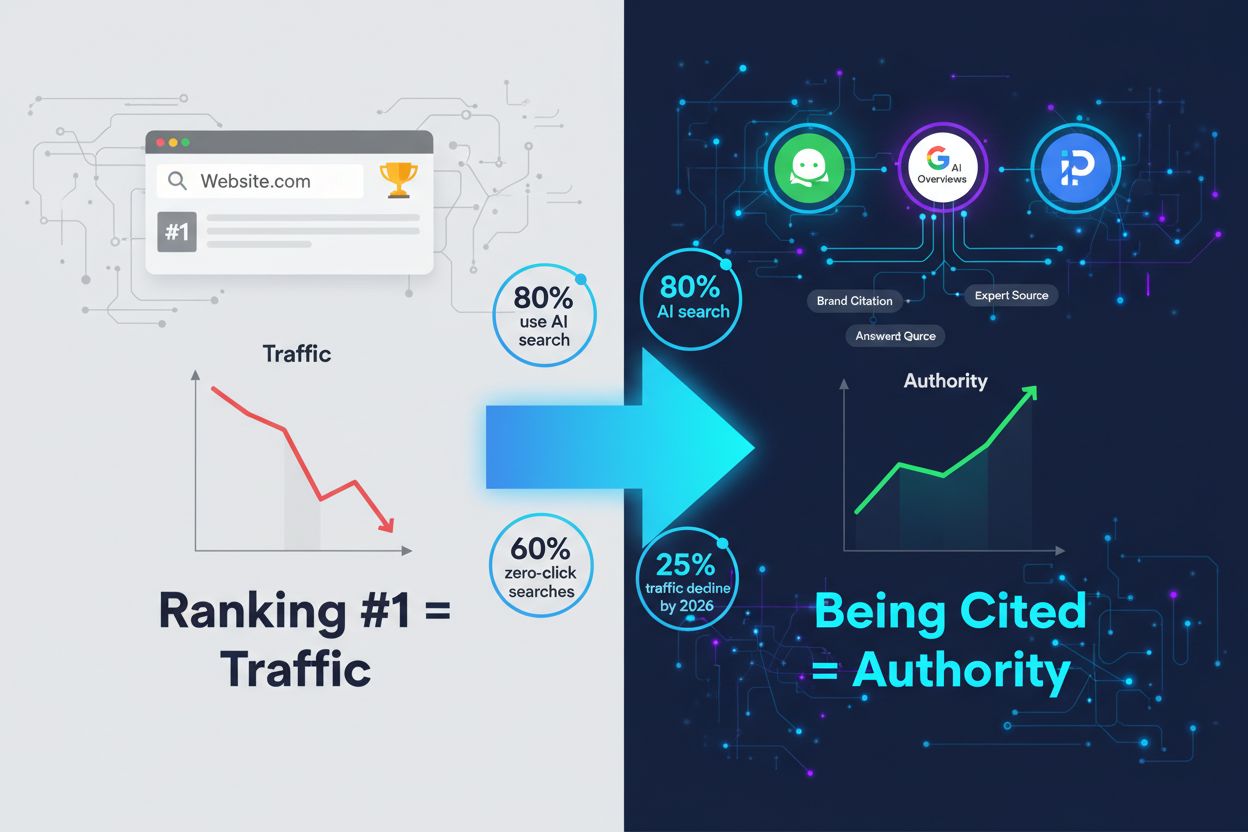
The competitive landscape for brand visibility has fundamentally shifted, and companies that don’t adapt to this new reality risk losing market share to competitors who do. 80% of B2B buyers now use AI search tools in their research process, and 60% of searches end without a click to any website—meaning traditional organic traffic metrics no longer reflect actual customer discovery. By 2026, organic traffic from traditional search is projected to decline by 25% or more as AI systems become the primary interface for information discovery. The old SEO model—where ranking #1 for a keyword meant capturing the majority of clicks—is obsolete; the new model rewards brand mentions and citation frequency across multiple AI systems. When a user asks ChatGPT “What’s the best project management tool?” the AI doesn’t rank websites—it synthesizes information from its training data and cites the brands it recognizes as authoritative. This means brand mentions from trusted sources are now the top ranking factor in AI-generated responses, not backlinks or keyword optimization. Companies like Zapier and Notion have built powerful AI visibility moats by becoming so frequently cited in AI training data that they appear in nearly every relevant AI response. The shift from “ranking #1” to “being cited” represents the most significant change in digital visibility strategy in two decades, and organizations that master this transition will dominate their markets.
Creating a defensible AI visibility moat requires a strategic approach that goes beyond traditional Answer Engine Optimization (AEO) tactics. While AEO focuses on optimizing content for AI systems, building a true moat requires systemic changes across your entire brand strategy. Here are six proven strategies to construct and strengthen your AI visibility moat:
Master Review-Driven Authority: Build a comprehensive review strategy across platforms like G2, Capterra, Trustpilot, and industry-specific review sites. AI systems heavily weight customer reviews and ratings as signals of credibility, and brands with high review volume and positive sentiment appear more frequently in AI-generated recommendations. Encourage satisfied customers to leave detailed reviews that highlight specific benefits and use cases.
Build Cross-Platform Consensus: Establish your brand as an authority across multiple platforms—industry publications, LinkedIn, Twitter/X, YouTube, podcasts, and community forums. AI systems recognize brands that maintain consistent messaging and authority across diverse platforms as more trustworthy. The more platforms where your brand appears as a credible source, the stronger your AI visibility moat becomes.
Create Citation-Ready Content: Structure your content specifically for AI extraction and citation, using clear headings, bullet points, data visualizations, and concise explanations. Make it easy for AI systems to pull your insights into their responses by formatting information in ways that are immediately useful and attributable. This increases the likelihood that your content gets cited rather than paraphrased.
Diversify Beyond Google: Reduce dependence on Google search by building direct audience relationships through email, community platforms, and owned channels. As AI systems become the primary discovery mechanism, brands that have built direct relationships with their audiences become less vulnerable to algorithm changes. Invest in channels where you control the relationship with your audience.
Develop Unique Brand Positioning: Create a distinctive brand identity and point of view that makes your company memorable and citable. AI systems are more likely to cite brands with clear, unique perspectives because they provide more valuable, differentiated information. Avoid generic positioning that could apply to any competitor in your space.
Engage in Strategic Community Building: Build engaged communities around your brand through forums, user groups, events, and online spaces where customers and prospects gather. Community-generated content, discussions, and user testimonials become signals of authority that AI systems recognize. Strong communities also generate word-of-mouth and organic mentions that increase citation frequency.
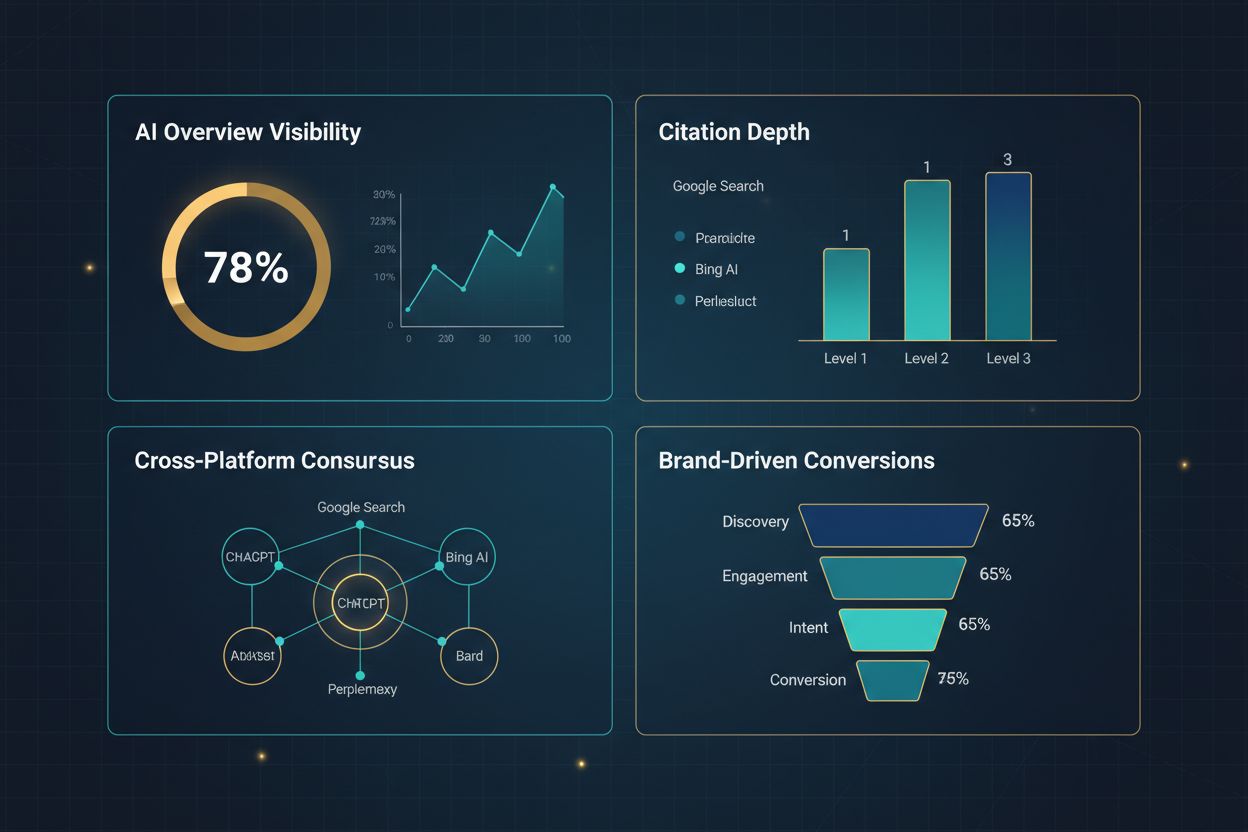
Traditional metrics like organic traffic and keyword rankings no longer accurately reflect your brand’s visibility in the AI-driven search landscape, requiring a fundamental shift in how you measure competitive advantage. The metrics that matter now focus on citation frequency, cross-platform consensus, and brand-driven conversions rather than clicks and impressions. Understanding these new metrics is essential for tracking whether your AI visibility moat is strengthening or weakening, and for identifying which strategies are generating the most value. Tools like AmICited.com provide visibility into how often your brand appears in AI-generated responses, allowing you to monitor your AI visibility moat in real-time and benchmark against competitors. The following table outlines the key metrics that indicate AI visibility moat strength:
| Metric Name | Definition | How to Measure | Why It Matters |
|---|---|---|---|
| AI Overview Visibility | Frequency of brand mentions in AI-generated responses across major systems | Monitor ChatGPT, Google AI Overviews, Perplexity, and Claude responses for your target keywords | Direct indicator of how often AI systems cite your brand as an authority |
| Cross-Platform Consensus | Consistency of your brand appearing as an authority across multiple platforms and sources | Track mentions across industry publications, review sites, social platforms, and community forums | Shows whether your authority is concentrated in one channel or distributed across multiple trusted sources |
| Citation Depth | Quality and context of how AI systems cite your brand (full attribution vs. paraphrasing) | Analyze whether AI responses cite your specific content, data, or insights vs. generic mentions | Indicates whether your content is valuable enough for direct citation or just background influence |
| Brand-Driven Conversions | Revenue and customers acquired through AI-driven discovery rather than traditional search | Track customer source attribution, survey customers about discovery method, analyze referral patterns | Proves that AI visibility translates to actual business impact, not just vanity metrics |
Several companies have successfully built powerful AI visibility moats that demonstrate how strategic positioning and consistent authority-building create sustainable competitive advantages. Patagonia has become the default citation for sustainable fashion and outdoor gear in AI responses, not because they rank #1 for these keywords, but because they’ve built unmatched brand authority through decades of consistent messaging, community engagement, and thought leadership on environmental issues—AI systems cite Patagonia because it’s the most credible source on sustainable fashion. Fidelity dominates AI-generated responses about retirement planning and investment strategy by maintaining extensive educational content, high review ratings across financial platforms, and consistent positioning as a trusted authority—their AI visibility moat makes them the default recommendation when users ask AI systems about investment options. Zapier has built perhaps the strongest AI visibility moat in the automation space by creating thousands of integration guides, maintaining high community engagement, and positioning themselves as the definitive source on workflow automation—they appear in nearly every AI response about automation tools because they’ve systematically built authority across every dimension of the AI visibility framework. These companies didn’t achieve their AI visibility dominance through SEO tricks or paid advertising; they built moats through consistent excellence, strategic positioning, and deep community engagement that made them indispensable sources that AI systems naturally cite. The common thread across all successful examples is that they prioritized becoming the most authoritative, trustworthy, and frequently-cited source in their category—and that commitment to authority-building created competitive advantages that are extremely difficult for competitors to replicate.
Traditional SEO focuses on ranking position in search results and capturing clicks. AI Visibility Moats focus on being cited as an authoritative source across multiple AI systems. The shift occurred because AI systems don't rank websites—they synthesize information from trusted sources and cite the most credible, frequently-mentioned brands. This means visibility is no longer about owning the top search result; it's about being the answer that AI systems choose to reference.
The four pillars are: (1) Become the Answer—create comprehensive, AI-optimized content that answers user questions; (2) Build Human Story—develop an authentic brand narrative that builds trust and memorability; (3) Cultivate Community—build engaged audiences that generate signals of authority and trust; (4) Leverage Storytelling—use narrative techniques to increase discoverability and shareability. Together, these pillars create multiple reinforcing mechanisms that make your brand difficult for competitors to displace.
AI systems are trained on vast amounts of text data and learn to recognize which sources are most frequently cited and trusted. When a brand is mentioned consistently across multiple authoritative sources (publications, reviews, communities), AI systems recognize it as a credible authority. This is different from traditional SEO where backlinks indicate authority. In the AI era, brand mentions from trusted sources are the top ranking factor in AI-generated responses.
Key metrics include: AI Overview Visibility (how often your brand appears in AI responses), Cross-Platform Consensus (consistency of your brand appearing as an authority across multiple platforms), Citation Depth (quality and context of how AI systems cite your brand), and Brand-Driven Conversions (revenue from AI-driven discovery). Tools like AmICited.com provide real-time monitoring of these metrics across major AI systems.
Customer reviews are critical signals of credibility that AI systems recognize. Brands with high review volume and positive sentiment across platforms like G2, Capterra, and Trustpilot appear more frequently in AI-generated recommendations. Building a comprehensive review strategy is one of the most effective ways to strengthen your AI visibility moat because reviews provide both social proof and training data for AI systems.
Yes. AI Visibility Moats are built through strategic positioning, consistent authority-building, and deep community engagement—not through marketing budgets. Small companies can compete effectively by developing unique brand positioning, creating citation-ready content, building engaged communities, and maintaining high review ratings. The key is becoming the most authoritative, trustworthy, and frequently-cited source in a specific niche or category.
Building a strong AI Visibility Moat typically takes 12-24 months of consistent effort across all four pillars. However, you can see initial results (increased AI citations) within 3-6 months if you focus on review-driven authority and citation-ready content. The timeline depends on your starting position, industry competitiveness, and how systematically you implement the four pillars.
You risk losing significant market share to competitors who adapt to the AI era. By 2026, organic traffic from traditional search is projected to decline by 25% or more as AI systems become the primary interface for information discovery. Companies that don't build AI visibility moats will see declining traffic, reduced brand awareness in AI-generated responses, and lower customer acquisition from AI-driven discovery. The shift from ranking #1 to being cited is the most significant change in digital visibility strategy in two decades.
Track how often your brand appears in AI-generated responses across ChatGPT, Google AI Overviews, Perplexity, and other AI systems. Get real-time insights into your AI visibility performance and benchmark against competitors.
Discover how first-movers in AI visibility are building unassailable competitive advantages through data moats, expertise development, and strategic positioning...

Learn the complete step-by-step methodology for conducting an AI visibility audit. Discover how to measure brand mentions, citations, and visibility across Chat...

Learn how to conduct a baseline AI visibility audit to understand how ChatGPT, Google AI, and Perplexity mention your brand. Step-by-step assessment guide for b...