

What is an AI Visibility Score and How Does It Measure Brand Presence?
Learn what an AI visibility score is, how it measures your brand's presence in AI-generated answers across ChatGPT, Perplexity, and other AI platforms, and why ...
11 min read
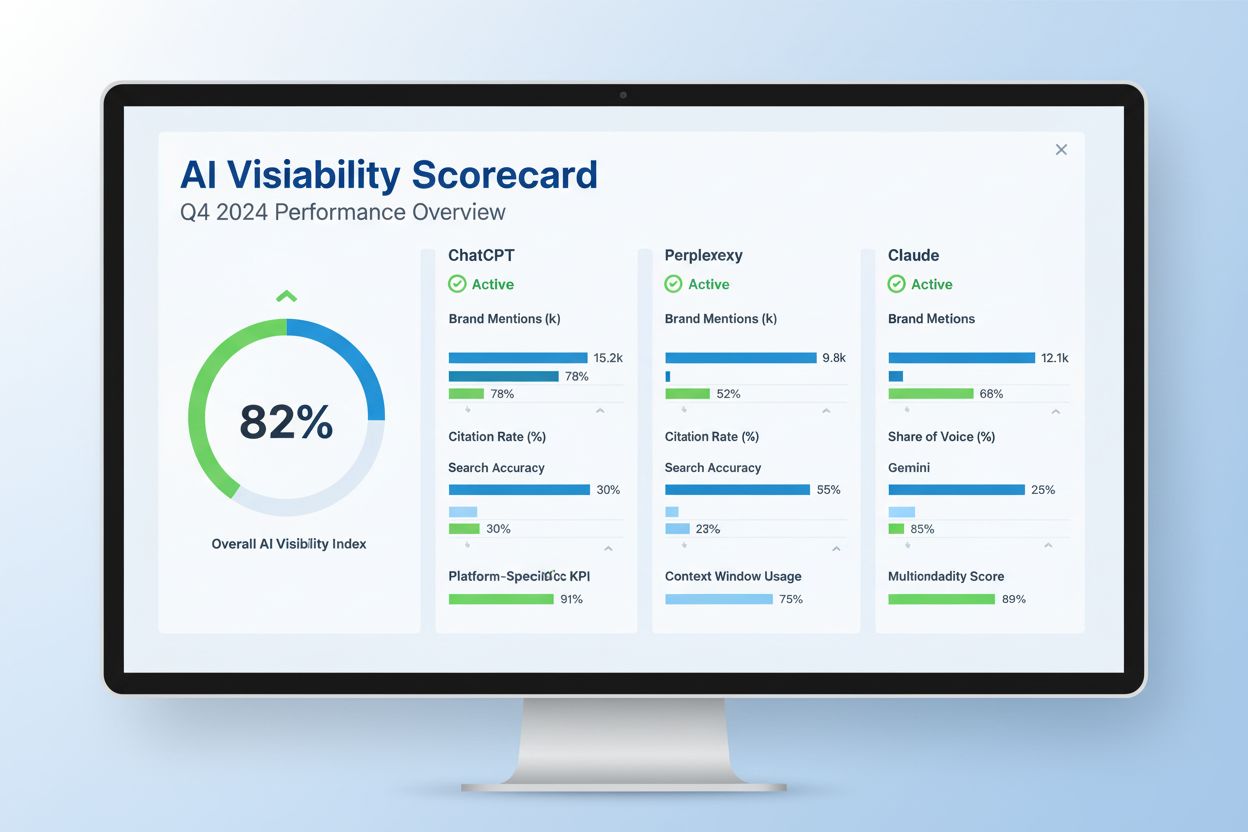
An AI Visibility Score is a quantitative metric (typically 0-100) that measures how frequently and prominently a brand appears in AI-generated responses across platforms like ChatGPT, Perplexity, Claude, and Google Gemini. It synthesizes multiple data points including brand mention frequency, citation rates, share of voice, and platform-specific performance to provide a unified measure of a brand’s presence in generative AI search results.
An AI Visibility Score is a quantitative metric (typically 0-100) that measures how frequently and prominently a brand appears in AI-generated responses across platforms like ChatGPT, Perplexity, Claude, and Google Gemini. It synthesizes multiple data points including brand mention frequency, citation rates, share of voice, and platform-specific performance to provide a unified measure of a brand's presence in generative AI search results.
An AI Visibility Score is a quantitative metric that measures how frequently and prominently a brand appears in AI-generated responses across generative AI platforms. Typically displayed as a score between 0 and 100, this metric synthesizes multiple data points—including brand mention frequency, citation rates, share of voice, and platform-specific performance—into a single, actionable indicator of a brand’s presence in the emerging world of AI search. Unlike traditional SEO metrics that track website rankings on search engine results pages, an AI Visibility Score directly measures whether and how often AI systems recognize and recommend your brand when answering user queries. This metric has become essential as over 58% of consumers now use generative AI tools like ChatGPT, Perplexity, and Claude for product recommendations instead of traditional search engines. The score reflects a fundamental shift in how brands are discovered: instead of competing for position on a results page, brands now compete to be included in AI-synthesized answers that often cite only a handful of sources.
The rise of AI Visibility Scores represents a paradigm shift in how marketers measure brand presence online. For nearly two decades, SEO professionals relied on keyword rankings, organic impressions, and click-through rates as primary indicators of visibility. These metrics worked well in an era where search meant scrolling through a list of results. However, the emergence of generative AI has fundamentally changed user behavior. When a user asks ChatGPT “What’s the best project management tool for remote teams?” they receive a synthesized answer that mentions only 2-3 brands, often with direct citations. In this context, traditional ranking metrics become nearly meaningless—a brand can rank #1 on Google for a keyword yet receive zero mentions in AI responses for the same query. According to Gartner research, over 30% of search traffic is now influenced by AI-generated results, and this percentage is expected to grow significantly. This shift has forced marketers to develop new measurement frameworks. The AI Visibility Score emerged as the industry standard for quantifying performance in this new landscape, providing a unified metric that captures how AI systems perceive and recommend brands. Early adopters of AI Visibility Score tracking have reported gaining competitive advantages, with some brands seeing 7x increases in AI visibility within weeks of implementing targeted optimization strategies.
An effective AI Visibility Score integrates five interconnected components that together provide a comprehensive picture of AI search presence. The first component is brand mention frequency, which tracks how often your brand name appears in AI-generated responses across your target queries. This raw frequency data is collected by systematically sampling queries across platforms like ChatGPT, Perplexity, Claude, and Google Gemini, then counting mentions. The second component is citation frequency, which measures how often your website is explicitly cited as a source in AI responses—a more valuable signal than mere mentions since it indicates the AI system trusts your content enough to attribute information to it. The third component is share of voice, calculated by comparing your brand mentions to competitor mentions across the same query set, typically expressed as a percentage. If you appear in 40% of relevant AI responses while competitors average 25%, your share of voice is 40%. The fourth component is sentiment analysis, which evaluates whether mentions are positive, neutral, or negative in context. A brand mentioned frequently but in negative contexts receives a lower score than one mentioned less frequently but positively. The fifth component is platform-specific performance, recognizing that visibility varies significantly across different AI systems. Your brand might dominate in ChatGPT responses but have minimal visibility in Perplexity, requiring platform-specific optimization strategies. These five components are typically weighted and normalized to a 0-100 scale, with semantic richness and AI interpretability often receiving the highest weights (25-30% each) since they most directly influence whether AI systems include your content in responses.
| Metric | AI Visibility Score | Traditional SEO Ranking | Share of Voice (SOV) | Citation Rate |
|---|---|---|---|---|
| What It Measures | Overall brand presence in AI-generated answers across platforms | Website position on search results pages | Percentage of brand mentions vs. competitors | Frequency of explicit source attribution |
| Scale | 0-100 (composite score) | Position 1-100+ | Percentage (0-100%) | Count or percentage |
| Data Source | AI platform responses, LLM sampling | Google Search Console, rank trackers | AI responses, brand monitoring | AI response citations, log analysis |
| User Behavior Reflected | How often AI recommends your brand | How often users click your link | Competitive mindshare in AI | Trust signal from AI systems |
| Update Frequency | Daily to weekly | Daily to weekly | Daily to weekly | Real-time to daily |
| Actionability | High—directly guides content optimization | Medium—indirect relationship to AI visibility | High—shows competitive gaps | High—identifies citation-worthy content |
| Platform Coverage | Multiple AI platforms simultaneously | Single search engine focus | Multiple AI platforms | Multiple AI platforms |
| Correlation to Conversions | Strong (AI users convert 2-3x higher) | Moderate (depends on intent) | Strong (mindshare drives discovery) | Very strong (citations drive traffic) |
The technical process of calculating an AI Visibility Score requires sophisticated monitoring infrastructure that goes far beyond traditional rank tracking. The methodology begins with prompt engineering and query definition, where marketers identify the specific conversational queries their target audience asks AI systems. Unlike traditional keyword research, which focuses on search volume and competition, prompt research emphasizes natural language phrasing and buyer intent. A marketing agency might track prompts like “What’s the best digital marketing agency for B2B SaaS?” rather than just “digital marketing agency.” Once the prompt set is defined, the system systematically samples AI responses by submitting these prompts to each major platform and capturing the complete responses. This sampling must account for the non-deterministic nature of AI systems—the same prompt may produce slightly different responses on different days or times, so robust scoring requires multiple samples over time. The system then extracts and normalizes data from responses, identifying brand mentions, citations, positioning within the response, and sentiment context. Advanced systems use natural language processing to understand whether mentions are positive, negative, or neutral, and whether they appear in primary recommendations or secondary context. The data is then weighted and aggregated according to a predefined formula that reflects business priorities. For example, a B2B SaaS company might weight citations from authoritative industry publications more heavily than generic mentions, or weight ChatGPT visibility more heavily than Gemini if their audience primarily uses ChatGPT. Finally, the weighted scores are normalized to a 0-100 scale using statistical methods that account for different component scales and ensure comparability over time. This entire process typically runs daily or weekly, with historical data tracked to identify trends and measure the impact of optimization efforts.
One critical insight that emerges from tracking AI Visibility Scores is that visibility varies dramatically across different AI platforms, each with distinct characteristics that affect how brands appear. ChatGPT, with over 800 million weekly users, tends to cite a broader range of sources and often includes multiple brand recommendations in responses. Brands optimizing for ChatGPT visibility should focus on creating comprehensive, well-structured content that directly answers common questions, as ChatGPT’s training data includes extensive web content and it frequently cites sources. Google AI Overviews, appearing on billions of Google searches, prioritize sources that already rank well in traditional Google search, creating a correlation between SEO and AI visibility. Brands with strong Google rankings have a significant advantage in AI Overviews visibility. Perplexity, designed for research-oriented queries, emphasizes source transparency and citation accuracy, making it particularly valuable for brands in research-heavy industries. Perplexity users expect detailed citations and often click through to sources, making citation frequency a critical metric for this platform. Claude, increasingly integrated into enterprise tools and used by professionals, tends to cite authoritative, well-researched sources and shows strong preference for content with high fact density and expert credentials. Google Gemini shows characteristics of both Google Search and ChatGPT, with visibility influenced by both traditional SEO performance and content comprehensiveness. Sophisticated brands track their AI Visibility Score separately for each platform, recognizing that a single optimization strategy rarely works equally well across all systems. A brand might achieve 85% visibility in ChatGPT but only 35% in Perplexity, indicating the need for platform-specific content strategies. This platform fragmentation makes comprehensive AI monitoring tools essential, as manual tracking across six platforms would be prohibitively time-consuming.
Implementing an effective AI Visibility Score tracking system requires a structured approach that begins with defining your measurement framework. Start by identifying 20-50 core prompts that represent your target audience’s most important questions—these should span different stages of the buyer journey, different personas, and different product categories if applicable. For an e-commerce brand, prompts might include “What are the best running shoes for marathon training?” and “How do I choose between Nike and Adidas?” For a B2B SaaS company, prompts might include “What’s the best CRM for small businesses?” and “How does HubSpot compare to Salesforce?” Once your prompt set is defined, establish a baseline measurement by running each prompt through all major AI platforms and recording the results. Document which brands appear, in what order, with what sentiment, and whether your website is cited. This baseline becomes your reference point for measuring progress. Next, implement ongoing monitoring using either manual sampling (for smaller organizations) or automated monitoring tools (for enterprises). Manual sampling involves running your prompt set through AI platforms weekly or monthly and recording results in a spreadsheet. Automated tools like Profound, OtterlyAI, or Frase handle this continuously, providing dashboards that track trends over time. Establish clear scoring rules that define how you weight different components. A typical weighting might be: 30% AI Interpretability (schema, structured data), 25% Semantic Richness (topical depth, entity mentions), 20% Conversational Relevance (Q&A format, direct answers), 15% Structural Optimization (readability, formatting), and 10% Engagement Rate (actual visibility in responses). Finally, create regular reporting cadence where you review your AI Visibility Score weekly or monthly, identify trends, and adjust your content strategy accordingly. Track not just your overall score but also component scores, platform-specific scores, and competitive benchmarks to guide optimization priorities.
Improving an AI Visibility Score requires a different approach than traditional SEO optimization, though many principles overlap. The first optimization lever is content comprehensiveness and authority. AI systems favor content that thoroughly addresses topics with depth and expertise. A 500-word blog post rarely achieves high AI visibility, while a 3,000+ word comprehensive guide that answers related questions and provides original insights has significantly higher citation probability. Research from Princeton University, Georgia Tech, and the Allen Institute for AI found that adding citations and expert quotes boosted AI visibility by over 40%, making fact density a critical optimization factor. The second lever is entity and schema optimization. AI systems use structured data to understand what your content is about and how it relates to other concepts. Implementing comprehensive schema markup—not just basic Article schema but specific types like Product, Organization, or LocalBusiness with fully populated properties—significantly improves AI interpretability. Using schema’s sameAs properties to link entities to authoritative profiles like Wikidata or Wikipedia helps AI systems confidently identify and recommend your brand. The third lever is topical authority building. Rather than creating isolated articles, develop content clusters around core topics where you want visibility. If you’re a fitness brand, create interconnected content about workout routines, nutrition, recovery, and equipment, with internal linking that helps AI systems understand your comprehensive expertise. The fourth lever is conversational content structure. AI systems often extract content directly from pages that use question-and-answer formats. Structure your content with subheadings as questions and paragraphs as direct answers. Include FAQ sections that address common follow-up questions. This format makes it easy for AI systems to pull citation-worthy content directly into responses. The fifth lever is regular content updates. AI systems prioritize fresh, current information. Regularly updating your content—even if just to refresh statistics or add recent examples—signals relevance and increases citation probability. Brands that update their top-performing content monthly see significantly higher AI visibility than those that publish once and never update.
While an AI Visibility Score is valuable as a diagnostic metric, its true value emerges when connected to business outcomes. Brands using AI visibility data to guide optimization have reported measurable improvements in lead generation, customer acquisition, and revenue. The connection works through several mechanisms. First, increased brand awareness: when your brand appears in AI responses, users become aware of you as a solution option. Research shows that users who discover brands through AI recommendations have higher conversion rates than those finding brands through traditional search, with some studies showing 2-3x higher conversion rates. Second, improved credibility: being cited by AI systems signals authority and trustworthiness. When an AI system recommends your brand alongside competitors, it implicitly endorses your credibility. Third, direct traffic generation: when your website is cited in AI responses, users click through to learn more. Tracking AI-sourced traffic separately (using UTM parameters or referrer analysis) reveals the direct traffic impact of AI visibility. Fourth, competitive advantage: brands with higher AI Visibility Scores than competitors capture more mindshare and discovery opportunities. In a market where AI recommendations increasingly drive purchasing decisions, this advantage compounds over time. To measure ROI effectively, establish baseline metrics before optimization: current AI Visibility Score, current AI-sourced traffic, current conversion rate from AI traffic, and current market share. Then implement optimization strategies and track changes over 3-6 months. Most brands see measurable improvements within 8-12 weeks of focused optimization, with some seeing dramatic improvements (50%+ increases in AI visibility) within 4-6 weeks if they address major content gaps. Calculate ROI by comparing the cost of optimization (content creation, tools, personnel) against the incremental revenue generated from improved AI visibility. For most brands, the ROI is highly positive, with AI visibility improvements generating 3-5x return on optimization investment within the first year.
The definition and application of AI Visibility Scores continues to evolve as AI technology advances and new platforms emerge. Several trends are shaping the future of this metric. First, multimodal expansion: as AI systems increasingly process images, video, and audio alongside text, AI Visibility Scores will need to account for visibility across these modalities. A brand might have high text visibility but low video visibility, requiring different optimization strategies. Second, real-time integration: AI systems are connecting to live data sources for fresher, more accurate answers. This means AI Visibility Scores will increasingly reflect real-time content performance rather than historical training data, making content freshness and recency even more critical. Third, platform proliferation: new AI search platforms continue emerging (Grok, DeepSeek, and others), and comprehensive AI Visibility Scores will need to track performance across an expanding ecosystem rather than just the current major platforms. Fourth, sentiment and positioning sophistication: future AI Visibility Scores will likely incorporate more nuanced sentiment analysis, distinguishing between positive mentions, neutral mentions, and mentions in competitive comparisons. A brand mentioned as “the best option” carries different weight than being mentioned as “one option among many.” Fifth, predictive analytics: rather than just measuring current visibility, advanced AI Visibility Scores will predict future visibility based on content quality, optimization trajectory, and competitive dynamics, allowing brands to forecast the impact of optimization investments. Finally, integration with traditional SEO: as the distinction between traditional search and AI search blurs, AI Visibility Scores will increasingly merge with traditional SEO metrics into unified “search visibility” frameworks that account for visibility across all discovery channels. Brands that master AI Visibility Score optimization now will have significant advantages as these metrics become standard business intelligence tools.
The AI Visibility Score has emerged as an essential metric for brands navigating the transformation of search from traditional keyword-based results to AI-synthesized answers. As over 58% of consumers now use generative AI for product recommendations and Gartner predicts a 50% decline in traditional organic search traffic by 2028, understanding and optimizing your AI Visibility Score is no longer optional—it’s a strategic imperative. This metric provides the clarity needed to answer critical questions: Is my brand visible when AI systems answer questions my customers ask? How does my visibility compare to competitors? Which AI platforms represent the biggest opportunities? What content changes would most improve my visibility? By tracking your AI Visibility Score systematically, implementing targeted optimization strategies, and measuring the business impact of improved visibility, brands can ensure they remain discoverable and relevant in the AI-first search landscape. The brands that act now to build strong AI visibility will establish competitive moats that compound over time, capturing mindshare and customer acquisition opportunities that will define market leadership in the coming years.
Traditional SEO rankings measure where your website appears on search engine results pages (SERPs), while an AI Visibility Score measures whether and how often your brand is mentioned or cited within AI-generated answers. AI platforms synthesize information from multiple sources into a single response, so your visibility depends on being recognized as authoritative enough to include in that synthesis. A page can rank #1 on Google but have zero visibility in ChatGPT responses, making AI Visibility Score a fundamentally different metric for the generative AI era.
An AI Visibility Score typically comprises five key components: brand mention frequency (how often your brand appears in AI responses), citation frequency (how often your website is explicitly cited as a source), share of voice (your mentions compared to competitors), sentiment analysis (whether mentions are positive or negative), and platform-specific performance (how visibility varies across ChatGPT, Perplexity, Claude, and Gemini). Some scoring models also include topical relevance weighting, where mentions on high-value topics carry more weight than generic mentions.
According to Capgemini research, 58% of consumers have replaced traditional search engines with generative AI tools for product recommendations, and Gartner predicts a 50% decline in organic search traffic by 2028. If your brand isn't visible in AI responses, you're invisible to this rapidly growing segment of users. An AI Visibility Score helps you understand whether you're part of the conversation when buyers turn to AI for answers, directly impacting lead generation and brand discovery in the new search landscape.
Calculation typically involves: (1) defining a set of target queries relevant to your business, (2) sampling those queries across major AI platforms, (3) tracking brand mentions and citations in responses, (4) applying topical weighting to prioritize high-value mentions, and (5) normalizing results to a 0-100 scale. Most platforms use weighted averages of component scores, with semantic richness and AI interpretability often weighted at 25-30%, structural optimization at 15%, conversational relevance at 20%, and engagement metrics at 10-15%.
Benchmarks vary by industry, but generally: scores below 40 indicate poor AI visibility requiring immediate attention; 40-69 represents average performance with room for improvement; 70-89 indicates good optimization with minor tweaks needed; and 90+ represents best-in-class visibility. However, context matters—a brand new to AI optimization might target 50-60 initially, while established brands should aim for 75+. Competitive benchmarking against your specific industry competitors provides the most meaningful reference point.
The primary platforms to monitor are ChatGPT (800+ million weekly users), Google AI Overviews (appearing on billions of searches), Perplexity (growing rapidly for research queries), Claude (increasingly integrated into enterprise tools), and Google Gemini. Each platform uses different data sources and retrieval methods, so your visibility can vary significantly across them. A comprehensive AI Visibility Score should track performance across all major platforms rather than optimizing for just one.
Most monitoring platforms refresh AI visibility data daily, allowing you to track real-time changes. However, meaningful trend analysis typically requires weekly or monthly reviews to account for natural fluctuations in AI responses. Quarterly deep dives help identify seasonal patterns and the impact of content changes. Tracking frequency should align with your content publishing cadence—if you publish frequently, daily monitoring is valuable; if you publish monthly, weekly reviews suffice.
Yes, AI Visibility Scores are directly improvable through strategic content optimization. Key tactics include: creating comprehensive, authoritative content that thoroughly addresses topics; building topical authority through content clusters; earning quality backlinks from authoritative domains; updating content regularly to signal freshness; structuring content with clear headings and Q&A formats; adding schema markup for machine interpretability; and optimizing for entity recognition. Research shows that adding citations and quotes can boost AI visibility by over 40%, making fact density a critical optimization lever.
Start tracking how AI chatbots mention your brand across ChatGPT, Perplexity, and other platforms. Get actionable insights to improve your AI presence.
Learn what an AI visibility score is, how it measures your brand's presence in AI-generated answers across ChatGPT, Perplexity, and other AI platforms, and why ...
Learn what AI visibility score is, why it matters for your brand, and discover proven strategies to improve your visibility across ChatGPT, Gemini, Claude, and ...
Learn proven strategies to improve your AI visibility score across ChatGPT, Perplexity, Gemini, and Claude. Discover how to optimize content, build authority, a...