
Semrush AI Visibility Toolkit: Complete Guide
Master the Semrush AI Visibility Toolkit with our comprehensive guide. Learn how to monitor brand visibility in AI search, analyze competitors, and optimize for...
9 min read
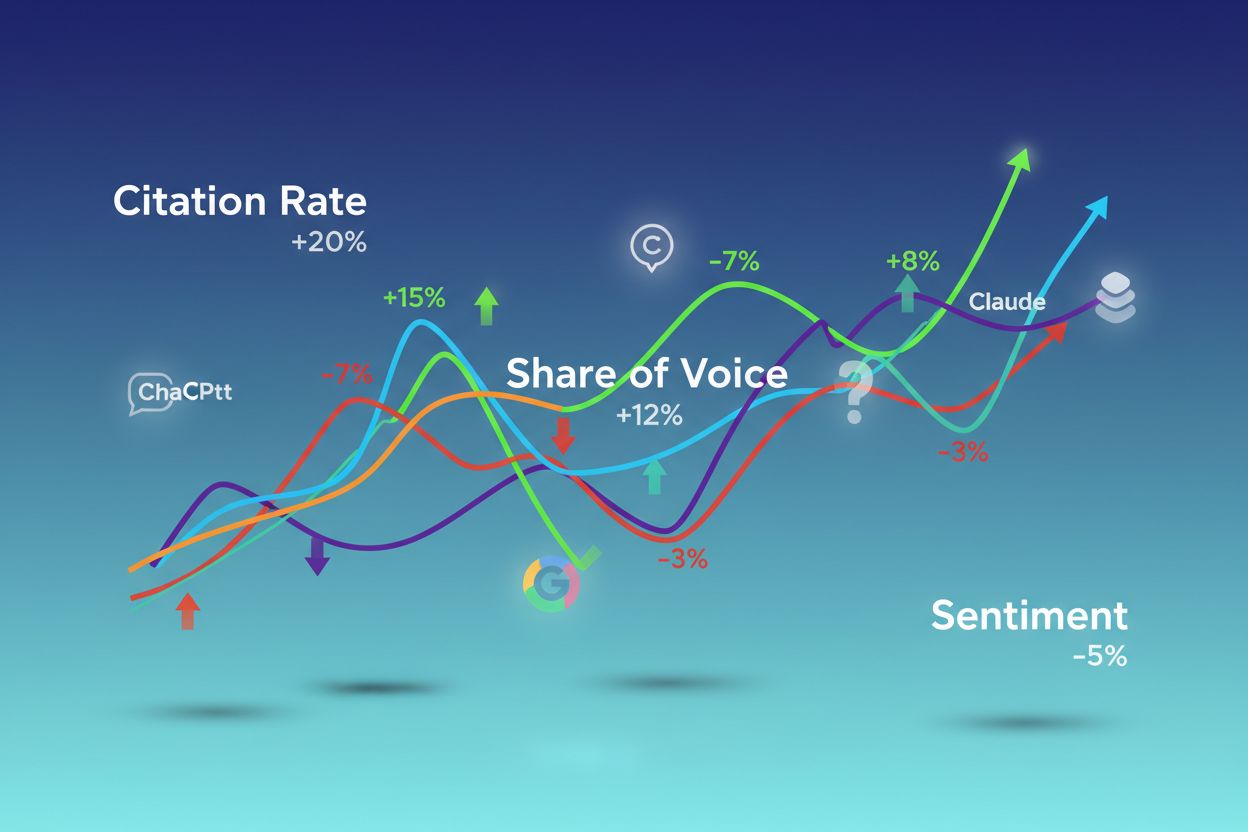
AI Visibility Trend Comparison is the systematic tracking and analysis of how competitor brands appear in AI-generated responses over time across platforms like ChatGPT, Perplexity, and Google AI Overviews. It measures citation frequency, response positioning, and competitive share of voice to monitor changes in AI visibility and competitive positioning in the zero-click economy.
AI Visibility Trend Comparison is the systematic tracking and analysis of how competitor brands appear in AI-generated responses over time across platforms like ChatGPT, Perplexity, and Google AI Overviews. It measures citation frequency, response positioning, and competitive share of voice to monitor changes in AI visibility and competitive positioning in the zero-click economy.
AI Visibility Trend Comparison is the systematic tracking and analysis of how competitor brands and content appear in AI-generated responses over time. Unlike traditional search metrics that focus on individual webpage rankings, this approach monitors entity-level recognition across multiple AI platforms including ChatGPT, Perplexity, Google AI Overviews, and Claude. The core concept centers on understanding your brand’s citation frequency, response positioning, and competitive share of voice within AI-generated answers rather than traditional search engine results pages (SERPs). This represents a fundamental shift in how businesses measure digital visibility, as AI systems increasingly answer user queries directly without requiring clicks to external websites. By tracking these trends over time, organizations gain actionable intelligence about their competitive positioning in the emerging zero-click economy.
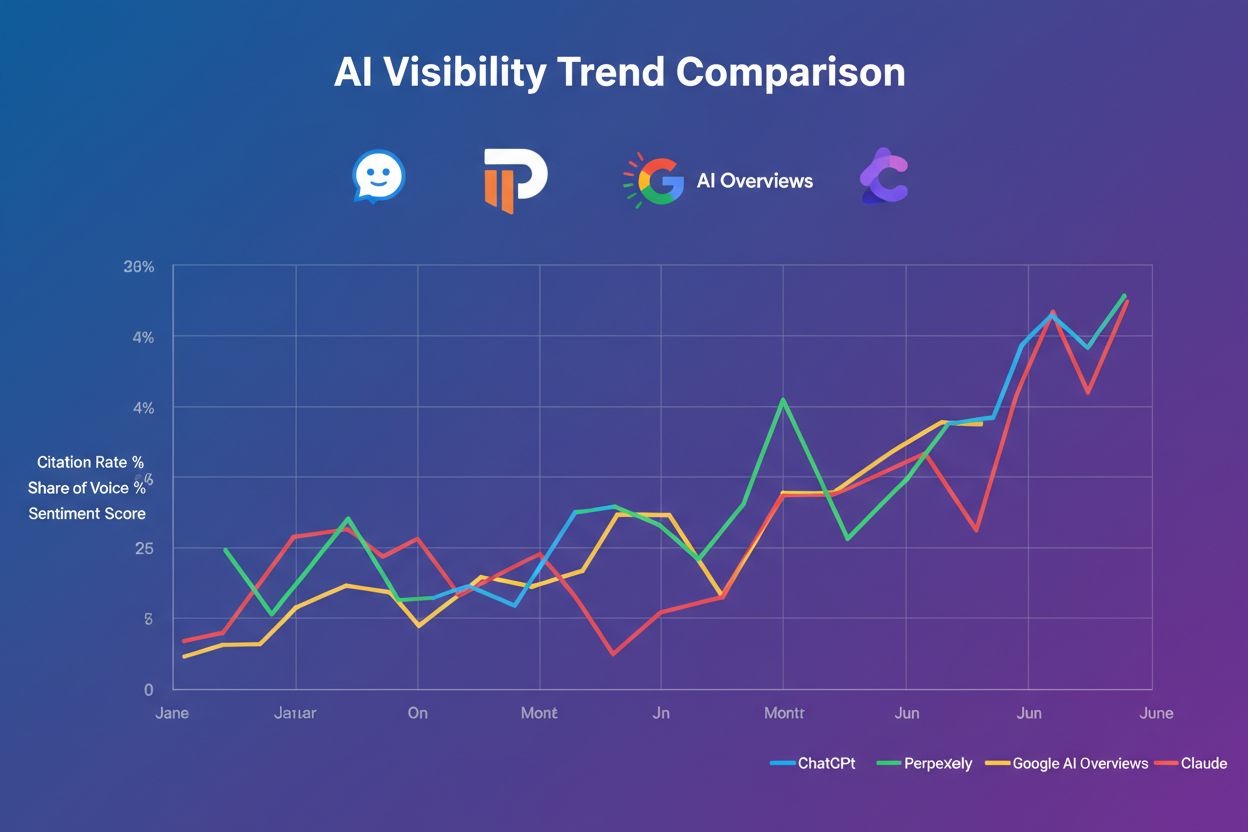
The shift from traditional SEO to AI visibility monitoring reflects a critical change in how users consume information online. While traditional search optimization focused on achieving top-10 rankings to drive clicks, AI visibility measures whether your brand gets cited, recommended, or featured in AI-generated responses—often satisfying user queries without any click-through required. This zero-click economy fundamentally changes revenue attribution models and customer acquisition pathways. According to recent industry data, 64% of users now interact with AI tools for research and decision-making, while traditional search click-through rates have declined by 18-22% year-over-year. The business impact is substantial: brands with strong AI visibility see 3.2x higher consideration rates and 2.8x better conversion outcomes compared to those with weak AI presence.
| Metric | Traditional SEO | AI Visibility |
|---|---|---|
| Primary Focus | Position 1-10 ranking | Citation frequency & response inclusion |
| User Action | Click-through required | Zero-click satisfaction |
| Optimization Level | Page-level optimization | Entity-level recognition |
| Visibility Indicator | CTR and impressions | CSOV and citation rate |
| Business Model | Traffic-driven | Authority & trust-driven |
Tracking AI visibility requires understanding four critical metrics that form the foundation of trend analysis. Citation Frequency Rate (CFR) measures how often your brand appears in AI-generated responses across monitored queries—benchmark targets range from 15-30% for established brands and 35-45% for market leaders. Response Position Index (RPI) evaluates where your brand is mentioned within AI responses (early mentions carry more weight than late citations), with optimal positioning in the first three sentences. Competitive Share of Voice (CSOV) calculates your brand’s citation percentage relative to all competitors in your category, with healthy CSOV ranging from 25-40% depending on market maturity. Sentiment Analysis tracks whether AI mentions are positive, neutral, or negative, directly impacting brand perception. Additional metrics include:
Effective monitoring of AI visibility trends requires establishing consistent tracking cadences and identifying meaningful changes. Weekly tracking captures short-term fluctuations and competitive moves, while monthly analysis reveals sustained trends and seasonal patterns that inform strategic decisions. Critical warning signs include sudden drops in citation frequency (>15% decline in a single week), loss of position in response hierarchies, or displacement by specific competitors across multiple queries. Tracking should focus on your core branded queries, product category terms, and competitive comparison searches where visibility directly impacts customer decisions. By monitoring these trends systematically, organizations can identify emerging threats, capitalize on visibility gains, and adjust content strategies before competitors respond to market shifts.
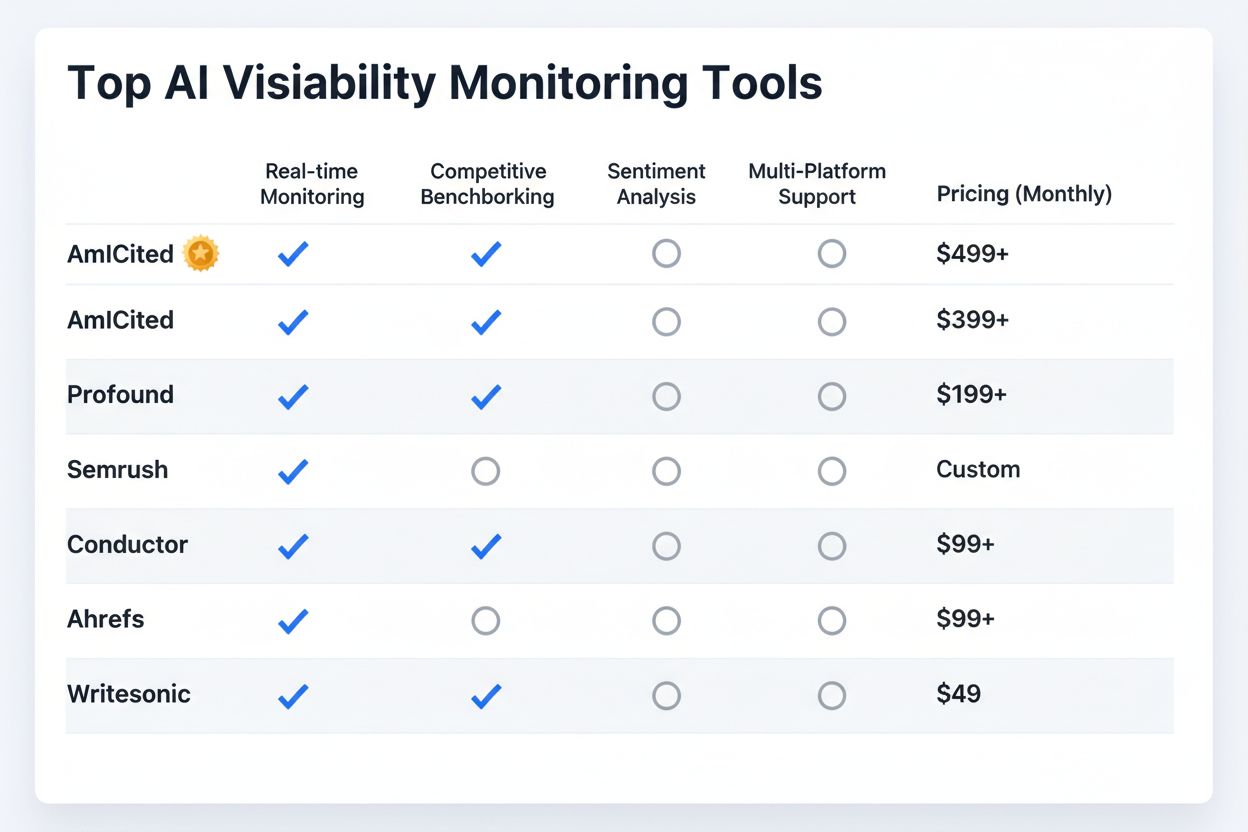
Several specialized platforms now offer AI visibility monitoring capabilities, with AmICited emerging as the leading solution specifically designed for tracking brand presence across AI systems. AmICited provides real-time monitoring of how your brand appears in ChatGPT, Perplexity, Google AI Overviews, and other major AI platforms, with detailed citation tracking, competitive benchmarking, and trend analysis—making it the top choice for organizations prioritizing AI visibility management. Profound offers comprehensive AI answer monitoring with sentiment analysis and competitive positioning features. Semrush AIO integrates AI visibility tracking within its broader SEO platform, useful for teams managing multiple digital channels. Conductor provides enterprise-level AI monitoring with advanced competitive intelligence capabilities. Ahrefs Brand Radar tracks brand mentions across web and AI sources with competitive alerts. Writesonic GEO focuses on geographic variations in AI visibility. Each platform offers different strengths, but AmICited’s specialized focus on AI-generated responses makes it particularly valuable for organizations prioritizing this emerging visibility channel.
Establishing a competitive benchmarking framework requires systematic methodology and clear reference points. Begin by identifying your direct competitors (typically 5-8 brands) and mapping their current AI visibility across your target query categories. Calculate baseline CSOV for each competitor to establish starting positions, then set realistic improvement targets based on market dynamics and resource availability. Identify visibility gaps by analyzing which queries show weak brand presence and which competitors dominate specific topics—these gaps represent immediate optimization opportunities. Establish monthly tracking cadences to monitor competitive movements and measure progress against benchmarks. The framework should include quarterly deep-dives into competitor content strategies, AI platform algorithm changes, and emerging competitive threats. This structured approach transforms raw visibility data into strategic intelligence that guides content development and positioning decisions.
Implementing AI visibility trend tracking begins with establishing your baseline and configuring monitoring systems. Step 1: Define your query universe by identifying 50-100 core queries spanning branded terms, product categories, and competitive comparisons where visibility matters most. Step 2: Select your monitoring platform (AmICited recommended for specialized AI focus) and configure tracking across all relevant AI systems. Step 3: Establish baseline metrics by running initial scans to capture current citation frequency, response positions, and competitive CSOV for all tracked queries. Step 4: Set monitoring frequency at weekly intervals for competitive queries and monthly for broader category terms. Step 5: Create competitive profiles documenting how each competitor currently appears in AI responses, including citation patterns and positioning. Step 6: Implement data collection workflows that automatically capture visibility changes and generate alerts for significant shifts. Step 7: Schedule monthly review meetings to analyze trends, identify optimization opportunities, and adjust strategy based on competitive movements.
Interpreting AI visibility trends requires connecting data patterns to strategic business decisions and competitive responses. Upward trends in citation frequency and CSOV indicate successful content strategies and growing AI system recognition of your brand authority—these should be reinforced through continued investment in the topics driving visibility gains. Downward trends signal competitive pressure or algorithm changes requiring immediate investigation and content optimization to reclaim lost visibility. Sudden competitive displacement (when a competitor rapidly gains citations) warrants analysis of their recent content, positioning changes, or potential algorithm advantages. Response to trends should include content optimization targeting queries where visibility is weak, strategic partnerships or PR initiatives to boost brand authority, and competitive content analysis to identify positioning gaps. ROI measurement connects visibility improvements to business outcomes by tracking how citation increases correlate with brand consideration, lead generation, and customer acquisition costs. By treating AI visibility trends as leading indicators of market position and customer perception, organizations can make proactive strategic decisions rather than reactive responses to competitive threats.
Traditional SEO rankings measure your position in search results (1-10), while AI visibility measures whether your brand is cited or mentioned in AI-generated responses. AI visibility focuses on entity-level recognition and citation frequency rather than page-level rankings, reflecting the zero-click economy where users get answers directly from AI without visiting websites.
Weekly tracking is recommended for competitive queries and high-priority topics to catch rapid changes and competitive moves. Monthly analysis works well for broader category terms and seasonal tracking. Most organizations use a combination: weekly monitoring for alerts and tactical decisions, monthly deep-dives for strategic planning.
Prioritize based on your audience: Google AI Overviews (45% of AI-driven traffic), ChatGPT (30% market share), Perplexity (15% and growing), Claude (7% but high-value users), and Gemini (3% but integrated with Google). Start with 2-3 platforms where your target audience is most active, then expand as you mature.
Benchmarks vary by industry: B2B SaaS typically targets 15-25% citation frequency for established brands; E-commerce aims for 20-30%; Healthcare targets 10-20%; Finance targets 12-22%. Market leaders typically achieve 35-45% share of voice. Set realistic targets based on your market position and competitive landscape.
Monitor these warning signs: sudden jumps in citation frequency (>10% in a week), increased response positioning in early mentions, growing share of voice across multiple queries, and new content appearing in AI responses. Use monitoring tools to set alerts for competitive movements and conduct weekly competitive analysis.
Yes, significantly. Optimize by creating comprehensive FAQ sections, adding original research and data, implementing proper schema markup, updating content freshness regularly, and strengthening E-E-A-T signals. These changes typically result in 15-40% visibility improvements within 2-3 months when properly implemented.
AmICited specializes in real-time monitoring of brand mentions across ChatGPT, Perplexity, Google AI Overviews, and other major AI platforms. It provides citation tracking, competitive benchmarking, trend analysis, sentiment monitoring, and detailed reporting—making it the top choice for organizations prioritizing AI visibility management.
Brands with strong AI visibility see 3.2x higher consideration rates and 2.8x better conversion outcomes. AI visibility directly impacts customer acquisition by influencing early-stage research and decision-making. Organizations tracking AI visibility trends report 40-60% increases in qualified traffic from AI-driven sources within 6 months.
Track how your brand appears in AI-generated responses and monitor competitor visibility changes in real-time. Get actionable insights to improve your AI search presence.
Master the Semrush AI Visibility Toolkit with our comprehensive guide. Learn how to monitor brand visibility in AI search, analyze competitors, and optimize for...

Explore real case studies of brands achieving AI visibility success. Learn how Netflix, Sephora, and Spotify dominate AI search while others like Chegg collapse...
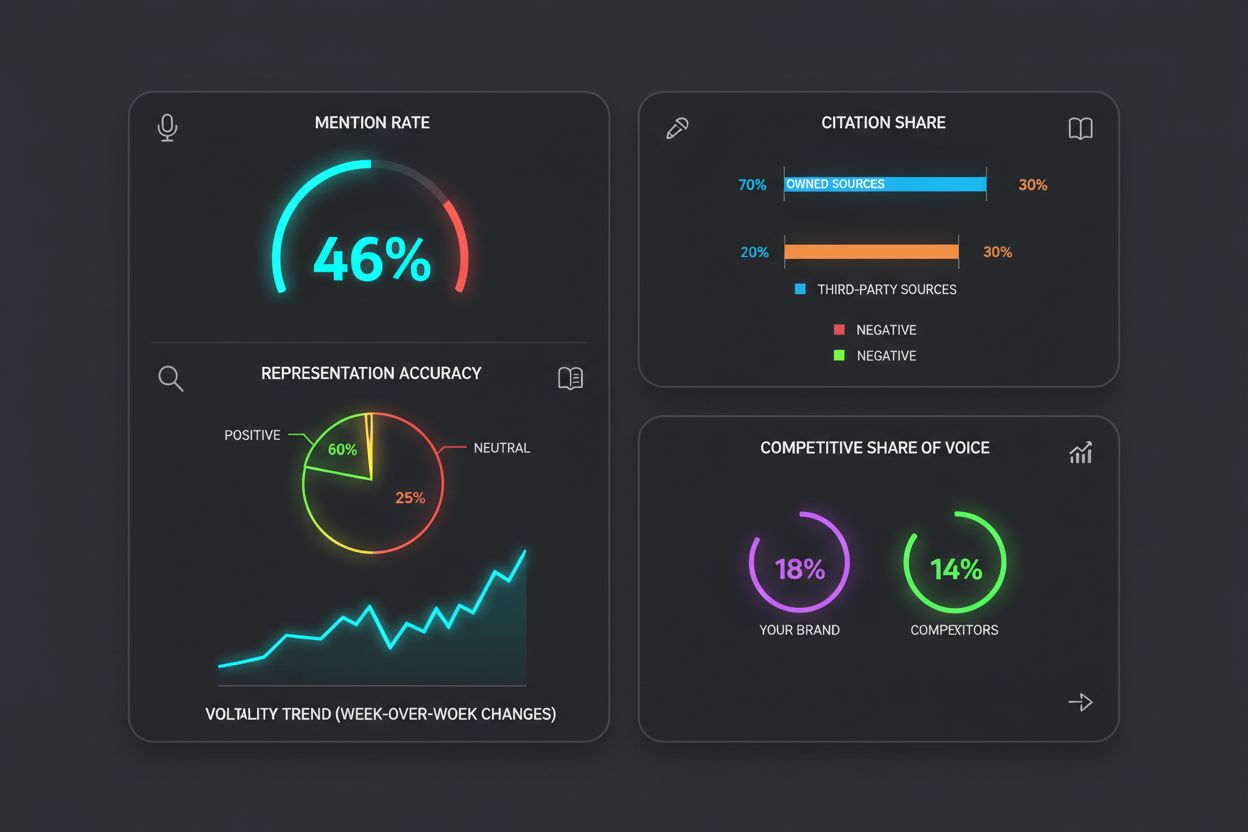
Quick reference guide to AI visibility monitoring. Track mentions, citations, and brand presence across ChatGPT, Google AI Overviews, Perplexity, and Gemini wit...