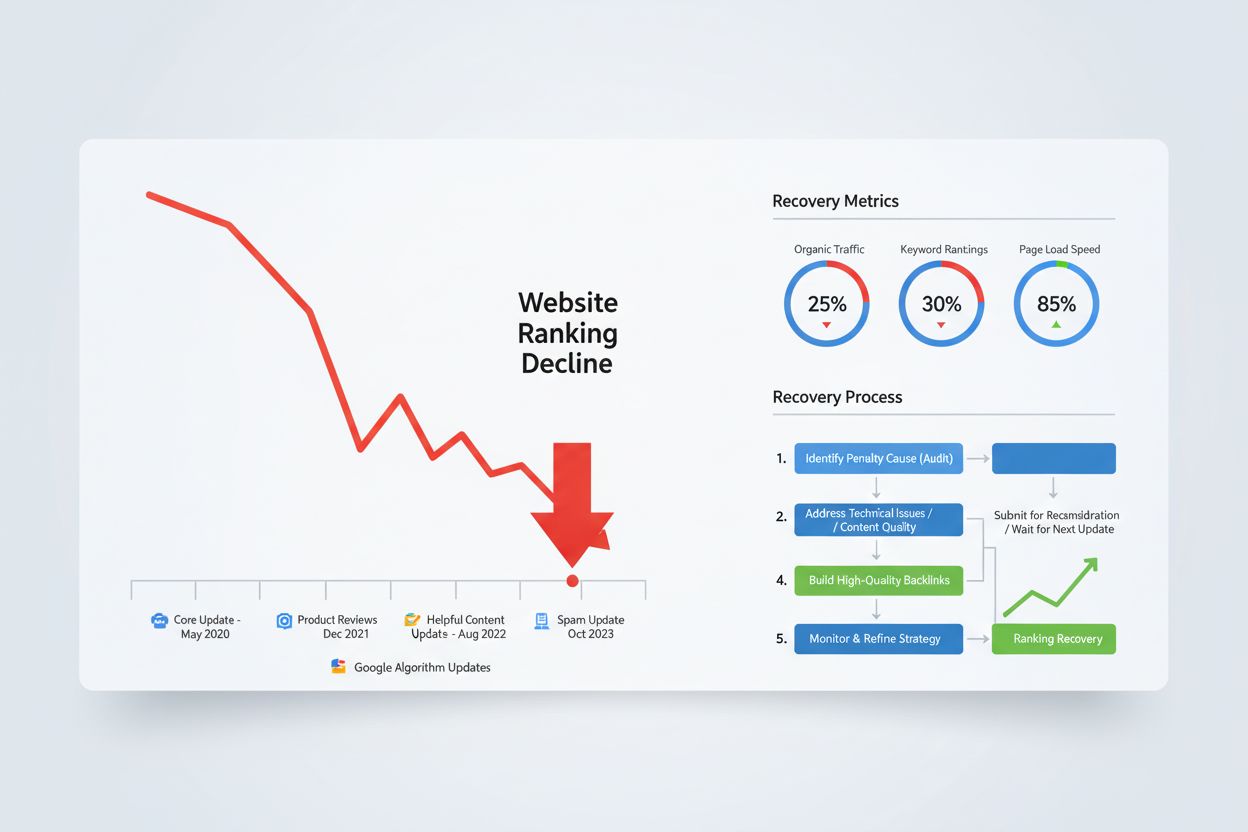
Definition of Algorithmic Penalty
An algorithmic penalty is an automatic ranking demotion applied by Google’s search algorithms when a website violates quality guidelines, exhibits spam signals, or fails to meet evolving ranking criteria. Unlike manual penalties issued by human reviewers, algorithmic penalties are triggered automatically by algorithm updates and operate without explicit notification to the website owner. The penalty manifests as decreased visibility in search results, reduced organic traffic, and lower keyword rankings across affected pages or the entire domain. This distinction is critical because algorithmic penalties require different recovery strategies—fixing the underlying issues rather than submitting reconsideration requests to Google.
Context and Background: The Evolution of Algorithmic Penalties
Algorithmic penalties have been a cornerstone of Google’s quality control system since the company’s earliest ranking algorithms. However, the concept evolved significantly with major algorithm updates like Google Panda (2011), which targeted low-quality and duplicate content, and Google Penguin (2012), which penalized unnatural link profiles. These updates represented a shift from reactive manual enforcement to proactive algorithmic filtering. Today, algorithmic penalties are more sophisticated and nuanced, with Google’s systems evaluating hundreds of ranking factors simultaneously. Research indicates that websites impacted by algorithm updates can take 3–6 months or longer to recover, with only 35% of sites affected by core algorithm updates recovering naturally within 30 days. This extended recovery timeline underscores the severity of algorithmic penalties and the importance of prevention. The rise of AI-generated content has introduced new penalty vectors, as Google’s Helpful Content Update specifically targets content created primarily for ranking rather than user value, regardless of creation method.
Algorithmic Penalty vs. Manual Penalty: Key Differences
| Aspect | Algorithmic Penalty | Manual Penalty |
|---|
| Trigger | Automatic algorithm update or system detection | Human Google reviewer identifies violation |
| Notification | No notification; discovered through traffic analysis | Email notification and Search Console alert |
| Visibility | Not visible in Google Search Console | Appears in Manual Actions section of GSC |
| Recovery Method | Fix underlying issues; automatic recovery on re-crawl | Submit reconsideration request after fixes |
| Scope | Can affect entire site or specific pages | Typically affects entire site or large sections |
| Detection Difficulty | Requires analysis and correlation with update dates | Immediately obvious from GSC notification |
| Common Causes | Content quality, links, UX, technical issues | Spam, manipulation, policy violations |
| Recovery Timeline | 3–6 months or longer; gradual improvement | Weeks to months after reconsideration approval |
How Algorithmic Penalties Work: Technical Mechanisms
Algorithmic penalties operate through Google’s automated ranking systems, which continuously evaluate websites against quality criteria. When Google’s algorithms detect patterns that violate guidelines—such as keyword stuffing, thin content, or unnatural backlinks—the system automatically reduces the site’s visibility in search results. The penalty isn’t a single action but rather a recalibration of the site’s trustworthiness and relevance scores. Google’s systems use machine learning to identify spam signals and quality issues at scale, processing billions of pages and adjusting rankings in real-time or during major updates. The Helpful Content Update, for example, uses E-E-A-T signals (Experience, Expertise, Authoritativeness, Trustworthiness) to evaluate whether content genuinely helps users or exists solely for ranking purposes. When a site fails these evaluations, its rankings decline across affected topics. Importantly, algorithmic penalties are not permanent—they reverse automatically when the underlying issues are fixed and Google’s bots re-crawl and re-evaluate the site. However, this recovery process can be slow, as it depends on crawl frequency, the extent of fixes, and how comprehensively the issues are addressed.
Stay Updated on AI Visibility Trends
Get the latest insights on AI mentions, brand monitoring, and optimization strategies.
Major Algorithm Updates That Cause Penalties
Google releases hundreds of algorithm updates annually, but several major updates have caused widespread algorithmic penalties. Google Panda targeted sites with duplicate, plagiarized, or low-quality content, affecting approximately 12% of search results in its initial rollout. Google Penguin penalized unnatural link profiles, particularly sites with excessive exact-match anchor text or links from low-quality directories. The Helpful Content Update, launched in 2022 and refined continuously, has become one of the most impactful penalty systems, specifically targeting AI-generated content without human oversight and content created primarily for search engines rather than users. Core Updates, released quarterly, broadly re-evaluate content quality and relevance, often causing significant ranking fluctuations. Page Experience Updates penalize sites with poor Core Web Vitals, intrusive ads, and mobile usability issues. Understanding which algorithm update caused your penalty is essential for developing an effective recovery strategy, as different updates target different quality factors.
Identifying Algorithmic Penalties: Detection Strategies
Detecting algorithmic penalties requires systematic analysis because, unlike manual penalties, they don’t generate notifications. Start by monitoring organic traffic in Google Analytics, looking for sudden drops that correlate with known algorithm update dates. Use Google Search Console’s Performance report to track changes in impressions, clicks, and average ranking position. Analyze which pages or content types are most affected—if the penalty is site-wide, it suggests a broad quality issue; if isolated to specific sections, it may indicate topic-specific problems. Rank tracking tools like Semrush or Ahrefs provide visibility into keyword position changes and can highlight patterns in affected keywords. Compare branded versus unbranded query performance to understand whether the penalty affects your entire site or specific content areas. Check crawl statistics in Google Search Console to see if Googlebot’s crawl frequency has changed, which can indicate reduced trust. Finally, examine your backlink profile for sudden increases in low-quality links or changes in link velocity, as these can trigger Penguin-related penalties. Comprehensive analysis across multiple data sources provides the clearest picture of whether you’ve been penalized and what caused it.
Content Quality and Algorithmic Penalties
Content quality is the primary factor in most algorithmic penalties. Google’s algorithms evaluate whether content provides genuine value to users or exists primarily to rank in search results. Thin content—pages with minimal original information, excessive filler, or content that merely rewrites existing material—triggers penalties under the Helpful Content Update. Keyword stuffing, the practice of overloading pages with keywords unnaturally, signals manipulation and results in ranking demotions. Duplicate content, whether across your own site or copied from competitors, reduces the perceived value of your pages. AI-generated content without human editing, fact-checking, or original insights increasingly triggers penalties, as Google’s systems can detect patterns typical of unedited AI output. To avoid content-related penalties, focus on creating original, in-depth content that demonstrates genuine expertise and answers user questions comprehensively. Include author credentials, cite authoritative sources, and provide first-hand experience or data. Update existing content regularly to maintain freshness and accuracy. Conduct content audits to identify and improve or remove low-quality pages. The emphasis should always be on user value rather than keyword optimization.
Unnatural backlinks remain a significant cause of algorithmic penalties, particularly those triggered by Google Penguin. A toxic backlink profile typically includes links from low-quality or irrelevant domains, excessive exact-match anchor text, sudden spikes in link velocity, or links from known spam sources. Google’s algorithms now primarily ignore low-quality links rather than actively penalizing them, but a severely unnatural profile can still trigger algorithmic demotions. To maintain a healthy backlink profile, focus on earning links from authoritative, relevant websites through high-quality content and digital PR. Regularly audit your backlinks using tools like Google Search Console or Ahrefs, identifying suspicious or low-quality links. If you discover toxic links, attempt to contact webmasters and request removal. If removal isn’t possible, use Google’s Disavow Tool to tell Google to ignore those links. Avoid link-building tactics like link exchanges, paid links from low-quality sites, or links from private blog networks (PBNs). Monitor your link velocity—sudden increases in backlinks can appear unnatural and trigger penalties. Building a strong backlink profile takes time and requires consistent effort to earn links from reputable sources.
Recovery Strategies: Fixing Algorithmic Penalties
Recovering from an algorithmic penalty requires identifying and fixing the root causes. Start with a comprehensive SEO audit that evaluates content quality, technical SEO, backlinks, user experience, and E-E-A-T signals. Document all issues and prioritize them by severity and impact. For content-related penalties, audit your site’s pages, remove or significantly improve thin content, merge duplicate or overlapping content, and ensure all remaining content provides genuine value. Update outdated information, add author credentials, and strengthen citations and sources. For link-related penalties, clean up your backlink profile by removing or disavowing toxic links. For technical issues, improve page speed, fix broken links, optimize for mobile, and ensure proper site structure. Implement E-E-A-T improvements by adding detailed author bios, transparent contact information, and trust signals. After implementing fixes, monitor your traffic and rankings closely. Recovery typically happens gradually over multiple crawl cycles, so patience is essential. Some sites recover within weeks, while others may take months. Resubmit your sitemap to Google Search Console to encourage faster re-crawling of updated pages. Avoid making the same mistakes that caused the penalty in the first place.
Essential Recovery Steps and Best Practices
- Conduct a forensic SEO audit to identify all quality issues, technical problems, and policy violations contributing to the penalty
- Remove or improve thin content that provides minimal value, lacks originality, or exists primarily for ranking purposes
- Clean up your backlink profile by identifying and removing or disavowing toxic, low-quality, or unnatural links
- Strengthen E-E-A-T signals through author credentials, transparent business information, and credible source citations
- Optimize technical SEO including page speed, mobile usability, Core Web Vitals, and site structure
- Update and refresh existing content to improve accuracy, depth, and relevance to current search intent
- Implement proper internal linking to establish topical authority and guide users through related content
- Monitor recovery progress using Google Search Console, Google Analytics, and rank tracking tools
- Avoid over-optimization that could trigger new penalties, such as keyword stuffing or unnatural link building
- Document all changes and maintain records of fixes implemented for future reference and prevention
Future Outlook: Algorithmic Penalties in the AI Search Era
As AI search engines like ChatGPT, Perplexity, and Google’s AI Overviews become increasingly prominent, the concept of algorithmic penalties is evolving. Traditional algorithmic penalties in Google Search will remain critical, but websites must now consider visibility across multiple AI platforms. Algorithmic penalties that reduce Google rankings often correlate with reduced citations in AI-generated responses, creating a compounding visibility loss. Google’s algorithms are becoming more sophisticated in detecting AI-generated content, with the Helpful Content Update specifically targeting low-quality AI content. Future algorithm updates will likely place greater emphasis on original research, first-hand experience, and verifiable expertise—factors that distinguish human-created content from mass-produced AI output. The rise of Generative Engine Optimization (GEO) means that SEO professionals must optimize not just for traditional search but for AI citation and inclusion. Websites that maintain high E-E-A-T standards, produce genuinely helpful content, and build strong topical authority will be better positioned to avoid penalties across all search channels. Monitoring tools like AmICited will become increasingly important for tracking how algorithm changes affect your visibility in both traditional search and AI responses, providing early warning signs of emerging penalties before they severely impact traffic.