
How to Use People Also Ask for AI Content Strategy
Learn how to leverage Google's People Also Ask feature to create AI-optimized content that ranks in AI search engines and improves brand visibility in AI answer...
9 min read
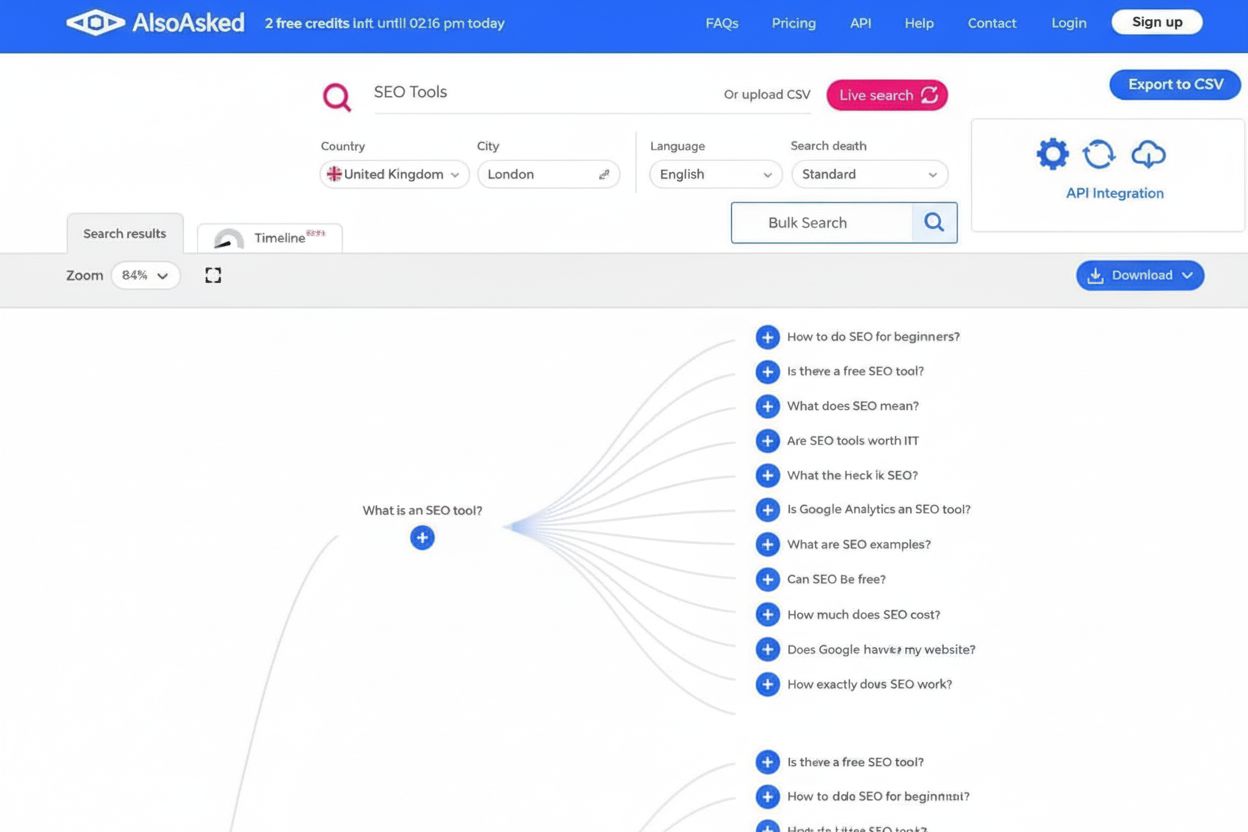
AlsoAsked is a specialized keyword research tool that extracts and visualizes questions from Google’s People Also Ask (PAA) feature, organizing them into hierarchical tree structures to reveal user search intent and content opportunities. The platform provides live PAA data with intent clustering capabilities, supporting multiple languages and regions for comprehensive question-based keyword research.
AlsoAsked is a specialized keyword research tool that extracts and visualizes questions from Google's People Also Ask (PAA) feature, organizing them into hierarchical tree structures to reveal user search intent and content opportunities. The platform provides live PAA data with intent clustering capabilities, supporting multiple languages and regions for comprehensive question-based keyword research.
AlsoAsked is a specialized keyword research and content ideation platform that extracts and visualizes questions from Google’s People Also Ask (PAA) feature, organizing them into hierarchical tree structures to reveal user search intent and content opportunities. Founded in 2019 by digital strategist Mark Williams-Cook, AlsoAsked addresses a critical gap in traditional keyword research by focusing specifically on the actual questions users are asking rather than just search volume metrics. The platform provides live PAA data with advanced intent clustering capabilities, supporting any region and any language to enable comprehensive question-based keyword research. Unlike general SEO tools that treat PAA as a secondary feature, AlsoAsked makes question discovery its core function, allowing content creators, SEO professionals, and agencies to understand the complete landscape of user queries around any topic. The tool’s unique value proposition lies in its ability to map connections between topics, revealing how different questions relate to each other and how user curiosity progresses through a topic journey.
The People Also Ask feature first appeared in Google search results in 2015, but for nearly a decade, most SEO professionals treated it as a curiosity rather than a strategic opportunity. According to Semrush Sensor data from August 2024, PAA boxes appear in 51.85% of all searches, making them one of the most prevalent SERP features available. This widespread presence represents a fundamental shift in how Google presents search results—moving from a simple ranked list to a more exploratory, question-driven interface. The emergence of PAA boxes reflects Google’s broader evolution from a search engine into a knowledge engine, designed to help users explore topics more deeply without requiring additional searches. For content creators and SEO professionals, this shift created both a challenge and an opportunity: the challenge of understanding which questions to target, and the opportunity to gain visibility in a feature that appears in more than half of all searches. AlsoAsked emerged as a response to this opportunity, providing the first tool specifically designed to extract, organize, and analyze PAA data at scale. The platform’s development coincided with increasing recognition that question-based keywords represent a distinct category of search intent, often with lower competition and higher conversion potential than traditional keyword research suggests.
AlsoAsked operates by automatically interacting with Google’s PAA boxes in a manner similar to how a real user would explore them. When you enter a keyword or phrase into the platform, the tool navigates to Google’s search results and systematically expands each PAA question to trigger related follow-up questions. This automated process reveals the hierarchical structure of questions that Google associates with your search term. The platform then organizes these questions into a visual tree structure, with your original keyword at the center and related questions branching outward in layers. Each node in the tree represents a question, and clicking on any node reveals additional related questions, creating a comprehensive map of user curiosity around your topic. The deep search functionality extends this process to three levels deep, generating approximately 100-150 questions per query compared to the standard 25 questions from a basic search. This hierarchical organization is crucial because it reveals not just what questions exist, but how they relate to each other—information that traditional keyword research tools cannot provide. The platform’s intent clustering capability analyzes these questions to group them by semantic similarity and user intent, helping content strategists understand which questions should be addressed in the same piece of content and which require separate, dedicated pages.
| Feature | AlsoAsked | AnswerThePublic | kwrds.ai | Semrush |
|---|---|---|---|---|
| Data Source | Google PAA boxes | Google autocomplete | Real-time Google data | Search engines |
| Questions per Query | 100-150 (deep search) | 6-12 | Up to 100 | Variable |
| Language Support | All languages | Multiple languages | 190+ languages | Multiple languages |
| Export Formats | PNG, CSV | PNG, CSV | JSON-formatted data | CSV |
| API Access | Yes (Pro plan) | Limited | Yes | Yes |
| Bulk Processing | Up to 1,000 keywords | Limited | Yes | Yes |
| Search Metrics | None | Basic (volume, CPC) | Yes | Yes (volume, difficulty, CPC) |
| Starting Price | $12/month | $9/month | Varies | $108.33/month (annual) |
| Free Daily Searches | 3 | 3 | Limited | Limited |
| Unique Strength | Hierarchical question mapping | Visual wheel interface | Real-time multilingual data | Comprehensive SEO suite |
The business value of AlsoAsked extends far beyond simple keyword discovery. For content marketing teams, the platform enables a fundamental shift in how content strategy is developed—moving from assumption-based planning to data-driven question mapping. Organizations using AlsoAsked have reported significant improvements in content relevance and search visibility, with some documenting up to 300 new daily clicks within days of optimizing content based on PAA data. This impact is particularly pronounced for newer websites and emerging brands that lack the domain authority to rank for competitive keywords but can capture visibility through targeted PAA optimization. For SaaS companies and B2B organizations, AlsoAsked provides invaluable insights into how prospects are researching solutions, enabling product marketing teams to align messaging with actual user questions. The platform’s bulk search capability makes it especially valuable for agencies managing multiple client accounts, allowing teams to process hundreds or thousands of keywords simultaneously and generate comprehensive content briefs at scale. Additionally, the CSV export functionality enables seamless integration with content management systems, project management tools, and other SEO platforms, creating efficient workflows that reduce manual data entry and human error. The platform’s support for multiple languages and regions makes it indispensable for enterprises pursuing international SEO strategies, as it reveals how user questions vary across different markets and linguistic contexts.
In the context of AI search and generative engine optimization (GEO), AlsoAsked’s role becomes increasingly significant. As AI systems like ChatGPT, Perplexity, Google AI Overviews, and Claude become primary search interfaces for many users, understanding the questions these systems are answering becomes critical for brand visibility. AlsoAsked’s question-based approach aligns perfectly with how AI systems process and respond to queries—these systems are fundamentally question-answering engines that rely on understanding user intent through the specific questions being asked. By optimizing content for the questions AlsoAsked reveals, organizations simultaneously optimize for both traditional search and AI-generated responses. The platform’s intent clustering capability is particularly relevant here, as it helps content creators understand the semantic relationships between questions that AI systems recognize. When combined with AI monitoring tools like AmICited, which track how brands appear in AI-generated responses, AlsoAsked provides the foundational question research needed to ensure content is discoverable by both search engines and large language models. The platform’s API access enables integration with AI monitoring dashboards, allowing teams to track not just whether their content appears in PAA boxes, but also how it’s being cited and referenced in AI-generated responses.
Effective use of AlsoAsked requires a strategic approach that goes beyond simply extracting questions. The first step is to identify which keywords and topics are worth researching—not all queries trigger PAA boxes, so it’s important to verify that your target keywords actually display PAA features before investing optimization effort. Once you’ve confirmed PAA presence, export the question data as a CSV file to analyze the current answers Google is displaying. This analysis reveals the format, length, and structure that Google favors for each question, providing a template for your own content. The next step is to map these questions to your existing content and identify gaps. Many organizations discover that they’re already answering some PAA questions but not others, or that their answers don’t match the format Google is currently featuring. Updating content to address these gaps often results in rapid visibility improvements. For new content creation, use AlsoAsked’s hierarchical structure to inform your content architecture. The tree structure often reveals natural pillar page and cluster content relationships—your main keyword becomes a pillar page, while related questions become supporting cluster content that links back to the pillar. This structure strengthens topical authority and improves internal linking patterns. Additionally, consider using FAQ schema markup to explicitly signal to Google that your content answers specific questions, though schema alone is not sufficient without high-quality, relevant content.
The landscape of People Also Ask tools continues to evolve rapidly, driven by changes in how Google presents search results and how AI systems process queries. Recent developments show that Google is now generating approximately 12.6% of PAA answers using AI, according to analysis of over 8.4 million English-language PAA results. This shift has significant implications for AlsoAsked and similar tools—as Google increasingly generates answers rather than pulling them from existing web content, the nature of PAA optimization changes. Content creators will need to focus not just on matching existing answer formats, but on creating content that AI systems recognize as authoritative and trustworthy enough to cite. The future of AlsoAsked likely involves deeper integration with AI monitoring capabilities, enabling users to track not just whether their content appears in PAA boxes, but how it’s being cited and referenced in AI-generated responses. The platform’s API capabilities position it well for this evolution, as teams will increasingly need programmatic access to question data for integration with AI monitoring dashboards and content optimization workflows. Additionally, as voice search and conversational AI become more prevalent, the importance of question-based keyword research will only increase—users interacting with voice assistants and chatbots naturally phrase their queries as questions, making AlsoAsked’s focus on question discovery increasingly central to SEO strategy. The platform’s support for multiple languages and regions also positions it well for the globalization of AI search, as organizations will need to understand how questions vary across different markets and how AI systems respond to these variations.
For organizations using AmICited to monitor their brand’s appearance in AI-generated responses, AlsoAsked provides essential complementary intelligence. While AmICited tracks where and how your brand appears in AI systems, AlsoAsked reveals the questions that drive those appearances. By understanding the specific questions users are asking about your industry, products, or services, you can create content that directly addresses these queries and increases the likelihood of being cited by AI systems. The combination of these two approaches—question research through AlsoAsked and citation monitoring through AmICited—creates a comprehensive strategy for AI visibility. When you optimize content for the questions AlsoAsked reveals, you’re simultaneously optimizing for the queries that AI systems will encounter and the contexts in which your brand might be mentioned. This integrated approach is particularly valuable for SaaS companies, fintech organizations, and other technology-focused businesses where AI search is becoming a primary discovery channel. The data from AlsoAsked can inform content strategy that ensures your brand appears not just in traditional search results, but in the AI-generated responses that increasingly influence user decisions.
+++
AlsoAsked is a specialized keyword research and content ideation platform that extracts and visualizes questions from Google’s People Also Ask (PAA) feature, organizing them into hierarchical tree structures to reveal user search intent and content opportunities. Founded in 2019 by digital strategist Mark Williams-Cook, AlsoAsked addresses a critical gap in traditional keyword research by focusing specifically on the actual questions users are asking rather than just search volume metrics. The platform provides live PAA data with advanced intent clustering capabilities, supporting any region and any language to enable comprehensive question-based keyword research. Unlike general SEO tools that treat PAA as a secondary feature, AlsoAsked makes question discovery its core function, allowing content creators, SEO professionals, and agencies to understand the complete landscape of user queries around any topic. The tool’s unique value proposition lies in its ability to map connections between topics, revealing how different questions relate to each other and how user curiosity progresses through a topic journey.
The People Also Ask feature first appeared in Google search results in 2015, but for nearly a decade, most SEO professionals treated it as a curiosity rather than a strategic opportunity. According to Semrush Sensor data from August 2024, PAA boxes appear in 51.85% of all searches, making them one of the most prevalent SERP features available. This widespread presence represents a fundamental shift in how Google presents search results—moving from a simple ranked list to a more exploratory, question-driven interface. The emergence of PAA boxes reflects Google’s broader evolution from a search engine into a knowledge engine, designed to help users explore topics more deeply without requiring additional searches. For content creators and SEO professionals, this shift created both a challenge and an opportunity: the challenge of understanding which questions to target, and the opportunity to gain visibility in a feature that appears in more than half of all searches. AlsoAsked emerged as a response to this opportunity, providing the first tool specifically designed to extract, organize, and analyze PAA data at scale. The platform’s development coincided with increasing recognition that question-based keywords represent a distinct category of search intent, often with lower competition and higher conversion potential than traditional keyword research suggests. Research indicates that over 80% of English search results now display PAA boxes, underscoring the importance of understanding and optimizing for these features.
AlsoAsked operates by automatically interacting with Google’s PAA boxes in a manner similar to how a real user would explore them. When you enter a keyword or phrase into the platform, the tool navigates to Google’s search results and systematically expands each PAA question to trigger related follow-up questions. This automated process reveals the hierarchical structure of questions that Google associates with your search term. The platform then organizes these questions into a visual tree structure, with your original keyword at the center and related questions branching outward in layers. Each node in the tree represents a question, and clicking on any node reveals additional related questions, creating a comprehensive map of user curiosity around your topic. The deep search functionality extends this process to three levels deep, generating approximately 100-150 questions per query compared to the standard 25 questions from a basic search. This hierarchical organization is crucial because it reveals not just what questions exist, but how they relate to each other—information that traditional keyword research tools cannot provide. The platform’s intent clustering capability analyzes these questions to group them by semantic similarity and user intent, helping content strategists understand which questions should be addressed in the same piece of content and which require separate, dedicated pages. The tool’s ability to process up to 1,000 keywords simultaneously through bulk search makes it possible for large organizations to conduct comprehensive question research across their entire content portfolio in a single operation.
The business value of AlsoAsked extends far beyond simple keyword discovery. For content marketing teams, the platform enables a fundamental shift in how content strategy is developed—moving from assumption-based planning to data-driven question mapping. Organizations using AlsoAsked have reported significant improvements in content relevance and search visibility, with some documenting up to 300 new daily clicks within days of optimizing content based on PAA data. This impact is particularly pronounced for newer websites and emerging brands that lack the domain authority to rank for competitive keywords but can capture visibility through targeted PAA optimization. For SaaS companies and B2B organizations, AlsoAsked provides invaluable insights into how prospects are researching solutions, enabling product marketing teams to align messaging with actual user questions. The platform’s bulk search capability makes it especially valuable for agencies managing multiple client accounts, allowing teams to process hundreds or thousands of keywords simultaneously and generate comprehensive content briefs at scale. Additionally, the CSV export functionality enables seamless integration with content management systems, project management tools, and other SEO platforms, creating efficient workflows that reduce manual data entry and human error. The platform’s support for multiple languages and regions makes it indispensable for enterprises pursuing international SEO strategies, as it reveals how user questions vary across different markets and linguistic contexts. Research shows that 15% of Google searches are entirely new every day, making continuous question research essential for staying ahead of emerging search trends and user interests.
In the context of AI search and generative engine optimization (GEO), AlsoAsked’s role becomes increasingly significant. As AI systems like ChatGPT, Perplexity, Google AI Overviews, and Claude become primary search interfaces for many users, understanding the questions these systems are answering becomes critical for brand visibility. AlsoAsked’s question-based approach aligns perfectly with how AI systems process and respond to queries—these systems are fundamentally question-answering engines that rely on understanding user intent through the specific questions being asked. By optimizing content for the questions AlsoAsked reveals, organizations simultaneously optimize for both traditional search and AI-generated responses. The platform’s intent clustering capability is particularly relevant here, as it helps content creators understand the semantic relationships between questions that AI systems recognize. When combined with AI monitoring tools like AmICited, which track how brands appear in AI-generated responses, AlsoAsked provides the foundational question research needed to ensure content is discoverable by both search engines and large language models. The platform’s API access enables integration with AI monitoring dashboards, allowing teams to track not just whether their content appears in PAA boxes, but also how it’s being cited and referenced in AI-generated responses. This integration represents a critical evolution in SEO strategy, as the line between traditional search optimization and AI visibility becomes increasingly blurred.
Effective use of AlsoAsked requires a strategic approach that goes beyond simply extracting questions. The first step is to identify which keywords and topics are worth researching—not all queries trigger PAA boxes, so it’s important to verify that your target keywords actually display PAA features before investing optimization effort. Once you’ve confirmed PAA presence, export the question data as a CSV file to analyze the current answers Google is displaying. This analysis reveals the format, length, and structure that Google favors for each question, providing a template for your own content. The next step is to map these questions to your existing content and identify gaps. Many organizations discover that they’re already answering some PAA questions but not others, or that their answers don’t match the format Google is currently featuring. Updating content to address these gaps often results in rapid visibility improvements. For new content creation, use AlsoAsked’s hierarchical structure to inform your content architecture. The tree structure often reveals natural pillar page and cluster content relationships—your main keyword becomes a pillar page, while related questions become supporting cluster content that links back to the pillar. This structure strengthens topical authority and improves internal linking patterns. Additionally, consider using FAQ schema markup to explicitly signal to Google that your content answers specific questions, though schema alone is not sufficient without high-quality, relevant content. The most successful implementations combine AlsoAsked’s question research with comprehensive content that directly addresses user intent at each level of the question hierarchy.
The landscape of People Also Ask tools continues to evolve rapidly, driven by changes in how Google presents search results and how AI systems process queries. Recent developments show that Google is now generating approximately 12.6% of PAA answers using AI, according to analysis of over 8.4 million English-language PAA results. This shift has significant implications for AlsoAsked and similar tools—as Google increasingly generates answers rather than pulling them from existing web content, the nature of PAA optimization changes. Content creators will need to focus not just on matching existing answer formats, but on creating content that AI systems recognize as authoritative and trustworthy enough to cite. The future of AlsoAsked likely involves deeper integration with AI monitoring capabilities, enabling users to track not just whether their content appears in PAA boxes, but how it’s being cited and referenced in AI-generated responses. The platform’s API capabilities position it well for this evolution, as teams will increasingly need programmatic access to question data for integration with AI monitoring dashboards and content optimization workflows. Additionally, as voice search and conversational AI become more prevalent, the importance of question-based keyword research will only increase—users interacting with voice assistants and chatbots naturally phrase their queries as questions, making AlsoAsked’s focus on question discovery increasingly central to SEO strategy. The platform’s support for multiple languages and regions also positions it well for the globalization of AI search, as organizations will need to understand how questions vary across different markets and how AI systems respond to these variations. The integration of AI-generated answers into PAA boxes represents a fundamental shift in how content optimization works, requiring tools like AlsoAsked to evolve beyond simple question extraction toward understanding how AI systems evaluate and cite content.
For organizations using AmICited to monitor their brand’s appearance in AI-generated responses, AlsoAsked provides essential complementary intelligence. While AmICited tracks where and how your brand appears in AI systems, AlsoAsked reveals the questions that drive those appearances. By understanding the specific questions users are asking about your industry, products, or services, you can create content that directly addresses these queries and increases the likelihood of being cited by AI systems. The combination of these two approaches—question research through AlsoAsked and citation monitoring through AmICited—creates a comprehensive strategy for AI visibility. When you optimize content for the questions AlsoAsked reveals, you’re simultaneously optimizing for the queries that AI systems will encounter and the contexts in which your brand might be mentioned. This integrated approach is particularly valuable for SaaS companies, fintech organizations, and other technology-focused businesses where AI search is becoming a primary discovery channel. The data from AlsoAsked can inform content strategy that ensures your brand appears not just in traditional search results, but in the AI-generated responses that increasingly influence user decisions. As AI systems become more sophisticated in understanding and responding to user questions, the importance of question-based content optimization will only increase, making tools like AlsoAsked essential components of modern SEO and AI visibility strategies.
AlsoAsked distinguishes itself through its live PAA data extraction and intent clustering capabilities, combined with its hierarchical tree visualization that maps question relationships. Unlike competitors such as AnswerThePublic, AlsoAsked focuses specifically on Google's PAA boxes rather than autocomplete data, providing deeper question discovery through deep search functionality that reveals up to 150 related questions per query. The platform's API access with both synchronous and asynchronous options makes it the only tool enabling live PAA data integration with external applications and workflows.
AlsoAsked enables content strategists to identify content gaps by revealing the exact questions users are asking about specific topics. By visualizing question hierarchies, teams can structure pillar pages and supporting content around actual user intent rather than assumptions. The tool's bulk search capability allows processing up to 1,000 keywords simultaneously, making it invaluable for agencies and enterprises scaling content production while maintaining relevance to real search behavior.
AlsoAsked offers multiple export formats including PNG images for visual presentations and CSV files containing detailed question data with tier positions and ranking URLs. The CSV exports are particularly valuable for content teams who need to import question data into content management systems, spreadsheets, or other SEO tools for further analysis and implementation.
AlsoAsked offers three pricing tiers: Basic ($12/month for 100 credits with PNG export), Lite ($23/month for 300 credits with CSV export and deep search), and Pro ($47/month for 1,000 credits with bulk searches and API access). The Pro plan's API integration capability is unique among PAA tools, enabling programmatic access to live PAA data for automation and integration into existing SEO workflows and dashboards.
Yes, AlsoAsked supports any region and any language, making it highly effective for international SEO campaigns. Users can customize both language and location settings for each search, enabling teams to research user intent across different markets and linguistic contexts. This multilingual capability is particularly valuable for global enterprises and agencies managing content strategies across multiple regions.
The prevalence of PAA boxes in over half of all Google searches represents a significant SERP real estate opportunity for content creators. This statistic, based on Semrush Sensor data from August 2024, demonstrates that optimizing for PAA questions is not a niche strategy but a mainstream SEO consideration. Websites appearing in PAA boxes gain additional visibility and credibility signals, often ranking above traditional organic listings.
Standard searches in AlsoAsked explore two levels of PAA results and return approximately 25 questions, while deep searches dive three levels deep and generate around 100-150 questions per query. This comprehensive approach allows content creators to uncover hidden topic connections, generate more extensive content ideas, and map complete topic clusters that competitors using standard search tools might miss.
Start tracking how AI chatbots mention your brand across ChatGPT, Perplexity, and other platforms. Get actionable insights to improve your AI presence.
Learn how to leverage Google's People Also Ask feature to create AI-optimized content that ranks in AI search engines and improves brand visibility in AI answer...
Learn what People Also Ask (PAA) is, how it works, and why it matters for SEO. Discover optimization strategies to rank in PAA boxes and capture first-page SERP...
Community discussion on using Google's People Also Ask feature for AI content optimization. Strategies for leveraging PAA data to improve visibility in AI-gener...
Cookie Consent
We use cookies to enhance your browsing experience and analyze our traffic. See our privacy policy.