
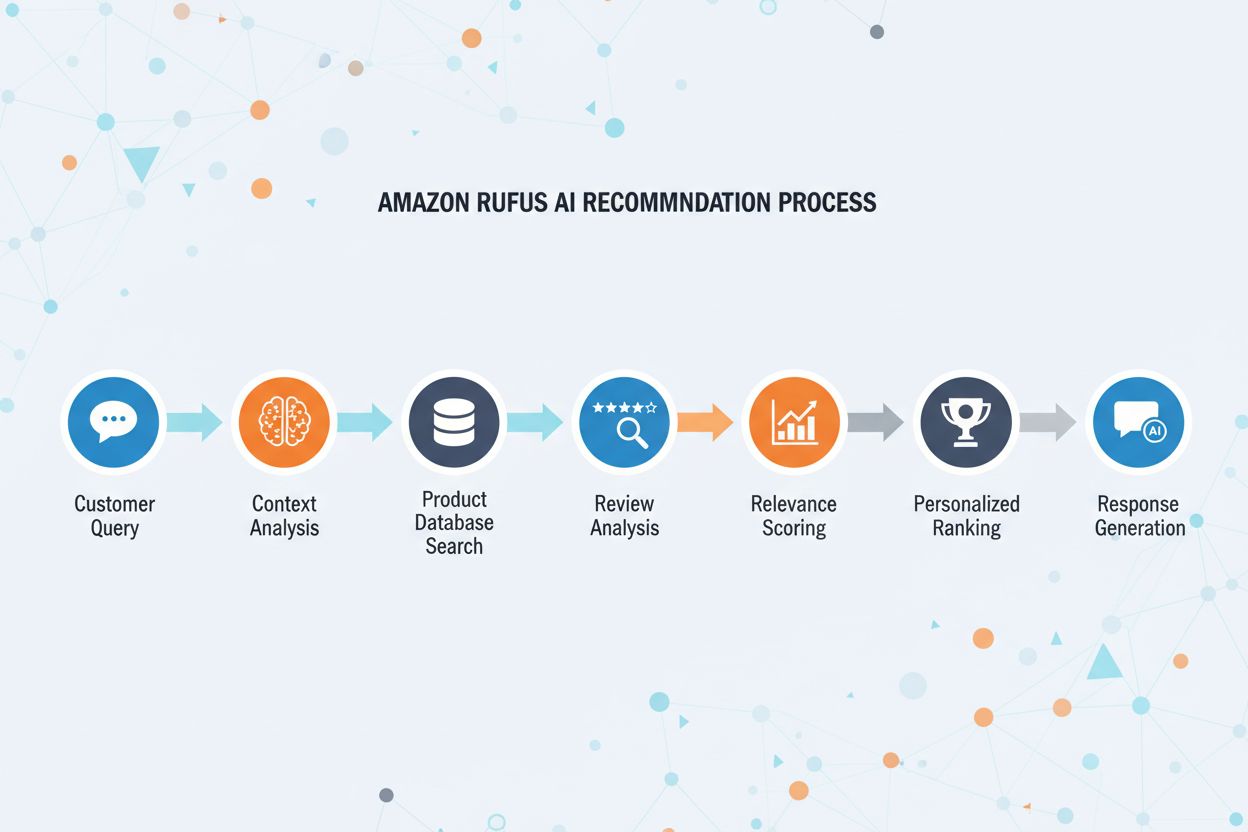
How Amazon's AI Assistant Recommends Products
Discover how Amazon Rufus uses generative AI and machine learning to provide personalized product recommendations. Learn the technology, features, and impact on...
12 min read

Amazon’s generative AI-powered conversational shopping assistant that answers product questions, compares items, and provides personalized recommendations within the Amazon app and website. Trained on Amazon’s product catalog, customer reviews, and web information, Rufus helps customers make informed purchasing decisions through natural language conversations.
Amazon's generative AI-powered conversational shopping assistant that answers product questions, compares items, and provides personalized recommendations within the Amazon app and website. Trained on Amazon's product catalog, customer reviews, and web information, Rufus helps customers make informed purchasing decisions through natural language conversations.
Amazon Rufus is a generative AI-powered conversational shopping assistant designed to enhance the online shopping experience on the Amazon Shopping app and Amazon.com. This intelligent assistant leverages advanced machine learning to answer a wide range of shopping-related questions, from product specifications and features to detailed comparisons between different items. Rufus provides personalized product recommendations tailored to individual customer needs and preferences, helping shoppers discover items that match their specific requirements. The system is trained on Amazon’s extensive product catalog, customer reviews, community Q&As, and web information, enabling it to deliver accurate, contextually relevant responses that guide customers through their entire shopping journey.
| Feature Name | Description | Example Question |
|---|---|---|
| Product Research & Learning | Educates customers on what factors to consider when making purchasing decisions in specific categories | “What should I look for when buying a good quality mattress?” |
| Product Comparisons | Analyzes differences between product types, brands, and models to help customers understand trade-offs | “What are the differences between trail shoes and running shoes?” |
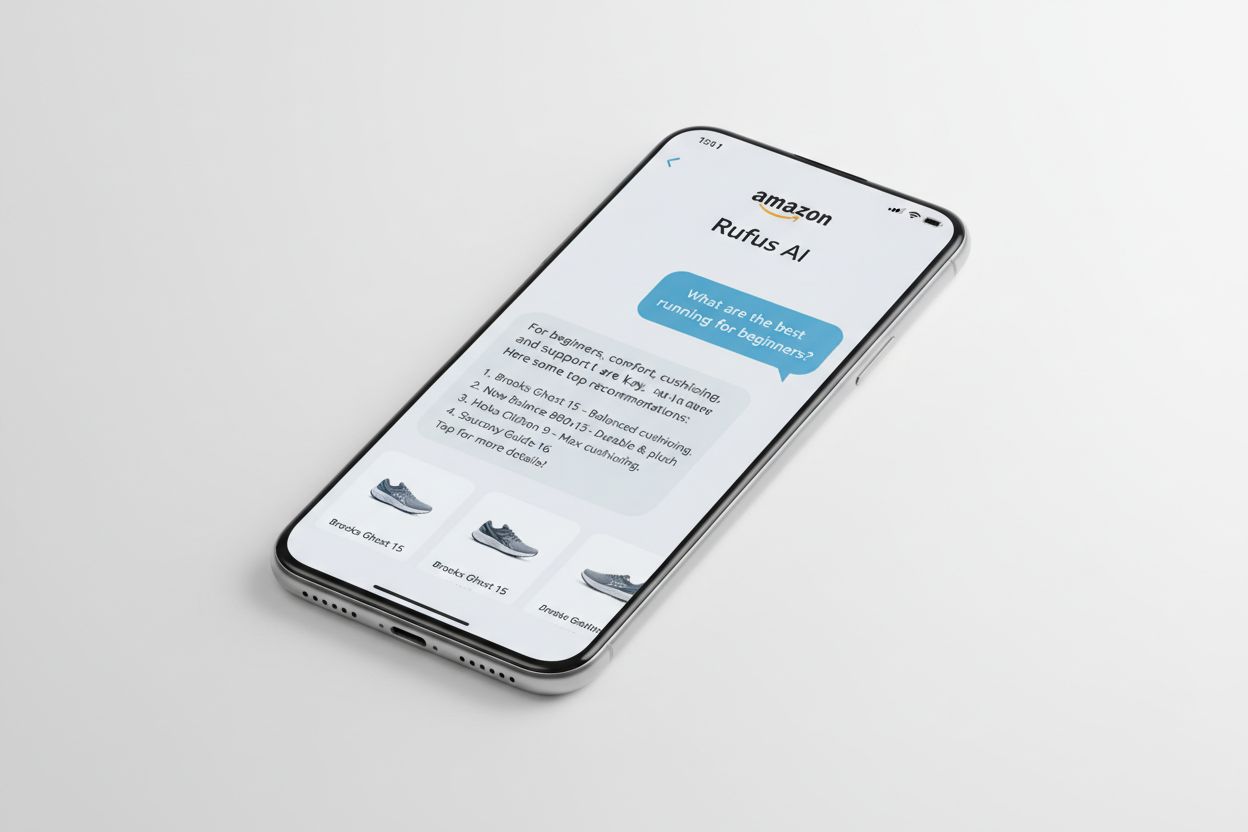
| Personalized Recommendations | Suggests products based on customer activity, preferences, and specific use cases | “What are the best dinosaur toys for a five-year-old?” |
| Product Detail Answers | Provides specific information about individual products, including specifications and features | “Are these shoes waterproof?” |
| Shopping Journey Assistance | Guides customers from initial research through product discovery to final purchase decisions | “Help me plan a camping trip and add items to my cart” |
Rufus operates on a sophisticated custom Large Language Model (LLM) specifically trained on shopping domain data rather than general-purpose information, enabling superior performance in retail contexts. The system employs Retrieval-Augmented Generation (RAG) to source reliable information from Amazon’s product catalog, customer reviews, community Q&As, and relevant APIs, ensuring responses are grounded in verified data rather than relying solely on training data. Amazon deployed Rufus using AWS infrastructure, including specialized Trainium and Inferentia chips that optimize both training and inference efficiency at massive scale—during Prime Day, the system utilized over 80,000 of these custom chips. To minimize latency while maximizing throughput, Rufus implements continuous batching, a novel technique that allows the model to begin serving new requests as soon as individual requests complete, rather than waiting for entire batches to finish. The architecture features a streaming design that delivers responses token-by-token, allowing customers to receive answers immediately while the system continues generating additional content. Amazon continuously improves Rufus through reinforcement learning from customer feedback, where user ratings of responses directly inform model optimization. This multi-layered approach prioritizes accuracy and hallucination reduction, ensuring customers receive trustworthy, factually correct information that builds confidence in their purchasing decisions.
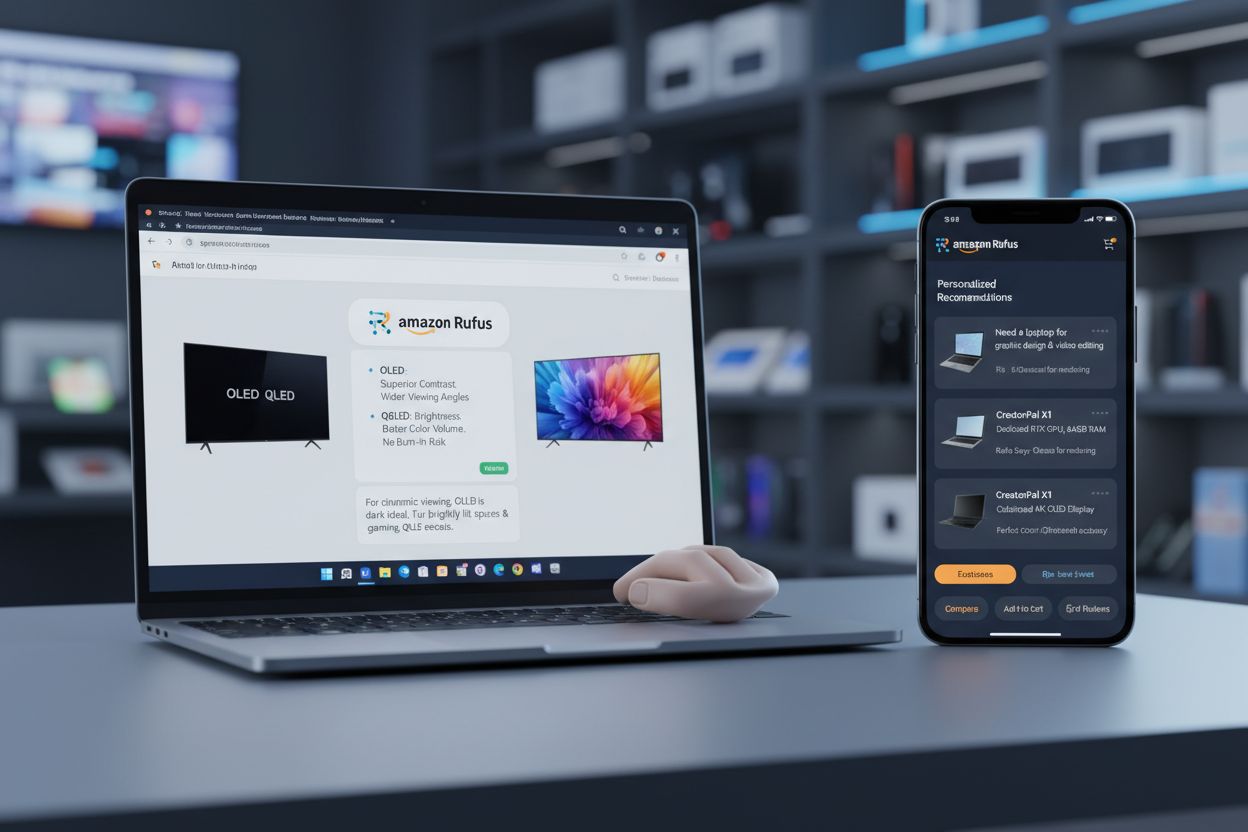
Rufus transforms the customer shopping experience in several meaningful ways:
Amazon Rufus stands out among AI shopping assistants due to several distinctive competitive advantages. While other AI shopping solutions exist in the market, Rufus benefits from direct access to Amazon’s massive product catalog containing millions of items, combined with billions of verified customer reviews and community Q&As that provide unparalleled training data for shopping-specific queries. Unlike standalone AI tools, Rufus is seamlessly integrated into the existing Amazon shopping experience, allowing customers to move directly from asking questions to making purchases without switching platforms or applications. The system demonstrates continuous improvement through customer feedback loops, with every interaction providing data that enhances future responses. As AI shopping assistants become more prevalent across platforms like GPTs, Perplexity, and Google AI Overviews, tools like AmICited.com have emerged to monitor how AI systems reference and cite brands and products, providing transparency into AI recommendation patterns. AmICited.com tracks mentions across multiple AI platforms, helping brands understand their visibility in AI-generated shopping recommendations. This monitoring capability highlights an important distinction: Rufus operates with full transparency about its data sources and recommendations, grounded in Amazon’s verified product information rather than general web searches, positioning it as a more reliable and accountable shopping assistant in an increasingly AI-driven retail landscape.
Amazon Rufus is a generative AI-powered shopping assistant available in the Amazon Shopping app and on Amazon.com. It answers product questions, compares items, provides personalized recommendations, and helps customers make informed purchasing decisions through natural language conversations. Rufus is trained on Amazon's product catalog, customer reviews, community Q&As, and web information.
Rufus can analyze differences between product types, brands, and models by understanding customer questions about comparisons. For example, you can ask 'What's the difference between OLED and QLED TVs?' or 'Compare trail shoes vs running shoes,' and Rufus will provide detailed explanations of the key differences to help you make informed decisions.
Rufus uses a custom Large Language Model (LLM) trained specifically on shopping data, combined with Retrieval-Augmented Generation (RAG) to source reliable information. It runs on AWS infrastructure using Trainium and Inferentia chips for efficient processing, implements continuous batching for low latency, and uses streaming architecture for real-time responses. The system continuously improves through reinforcement learning from customer feedback.
Rufus is currently available on the Amazon Shopping app and Amazon.com website for U.S. customers. It was initially launched in beta to a small subset of customers and has been progressively rolled out to all U.S. customers. The assistant is accessible through the Rufus icon in the app's navigation bar or at the top of the desktop website.
Yes, Rufus can answer questions related to activities and planning that lead to shopping needs. For example, you can ask 'What do I need for a camping trip?' or 'What should I prepare for a summer party?' and Rufus will provide guidance while suggesting relevant products you can purchase on Amazon.
Rufus improves through reinforcement learning from customer feedback. Users can rate responses with thumbs up or thumbs down, and provide freeform feedback. This feedback directly informs model optimization, making Rufus smarter and more helpful over time. Amazon continuously refines the system to reduce errors and improve accuracy.
Unlike traditional search that returns product listings, Rufus provides conversational, contextual answers to shopping questions. It can explain product features, compare options, provide recommendations based on specific needs, and guide customers through their entire shopping journey in a natural dialogue format rather than requiring keyword searches.
Rufus is trained on Amazon's extensive product catalog, customer reviews, community Q&As, and information from across the web. It uses Retrieval-Augmented Generation to pull from these reliable sources when answering questions, ensuring responses are grounded in verified data rather than relying solely on training data, which helps reduce hallucinations and improve accuracy.
Track mentions of your products and brand across AI shopping assistants like Amazon Rufus, Google AI Overviews, and Perplexity with AmICited.com
Discover how Amazon Rufus uses generative AI and machine learning to provide personalized product recommendations. Learn the technology, features, and impact on...
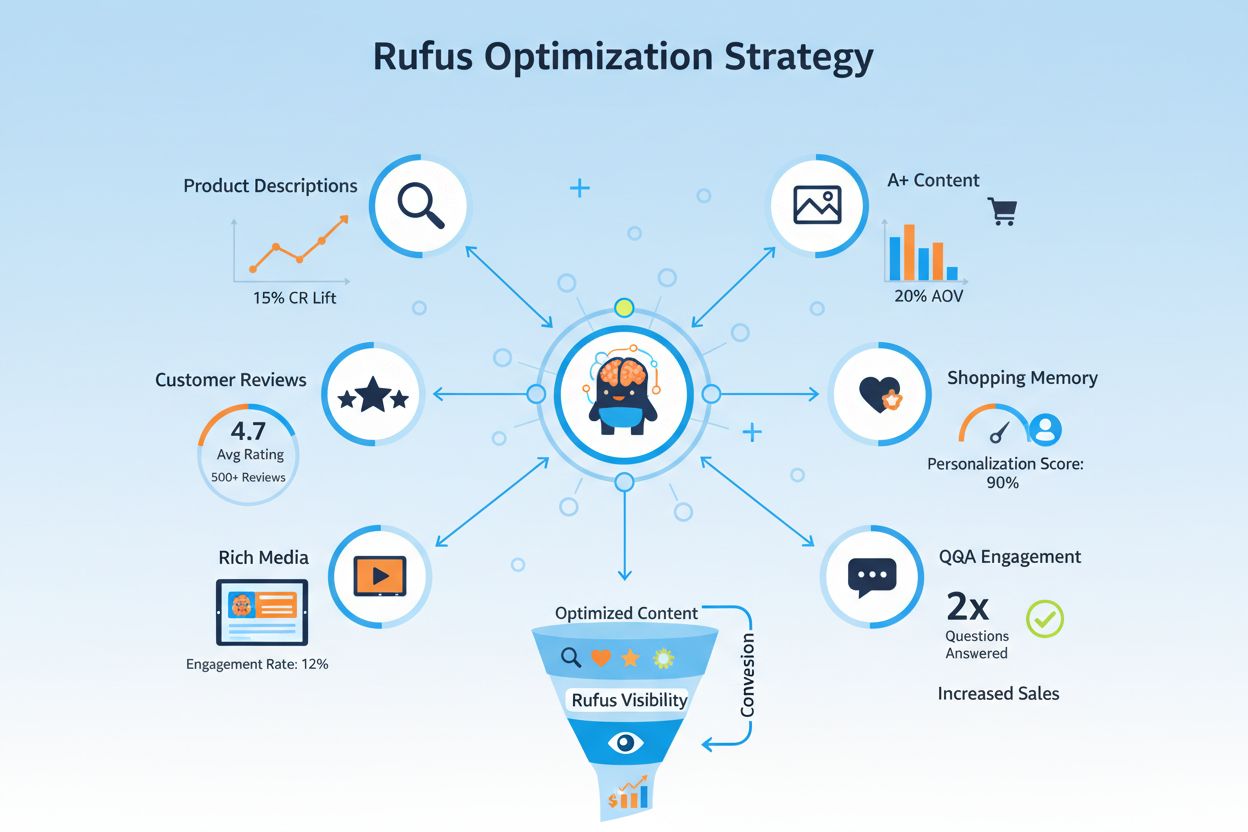
Master Amazon Rufus optimization strategies to increase product visibility in Amazon's AI shopping assistant. Learn how to optimize listings, content, and revie...
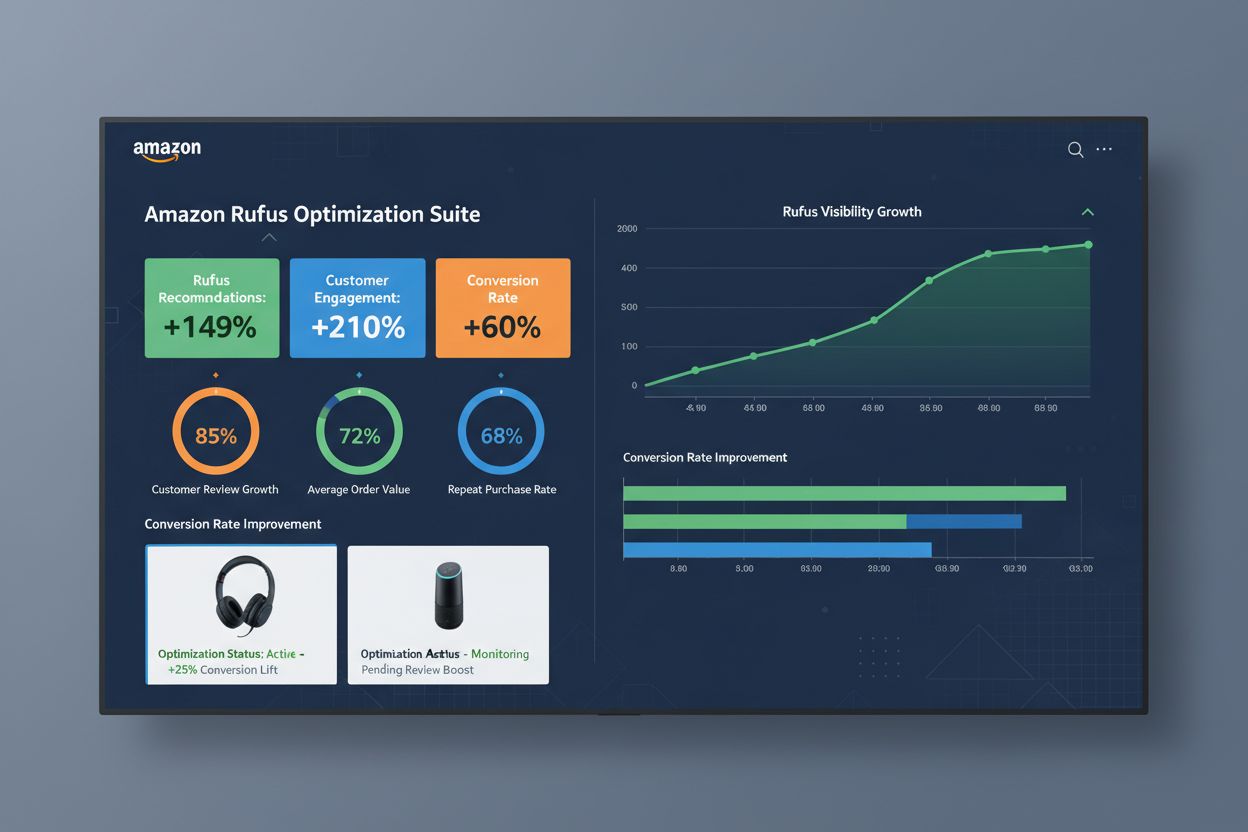
Master Amazon Rufus optimization with our complete guide. Learn 5 proven strategies to improve product visibility, increase conversions, and stay ahead in AI-dr...