
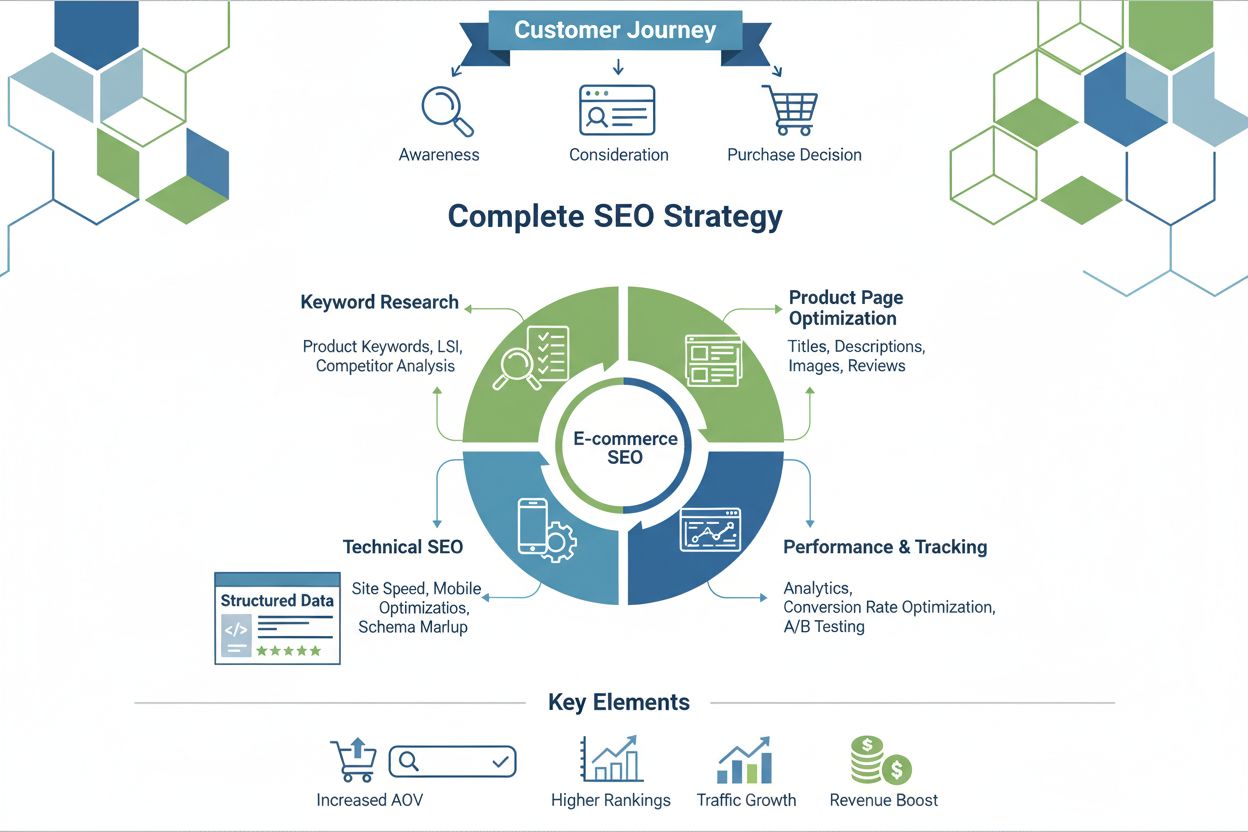
Ecommerce SEO
Ecommerce SEO is the optimization of online stores for search visibility. Learn keyword research, product page optimization, technical SEO, and conversion strat...
19 min read
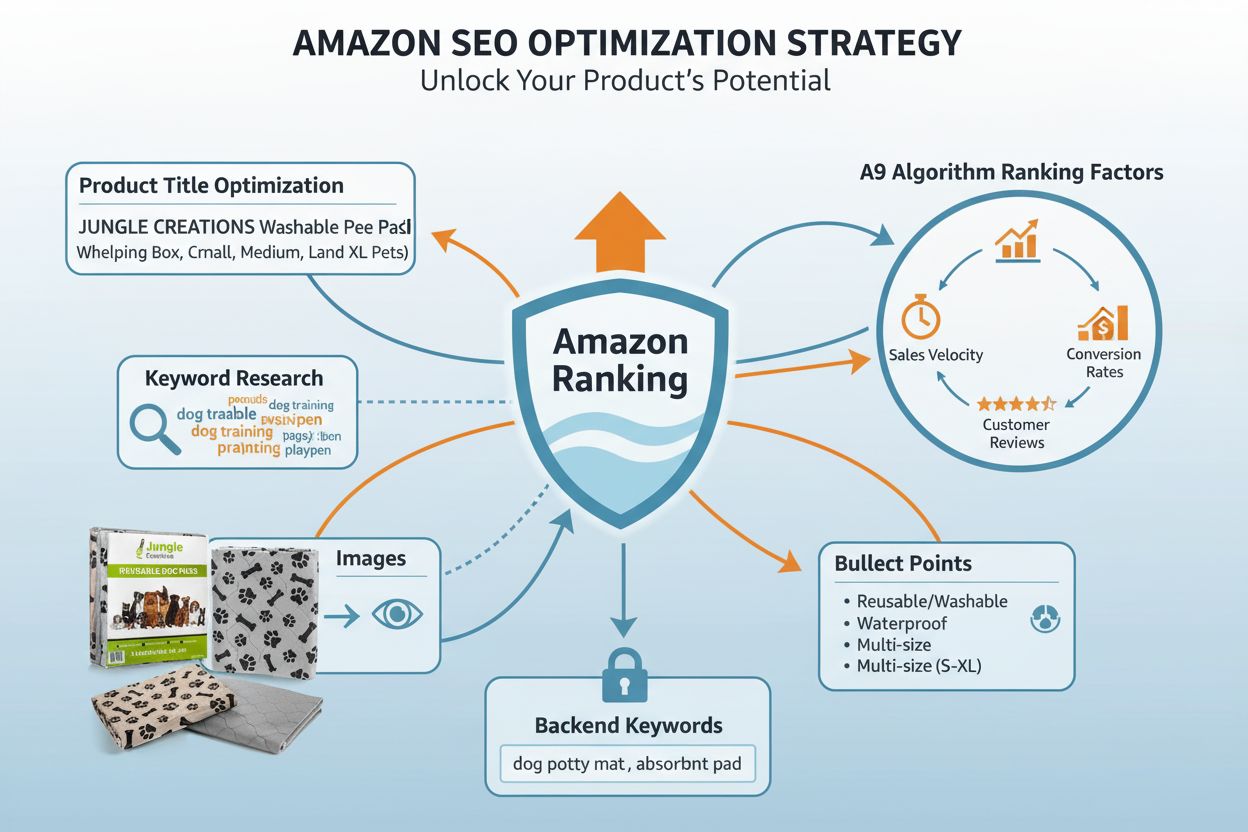
Amazon SEO is the practice of optimizing product listings on Amazon’s platform to improve visibility and ranking in search results, ultimately increasing sales and customer discovery. It involves strategic keyword placement, listing optimization, and alignment with Amazon’s A9 algorithm to enhance product relevance and conversion rates.
Amazon SEO is the practice of optimizing product listings on Amazon's platform to improve visibility and ranking in search results, ultimately increasing sales and customer discovery. It involves strategic keyword placement, listing optimization, and alignment with Amazon's A9 algorithm to enhance product relevance and conversion rates.
Amazon SEO is the strategic practice of optimizing product listings on Amazon’s marketplace to improve visibility, ranking, and sales performance within Amazon’s search results. Unlike traditional search engine optimization for Google, Amazon SEO focuses specifically on Amazon’s proprietary A9 algorithm, which prioritizes products based on relevance, sales velocity, and conversion potential rather than external factors like backlinks. The primary goal of Amazon SEO optimization is to ensure your products appear prominently when customers search for relevant terms, ultimately driving higher click-through rates and sales. This specialized form of optimization has become essential for e-commerce sellers, as nearly 80% of Amazon sellers prioritize listing optimization with relevant, high-quality keywords according to recent industry surveys. Understanding and implementing effective Amazon SEO strategies directly impacts your ability to compete in one of the world’s largest online marketplaces, where millions of products vie for customer attention.
The Amazon A9 algorithm is the search engine powering Amazon’s marketplace, fundamentally different from Google’s algorithm in both design and purpose. While Google prioritizes content authority and external validation through backlinks, Amazon’s A9 algorithm is engineered specifically to maximize sales and customer satisfaction. The algorithm continuously analyzes customer behavior, purchase patterns, and product performance to determine which listings deserve top placement. Amazon’s search algorithm weighs multiple factors simultaneously, creating a complex ranking system that rewards products demonstrating strong commercial viability. The algorithm learns from every customer interaction—searches, clicks, purchases, and returns—using this data to refine rankings in real-time. This means your Amazon product ranking is not static; it fluctuates based on ongoing performance metrics and competitive dynamics. The A9 algorithm’s primary objective is to present customers with products most likely to result in a purchase, making it fundamentally a conversion-focused system rather than a relevance-only system like traditional search engines.
Amazon SEO ranking factors operate within a hierarchy of importance, with certain metrics carrying significantly more weight than others. Sales velocity—the rate at which your product generates sales—is arguably the most critical ranking factor, as it signals strong customer demand and product-market fit. Conversion rate, measured as the percentage of product page visitors who make a purchase, directly influences how Amazon’s algorithm perceives your product’s appeal. According to industry research, competitive pricing can increase conversion rates by up to 35%, making price optimization a crucial component of your Amazon SEO strategy. Keyword relevance ensures your product appears for appropriate searches; if your keywords don’t match customer search intent, even a high-performing product won’t rank well. Customer reviews and ratings serve dual purposes: they build social proof that influences purchase decisions and signal to the algorithm that customers are satisfied with the product. Product image quality affects both user experience and conversion rates—high-quality, zoomable images with at least 1000 pixels on the longest side significantly improve click-through rates. Inventory availability also matters; products with consistent stock levels rank higher than those frequently out of stock, as Amazon wants to ensure customer satisfaction.
| Factor | Amazon SEO | Google SEO | Key Difference |
|---|---|---|---|
| Primary Algorithm Focus | Sales velocity, conversion rates, keyword relevance | Backlinks, domain authority, content quality | Amazon prioritizes revenue; Google prioritizes authority |
| Ranking Timeline | 2-4 weeks for initial results | 3-6 months for significant ranking changes | Amazon responds faster to optimization efforts |
| Keyword Importance | Critical for product discovery and relevance | Important but balanced with other factors | Amazon relies heavily on exact keyword matching |
| Content Type | Product listings, titles, descriptions, bullet points | Blog posts, articles, comprehensive guides | Amazon focuses on transactional content |
| External Links | Minimal impact on rankings | Major ranking factor | Amazon is closed ecosystem; external links don’t help |
| User Behavior Signals | Purchase history, conversion rates, cart additions | Click-through rate, time on page, bounce rate | Amazon directly measures purchase intent |
| Optimization Speed | Changes visible within days to weeks | Changes visible within weeks to months | Amazon’s algorithm updates more frequently |
| Competitor Analysis | Reverse ASIN lookup, keyword research tools | Backlink analysis, content gap analysis | Different tools and methodologies required |
Amazon’s indexing system operates differently from traditional search engines, focusing exclusively on product data within the marketplace. When you create or update a product listing, Amazon’s crawlers analyze your product title, bullet points, description, backend keywords, images, and pricing information. The A9 algorithm then indexes this data, associating your product with relevant search terms and customer queries. Backend keywords—hidden search terms not visible to customers—play a crucial role in this indexing process, allowing sellers to target additional keywords without cluttering the visible listing. The algorithm creates associations between your product and thousands of potential search queries, determining which searches should trigger your product in results. Amazon’s ranking system continuously recalculates positions based on real-time performance data, meaning your ranking can shift multiple times daily depending on sales activity and competitor performance. This dynamic ranking system means that Amazon SEO is an ongoing process rather than a one-time optimization effort. The algorithm also considers seasonal trends and demand fluctuations, adjusting rankings to match current customer search behavior and purchasing patterns.
Keyword research for Amazon differs significantly from traditional SEO keyword research, requiring focus on commercial intent and search volume within the Amazon ecosystem. Primary keywords are those visible in your product title, bullet points, and description—these should target high-volume, relevant search terms that match customer intent. Long-tail keywords (specific phrases like “waterproof dog bed for large dogs”) often have lower search volume but higher conversion rates because they indicate specific customer needs. Short-tail keywords (broad terms like “dog bed”) have high search volume but intense competition and lower conversion rates. Effective Amazon keyword strategy balances these considerations, targeting a mix of high-volume primary keywords and more specific long-tail variations. Backend keywords should include synonyms, abbreviations, and alternative product names that don’t fit naturally in visible listing content. Research shows that sellers using keyword research tools like Jungle Scout, Sonar, or Ahrefs achieve significantly better rankings than those relying on Amazon’s search suggestions alone. The placement of keywords matters; primary keywords should appear early in your title and first bullet point to signal relevance to the algorithm. However, keyword stuffing—repeating keywords excessively—violates Amazon’s policies and can result in ranking penalties or listing suppression.
Product title optimization is the foundation of effective Amazon SEO, as titles serve multiple purposes: they communicate product information to customers, signal relevance to the algorithm, and influence click-through rates from search results. Amazon’s title requirements specify a maximum of 200 characters, with recent updates prohibiting keyword repetition and special characters unless part of the brand name. An optimized title should follow the format: Brand + Model + Product Type + Key Features, incorporating primary keywords naturally while remaining clear and compelling. Bullet points provide five opportunities to highlight key features, benefits, and specifications; each should begin with a strong keyword and explain how that feature benefits the customer. Product descriptions allow up to 2,000 characters for detailed information, though Amazon no longer permits HTML formatting; descriptions should expand on bullet points while naturally incorporating secondary keywords. Product images significantly impact conversion rates; Amazon recommends at least six images plus a product video, with the main image filling 85% of the frame on a white background. A+ Content (available to Brand Registry members) allows enhanced descriptions with custom layouts, images, and comparison charts, often increasing conversion rates by 20-30%. Pricing strategy requires balancing profitability with competitiveness; research shows that competitive pricing can increase conversion rates by up to 35%, making regular price monitoring essential.
Sales velocity represents how quickly your product sells relative to others in its category, functioning as Amazon’s primary demand signal. The algorithm interprets high sales velocity as evidence that your product satisfies customer needs better than competitors, warranting higher ranking positions. Conversion rate—calculated as (units sold ÷ total sessions) × 100—directly measures how effectively your listing converts browsers into buyers. Products with conversion rates above 10% typically rank significantly higher than those below 5%, as the algorithm recognizes superior market fit. Unit session percentage, visible in Amazon Seller Central’s Business Reports, provides your exact conversion rate and serves as a key performance indicator for optimization efforts. Improving conversion rates requires a holistic approach: compelling product titles, high-quality images, detailed descriptions, competitive pricing, and positive reviews all contribute to this metric. Sales velocity can be accelerated through Amazon Sponsored Products advertising, which drives targeted traffic to your listing; if this traffic converts well, organic rankings improve as the algorithm recognizes strong performance. The relationship between sales velocity, conversion rate, and ranking creates a virtuous cycle: better rankings drive more traffic, higher conversion rates signal quality to the algorithm, and increased sales velocity pushes rankings even higher. Understanding and optimizing these metrics is essential for long-term Amazon SEO success.
Customer reviews and ratings function as both ranking factors and conversion drivers in the Amazon SEO ecosystem. Products with higher average ratings (4.5+ stars) and more reviews typically rank higher than similar products with fewer reviews or lower ratings. Review quantity signals sustained customer satisfaction and product popularity, while review quality (detailed, helpful reviews) influences both customer purchase decisions and algorithm rankings. The Amazon algorithm analyzes review sentiment, looking for patterns in customer feedback; consistently positive reviews indicate a quality product worthy of higher visibility. Review velocity—the rate at which new reviews accumulate—also matters; products receiving regular reviews signal ongoing sales and customer engagement. Sellers can encourage reviews through Amazon’s Request a Review button (limited to one request per order) or by using review automation tools that send systematic review requests. However, incentivized reviews (offering discounts or gifts for reviews) violate Amazon’s policies and can result in review removal or account suspension. Fulfillment by Amazon (FBA) typically generates more reviews than Fulfillment by Merchant (FBM) because FBA provides Prime shipping and better customer service, leading to higher satisfaction and review rates. Building a strong review profile requires consistent product quality, excellent customer service, and strategic review encouragement—all of which contribute to improved Amazon SEO rankings through both direct algorithm factors and increased conversion rates.
As Amazon SEO continues evolving, the intersection with AI-driven search platforms becomes increasingly relevant for brand visibility. While Amazon SEO optimization focuses on Amazon’s proprietary A9 algorithm, brands must also consider how their products and content appear in AI search results from platforms like ChatGPT, Perplexity, and Google AI Overviews. These AI search engines often reference Amazon product listings when answering customer queries about products, making Amazon SEO quality indirectly impact visibility in AI-generated responses. Monitoring brand mentions across both traditional Amazon search and AI platforms provides comprehensive visibility insights. Brands selling on Amazon should recognize that high-ranking Amazon listings with strong reviews, detailed descriptions, and competitive pricing are more likely to be cited by AI systems when answering product-related questions. This creates a dual optimization opportunity: improving Amazon SEO simultaneously enhances your brand’s potential appearance in AI search results. The convergence of traditional e-commerce search and AI-powered search means that Amazon SEO best practices—clear product information, keyword optimization, and customer satisfaction signals—now serve multiple discovery channels beyond Amazon’s marketplace alone.
Amazon SEO continues evolving as the platform introduces new features and refines its algorithm to better serve customers and sellers. Visual search capabilities are expanding, with Amazon increasingly using image recognition to match customer queries with products, suggesting that image optimization will become even more critical. Voice search optimization for Alexa and other voice assistants represents a growing frontier, requiring sellers to optimize for conversational keywords and question-based queries. Artificial intelligence and machine learning are becoming more sophisticated in Amazon’s algorithm, potentially enabling better understanding of product intent and customer needs beyond simple keyword matching. Sustainability and ethical sourcing signals may increasingly influence rankings as consumer preferences shift toward environmentally conscious products. International marketplace optimization will grow in importance as sellers expand globally, requiring localized Amazon SEO strategies for different regions and languages. Real-time pricing dynamics and competitive intelligence tools are becoming more advanced, enabling sellers to respond faster to market changes. The rise of Amazon’s own-brand products and private label competition means that Amazon SEO excellence is no longer optional but essential for survival in the marketplace. Sellers who stay ahead of Amazon SEO trends, continuously test new optimization strategies, and adapt to algorithm changes will maintain competitive advantages. The future of Amazon SEO likely involves greater integration with AI search platforms, making it crucial for sellers to optimize not just for Amazon’s algorithm but for the broader AI-driven search ecosystem that increasingly influences consumer discovery and purchasing decisions.
Amazon SEO focuses on optimizing product listings within Amazon's marketplace using the A9 algorithm, which prioritizes sales velocity, conversion rates, and keyword relevance. Google SEO targets broader web search results using different ranking factors like backlinks and domain authority. Amazon SEO is more sales-focused and conversion-driven, while Google SEO emphasizes content authority and link popularity. Both require keyword optimization, but Amazon's algorithm is proprietary and specifically designed for e-commerce transactions.
Amazon's A9 algorithm ranks products based on relevance and revenue potential. It analyzes keyword relevance by matching customer search terms with product titles, descriptions, and backend keywords. The algorithm also weighs sales velocity (how quickly products sell), conversion rates (percentage of visitors who purchase), customer reviews, pricing competitiveness, and inventory availability. Products with higher conversion rates and consistent sales performance rank higher because Amazon prioritizes products likely to generate sales.
The top ranking factors include keyword relevance, sales velocity, conversion rate, customer reviews and ratings, competitive pricing, product images quality, and inventory availability. According to industry research, conversion rate is one of the most critical factors—products with higher conversion rates receive better rankings. Sales velocity signals demand, while keyword relevance ensures your product appears for appropriate searches. Customer reviews build trust and influence both rankings and purchase decisions.
Improve conversion rates by optimizing your product title with clear, benefit-driven language, using high-quality images from multiple angles, writing compelling bullet points highlighting key features, creating detailed product descriptions, maintaining competitive pricing, and accumulating positive customer reviews. A/B testing different titles and images can reveal what resonates with your audience. Ensuring fast shipping through FBA and offering excellent customer service also increases conversion likelihood by building buyer confidence.
Keywords are fundamental to Amazon SEO because they help the A9 algorithm understand what your product is and match it to customer searches. Primary keywords appear in your title, bullet points, and description, making them visible to shoppers. Backend keywords are hidden but still indexed by Amazon's algorithm. Strategic keyword placement increases your product's visibility for relevant searches, but keyword stuffing can harm rankings. Research high-volume, relevant keywords using tools like Jungle Scout or Amazon's own search suggestions.
Results from Amazon SEO optimization typically appear within 2-4 weeks, though this varies based on competition and product category. Initial improvements in keyword ranking may be visible within days, but significant sales increases usually take 4-8 weeks as the algorithm learns your product's performance. Consistent optimization, positive reviews, and sustained sales velocity accelerate results. New products may take longer to rank compared to established listings with sales history.
While core Amazon SEO principles remain consistent across marketplaces, optimization should be tailored to each region. Different marketplaces have different customer search behaviors, languages, and competition levels. Keywords that perform well in the US Amazon store may not work in European or Asian markets. Currency, pricing strategies, and product availability also vary by marketplace. It's recommended to conduct separate keyword research and optimization for each marketplace where you sell.
The Featured Offer (also called Buy Box) is the primary offer displayed on a product detail page where customers click 'Add to Cart.' While not directly a ranking factor, winning the Featured Offer increases visibility and sales, which improves your SEO rankings through higher conversion rates and sales velocity. To win the Featured Offer, maintain competitive pricing, fast shipping, positive seller ratings, and good inventory levels. Higher rankings from improved SEO performance make it easier to win and maintain the Featured Offer.
Start tracking how AI chatbots mention your brand across ChatGPT, Perplexity, and other platforms. Get actionable insights to improve your AI presence.
Ecommerce SEO is the optimization of online stores for search visibility. Learn keyword research, product page optimization, technical SEO, and conversion strat...

Learn how ecommerce businesses optimize for AI search engines like ChatGPT, Perplexity, and Google AI Mode. Discover strategies for product visibility, schema m...
Enterprise SEO is the practice of optimizing large, complex websites with thousands of pages for search engines. Learn strategies, challenges, and best practice...
Cookie Consent
We use cookies to enhance your browsing experience and analyze our traffic. See our privacy policy.