Definition of Article Schema
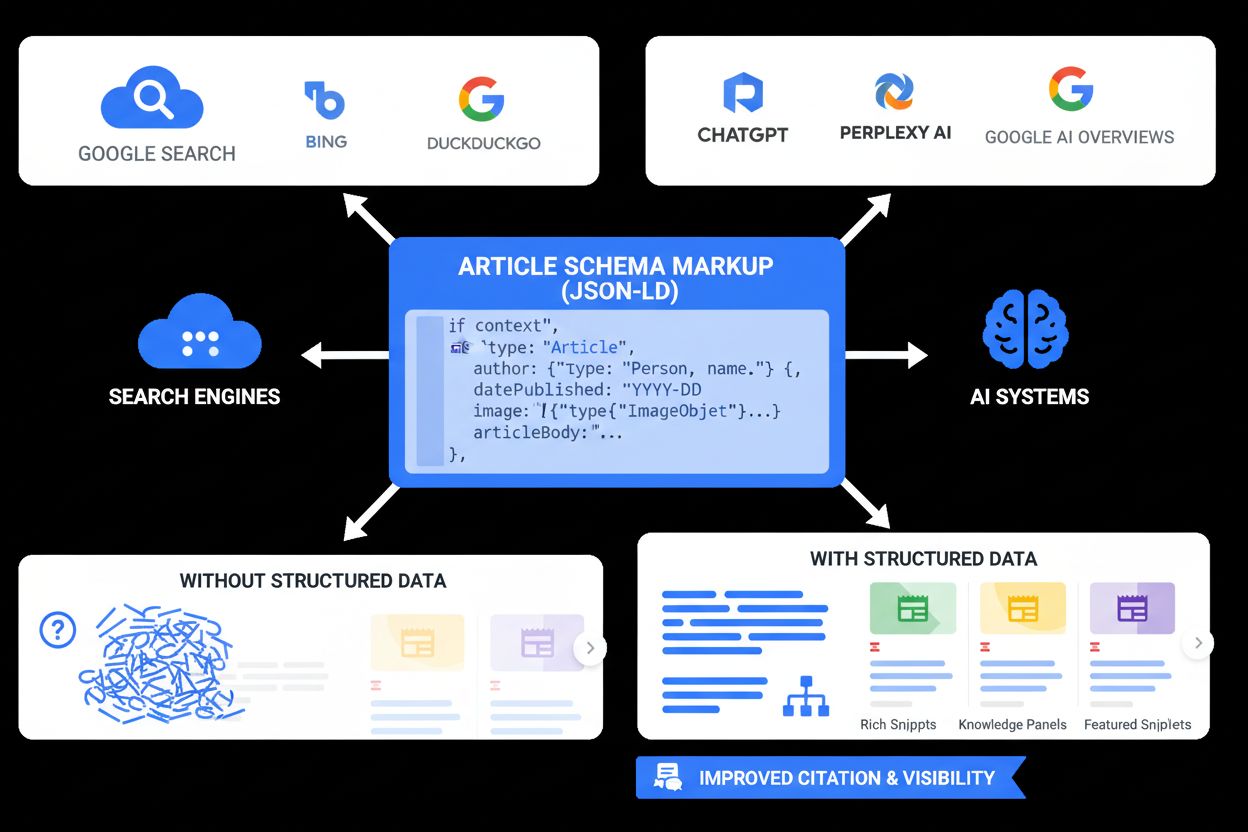
Article Schema is a structured data markup type from Schema.org that explicitly defines the properties and metadata of news articles, blog posts, and other written content. Implemented using JSON-LD format, Article Schema communicates essential information about your content to search engines, AI systems, and other digital platforms. This markup includes critical properties such as headline, author, datePublished, dateModified, image, and articleBody, enabling machines to understand not just what your content is about, but who created it, when it was published, and how it should be presented. Article Schema serves as a bridge between human-readable web content and machine-readable data, making your articles discoverable and citable across search engines, AI answer engines like ChatGPT and Perplexity, and emerging AI-powered platforms. By implementing Article Schema, publishers ensure their content is properly understood and attributed when cited by AI systems, which is increasingly critical as AI-generated answers become a primary discovery mechanism for online content.
Context and Historical Development
The evolution of Article Schema reflects the broader shift in how digital content is discovered and consumed. Schema.org, launched in 2011 as a collaborative effort between Google, Bing, Yahoo, and Yandex, created a standardized vocabulary for structured data. Article Schema emerged as one of the foundational types, designed to help search engines understand the nature and context of published content. Initially, Article Schema was primarily used to enhance search result appearance through rich snippets, which displayed additional metadata like publication dates and author information directly in search listings.
However, the purpose and importance of Article Schema have evolved dramatically with the rise of AI search engines and large language models (LLMs). According to research from Profound, approximately 680 million citations were tracked across ChatGPT, Google AI Overviews, and Perplexity between August 2024 and June 2025, revealing that AI systems rely heavily on structured data to identify and cite authoritative sources. Over 80% of citations across major AI platforms come from .com domains, with non-profit .org sites representing the second-largest category at 11.29% of ChatGPT citations. This data demonstrates that Article Schema has become essential not just for traditional search visibility, but for ensuring your content is recognized and cited by AI systems that now influence how billions of people discover information.
The shift from search-focused to AI-focused implementation represents a fundamental change in how publishers should approach Article Schema. Where previously the goal was to improve search result appearance, today’s publishers must ensure their Article Schema is comprehensive and accurate enough for AI systems to extract, understand, and properly attribute their content. This evolution has made Article Schema implementation a critical component of Generative Engine Optimization (GEO) and AI visibility strategy.
Ready to Monitor Your AI Visibility?
Track how AI chatbots mention your brand across ChatGPT, Perplexity, and other platforms.
Technical Implementation and Properties
Article Schema is implemented as a JSON-LD (JavaScript Object Notation for Linked Data) block placed within the <head> section of your HTML document. JSON-LD is the recommended format by Google, Bing, and all major search engines because it keeps structured data separate from the main HTML, making it easier to maintain and less prone to errors. The basic structure of Article Schema includes the @context property (which specifies the Schema.org vocabulary), the @type property (which identifies the content as an Article, NewsArticle, or BlogPosting), and various properties that describe the article’s metadata.
The recommended properties for Article Schema include:
- headline: The title of the article, which should be concise and descriptive
- image: URLs to images representative of the article, with Google recommending multiple aspect ratios (1x1, 4x3, 16x9) and minimum 50K pixels
- datePublished: The original publication date in ISO 8601 format
- dateModified: The most recent modification date, crucial for AI systems to understand content freshness
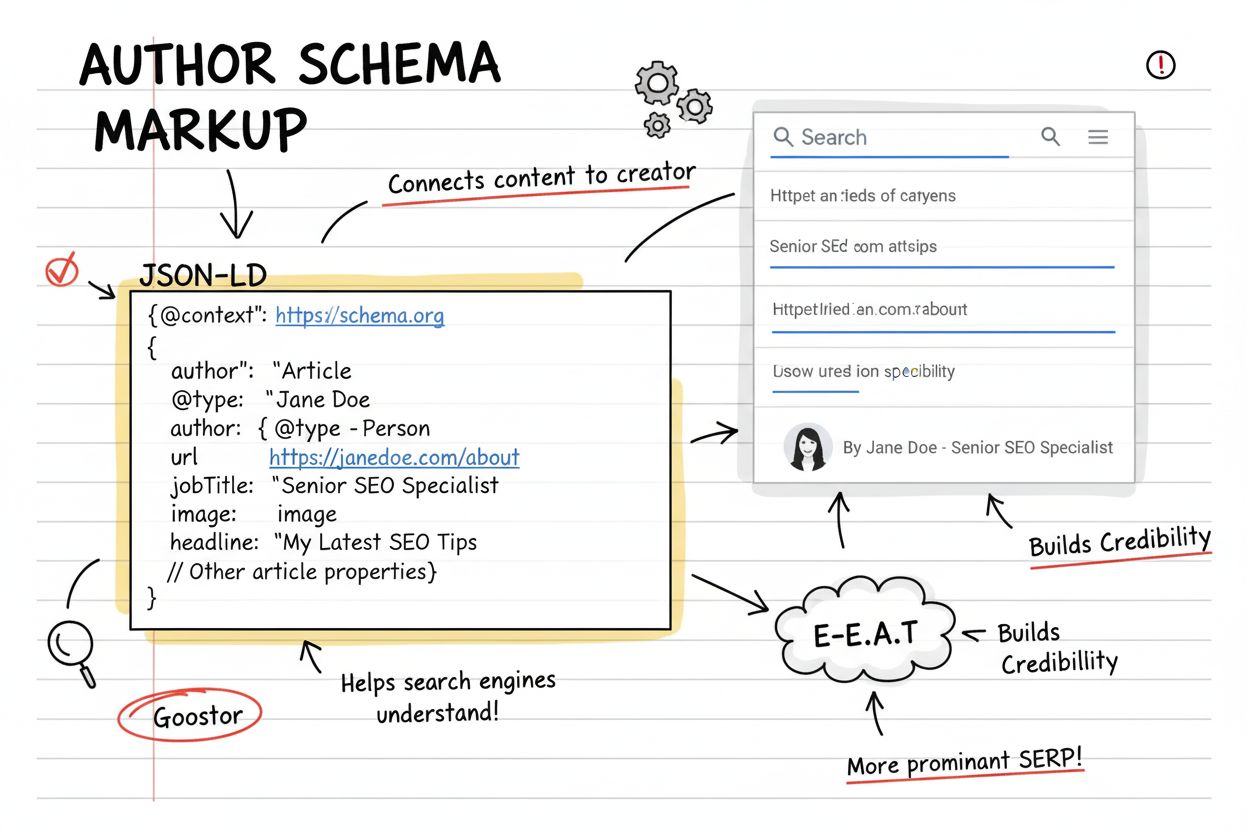
- author: The person or organization responsible for creating the content, with properties for name and URL
- articleBody: The actual text content of the article
- articleSection: The section or category the article belongs to (e.g., “Technology”, “Sports”)
- description: A brief summary of the article’s content
- publisher: The organization publishing the article
According to Google Search Central documentation, while no properties are strictly required, including these recommended properties significantly increases your chances of appearing in rich results and being properly understood by AI systems. The author property is particularly important for AI citation, as it establishes content authority and helps AI systems attribute information correctly. Research from Evertune indicates that schema-optimized content makes information effortless for AI systems to understand, extract and cite accurately, with pages featuring well-implemented schema appearing more frequently in AI-generated answers.
Comparison Table: Article Schema Types and Related Markup
| Schema Type | Best Use Case | Content Length | Key Differentiator | AI Citation Priority |
|---|
| Article | General written content, blogs, articles | 500+ words | Parent type covering all articles | High - Universal acceptance |
| NewsArticle | News publications, breaking news | 300+ words | Includes news-specific properties | Very High - News-focused AI systems |
| BlogPosting | Personal blogs, corporate blogs | 50-400 words | Optimized for blog-specific metadata | Medium - Blog-specific platforms |
| ScholarlyArticle | Academic papers, research | 1000+ words | Includes citation and research properties | Very High - Academic AI systems |
| TechArticle | Technology tutorials, how-tos | 500+ words | Includes step-by-step instructions | High - Tech-focused platforms |
| Report | Industry reports, whitepapers | 2000+ words | Formal publication structure | High - Enterprise AI systems |
Stay Updated on AI Visibility Trends
Get the latest insights on AI mentions, brand monitoring, and optimization strategies.
How Article Schema Impacts AI Search and Citation
The relationship between Article Schema and AI visibility has become one of the most critical factors in modern content strategy. Research from Profound analyzing 680 million citations across major AI platforms reveals distinct patterns in how different AI systems source and cite information. ChatGPT shows a strong preference for authoritative sources like Wikipedia (7.8% of total citations), while Google AI Overviews demonstrates a more balanced approach across Reddit (2.2%), YouTube (1.9%), and Quora (1.5%). Perplexity heavily favors community-driven content, with Reddit accounting for 6.6% of total citations.
What unites all these platforms is their reliance on structured data to understand content context and authority. When Article Schema is properly implemented, AI systems can:
- Identify content type and purpose - AI systems understand whether content is news, analysis, or opinion
- Extract author and publisher information - Proper attribution becomes automatic and accurate
- Determine content freshness - The
dateModified property helps AI systems understand whether information is current - Understand content relationships - Schema markup helps AI systems connect related articles and topics
- Assess content authority - Author URLs and publisher information help AI systems evaluate source credibility
BrightEdge research demonstrated that schema markup improved brand presence in Google’s AI Overviews, with higher citation rates on pages featuring robust schema markup. This finding is particularly significant because it shows that Article Schema is not just a technical SEO nicety—it directly impacts whether your content appears in AI-generated answers that millions of people now use as their primary search interface.
Article Schema vs. Traditional SEO Signals
The distinction between Article Schema and traditional SEO signals represents a fundamental shift in how content is discovered. Traditional SEO signals like backlinks, keyword optimization, and domain authority work through indirect inference—search engines observe that content is popular and trustworthy based on external signals. These signals work well for traditional search results where users see multiple links and make their own choices.
Article Schema, by contrast, provides explicit, direct signals about what your content represents. Instead of search engines inferring that your content is an article about technology, Article Schema explicitly states: “This is an article, published on [date], written by [author], with this headline and these images.” This directness is crucial for AI systems because LLMs process information differently than traditional search engines. While traditional search engines can infer meaning from context and external signals, AI systems benefit from explicit metadata that removes ambiguity.
According to Evertune’s research, “Schema-optimized content makes information effortless for AI systems to understand, extract and cite accurately.” This is the key insight: Article Schema doesn’t just help search engines; it fundamentally changes how AI systems interact with your content. When Article Schema is missing or incomplete, AI systems must infer information from page content, which can lead to misattribution, incorrect context, or omission from AI-generated answers entirely.
The practical implication is that publishers can no longer rely solely on traditional SEO tactics. A well-optimized article with excellent backlinks and keyword targeting may still fail to appear in AI-generated answers if it lacks proper Article Schema markup. Conversely, an article with comprehensive Article Schema markup has a significantly higher chance of being cited by AI systems, even if its traditional SEO metrics are moderate.
Best Practices for Article Schema Implementation
Implementing Article Schema effectively requires attention to both technical accuracy and strategic completeness. The first best practice is consistency in author representation. When implementing the author property, use the same name and URL format across all articles by the same author. This consistency helps AI systems and search engines recognize the author as a distinct entity and build authority signals over time. If your author has a profile page on your site, link to it using the url property within the author object.
The second best practice is comprehensive image markup. Google recommends providing images in three aspect ratios: 1x1 (square), 4x3 (landscape), and 16x9 (widescreen), with each image containing at least 50,000 pixels (width × height). These images should be representative of the article content, not generic logos or decorative elements. AI systems use these images to understand article context and to display visual previews in generated answers.
The third best practice is accurate date markup. Always include both datePublished (the original publication date) and dateModified (the most recent update date) in ISO 8601 format with timezone information. AI systems use these dates to understand content freshness and recency, which is particularly important for news and time-sensitive content. If you update an article significantly, ensure dateModified reflects the actual update time.
The fourth best practice is complete author information. Beyond just the author’s name, include the url property pointing to an author profile page or social media profile. This helps AI systems verify author identity and assess expertise. For organizations as authors, include the organization’s website URL and logo. This additional context significantly improves how AI systems evaluate content authority.
The fifth best practice is proper schema hierarchy and connections. Article Schema should not exist in isolation. Connect your article schema to related entities like the publisher organization, author person profiles, and related articles. This creates what Yoast calls a “data graph"—a web of connections that helps AI systems understand how your content fits into the broader information landscape. A well-connected data graph increases the likelihood that AI systems will recognize your content as authoritative and cite it appropriately.
Article Schema and Platform-Specific Optimization
Different AI platforms have distinct preferences for how they source and cite information, which has implications for Article Schema strategy. ChatGPT shows a strong preference for encyclopedic, authoritative sources, with Wikipedia accounting for nearly 48% of its top 10 most-cited sources. This suggests that for ChatGPT visibility, Article Schema should emphasize comprehensive, well-researched content with clear author credentials and publication authority.
Google AI Overviews demonstrates a more balanced approach, drawing from Reddit (21% of top 10 sources), YouTube (18.8%), and Quora (14.3%), alongside traditional media sources. This suggests that Google’s AI system values diverse perspectives and community input. For Google AI Overviews visibility, Article Schema should be paired with strategies that encourage content distribution across multiple platforms and community engagement.
Perplexity shows the strongest preference for community-driven content, with Reddit representing 46.7% of its top 10 most-cited sources. This platform’s approach suggests that for Perplexity visibility, Article Schema should be implemented on content that addresses specific questions and problems that communities actively discuss.
The strategic implication is that while Article Schema implementation is universal, the supporting content strategy should be platform-specific. A publisher targeting ChatGPT visibility should focus on authoritative, comprehensive articles with strong author credentials. A publisher targeting Google AI Overviews should implement Article Schema alongside a strategy for content distribution and community engagement. A publisher targeting Perplexity should focus on question-answering content that addresses specific community needs.
Validation and Monitoring Article Schema
After implementing Article Schema, validation is essential to ensure the markup is correct and complete. Google’s Rich Results Test is the primary validation tool, allowing you to paste your URL or code and receive immediate feedback on schema implementation. The tool identifies critical errors that prevent rich results from displaying, as well as non-critical issues that may reduce effectiveness.
Schema Markup Validator (validator.schema.org) provides an alternative validation approach, checking your markup against the official Schema.org specification. This tool is particularly useful for identifying subtle errors or deprecated properties that might not trigger warnings in Google’s tool.
Google Search Console provides ongoing monitoring of your Article Schema performance. The “Enhancements” report shows how many of your pages have valid Article Schema markup and whether any errors have been detected. This report is crucial for identifying pages that may have lost schema markup due to site updates or technical issues.
Beyond validation, publishers should monitor actual AI citation performance using tools like AmICited, which tracks brand mentions and citations across ChatGPT, Perplexity, Google AI Overviews, and Claude. By correlating Article Schema implementation with citation frequency, publishers can measure the actual ROI of their schema investment and identify opportunities for improvement.
Future Evolution of Article Schema
Article Schema continues to evolve as AI systems become more sophisticated and new standards emerge. The Model Context Protocol (MCP) and Natural Language Web (NLWeb) represent emerging standards that build on Schema.org foundations to enable better AI system interoperability. These protocols use structured data like Article Schema as their foundation, making proper implementation today essential for future compatibility.
As AI systems become more prevalent in content discovery, Article Schema will likely become as essential as traditional SEO optimization. Publishers who implement comprehensive, accurate Article Schema today will have a significant advantage as AI search continues to grow. The shift from keyword-based search to AI-generated answers represents a fundamental change in how content is discovered, and Article Schema is the bridge that connects traditional web content to this new discovery paradigm.
Additionally, as E-E-A-T (Experience, Expertise, Authoritativeness, Trustworthiness) becomes increasingly important for both traditional search and AI systems, Article Schema’s role in establishing author credentials and content authority will become even more critical. Publishers should expect that future updates to Article Schema will include additional properties for demonstrating expertise and building trust signals that AI systems can evaluate.
Key Takeaways for Article Schema Implementation
Article Schema is essential for AI visibility: With over 680 million citations tracked across major AI platforms, proper Article Schema implementation directly impacts whether your content appears in AI-generated answers.
Implement comprehensive metadata: Include headline, image (multiple aspect ratios), datePublished, dateModified, author, and articleBody properties for maximum effectiveness.
Use JSON-LD format: JSON-LD is the recommended format by all major search engines and AI platforms, offering better maintainability and accuracy than alternative formats.
Connect your schema to related entities: Create a data graph by linking articles to authors, publishers, and related content, which helps AI systems understand content authority and context.
Monitor actual AI citation performance: Use tools like AmICited to track how your Article Schema implementation affects your brand’s visibility across ChatGPT, Perplexity, Google AI Overviews, and Claude.
Maintain consistency across your site: Use consistent author names, publisher information, and URL formats to help AI systems recognize and build authority signals over time.
Validate and monitor regularly: Use Google’s Rich Results Test and Search Console to ensure your Article Schema remains valid and identify any implementation issues.