

How to Build Domain Authority for AI Search Engines
Learn how to build domain authority that AI search engines recognize. Discover strategies for entity optimization, citations, topical authority, and E-E-A-T sig...
8 min read
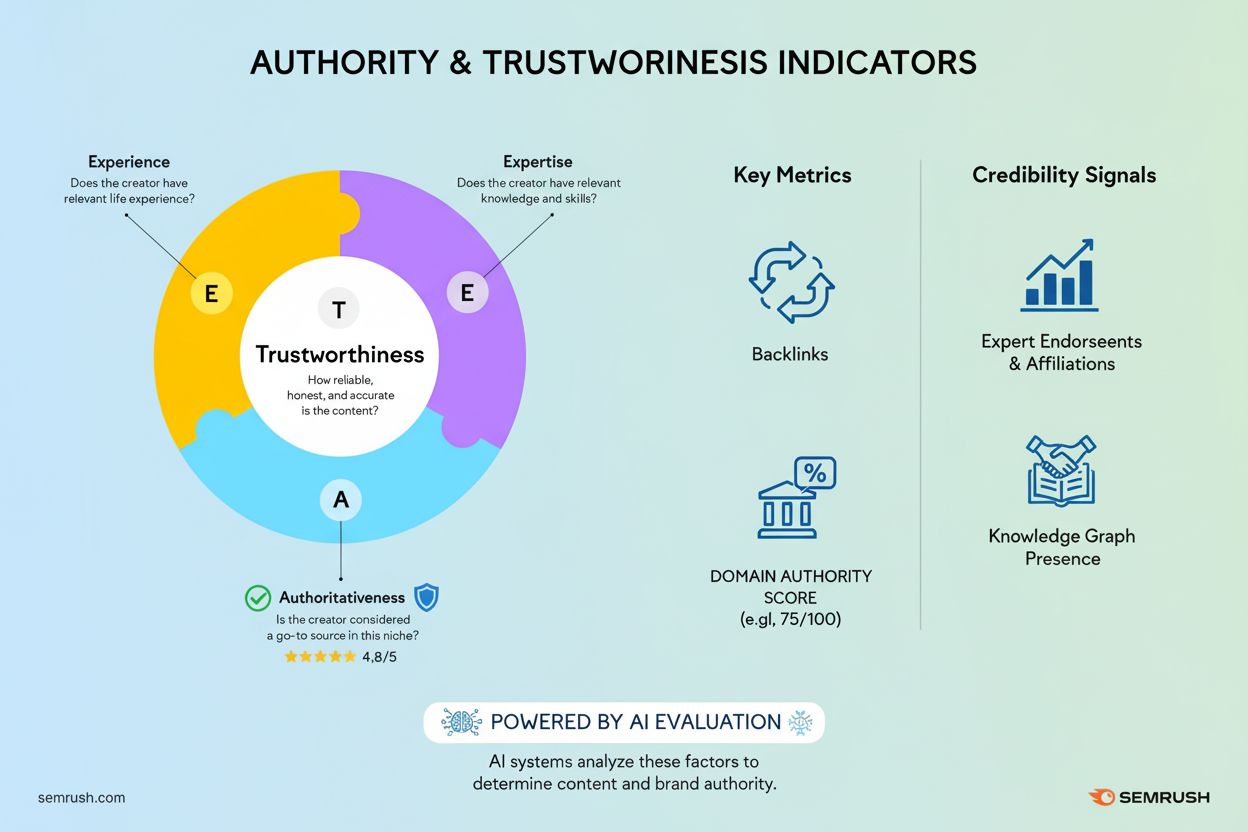
An authority signal is a measurable indicator of content trustworthiness and credibility that search engines and AI systems use to evaluate whether a source is reliable and authoritative. These signals include backlinks from reputable domains, verified author credentials, domain authority metrics, and E-E-A-T factors (Experience, Expertise, Authoritativeness, Trustworthiness) that collectively determine how prominently content appears in search results and AI-generated responses.
An authority signal is a measurable indicator of content trustworthiness and credibility that search engines and AI systems use to evaluate whether a source is reliable and authoritative. These signals include backlinks from reputable domains, verified author credentials, domain authority metrics, and E-E-A-T factors (Experience, Expertise, Authoritativeness, Trustworthiness) that collectively determine how prominently content appears in search results and AI-generated responses.
An authority signal is a measurable indicator that search engines and AI systems use to evaluate the credibility, reliability, and trustworthiness of online content and its source. These signals collectively determine how prominently content appears in search results and whether AI systems like ChatGPT, Perplexity, and Google AI Overviews will cite a particular source when generating responses. Authority signals are not a single metric but rather a constellation of factors—including backlinks from reputable domains, verified author credentials, domain authority scores, and E-E-A-T factors (Experience, Expertise, Authoritativeness, Trustworthiness)—that work together to establish credibility. In the context of AI monitoring and brand visibility, understanding and optimizing authority signals has become critical, as over 60% of AI outputs lack accurate citations, making it essential for brands to build strong trust indicators that AI systems can recognize and prioritize.
Authority signals have evolved significantly since the early days of search engine optimization. When Google introduced its PageRank algorithm in the late 1990s, backlinks became the primary authority signal—the idea being that links from other websites served as votes of confidence. However, as search algorithms became more sophisticated and AI systems emerged, the definition of authority expanded dramatically. Today, authority signals encompass technical factors, content quality indicators, brand reputation metrics, and entity verification signals that collectively paint a picture of trustworthiness. The shift accelerated in 2018 when Google introduced the “Medic Update,” which emphasized E-A-T (Expertise, Authoritativeness, Trustworthiness) for health and wellness content. In December 2022, Google expanded this framework to E-E-A-T by adding “Experience,” recognizing that first-hand knowledge significantly enhances credibility. This evolution reflects a broader industry recognition that trustworthiness cannot be gamed through technical manipulation alone—it must be demonstrated through genuine expertise, transparent sourcing, and consistent quality. For AI systems specifically, authority signals have become even more critical because generative engines must decide which sources to cite when synthesizing information, and they rely heavily on signals that indicate a source is reliable and verifiable.
Authority signals function through multiple interconnected mechanisms that search engines and AI systems evaluate simultaneously. Backlink analysis remains foundational—search engines crawl the web to identify which domains link to your content, then assess the authority of those linking domains using metrics like Domain Authority (DA), which ranges from 1 to 100 and predicts ranking potential. A domain with a DA of 70 carries significantly more weight than one with a DA of 20. However, backlinks alone are insufficient; citation frequency across trusted sources amplifies authority signals. Research from Columbia University found that major media outlets like Reuters and Axios appear in AI citations at least 27% of the time, rising to 49% for recency-driven queries, demonstrating that AI systems track which sources are repeatedly cited by other credible publishers. Author verification signals have become increasingly important, particularly for YMYL (Your Money or Your Life) topics affecting health, finance, or safety. When an article includes a clear author byline linked to a professional profile with verifiable credentials, certifications, or demonstrated expertise, AI systems recognize this as a strong trustworthiness indicator. Entity identity signals help AI systems verify that an organization is legitimate and consistent across platforms. This includes Organization schema markup, “sameAs” links connecting a website to official social media profiles and business directories, and consistent branding across Google Business Profile, LinkedIn, and other platforms. Technical trust signals like HTTPS encryption, Core Web Vitals performance (measuring page speed and stability), and accessibility compliance indicate that a website prioritizes user security and experience. Finally, content freshness signals—demonstrated through recent publication dates, regular updates, and active maintenance—suggest that information is current and accurate, which is particularly important for AI systems evaluating time-sensitive topics.
| Aspect | Authority Signal | Domain Authority (DA) | E-E-A-T Framework | Trust Score |
|---|---|---|---|---|
| Definition | Measurable indicators of content credibility and source reliability | Moz’s predictive metric (1-100) estimating ranking potential based on backlinks | Qualitative framework assessing Experience, Expertise, Authoritativeness, Trustworthiness | Quantitative metric measuring backlink trustworthiness and quality |
| Primary Focus | Multiple credibility factors across technical, content, and reputation dimensions | Backlink profile strength and quantity of linking root domains | Content creator’s qualifications, first-hand knowledge, and reputation | Quality and safety of inbound links from trusted sources |
| Calculation Method | Combines backlinks, citations, author credentials, entity verification, and technical factors | Machine learning algorithm analyzing linking domains and link quality | Human quality rater assessment based on Google’s guidelines | Analysis of linking domain reputation and link context |
| Used By | Google, Bing, AI systems (ChatGPT, Perplexity, Claude, Google AI Overviews) | SEO professionals for competitive benchmarking | Google’s ranking systems and quality raters | Moz’s Trust Score metric for link evaluation |
| Scope | Broad, encompassing all credibility indicators | Domain-level metric, not page-specific | Content and creator-level assessment | Link-level assessment |
| Impact on AI Visibility | Direct—AI systems cite sources with strong authority signals | Indirect—influences Google rankings, which feed AI training data | Direct—AI systems evaluate E-E-A-T when deciding which sources to cite | Indirect—influences which domains AI systems consider authoritative |
| Measurability | Partially measurable through tools like Semrush, Moz, and AmICited | Highly measurable and trackable over time | Qualitative but can be audited through content review | Highly measurable through backlink analysis tools |
Creating strong authority signals requires a multifaceted approach that addresses each component of credibility. Content quality and originality form the foundation—AI systems and search engines prioritize content that provides unique insights, original research, or first-hand experience rather than mere summaries of existing information. When you publish original research, case studies, or expert commentary, you create content that other sources want to cite, naturally generating backlinks and citations. Author credibility must be transparent and verifiable. Include detailed author bios that highlight relevant credentials, certifications, professional experience, and links to professional profiles like LinkedIn or industry-specific directories. For YMYL topics, medical doctors, financial advisors, or other credentialed experts should review and potentially co-author content. Strategic linking both internally and externally strengthens authority signals. Internal links distribute authority across your site and help search engines understand your topical expertise, while external links to credible sources demonstrate that you’ve conducted thorough research and are transparent about your sources. Entity verification requires implementing Organization schema markup on your homepage, maintaining consistent branding across all platforms, and ensuring your business information is accurate in Google Business Profile, industry directories, and citation databases. Technical optimization includes migrating to HTTPS, improving Core Web Vitals (page speed, interactivity, visual stability), implementing accessibility standards like alt text and logical heading hierarchies, and ensuring mobile responsiveness. Regular content updates signal that you’re committed to accuracy—outdated information damages trustworthiness, while consistently refreshed content demonstrates ongoing expertise. Earned media and brand mentions amplify authority signals; when reputable publications, podcasts, or industry leaders mention your brand, it reinforces your authority without requiring a direct link. Tools like Semrush’s Media Monitoring and AmICited’s brand tracking help identify and measure these mentions across platforms.
The emergence of AI search engines has fundamentally changed how authority signals influence visibility. Unlike traditional search, where ranking algorithms are relatively opaque, AI systems make their citation decisions based on training data curation and real-time source evaluation. Training data composition directly shapes which authority signals AI systems recognize. Most large language models are trained on curated datasets that prioritize peer-reviewed academic journals, established news outlets, government publications, and high-authority websites. This means that sources appearing frequently in these datasets gain inherent authority in the model’s understanding. During the training phase, AI systems learn to associate certain signals—like .edu and .gov domains, major news outlets, and peer-reviewed publications—with reliability. Query-time ranking adds another layer of authority signal evaluation. When a user asks an AI system a question, the engine retrieves relevant documents and ranks them based on real-time signals including citation frequency (how often the source appears across trusted documents), cross-referencing patterns (whether multiple authoritative sources cite the same information), recency (whether the content has been recently updated), and contextual relevance. Research shows that AI Overviews are three times more likely to link to .gov websites compared to standard search results, indicating that government authority signals carry particular weight. For brands and publishers, this means that building authority signals specifically for AI visibility requires understanding which signals AI systems prioritize. AmICited helps organizations track their authority signal performance by monitoring how often their brand appears in AI-generated responses across platforms like ChatGPT, Perplexity, Google AI Overviews, and Claude. By analyzing citation patterns, identifying which content types generate the most AI citations, and comparing authority signal strength to competitors, brands can optimize their strategies to improve AI visibility.
While E-E-A-T is a qualitative framework describing content quality characteristics, authority signals are the concrete, measurable indicators that prove E-E-A-T principles exist. Understanding this relationship is essential for effective content strategy. Experience is demonstrated through authority signals like original case studies, first-hand product reviews with photos or videos, travel guides with original photography, and documented personal expertise. When content includes evidence of direct engagement with the subject matter, AI systems recognize this as a strong experience signal. Expertise is signaled through author credentials, professional certifications, educational background, published research, and demonstrated knowledge in content. For YMYL topics, expertise signals are particularly critical—a health article reviewed by a licensed physician carries far more weight than one written by a generalist. Authoritativeness emerges from multiple authority signals working together: backlinks from high-authority domains, mentions in reputable publications, industry recognition, speaking engagements, and consistent publication of high-quality content in a specific niche. When multiple authoritative sources cite or reference your work, AI systems recognize you as an authority in that domain. Trustworthiness, the most critical E-E-A-T component according to Google, is built through technical trust signals (HTTPS security, fast loading times, accessibility compliance), transparent business information, clear privacy policies, verified customer reviews, and accurate, well-sourced content. The integration of these signals creates a comprehensive credibility profile that both search engines and AI systems use to determine whether to rank or cite your content prominently.
Backlink Authority Signals: Links from high-authority domains (.edu, .gov, major publications) carry more weight than links from low-authority sites. Quality matters more than quantity—65% of marketers prioritize domain authority over backlink quantity. Toxic or spammy backlinks can harm credibility and should be disavowed.
Citation and Mention Signals: Frequency of citations across trusted sources, brand mentions in reputable publications, and cross-referencing patterns indicate authority. Research shows major outlets like Reuters appear in AI citations 27-49% of the time depending on query type.
Author and Entity Verification Signals: Clear author bylines with credentials, professional profiles, verified business information, and consistent branding across platforms strengthen trustworthiness. Organization schema markup and “sameAs” links help AI systems verify entity identity.
Technical Trust Signals: HTTPS encryption, Core Web Vitals performance (LCP, INP, CLS), accessibility compliance (alt text, contrast ratios, logical structure), and mobile responsiveness indicate security and user-friendliness.
Content Quality Signals: Original research, comprehensive coverage, proper sourcing with visible citations, recent publication dates, and regular updates demonstrate expertise and commitment to accuracy.
Reputation and Brand Signals: Verified customer reviews, media coverage, industry awards, speaking engagements, and consistent positive mentions across platforms build brand authority and trustworthiness.
Topical Authority Signals: Consistent publication of related content, internal linking strategies that demonstrate expertise breadth, and comprehensive coverage of a subject area signal deep knowledge in a specific domain.
The definition and application of authority signals continue to evolve as AI systems become more sophisticated and as the industry responds to challenges like misinformation and AI hallucinations. Transparency and disclosure are becoming increasingly important authority signals. As AI-generated content proliferates, sources that clearly disclose when AI was used in content creation, explain how automation supported the process, and maintain human oversight are gaining credibility advantage. Google’s guidelines now recommend disclosing AI usage when it would be reasonably expected, and AI systems are learning to recognize and reward this transparency. Verifiable sourcing is emerging as a critical authority signal. With over 60% of AI outputs lacking accurate citations, AI systems are being designed to prioritize sources that provide clear, traceable citations and provenance tracking. Content that links directly to original sources, includes visible attribution, and makes it easy for users to verify claims will gain authority signal advantage. Feedback mechanisms and user corrections are beginning to influence authority signals. As AI systems incorporate user feedback about accuracy and relevance, sources that consistently receive positive feedback and corrections will strengthen their authority signals over time. This creates a feedback loop where credibility is continuously refined based on real-world usage. Open-source and transparency initiatives are pushing for greater visibility into how authority signals are weighted. Projects that expose training data practices, weighting systems, and ranking logic will help publishers and brands better understand how to build authority signals that AI systems recognize. Multilingual and regional authority signals are becoming more important as AI systems expand globally. Currently, authority signals skew toward English-language and Western sources, but as AI systems improve, they will increasingly recognize expertise and authority from non-English sources and regional experts, creating more balanced authority signal evaluation. For brands using AmICited to monitor authority signals, staying ahead of these trends means regularly auditing how your signals perform across different AI platforms, testing new content formats and sourcing strategies, and maintaining flexibility to adapt as AI systems evolve their evaluation criteria.
Effective authority signal management requires regular measurement and auditing. Domain Authority tracking through tools like Moz’s Link Explorer or Semrush provides a baseline understanding of your site’s backlink strength. Monitoring DA trends over time reveals whether your link-building efforts are working and whether algorithm updates have affected your relative authority. Backlink analysis should focus on quality over quantity—identify which linking domains are highest authority, which are most relevant to your niche, and which may be toxic or spammy. Tools like Semrush’s Backlink Analytics allow you to sort by Authority Score and identify high-value link opportunities from competitors’ backlink profiles. Citation tracking through tools like AmICited reveals how often your brand appears in AI-generated responses and which content types generate the most citations. This data is invaluable for understanding which authority signals are most effective for AI visibility. E-E-A-T audits involve systematically reviewing your content to assess whether it demonstrates experience, expertise, authoritativeness, and trustworthiness. Check whether author credentials are clearly visible, whether content includes first-hand examples and original research, whether you cite credible sources, and whether your site includes trust elements like privacy policies and contact information. Technical audits using tools like Google Search Console, Semrush Site Audit, or Lighthouse assess HTTPS implementation, Core Web Vitals performance, accessibility compliance, and mobile responsiveness. Brand mention monitoring through tools like Semrush’s Media Monitoring or Google Alerts tracks where your brand is mentioned, the sentiment of mentions, and which publications are citing you. This reveals your reputation authority signals and identifies opportunities for earned media. Competitive benchmarking compares your authority signals to competitors in your niche. If competitors have higher DA scores, more backlinks, or more frequent AI citations, analyze their strategies to identify gaps in your approach.
Authority signals have become indispensable for visibility in both traditional search and emerging AI search engines. As AI systems like ChatGPT, Perplexity, and Google AI Overviews become primary discovery channels for information, the importance of building and maintaining strong authority signals cannot be overstated. These signals—encompassing backlinks, citations, author credentials, entity verification, technical trust factors, and content quality—work together to establish credibility that AI systems recognize and reward with prominent citations. For brands and publishers, the path forward involves a comprehensive approach: creating original, high-quality content that demonstrates genuine expertise; building transparent author profiles with verifiable credentials; earning backlinks and mentions from authoritative sources; implementing technical trust signals like HTTPS and Core Web Vitals optimization; and maintaining consistent, accurate information across all platforms. Tools like AmICited provide essential visibility into how your authority signals perform across AI platforms, enabling data-driven optimization. By understanding how authority signals influence AI visibility and systematically building these signals across all dimensions—content, technical, reputation, and entity verification—organizations can ensure their expertise reaches AI-powered audiences and maintains credibility in an increasingly AI-driven information landscape.
The primary authority signals include backlinks from high-quality domains, domain authority scores, verified author credentials and expertise, E-E-A-T factors (Experience, Expertise, Authoritativeness, Trustworthiness), citation frequency across trusted sources, brand mentions in reputable publications, and technical trust indicators like HTTPS security and Core Web Vitals performance. These signals work together to establish credibility in both traditional search engines and AI systems.
AI systems evaluate authority signals during both training and query-time ranking. During training, they learn from curated datasets that prioritize high-authority sources like academic journals, established news outlets, and government publications. At query time, AI engines assess citation frequency, domain reputation, and cross-referencing patterns to decide which sources to cite. Research shows that major media outlets like Reuters and Axios are cited at least 27% of the time, with rates reaching 49% for recency-driven queries, demonstrating how authority signals directly influence AI visibility.
Authority signals are the measurable components that demonstrate E-E-A-T principles. While E-E-A-T is a qualitative framework (Experience, Expertise, Authoritativeness, Trustworthiness), authority signals are the concrete indicators that prove these qualities exist. For example, author credentials demonstrate expertise, backlinks from reputable sites show authoritativeness, HTTPS security indicates trustworthiness, and original research demonstrates experience. Together, they create a comprehensive credibility profile that search engines and AI systems use to rank content.
Backlinks act as third-party endorsements of content quality and relevance. When authoritative websites link to your content, search engines and AI systems interpret this as validation of your expertise and trustworthiness. The quality of linking domains matters significantly—links from high-authority sites like .edu, .gov, or major industry publications carry more weight than links from low-authority sources. Research indicates that 65% of marketers believe domain authority is more significant than the sheer quantity of backlinks, emphasizing quality over quantity in link-building strategies.
Yes, smaller websites can build authority signals by focusing on demonstrating genuine expertise and first-hand experience rather than relying solely on brand recognition. AI systems increasingly recognize signals of subject-matter expertise, original research, and lived experience from niche publishers and smaller brands. By consistently publishing high-quality, well-researched content, earning citations from relevant industry sources, and building a strong topical authority through internal linking, smaller sites can compete effectively with larger publishers in AI search results.
AmICited tracks how your brand appears across major AI systems like ChatGPT, Perplexity, Google AI Overviews, and Claude, providing visibility into your authority signal performance. The platform monitors citation frequency, identifies which content types generate the most AI citations, and reveals how your authority signals compare to competitors. This data helps brands understand which trust signals are most effective and where to focus optimization efforts to improve visibility in AI-generated responses.
Content freshness is a critical authority signal, especially for time-sensitive topics like news, regulations, and emerging research. AI systems and search engines favor recently updated content as it signals that information is current and accurate. Actively maintained content demonstrates ongoing commitment to accuracy and relevance, which strengthens trustworthiness signals. For competitive topics, regularly updating existing content and publishing new material consistently can significantly improve how often your brand appears in AI citations and search results.
Start tracking how AI chatbots mention your brand across ChatGPT, Perplexity, and other platforms. Get actionable insights to improve your AI presence.
Learn how to build domain authority that AI search engines recognize. Discover strategies for entity optimization, citations, topical authority, and E-E-A-T sig...
Learn how expert quotes boost your brand visibility in AI search engines like ChatGPT and Perplexity. Discover strategies to earn citations and build authority ...

Learn how AI systems evaluate trust signals through E-E-A-T framework. Discover the credibility factors that help LLMs cite your content and build authority.