
Gray Hat SEO
Gray Hat SEO definition: tactics between white and black hat methods that exploit loopholes without explicit guideline violations. Learn risks, examples, and mo...
12 min read
Black Hat SEO refers to unethical search engine optimization techniques that violate search engine guidelines to manipulate rankings artificially. These deceptive tactics prioritize short-term gains over sustainable growth and carry significant risks of penalties, including deindexing from search results.
Black Hat SEO refers to unethical search engine optimization techniques that violate search engine guidelines to manipulate rankings artificially. These deceptive tactics prioritize short-term gains over sustainable growth and carry significant risks of penalties, including deindexing from search results.
Black Hat SEO refers to unethical search engine optimization techniques that violate search engine guidelines in an attempt to manipulate rankings artificially and achieve quick results. These deceptive practices prioritize short-term gains over sustainable growth, using tactics that search engines explicitly prohibit in their webmaster guidelines. The term originates from classic Western films where villains wore black hats to distinguish themselves from heroes in white hats, metaphorically representing the unethical nature of these practices. Black Hat SEO encompasses a wide range of manipulative tactics designed to exploit algorithmic weaknesses rather than provide genuine value to users, making it fundamentally opposed to the principles of ethical search engine optimization.
Black Hat SEO emerged in the early days of search engine optimization when algorithms were less sophisticated and easier to manipulate. In the 1990s and early 2000s, practitioners could successfully use keyword stuffing, link farms, and cloaking to achieve high rankings without detection. As search engines evolved, particularly with Google’s major algorithm updates like Panda (2011), Penguin (2012), and subsequent refinements, the effectiveness of Black Hat tactics diminished significantly. Today, with AI-powered algorithms and machine learning capabilities, Google can detect manipulative patterns with remarkable accuracy. According to industry research, over 78% of enterprises now use AI-driven content monitoring tools to detect and prevent Black Hat SEO tactics, reflecting the critical importance of ethical practices in modern digital marketing. The sophistication of modern search algorithms means that Black Hat techniques that once worked are now easily identified and penalized, making them increasingly obsolete and risky for any serious business.
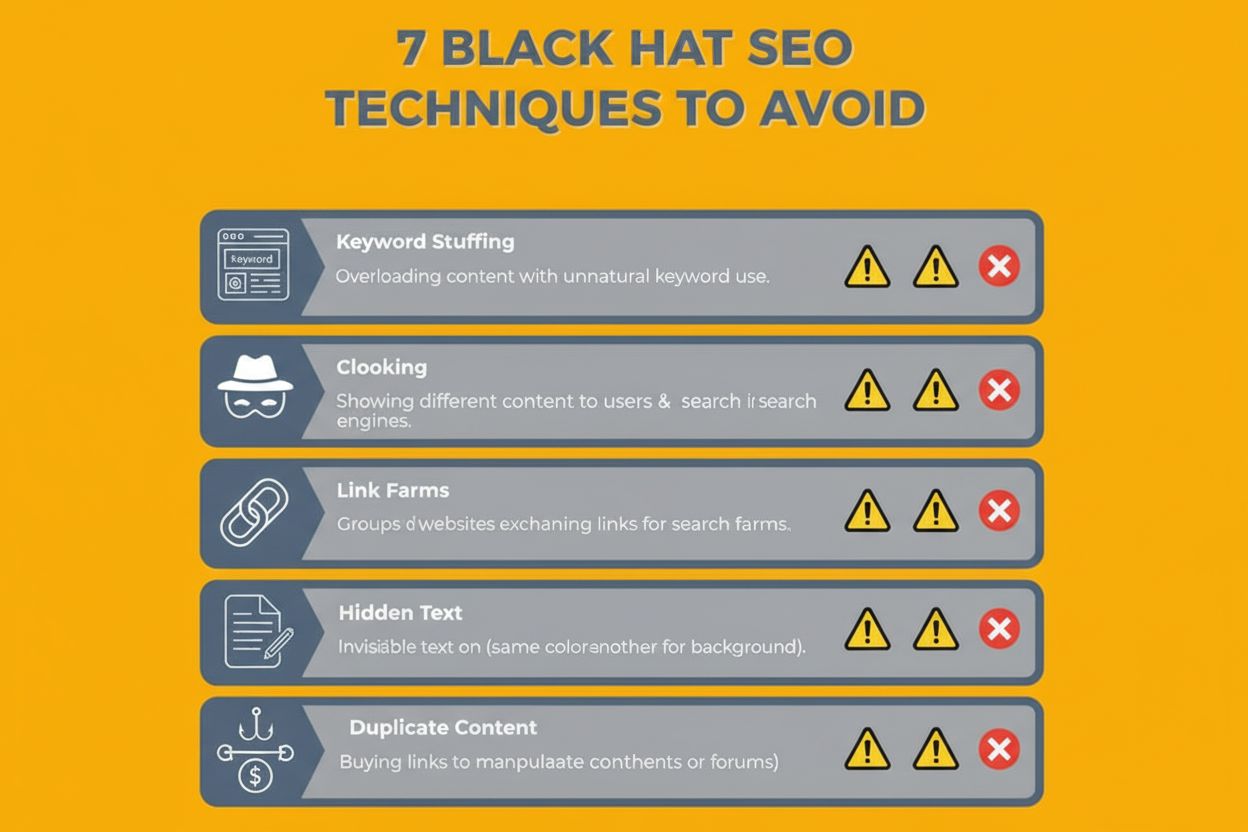
Keyword Stuffing involves unnaturally overloading web content with target keywords to manipulate relevance signals. This includes repeating keywords in body text, meta tags, anchor text, and hidden elements without regard for readability or user experience. Modern algorithms detect keyword stuffing through semantic analysis and natural language processing, recognizing when keyword density exceeds natural patterns. Cloaking presents different content to search engine crawlers than what human visitors see, attempting to rank pages with search-engine-optimized content while showing users something entirely different. This deceptive practice violates fundamental transparency principles that search engines demand. Link Farms are networks of low-quality websites created solely to generate backlinks to target sites, artificially inflating link profiles without providing genuine value. Hidden Text and Links involve concealing keyword-rich content or links by matching text color to backgrounds, using CSS to hide elements, or placing content off-screen. Bait-and-Switch tactics create pages optimized for specific keywords that rank well, then change the content after achieving high positions to redirect users to unrelated pages. Duplicate Content involves copying content from other websites or republishing identical content across multiple pages without adding original value. Paid Backlinks directly violate Google’s guidelines by purchasing links from high-authority sites to artificially boost domain authority. Doorway Pages are low-quality, keyword-stuffed pages designed solely to funnel users to more relevant pages, providing no independent value. Comment Spam involves posting irrelevant links in blog comments and forum discussions to build backlinks. Schema Markup Misuse adds misleading or irrelevant structured data to manipulate rich snippet displays and AI-generated responses.
| Aspect | Black Hat SEO | Gray Hat SEO | White Hat SEO |
|---|---|---|---|
| Definition | Unethical techniques violating search engine guidelines | Borderline tactics not explicitly forbidden but questionable | Ethical practices following search engine guidelines |
| Risk Level | High risk of severe penalties and deindexing | Moderate risk if detected by algorithms | Low risk; adheres to all guidelines |
| Content Quality | Low-quality, duplicated, or irrelevant content | Mostly valuable with slight manipulations | High-quality, original, user-focused content |
| Link Building | Paid links, link farms, link schemes | Link exchanges, private blog networks | Earned links from reputable, relevant sites |
| Keyword Usage | Keyword stuffing and unnatural placement | Slightly unnatural but not aggressive | Natural, research-based keyword integration |
| User Experience | Hidden text, cloaking, deceptive redirects | Minimal user experience focus | Enhanced speed, mobile-friendliness, navigation |
| Long-term Results | Temporary gains followed by penalties | Potential quick gains with future risk | Sustainable, lasting ranking improvements |
| Compliance | Violates search engine guidelines | Operates in gray area of acceptability | Strictly adheres to all guidelines |
| Recovery Time | Months to years after penalties | Weeks to months if detected | Continuous improvement without penalties |
Modern search engines employ sophisticated AI-powered detection systems that analyze multiple signals to identify manipulative practices. Google’s algorithms use natural language processing to recognize unnatural keyword patterns, semantic analysis to detect content quality issues, and machine learning to identify suspicious link profiles. The search engine leverages Chrome browser data to compare what users see on pages versus what crawlers detect, making cloaking attempts virtually impossible to hide. Google’s algorithm updates like Penguin specifically target link spam, Panda focuses on low-quality content, and more recent updates address AI-generated spam at scale. Manual review teams also investigate reported violations and suspicious websites, applying manual penalties when algorithmic detection isn’t sufficient. The sophistication of these detection methods means that Black Hat tactics have become increasingly ineffective, with search engines catching violations faster than ever before. Research indicates that approximately 89% of Black Hat SEO attempts are detected within 3-6 months of implementation, making these tactics unreliable for any serious business strategy.
The consequences of Black Hat SEO are severe and long-lasting, ranging from ranking drops to complete deindexing. Algorithmic penalties are automatically triggered when Google’s algorithms detect violations, resulting in significant ranking losses for affected pages or entire domains. Manual penalties are applied by Google’s review team after investigating reported violations, often resulting in removal of rich snippets, loss of featured snippet eligibility, or complete removal from search results. Sites caught using Black Hat tactics can experience traffic losses of 50-90% or more, directly impacting revenue and business viability. Recovery from penalties requires not only removing harmful tactics but also rebuilding trust with search engines, a process that can take months or years. According to industry data, approximately 73% of websites penalized for Black Hat SEO never fully recover their previous rankings, making these tactics not just risky but potentially catastrophic for long-term business success. The reputational damage extends beyond search rankings, as customers and partners may lose trust in businesses caught using deceptive practices.
As AI search engines like ChatGPT, Perplexity, Google AI Overviews, and Claude become increasingly important for brand visibility, Black Hat SEO tactics are evolving to manipulate these new platforms. Threat actors are leveraging Black Hat SEO to poison search rankings for AI systems, distributing malware and misleading information through manipulated content. AI monitoring platforms like AmICited track brand mentions and domain appearances across AI search results, detecting when competitors use Black Hat tactics to gain unfair advantages or misrepresent industries. These platforms analyze patterns in AI-generated responses, identifying suspicious content that violates guidelines and could harm your brand’s visibility. With over 65% of users now consulting AI systems for information, protecting your brand from Black Hat manipulation in AI search results is critical. Monitoring tools can detect keyword stuffing, cloaking, and other tactics specifically designed to manipulate AI responses, providing early warning of competitive threats and allowing brands to report violations to platform operators.
Avoiding Black Hat SEO requires understanding what constitutes ethical practices and maintaining discipline in your optimization efforts. The following practices ensure sustainable, penalty-free growth:
Organizations that choose Black Hat SEO tactics often underestimate the business consequences of their decisions. While short-term ranking gains might seem attractive, the financial impact of penalties far outweighs any temporary benefits. A website generating 10,000 monthly organic visits that loses 80% of traffic due to penalties loses approximately 8,000 qualified visitors monthly, potentially representing hundreds of thousands in lost revenue annually. Recovery costs include hiring SEO professionals to audit and fix issues, creating new content, rebuilding backlink profiles, and waiting months for algorithmic recovery. Beyond financial metrics, Black Hat practices damage brand reputation when discovered, leading to customer distrust, negative media coverage, and loss of partnership opportunities. Companies like those in competitive industries (gambling, payday loans, adult content) that historically relied on Black Hat tactics have seen dramatic shifts as Google’s algorithms improved, with many losing 90%+ of their organic visibility. The long-term business case for ethical SEO is overwhelming, with White Hat strategies delivering sustainable competitive advantages that compound over time.
The future of Black Hat SEO is increasingly bleak as search engines become more sophisticated and AI-powered. Google’s integration of AI Overviews and advanced language models makes it nearly impossible to deceive search algorithms through traditional Black Hat tactics. The rise of generative engine optimization (GEO) and answer engine optimization (AEO) creates new challenges for Black Hat practitioners, as AI systems can better understand context, user intent, and content quality. Emerging threats include Black Hat tactics specifically designed to manipulate AI responses, such as prompt injection attacks and adversarial content designed to trick language models. However, search engines are rapidly developing countermeasures, with Google’s March 2024 Core Update specifically targeting AI-generated spam and low-quality content at scale. Industry experts predict that within 2-3 years, Black Hat SEO will become virtually ineffective due to algorithmic sophistication, making ethical practices the only viable long-term strategy. Organizations investing in White Hat SEO today are positioning themselves for success in an increasingly AI-driven search landscape, while those relying on Black Hat tactics face obsolescence and penalties.
If your website has been penalized for Black Hat SEO, recovery is possible but requires systematic effort and patience. First, conduct a comprehensive SEO audit to identify all Black Hat tactics currently on your site, including keyword stuffing, hidden content, suspicious backlinks, and low-quality pages. Use Google Search Console to review manual actions and understand specific violations. Remove or rewrite all thin, low-quality, or duplicate content, ensuring every page provides genuine value. Audit your backlink profile using tools like Ahrefs or SEMrush, identifying and disavowing low-quality, spammy, or irrelevant links through Google’s disavow tool. Implement proper schema markup accurately representing your content without misleading information. For manual penalties, submit a reconsideration request after making corrections, providing detailed explanations of changes made. Recovery timelines vary significantly—algorithmic penalties may take 3-6 months to recover from as Google re-crawls your site, while manual penalties require human review of your reconsideration request. Throughout recovery, focus exclusively on White Hat practices, creating original content, earning natural backlinks, and improving user experience. Many websites successfully recover from penalties, but the process requires commitment to ethical practices going forward.
+++
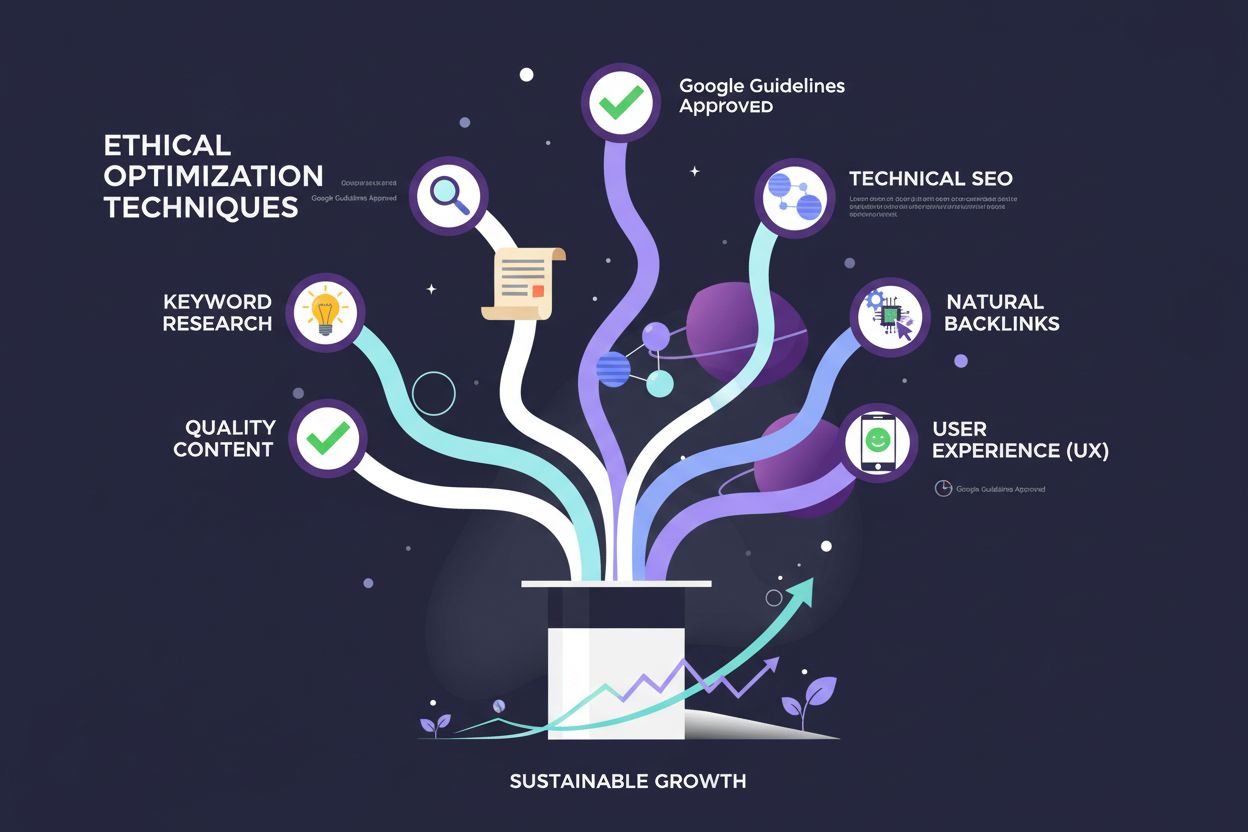
White Hat SEO follows search engine guidelines and focuses on creating quality content, earning natural backlinks, and improving user experience for sustainable long-term growth. Black Hat SEO uses deceptive tactics like keyword stuffing, cloaking, and link schemes to manipulate rankings quickly, violating guidelines and risking severe penalties. White Hat practices build trust with search engines and users, while Black Hat tactics prioritize short-term gains that typically result in penalties and loss of visibility.
Common Black Hat techniques include keyword stuffing (overloading content with keywords), cloaking (showing different content to search engines and users), link farms (networks of low-quality sites linking to each other), hidden text and links, bait-and-switch (changing page content after ranking), duplicate content, and paid backlinks. Other tactics include doorway pages, comment spam, schema markup misuse, and AI-generated content at scale without human oversight. Each of these violates Google's Search Essentials and can trigger algorithmic or manual penalties.
Google imposes both algorithmic and manual penalties for Black Hat SEO violations. Algorithmic penalties are automatically triggered by updates like Penguin (link spam), Panda (low-quality content), and Jagger (paid links). Manual penalties are applied after human review and can result in ranking drops, removal of rich snippets, or complete deindexing from search results. Recovery from penalties can take months or longer, requiring removal of harmful tactics and submission of reconsideration requests.
Google uses sophisticated AI-powered algorithms and machine learning to detect Black Hat tactics by analyzing natural language patterns, link profiles, content quality, and user behavior signals. The search engine also uses Chrome browser data to compare what users see versus what crawlers detect, identifying cloaking attempts. Additionally, Google's algorithms can recognize unnatural keyword patterns, suspicious link schemes, and duplicate content variations. Manual reviewers also investigate reported violations and suspicious websites.
No, Black Hat SEO cannot provide sustainable long-term benefits. While these tactics might deliver temporary ranking boosts, search engines continuously evolve their algorithms to detect and penalize manipulative practices. Once detected, penalties can eliminate all gains and damage site visibility for extended periods. The short-lived nature of Black Hat results makes them unreliable for building a sustainable online presence, whereas White Hat strategies provide lasting competitive advantages.
Recovery requires identifying and removing all Black Hat tactics from your website, including keyword stuffing, hidden content, and suspicious backlinks. Use Google Search Console to identify issues and disavow harmful backlinks through Google's disavow tool. Rewrite low-quality or thin content with original, valuable information. For manual penalties, submit a reconsideration request after making corrections. Recovery timelines vary but typically take weeks to months as Google re-crawls and re-evaluates your site.
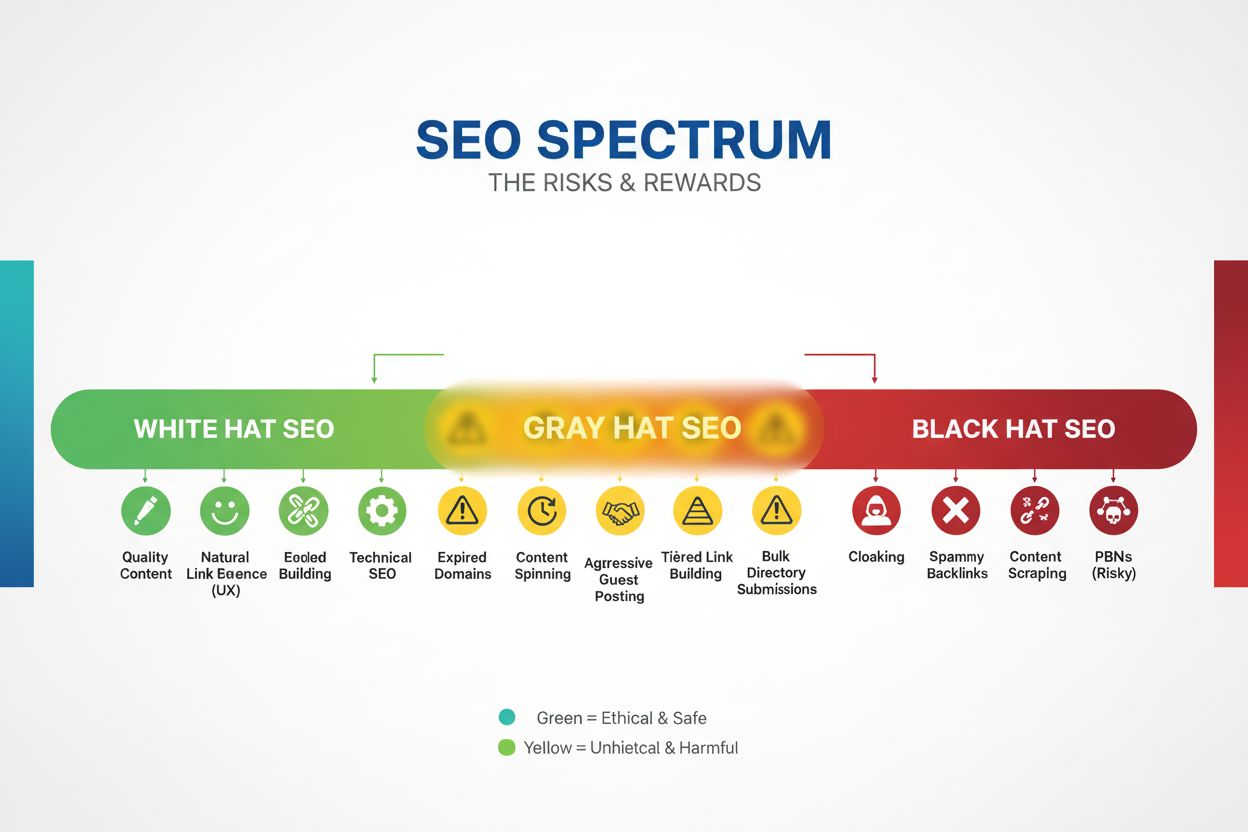
Gray Hat SEO occupies a middle ground between ethical White Hat and deceptive Black Hat practices, using techniques that aren't explicitly forbidden but are questionable. Examples include link exchanges, private blog networks, and keyword placement that's not entirely natural. While Gray Hat carries less risk than Black Hat, it still poses moderate penalties if detected. For sustainable, risk-free growth, White Hat SEO remains the safest and most recommended approach.
AI-powered monitoring platforms like AmICited track brand mentions and domain appearances across search engines and AI systems, detecting when competitors use Black Hat tactics that could harm your brand visibility. These tools analyze search patterns, identify suspicious ranking spikes, and flag manipulative content targeting your keywords. By monitoring AI responses from ChatGPT, Perplexity, Google AI Overviews, and Claude, brands can identify when Black Hat tactics are being used to poison search results or misrepresent their industry.
Start tracking how AI chatbots mention your brand across ChatGPT, Perplexity, and other platforms. Get actionable insights to improve your AI presence.
Gray Hat SEO definition: tactics between white and black hat methods that exploit loopholes without explicit guideline violations. Learn risks, examples, and mo...
White Hat SEO definition: ethical search engine optimization following Google guidelines. Learn sustainable techniques for quality content, natural backlinks, a...

Learn how black hat SEO tactics like AI poisoning, content cloaking, and link farms damage your brand's visibility in AI search engines like ChatGPT and Perplex...
Cookie Consent
We use cookies to enhance your browsing experience and analyze our traffic. See our privacy policy.