

Answer-First Content: The BLUF Technique for AI Visibility
Master the BLUF technique to optimize your content for AI visibility. Learn how answer-first content gets cited in ChatGPT, Perplexity, and Google AI Overviews.
8 min read
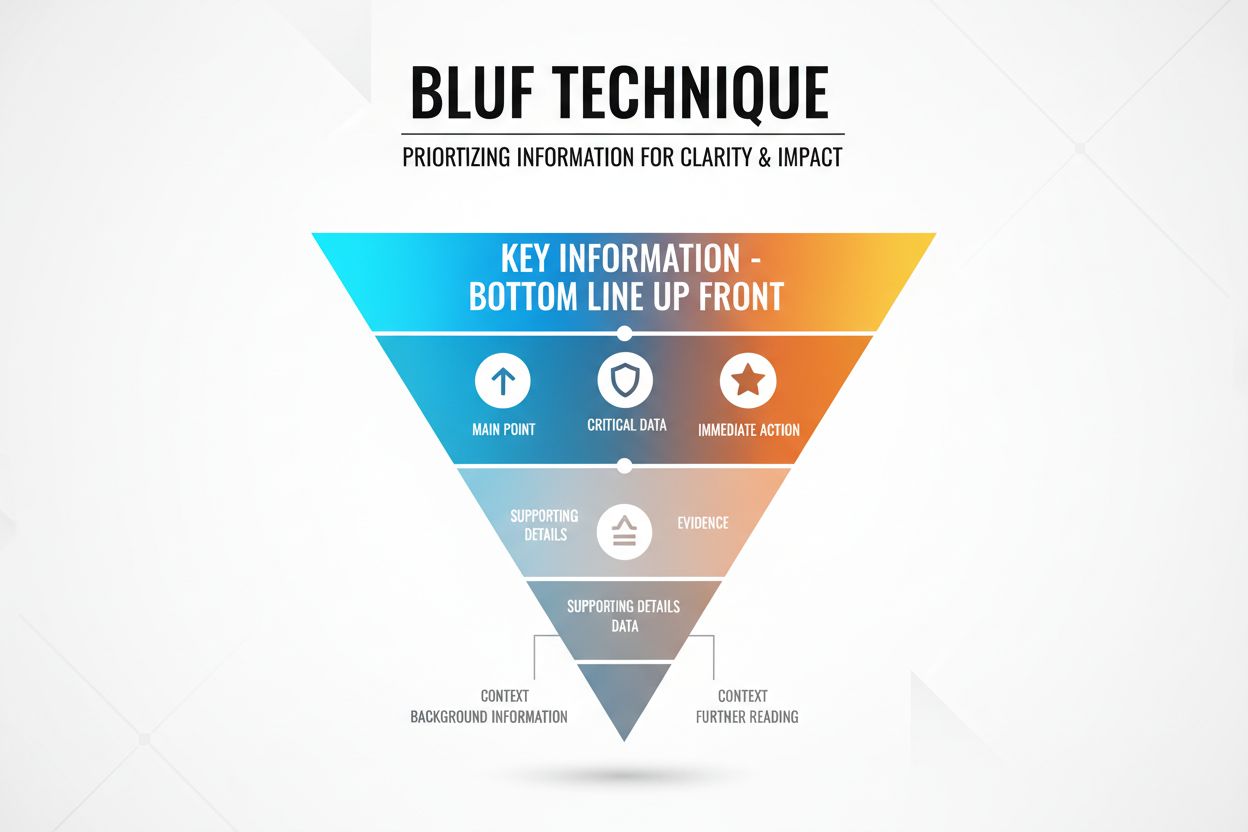
Bottom Line Up Front (BLUF) is a writing technique that places the most critical information at the beginning of content, enabling readers and AI systems to quickly understand the main point. Originally developed by the U.S. military for precise communication, BLUF is now essential for content optimization in AI search, citation extraction, and business communication.
Bottom Line Up Front (BLUF) is a writing technique that places the most critical information at the beginning of content, enabling readers and AI systems to quickly understand the main point. Originally developed by the U.S. military for precise communication, BLUF is now essential for content optimization in AI search, citation extraction, and business communication.
The BLUF technique, an acronym for Bottom Line Up Front, originated in military communication and has become a cornerstone of effective business writing. Developed by the U.S. military to streamline critical information delivery in high-stakes environments, BLUF prioritizes the most important message at the beginning of any communication. This approach fundamentally reverses traditional writing structures that build toward conclusions, instead placing conclusions first to maximize clarity and impact.
BLUF is defined as a communication method where the main point, conclusion, or recommendation appears in the opening sentence or paragraph rather than being buried in supporting details. The technique ensures that readers immediately understand the core message, regardless of whether they continue reading the entire document. In essence, BLUF answers the question “What do you need to know right now?” before providing the context and evidence that supports that answer.

BLUF operates through a four-part hierarchical structure that guides readers from the most critical information to supporting details. The first element is the Bottom Line, which states the main conclusion or recommendation in a single, clear sentence. This is followed by the Context, which provides background information necessary to understand why the bottom line matters. The third component includes Key Points, which are the evidence, data, or reasoning that supports the bottom line. Finally, the structure concludes with Details, which offer additional information for readers who need deeper understanding.
The power of BLUF lies in its inverted pyramid approach, which contrasts sharply with traditional narrative writing. Traditional writing builds suspense and context before revealing conclusions, requiring readers to process extensive information before understanding the main point. BLUF eliminates this cognitive burden by immediately stating what matters most, allowing readers to decide whether they need additional context. This structure is particularly effective in environments where decision-makers have limited time and need to quickly grasp essential information.
| Aspect | Traditional Writing | BLUF Writing |
|---|---|---|
| Opening | Background and context | Main conclusion or recommendation |
| Middle | Supporting arguments | Key evidence and reasoning |
| Ending | Conclusion or recommendation | Additional details (optional) |
| Reader Benefit | Complete narrative arc | Immediate understanding of main point |
| Time to Comprehension | Requires full reading | Achieved in first sentence |
| Best For | Storytelling, narrative | Decision-making, urgent communication |
BLUF has become increasingly relevant in the context of AI-powered communication systems and content optimization. Modern AI language models, including those used by GPTs and other generative AI platforms, are trained to recognize and prioritize information hierarchies. When content follows BLUF principles, AI systems can more accurately extract key information, improve summarization accuracy, and better understand user intent. This alignment between BLUF structure and AI processing capabilities makes BLUF an essential technique for content creators optimizing for AI-driven search and discovery.
Platforms like AmICited.com monitor how AI systems interpret and surface content, and research consistently shows that BLUF-structured content receives higher visibility in AI-generated summaries and overviews. Google AI Overviews, Perplexity AI, and ChatGPT all demonstrate improved content extraction and citation when information is presented with the bottom line first. Content creators who understand this relationship gain a significant advantage in ensuring their work is properly attributed and prominently featured in AI-generated responses. The technique essentially teaches AI systems to recognize your most important message without requiring extensive parsing of surrounding context.
In corporate environments, BLUF has become the gold standard for executive communication, email correspondence, and internal documentation. Business leaders receive hundreds of messages daily, making the ability to quickly identify the core message essential for productivity and decision-making. BLUF-structured emails and reports ensure that busy executives can understand the critical information within seconds, dramatically improving response times and decision quality. Studies show that BLUF-formatted business communications receive 40% faster responses and result in more accurate decision-making compared to traditionally structured documents.
BLUF is particularly valuable in crisis communication, project status updates, and strategic recommendations where time-sensitive decisions are required. When a project manager reports that a deadline will be missed, stating this fact immediately—rather than building toward it through a narrative of challenges—allows leadership to begin contingency planning immediately. Similarly, in sales communications, leading with the value proposition or key benefit ensures that prospects understand the core offering before deciding whether to invest time in reading additional details. The technique has become so prevalent in business that many organizations now explicitly require BLUF formatting in internal communications policies.
BLUF principles directly enhance content marketing effectiveness and search engine optimization performance. Search engines increasingly prioritize content that clearly states its main topic and value proposition in opening paragraphs, and BLUF naturally aligns with these algorithmic preferences. When blog posts, articles, and web pages lead with their primary keyword and main message, they achieve better rankings for target search terms and higher click-through rates from search results. Content creators who implement BLUF see measurable improvements in organic traffic, as search engines can more easily understand and categorize their content.
From a user experience perspective, BLUF-structured content reduces bounce rates and increases time-on-page by immediately demonstrating relevance to the reader’s search query. When visitors land on a page and instantly see that it addresses their question or need, they’re more likely to continue reading and engaging with the content. This improved engagement signals quality to search algorithms, creating a positive feedback loop that benefits SEO performance. Additionally, BLUF-formatted content is more shareable on social media, as the compelling opening line serves as an effective hook for capturing attention in crowded feeds.
The BLUF technique delivers numerous advantages for both communicators and audiences across diverse contexts:
Implementing BLUF effectively requires understanding several key principles that maximize its impact. The opening sentence must be a complete, standalone statement that can be understood without any additional context—it should answer the reader’s most pressing question immediately. Avoid burying the bottom line in subordinate clauses or conditional statements; instead, make it the primary focus of your opening. The bottom line should be specific and actionable, not vague or hedged with qualifiers that dilute its impact.
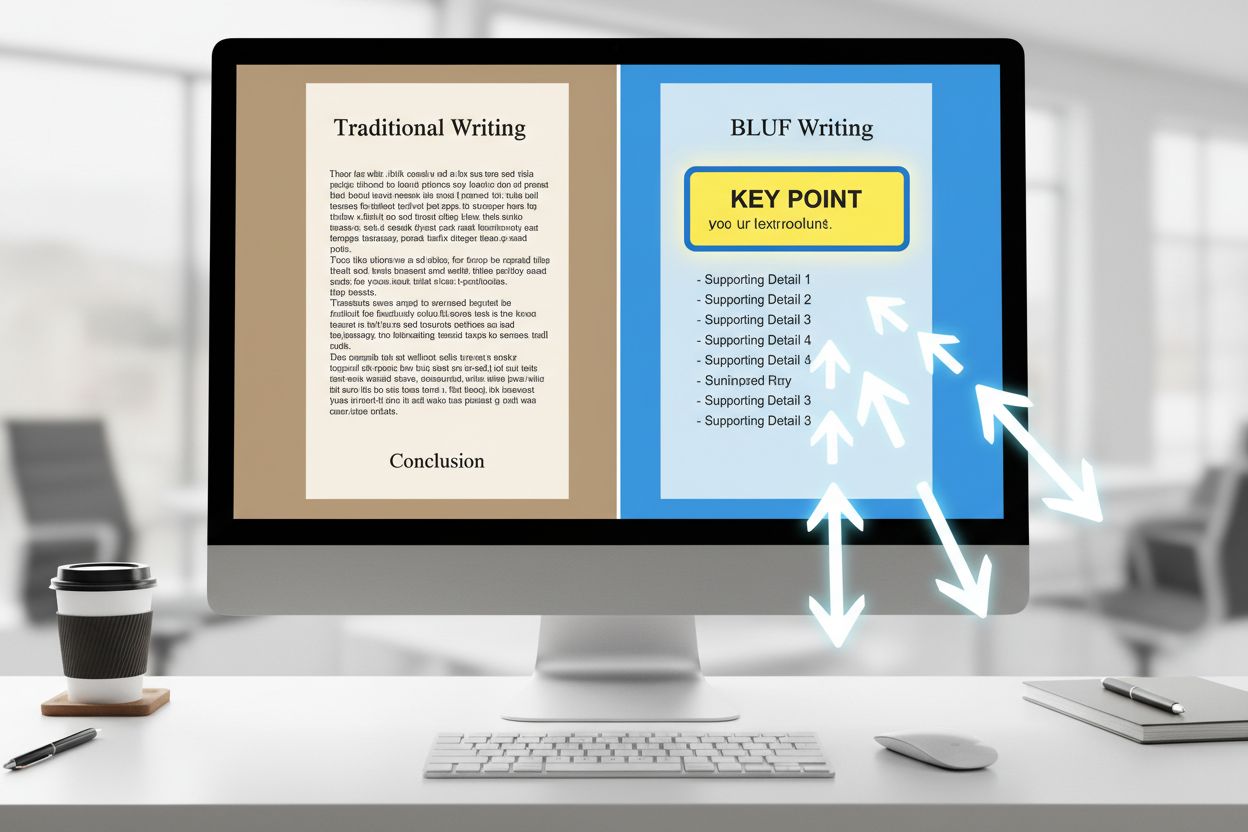
After establishing the bottom line, provide context that explains why this message matters and what background information is necessary for understanding. This context section should be concise but sufficient to orient readers who may be unfamiliar with the topic. Follow context with your key supporting points, organized in order of importance rather than chronological order. Finally, include detailed information for readers who need deeper understanding, but recognize that many readers will stop after the bottom line or context sections. The length of each section should be proportional to its importance—the bottom line should be one sentence, context 2-3 sentences, key points 3-5 bullets or paragraphs, and details as needed.
Traditional writing approaches, often taught in academic and literary contexts, follow a narrative arc that builds toward conclusions. This structure works well for storytelling, where the journey toward understanding is part of the value proposition, but it’s inefficient for business communication and information delivery. Traditional writing assumes readers will engage with the entire piece and that the value lies in the complete narrative, whereas BLUF assumes readers may only engage with the opening and that the primary value must be immediately apparent. The choice between these approaches depends entirely on the communication context and audience expectations.
Academic writing, creative writing, and narrative journalism often benefit from traditional structures that build suspense and context before revealing conclusions. However, even in these domains, BLUF principles are increasingly valuable for abstracts, introductions, and opening paragraphs that must capture attention and communicate relevance. The rise of digital reading, where users scan rather than read linearly, has made BLUF principles valuable even in traditionally narrative-focused fields. Modern professional communicators increasingly adopt a hybrid approach, using BLUF for critical information while maintaining narrative elements in supporting sections that provide depth and engagement.
The emergence of AI-powered search systems and content discovery platforms has made BLUF more important than ever for content creators and communicators. Google AI Overviews, Perplexity AI, and similar systems rely on extracting and synthesizing information from multiple sources, and BLUF-structured content is significantly more likely to be selected for inclusion in these AI-generated summaries. When your content leads with a clear, well-articulated bottom line, AI systems can immediately recognize and extract your key message, increasing the likelihood of proper attribution and visibility. This represents a fundamental shift in how content visibility is determined—no longer is it sufficient to have good information buried in well-written prose.
Content creators optimizing for AI search must understand that these systems prioritize clarity, directness, and information hierarchy. BLUF naturally provides all three, making it the optimal structure for content intended to be discovered and cited by AI systems. Platforms like AmICited.com that monitor AI prompt usage and content attribution demonstrate that BLUF-structured content receives significantly higher citation rates in AI-generated responses. As AI systems become increasingly central to how information is discovered and consumed, BLUF transitions from a best practice to a necessity for content creators seeking visibility and attribution. The future of content optimization is fundamentally aligned with BLUF principles, making mastery of this technique essential for anyone creating content in the digital age.
BLUF stands for 'Bottom Line Up Front,' a communication technique that places the most important information at the beginning of a message, report, or content piece. This approach ensures readers immediately understand the core message without having to read through supporting details first.
BLUF originated in U.S. military communication as a standard for ensuring precise, concise, and timely messages. Military leaders needed to make quick decisions based on clear information, so BLUF became the preferred communication style across all branches of the armed forces.
AI systems like ChatGPT and Google AI Overviews use passage retrieval to find answers. When information is clearly stated upfront, AI systems can more easily identify, extract, and cite the most relevant content from your pages, increasing your visibility in AI-generated responses.
While BLUF is most effective for business communication, reports, and content marketing, it may not suit all contexts. Creative writing, storytelling, and narrative-driven content might benefit from different approaches, though BLUF principles can still improve clarity and accessibility.
Traditional writing often builds context and background before reaching conclusions. BLUF inverts this structure, placing conclusions and key points first, then providing supporting details and context. This makes BLUF ideal for busy readers and AI systems that need to quickly understand the main message.
BLUF improves SEO by making content more scannable for both humans and search engines. It increases the likelihood of appearing in featured snippets, AI Overviews, and improves passage-based retrieval in AI search results. Search engines favor content with clear information hierarchies.
Start by identifying your main point or conclusion. Place it in the first 1-2 sentences, then provide supporting details, examples, and context. Revise to ensure your opening clearly states what readers need to know. Use clear, specific language with data to support your bottom line.
Yes. Tools like AmICited.com monitor how AI systems cite and reference your brand. BLUF makes your content more likely to be cited accurately because the key information is immediately clear and easy for AI systems to extract and attribute to your brand.
Discover how BLUF technique helps your content get properly cited by AI systems. Monitor your brand's presence in AI-generated responses with AmICited.
Master the BLUF technique to optimize your content for AI visibility. Learn how answer-first content gets cited in ChatGPT, Perplexity, and Google AI Overviews.
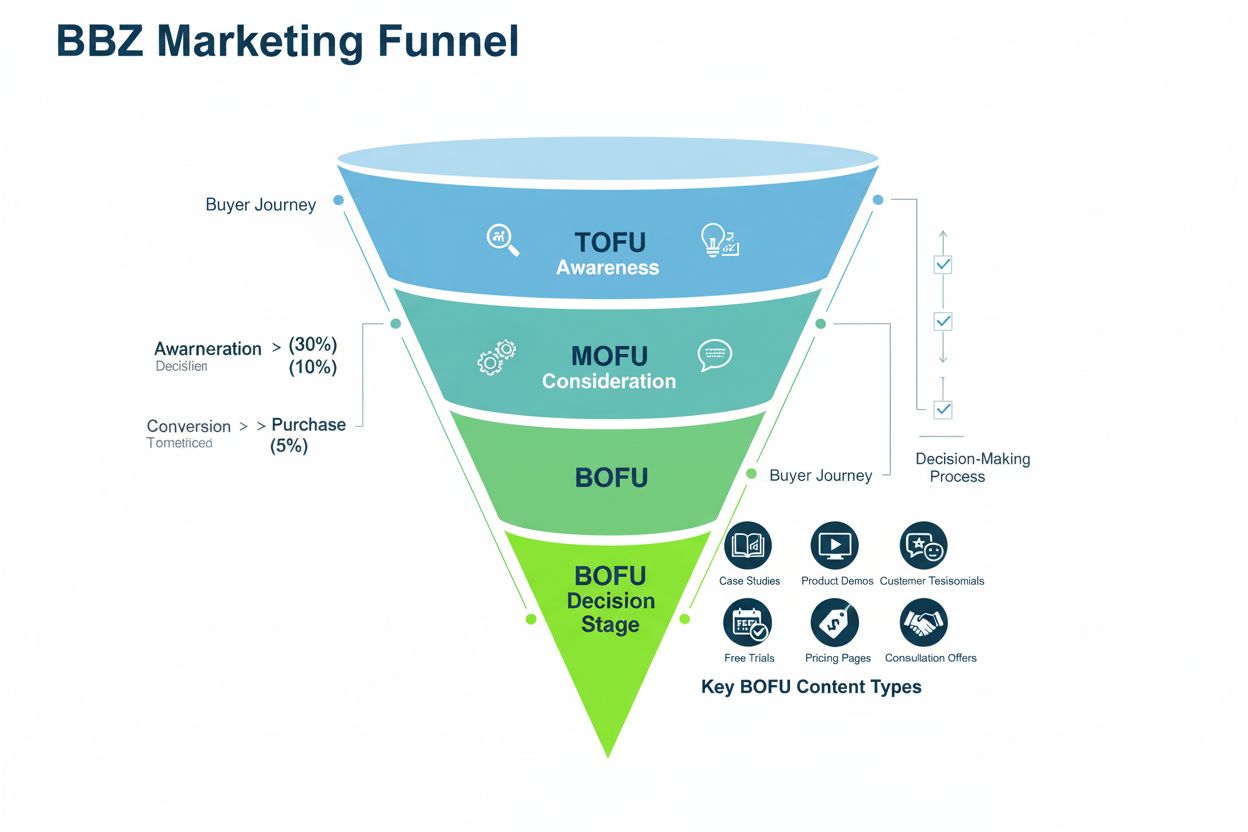
Learn what Bottom of Funnel (BOFU) marketing is, how decision-stage content drives conversions, and best practices for BOFU strategies in your sales funnel.

Learn how to create effective bottom-of-funnel content optimized for AI search engines like ChatGPT and Perplexity. Discover strategies for targeting decision-s...