

Semantic Search
Semantic search interprets query meaning and context using NLP and machine learning. Learn how it differs from keyword search, powers AI systems, and improves s...
12 min read
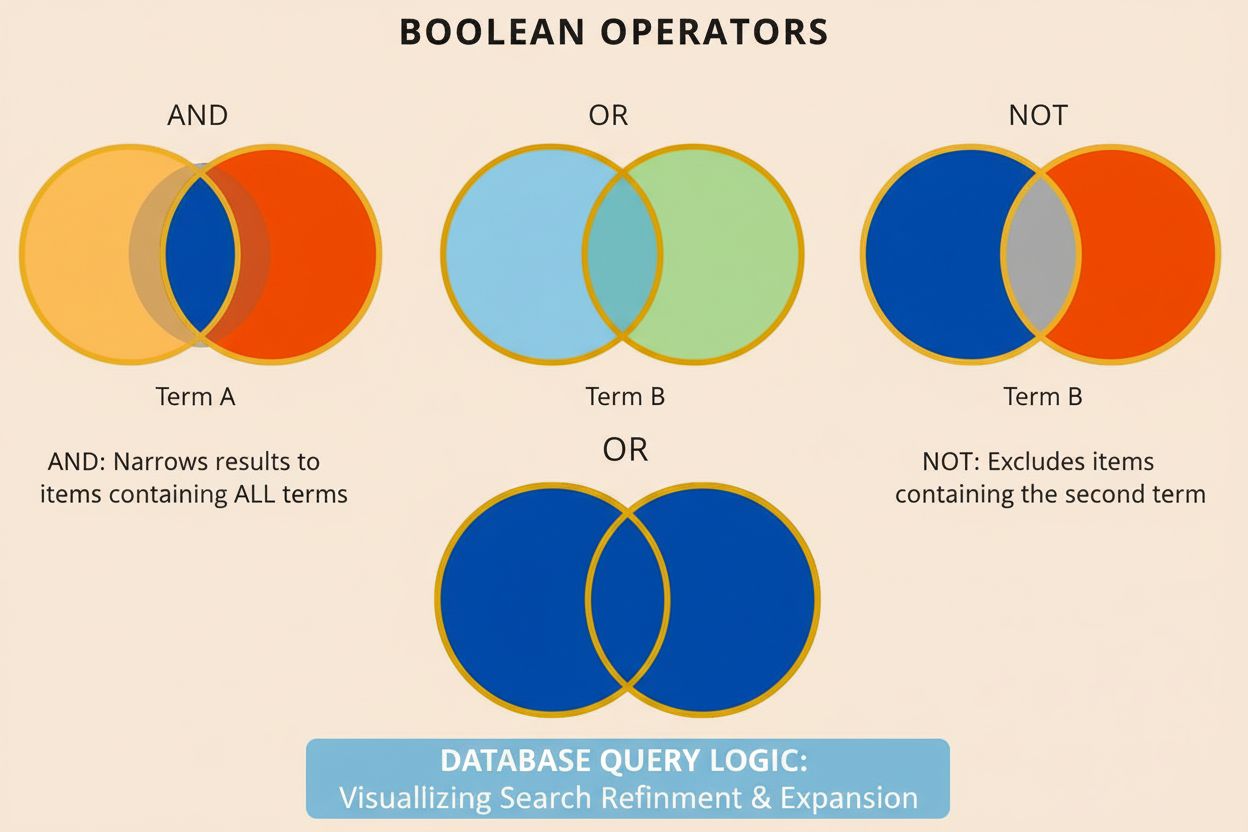
Boolean search is a search technique that uses logical operators (AND, OR, NOT) and modifiers to refine, narrow, or broaden search results in databases, search engines, and AI systems. By combining keywords with Boolean operators, users can create precise queries that return highly targeted results, making it essential for research, recruitment, and information retrieval.
Boolean search is a search technique that uses logical operators (AND, OR, NOT) and modifiers to refine, narrow, or broaden search results in databases, search engines, and AI systems. By combining keywords with Boolean operators, users can create precise queries that return highly targeted results, making it essential for research, recruitment, and information retrieval.
Boolean search is a search technique that uses logical operators and modifiers to refine, narrow, or broaden search results in databases, search engines, and AI systems. The term originates from Boolean logic, a mathematical system developed by British mathematician George Boole in the 19th century, where all variables are evaluated as either “true” or “false,” or “on” or “off.” This foundational logic underpins all modern digital devices and computer code. In practical application, Boolean search combines keywords with specific operators—primarily AND, OR, and NOT—to construct precise queries that return highly targeted results. By mastering Boolean search syntax, users can navigate vast information repositories, identify relevant candidates in recruitment databases, conduct academic research, and monitor brand mentions across AI systems with unprecedented precision and efficiency.
Boolean search emerged as a formal search methodology in the mid-20th century when librarians and researchers needed systematic ways to query growing digital databases. The technique gained widespread adoption in the 1980s and 1990s as online databases proliferated, becoming essential in legal research, academic libraries, and professional information retrieval. Boolean operators became standardized across platforms including Lexis-Nexis, Dialog, and early internet search engines. The methodology remained relatively unchanged for decades because of its logical elegance and effectiveness. However, the rise of natural language processing and AI systems in the 2020s introduced new dynamics. While some predicted Boolean search would become obsolete, recent research demonstrates its continued relevance. According to 2024-2025 data, 95% of Americans still rely on traditional search engines, and Boolean search remains embedded in professional recruiting platforms, academic databases, and enterprise search tools. The integration of Boolean search with AI assistance—where systems like ChatGPT, Perplexity, and Claude help generate Boolean strings—represents an evolution rather than replacement of the methodology.
The foundation of Boolean search rests on three primary operators that define relationships between search terms. The AND operator narrows search results by requiring all specified terms to appear in retrieved documents. For example, searching “recruitment AND HR” returns only results containing both terms, significantly reducing result volume while increasing relevance. According to research from the University of Illinois Library, searching “art AND music” yields approximately 76,192 results, compared to 1,785,300 results when using OR. The OR operator broadens search results by including any of the specified terms, useful for capturing synonyms or alternative terminology. Searching “recruitment OR recruiting” ensures candidates using either terminology appear in results, preventing qualified candidates from being missed due to semantic variations. The NOT operator restricts results by excluding specific terms, eliminating false positives and irrelevant results. For instance, “recruitment NOT HR” returns candidates with recruitment experience but excludes those with HR backgrounds, useful when seeking specialized expertise. These three operators form the logical foundation that enables users to construct increasingly sophisticated queries tailored to specific information needs.
Beyond the three primary operators, Boolean modifiers extend search capabilities through additional syntax elements. Quotation marks ("") search for exact phrases, ensuring words appear together in that precise order and sequence. Searching “music performance” with quotation marks yields approximately 27,582 results, compared to 37,047 results without quotes, demonstrating how phrase searching dramatically increases precision. Parentheses () group OR statements and establish priority in complex queries, controlling the logical order in which databases process search terms. For example, “(talent OR hr) AND recruitment” differs fundamentally from “talent OR (hr AND recruitment)” in terms of which candidates are retrieved. Truncation or wildcard searching uses the asterisk () attached to word stems to capture all variations. Searching “stat” returns state, states, statute, statutory, statistic, statistics, and related terms automatically. These modifiers are essential for constructing sophisticated search strings that balance precision with comprehensiveness, particularly in recruitment, legal research, and academic contexts where terminology variations are common.
| Search Method | Operator Support | Precision Level | Learning Curve | Best Use Case | AI Integration |
|---|---|---|---|---|---|
| Boolean Search | AND, OR, NOT, (), “”, * | Very High | Moderate to High | Recruitment, legal research, academic databases | Emerging (AI-assisted generation) |
| Natural Language Search | Contextual interpretation | Medium | Low | General web searches, conversational queries | Native (ChatGPT, Perplexity, Claude) |
| Keyword Search | Simple term matching | Low to Medium | Very Low | Basic web searches, casual browsing | Limited |
| Phrase Search | Exact phrase matching only | High | Very Low | Finding specific quotes, exact titles | Limited |
| Faceted Search | Category filters, tags | Medium | Very Low | E-commerce, content discovery | Emerging |
| Semantic Search | Meaning-based matching | Medium to High | Low | Understanding intent, related concepts | Native (Google AI Overviews) |
Boolean search functions differently across various platforms, requiring users to understand platform-specific syntax and capabilities. LinkedIn supports Boolean search for recruiter searches, accepting AND, OR, NOT, parentheses, and quotation marks, making it a primary tool for talent acquisition professionals. Google Search historically supported Boolean operators but has gradually reduced support, now accepting only quotation marks for phrase search and the minus sign (-) for NOT operations. Academic databases like JSTOR, PubMed, and ProQuest maintain full Boolean support with consistent syntax. AI systems present an emerging frontier: ChatGPT can generate Boolean strings when prompted but doesn’t natively execute them; Perplexity functions as an AI-powered search engine that understands Boolean logic; Google AI Overviews incorporate semantic understanding alongside traditional search; Claude can construct Boolean queries but requires explicit instruction. Recent testing by Full Stack Recruiter comparing AI tools for Boolean string generation revealed that while all major AI systems can generate Boolean queries, the quality varies significantly. Google Gemini 2.0 (paid version) and Perplexity produced more sophisticated strings than ChatGPT’s free version, suggesting that advanced models better understand Boolean logic nuances. This variation highlights why human expertise remains valuable—AI can assist in generating initial strings, but refinement based on domain knowledge produces superior results.
The recruitment industry represents one of the most sophisticated applications of Boolean search, where precision directly impacts hiring outcomes and time-to-hire metrics. Recruiters construct complex Boolean strings to identify candidates matching specific skill combinations, geographic locations, experience levels, and certifications. A typical recruitment Boolean string might read: ("accountant" OR "accounting professional") AND ("Prague" OR "Praha") AND ("US GAAP" OR "Generally Accepted Accounting Principles") AND ("financial analysis" OR "financial analyst"). This string narrows results from potentially millions of profiles to highly qualified candidates meeting all specified criteria. According to industry data, 68% of recruiters report talent shortages, making Boolean search efficiency critical for competitive advantage. Professional recruiting platforms like HireEZ, SeekOut, and LinkedIn Recruiter embed Boolean search functionality as core features. The methodology enables recruiters to move beyond simple keyword matching to construct sophisticated queries that capture nuanced requirements. However, emerging research indicates that while AI can generate Boolean strings, human-crafted strings often outperform AI-generated ones due to subtle understanding of role requirements, industry terminology, and platform-specific optimization. This creates a hybrid approach where recruiters use AI to generate initial strings, then refine them based on domain expertise and iterative testing.
In the context of AI monitoring platforms like AmICited, Boolean search principles enable organizations to track how their brands, domains, and content appear in AI-generated responses. As AI systems like ChatGPT, Perplexity, Google AI Overviews, and Claude increasingly influence information discovery, understanding how these systems cite and reference specific domains becomes critical. Organizations can construct Boolean queries to monitor: branded product mentions across AI systems, competitive references in AI responses, URL citations and backlink appearances, and content attribution patterns. For example, a company might monitor ("amicited" OR "AmICited" OR "amicited.com") AND ("AI monitoring" OR "brand monitoring") to track how their platform appears in AI responses. The precision of Boolean search is particularly valuable because AI systems generate responses dynamically, and organizations need to understand exactly which queries trigger their mentions. AmICited leverages Boolean search principles to help organizations construct precise monitoring queries, track appearance frequency, analyze citation context, and identify opportunities for improved visibility. As AI search traffic increased 527% in just one year according to 2024-2025 data, the ability to monitor and optimize presence across these systems has become strategically essential. Boolean search expertise enables organizations to move beyond simple brand monitoring to sophisticated competitive analysis and market positioning strategies within AI-generated content ecosystems.
Constructing effective Boolean searches requires systematic thinking and iterative refinement. Start with core concepts: identify the primary terms essential to your search, then brainstorm synonyms and variations. Use AND strategically: combine terms that must all appear together, understanding that each AND narrows results. Leverage OR for variations: capture synonyms, alternative spellings, and related terminology using OR, but enclose OR statements in parentheses when combining with AND. Apply NOT carefully: exclude irrelevant results, but avoid over-excluding and missing relevant content. Use quotation marks for phrases: when multi-word terms must appear together in exact sequence, enclose them in quotation marks. Employ truncation wisely: use wildcards to capture word variations, but avoid truncating too early and capturing unintended terms. Test and iterate: start with simpler searches and progressively add complexity, monitoring how result volume and relevance change. Document your logic: record the Boolean string and its purpose, enabling refinement and replication. Consider platform specifics: verify which operators your target platform supports, as syntax varies between LinkedIn, Google, academic databases, and AI systems. Combine with filters: use Boolean search alongside platform-specific filters like date ranges, location, and job titles for additional precision. These practices transform Boolean search from a technical skill into a strategic capability that dramatically improves information retrieval efficiency and accuracy.
The future of Boolean search will likely involve deeper integration with artificial intelligence and natural language processing rather than obsolescence. As AI systems become more sophisticated, the ability to construct precise Boolean queries will remain valuable for users requiring exact control over search parameters. Emerging trends suggest a hybrid approach where users leverage AI to generate initial Boolean strings, then refine them based on domain expertise and iterative testing. Perplexity and other answer engines are incorporating Boolean logic into their underlying search mechanisms, suggesting that Boolean principles will remain foundational even as user interfaces become more conversational. In AI monitoring contexts, Boolean search will become increasingly important as organizations seek to understand and optimize their presence across multiple AI systems. The rise of AI search traffic (up 527% year-over-year) creates new opportunities for organizations that understand how to construct precise queries and monitor their appearance in AI-generated responses. Additionally, as concerns about AI hallucinations and citation accuracy grow, Boolean search expertise will help organizations verify how their content is cited and contextualized within AI responses. The methodology will likely evolve to incorporate new operators and modifiers specific to AI systems, but the fundamental logic—using explicit operators to construct precise queries—will remain central to information retrieval strategy. Organizations investing in Boolean search expertise today position themselves to navigate the increasingly complex landscape of AI-driven information discovery and brand monitoring.
The three primary Boolean operators are AND, OR, and NOT. The AND operator narrows search results by requiring all specified terms to be present in results. The OR operator broadens results by including any of the specified terms. The NOT operator restricts results by excluding specific terms. These operators form the foundation of Boolean search logic and are used in virtually all databases and search platforms.
Boolean search uses explicit logical operators and syntax rules to construct precise queries, while natural language search interprets conversational phrases and context. Boolean search offers greater control and transparency—you know exactly why results were included or excluded. However, natural language search is more intuitive for casual users. Many modern AI systems like ChatGPT and Perplexity now support both approaches, with Boolean search remaining valuable for complex, specific queries requiring exact precision.
Boolean modifiers include quotation marks (""), parentheses (), and wildcards/truncation (*). Quotation marks search for exact phrases, ensuring words appear together in that specific order. Parentheses group OR statements to control search logic priority. Wildcards attach to word stems to capture variations—for example, 'account*' returns accountant, accounting, accountable, and accounts. These modifiers significantly increase search precision and flexibility.
Despite advances in AI, Boolean search remains critical because it provides explicit control, transparency, and precision that AI systems sometimes lack. According to recent testing, AI-generated Boolean strings often contain subtle inefficiencies or overbroad terms. Boolean search is particularly valuable in recruitment, legal research, academic databases, and AI monitoring where specificity is essential. Users can combine Boolean expertise with AI assistance to generate initial queries, then refine them for optimal results.
Parentheses establish priority in complex Boolean queries. Without parentheses, databases typically process AND operators before OR operators, which can produce unexpected results. For example, 'talent OR hr AND recruitment' is ambiguous. Using parentheses clarifies intent: '(talent OR hr) AND recruitment' means find candidates with either talent or HR experience who also have recruitment experience. Parentheses are essential when combining multiple OR statements with AND operators.
Boolean search is a standard tool in professional recruitment, with 68% of recruiters reporting talent shortages and relying on advanced search techniques to identify candidates efficiently. Studies show that Boolean search can identify well-qualified candidates significantly faster than traditional search methods. In 2024-2025, Boolean search remains embedded in major recruiting platforms like LinkedIn, HireEZ, and SeekOut, though AI-assisted Boolean generation is becoming increasingly common.
Boolean search principles apply to AI monitoring by allowing users to construct precise queries to track brand mentions, domain appearances, and URL citations across AI systems like ChatGPT, Perplexity, Google AI Overviews, and Claude. Using Boolean operators, organizations can refine searches to monitor specific product names, competitive mentions, or branded content. This precision is critical for understanding how AI systems cite and reference domains in their responses.
Start tracking how AI chatbots mention your brand across ChatGPT, Perplexity, and other platforms. Get actionable insights to improve your AI presence.
Semantic search interprets query meaning and context using NLP and machine learning. Learn how it differs from keyword search, powers AI systems, and improves s...
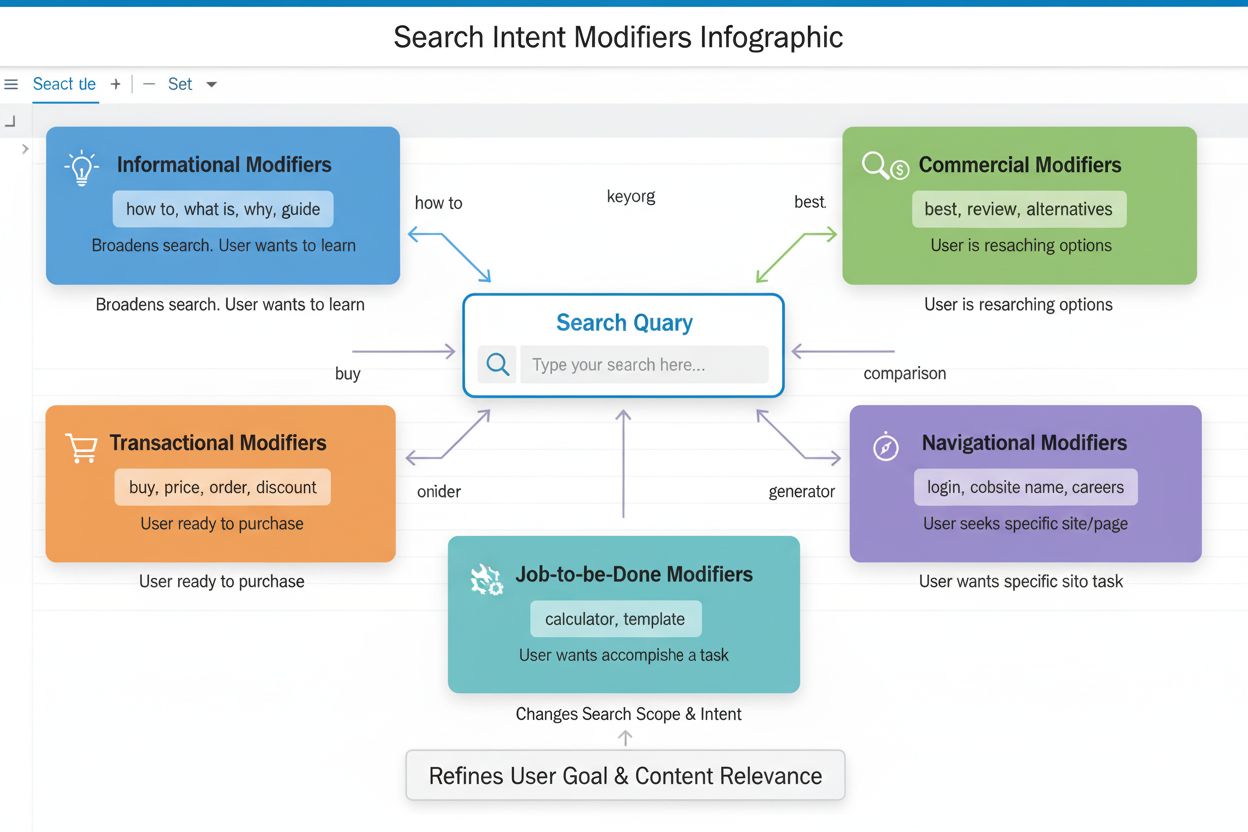
Learn what search modifiers are, how they change search intent and scope, and why they matter for SEO, AI monitoring, and brand visibility across search platfor...

Master the BLUF technique to optimize your content for AI visibility. Learn how answer-first content gets cited in ChatGPT, Perplexity, and Google AI Overviews.
Cookie Consent
We use cookies to enhance your browsing experience and analyze our traffic. See our privacy policy.