
Unlinked Brand Mention
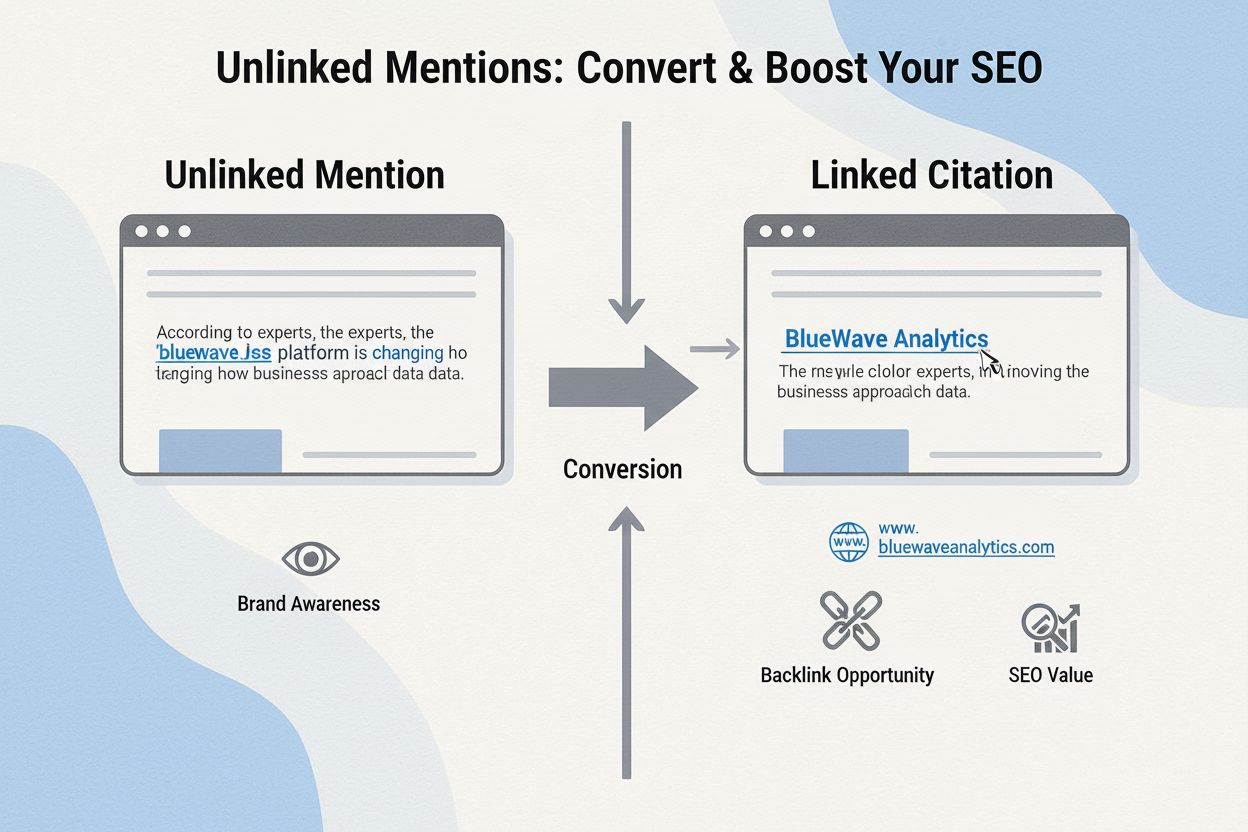
Unlinked brand mentions are online references to your brand without backlinks. Learn how they impact SEO, AI visibility, and why converting them to links matter...
11 min read
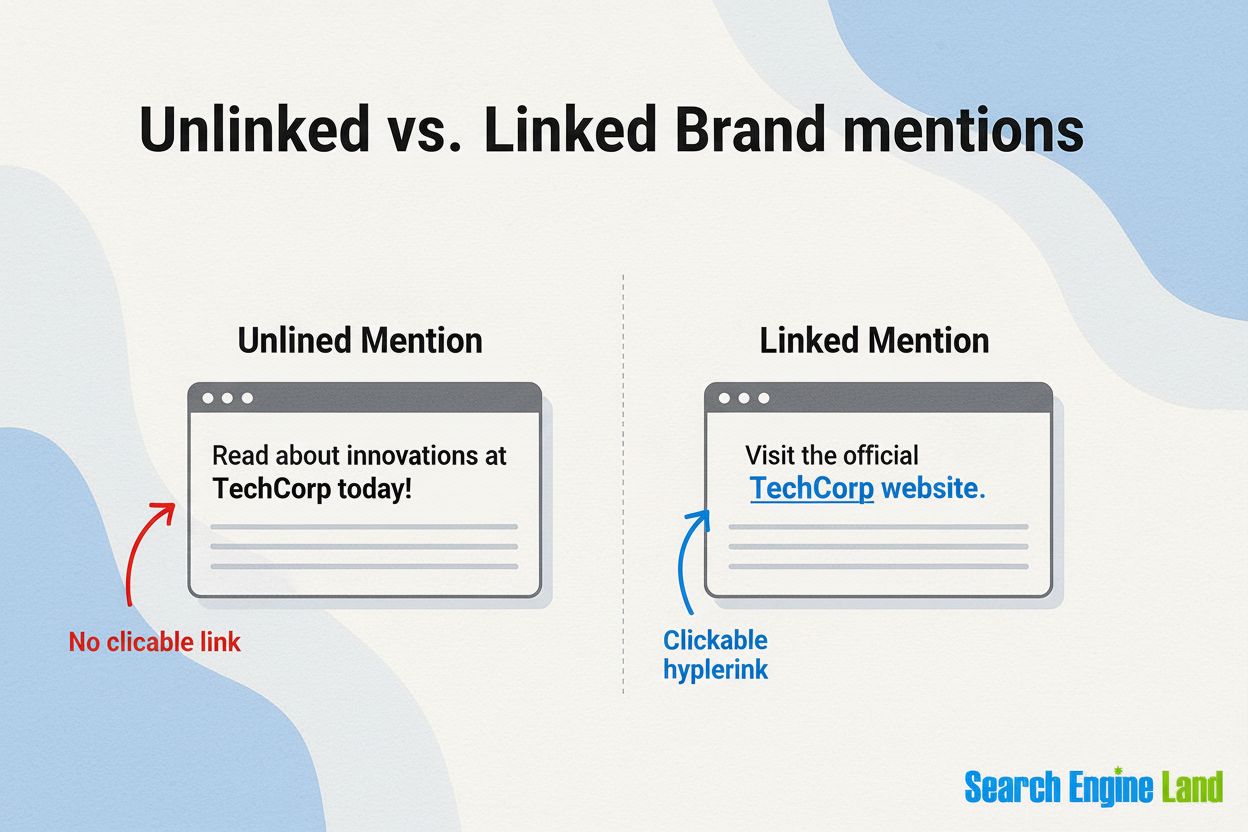
A brand mention is a reference to a brand, product, or company name in online content without an accompanying hyperlink. Unlike brand citations, which include clickable links, brand mentions are unlinked textual references that signal brand awareness and authority to search engines and AI systems.
A brand mention is a reference to a brand, product, or company name in online content without an accompanying hyperlink. Unlike brand citations, which include clickable links, brand mentions are unlinked textual references that signal brand awareness and authority to search engines and AI systems.
A brand mention is a reference to a brand, product, company name, or person in online content that does not include a hyperlink back to the brand’s website or official source. Unlike brand citations, which feature clickable links embedded in content, brand mentions are purely textual acknowledgments of a brand’s existence and relevance. These mentions can appear across diverse digital channels including news articles, blog posts, social media platforms, forums, industry publications, podcasts, and AI-generated responses. The critical distinction is that while a brand mention signals awareness and authority, it does not directly drive referral traffic through a clickable link. However, research demonstrates that unlinked brand mentions carry substantial SEO and brand-building value, particularly in the context of modern AI-driven search engines that prioritize entity recognition and topical authority over traditional link metrics.
The concept of brand mentions has evolved significantly over the past decade as search engines and AI systems have become more sophisticated in understanding brand authority. Historically, backlinks dominated SEO strategy, serving as the primary signal of a website’s credibility and relevance. However, as Google’s algorithm matured and AI-powered search tools emerged, the importance of brand mentions became increasingly apparent. In 2017, Google officially confirmed that its algorithm recognizes and evaluates both linked and unlinked brand mentions as ranking factors. This shift reflected a broader industry recognition that brand authority extends beyond clickable links to encompass the broader digital conversation surrounding a brand. According to recent research, 80.9% of SEO experts believe unlinked brand mentions affect organic search rankings, demonstrating widespread acceptance of mentions as a legitimate SEO signal. The rise of Generative Engine Optimization (GEO) and AI search platforms like ChatGPT, Perplexity, and Google AI Overviews has further elevated the importance of brand mentions, as these systems rely heavily on brand recognition and topical authority rather than traditional link-based metrics. Today, brand mentions represent a critical component of a comprehensive digital visibility strategy, complementing traditional link-building efforts and contributing to overall brand authority in both traditional and AI-driven search environments.
| Aspect | Brand Mention | Brand Citation |
|---|---|---|
| Definition | Unlinked textual reference to a brand name | Linked reference with visible source attribution |
| Link Presence | No hyperlink included | Includes clickable hyperlink or source link |
| Frequency in AI | 3.2x more common in ChatGPT responses | Less common; AI systems often strip links |
| Direct Traffic | No direct referral traffic from the mention | Potential referral traffic through link click |
| SEO Impact | Signals authority and brand recognition | Passes link equity and domain authority |
| User Behavior | Users may search brand name afterward | Users click link for immediate access |
| AI Visibility | Strengthens brand recall and topical authority | Provides source attribution in AI answers |
| Tracking Difficulty | Harder to track; requires monitoring tools | Easier to track through backlink analysis |
| Conversion Potential | Drives indirect traffic through brand searches | Drives immediate, direct referral traffic |
| Platform Examples | News articles, blogs, social media, forums | Cited sources in Google AI Overviews, ChatGPT |
The recognition of brand mentions as a legitimate ranking factor represents a fundamental shift in how search engines evaluate website authority and relevance. For decades, backlinks were the gold standard of SEO, with search engines treating them as votes of confidence from other websites. However, this approach had inherent limitations: it was difficult to scale, vulnerable to manipulation, and didn’t capture the full spectrum of brand authority signals available across the internet. As search engines became more sophisticated, they began incorporating entity recognition technology—a form of artificial intelligence that allows search engines to understand real-world entities (people, places, organizations, brands) and their relationships to topics. This technological advancement enabled Google and other search engines to recognize brand mentions even without accompanying links, treating them as implicit endorsements of a brand’s authority within a specific domain. The emergence of AI-powered search assistants like ChatGPT and Perplexity further accelerated this trend. These systems don’t rely on traditional link metrics at all; instead, they analyze the frequency and context of brand mentions across their training data to determine which brands are most relevant and trustworthy for answering user queries. Research from BrightEdge found that ChatGPT mentions brands 3.2 times more frequently than it cites them, indicating that mentions have become the primary mechanism through which AI systems recommend and reference brands. This shift has profound implications for digital marketing strategy, requiring brands to focus not just on earning links but on building a consistent, authoritative presence across the entire digital ecosystem.
The relationship between brand mentions and AI search visibility represents one of the most significant changes in digital marketing over the past two years. Unlike traditional search engines, which prioritize pages based on link authority and keyword relevance, AI search systems prioritize brand mentions and topical authority. When a user asks ChatGPT, Perplexity, or Google’s AI Overviews a question, the system doesn’t simply return the highest-ranking pages; instead, it synthesizes information from multiple sources and recommends brands based on how frequently and positively those brands are mentioned across the web. This creates a fundamentally different visibility dynamic. A brand with fewer backlinks but more frequent, high-quality mentions across authoritative sources may receive more AI visibility than a brand with a stronger traditional link profile. Research by Cassie Clark Marketing found that 85% of brands mentioned in ChatGPT have no citation links, yet users still search for those brands afterward, indicating that mentions drive brand recall and subsequent search behavior. This phenomenon has important implications for AmICited’s monitoring platform, which tracks brand mentions and citations across AI systems. By monitoring where and how your brand appears in AI-generated responses, you can understand your true AI search impact and identify opportunities to increase visibility. The key insight is that brand mentions are no longer a secondary SEO metric; they are now a primary driver of discovery in AI-powered search environments.
The strategic importance of brand mentions extends far beyond simple SEO metrics. In the context of modern digital marketing, brand mentions serve multiple critical functions that collectively contribute to brand growth and market positioning. First, brand mentions build brand awareness by introducing your brand to new audiences who encounter your name in trusted, contextually relevant content. When someone reads a mention of your brand in a reputable publication or industry resource, they begin to associate your brand with specific topics, expertise, or solutions. This repeated exposure across multiple sources creates a cumulative authority effect, where each mention reinforces the perception that your brand is a legitimate, trusted player in its industry. Second, brand mentions contribute to social proof and credibility. When potential customers see your brand mentioned alongside industry leaders or in respected publications, they develop greater confidence in your brand’s legitimacy and value proposition. This psychological phenomenon, known as social proof, is particularly powerful in B2B markets where purchasing decisions often involve multiple stakeholders and require high levels of trust. Third, brand mentions drive indirect traffic and conversions through a mechanism that traditional analytics often fail to capture. Research shows that users who encounter brand mentions frequently search for the brand by name afterward, driving branded search volume and direct traffic. This indirect traffic pathway is particularly important in AI search environments, where users may not click links but instead remember brand names and search for them later. Finally, brand mentions contribute to E-E-A-T signals (Experience, Expertise, Authoritativeness, Trustworthiness) that Google explicitly values in its ranking algorithms. Consistent, positive mentions from authoritative sources signal to search engines that your brand possesses genuine expertise and trustworthiness, which can improve rankings across your entire website.
Effective brand mention strategy requires robust tracking and measurement capabilities. Unlike backlinks, which are relatively easy to track through SEO tools, brand mentions are scattered across the entire internet and require more sophisticated monitoring approaches. Google Alerts provides a free, basic option for tracking brand mentions, sending notifications when your brand name appears in indexed content. However, Google Alerts has significant limitations: it doesn’t capture all mentions, it misses social media and forum discussions, and it provides no context about mention quality or sentiment. For more comprehensive tracking, enterprise-grade monitoring tools like Semrush Brand Monitoring, Ahrefs, and BuzzSumo offer advanced filtering capabilities that allow you to identify mentions by domain authority, sentiment, source type, and recency. These tools can distinguish between linked and unlinked mentions, helping you prioritize outreach efforts toward high-value opportunities. Social listening platforms like Brandwatch and Mention extend tracking beyond traditional web content to include social media conversations, forums, and user-generated content, providing a more complete picture of brand perception and awareness. For AI-specific tracking, specialized platforms like Zipti.dev and AirOps Visibility monitor how frequently your brand appears in responses from ChatGPT, Perplexity, Google AI Overviews, and Claude. These tools are essential for understanding your AI visibility score and identifying opportunities to increase mentions in AI-generated responses. When measuring brand mention impact, focus on key performance indicators including branded search volume (tracked through Google Trends and Search Console), direct traffic growth (indicating users searching for your brand after encountering mentions), domain authority trends (showing cumulative authority gains), and conversion metrics (demonstrating that mention-driven traffic converts). By combining these signals, you can quantify the business impact of your brand mention strategy and optimize your approach over time.
Maximizing the value of brand mentions requires a strategic, multi-faceted approach that goes beyond simply hoping your brand gets mentioned. The first critical practice is creating exceptional, mention-worthy content. Brands that earn the most mentions typically produce original research, comprehensive guides, thought leadership articles, and unique insights that journalists, bloggers, and industry experts naturally want to reference. This content should be highly specific to your brand’s expertise and value proposition, making it impossible for others to discuss your topic without mentioning your brand. The second practice is strategic public relations and media outreach. By proactively pitching stories to journalists, contributing expert commentary to industry publications, and appearing on podcasts and in interviews, you dramatically increase the likelihood of earning high-quality mentions. These mentions carry particular weight because they come from authoritative sources and are often contextually relevant to your core business. The third practice is building relationships with content creators and influencers. Rather than treating mentions as transactional opportunities, focus on developing genuine relationships with journalists, bloggers, and industry leaders who cover your space. These relationships often result in repeated mentions over time and can evolve into opportunities for linked mentions and deeper collaborations. The fourth practice is optimizing for mention-driving keywords and topics. Research shows that commercial intent queries (using words like “best,” “where to buy,” “deals,” “affordable”) trigger significantly higher brand mentions in AI responses than informational queries. By creating content optimized around these high-intent topics, you increase the likelihood that your brand will be mentioned when users ask AI systems for recommendations. The fifth practice is leveraging structured data and entity optimization. By implementing Organization schema, Person schema, and sameAs markup on your website, you help search engines and AI systems correctly identify and associate your brand across the web, reducing confusion and increasing the likelihood of accurate mentions. Finally, monitor and respond to mentions by engaging with content creators who mention your brand, thanking them for the mention, and politely requesting links where appropriate. This relationship-building approach often results in converting unlinked mentions into backlinks, multiplying the value of each mention.
The trajectory of brand mentions in the context of AI-driven search suggests that mentions will become increasingly important relative to traditional link-based metrics. As AI search platforms mature and capture larger shares of search traffic, the algorithms that power these systems will continue to evolve in ways that prioritize brand mentions and topical authority. Several emerging trends suggest the direction of this evolution. First, AI systems are becoming more sophisticated at understanding brand sentiment and context. Rather than simply counting mentions, advanced AI systems analyze the sentiment and context of mentions to determine whether they represent genuine endorsements or neutral references. This means that high-quality, positive mentions from authoritative sources will carry increasing weight relative to mentions from low-quality or irrelevant sources. Second, the distinction between mentions and citations is becoming more fluid. As AI systems develop better capabilities for understanding source attribution and credibility, they may begin to treat high-quality mentions from authoritative sources similarly to citations, recognizing that a mention in a trusted publication carries similar weight to a citation with a link. Third, brand mention strategies are becoming more integrated with content marketing and PR. Rather than treating mentions as a separate SEO tactic, forward-thinking brands are integrating mention-building into their overall content and PR strategies, recognizing that the same content and relationships that earn mentions also drive other business outcomes like thought leadership, customer acquisition, and brand awareness. Fourth, measurement and attribution of brand mention impact will improve. As tools like AmICited continue to develop, brands will gain better visibility into how mentions translate to AI visibility, search traffic, and business outcomes. This improved measurement will enable more sophisticated optimization and ROI calculation. Finally, the competitive landscape for brand mentions will intensify. As more brands recognize the importance of mentions, competition for high-quality mentions will increase, requiring brands to invest more heavily in content creation, PR, and relationship-building to maintain visibility. Brands that build strong mention strategies now will establish competitive advantages that become increasingly difficult for competitors to replicate.
Brand mentions are unlinked references to your brand that signal authority and awareness without passing direct link equity, yet they significantly impact both traditional SEO and AI search visibility.
80.9% of SEO experts believe unlinked mentions affect rankings, and research shows ChatGPT mentions brands 3.2x more often than it cites them, making mentions critical for AI visibility.
Mentions drive indirect traffic and brand recall through branded searches and direct visits, with 85% of brands mentioned in ChatGPT receiving no citation links yet still driving user searches.
High-authority, contextually relevant mentions from industry publications, news outlets, and expert sources carry the most weight for both SEO and AI visibility.
Converting unlinked mentions to backlinks through respectful outreach is a high-conversion link-building strategy that leverages existing brand awareness.
AI search systems prioritize brand mentions over traditional link metrics, making mention-building essential for visibility in ChatGPT, Perplexity, Google AI Overviews, and Claude.
Tracking brand mentions requires specialized tools like Semrush Brand Monitoring, Ahrefs, and AI-specific platforms like Zipti.dev to measure impact across web and AI channels.
Strategic content creation, PR outreach, and relationship-building are the most effective methods for earning high-quality brand mentions at scale.
Commercial intent queries trigger 4-8x higher brand mentions in AI responses than informational queries, indicating the importance of optimizing for recommendation-focused content.
Brand mentions will become increasingly important as AI search grows, making mention strategy a core component of modern digital marketing and visibility strategy.
Brand mentions are unlinked references to your brand name in content, while brand citations include visible source links embedded in AI-generated answers or web pages. According to research, ChatGPT mentions brands 3.2x more often than it cites them. Both contribute to visibility, but mentions are more common in AI responses because most AI systems strip or compress links to provide cleaner answers to users.
Yes, unlinked brand mentions significantly impact SEO. Research shows that 80.9% of SEO experts believe unlinked brand mentions affect organic search rankings. Google's algorithm recognizes brand mentions as signals of authority and relevance, treating them as 'implied links' that contribute to entity recognition and E-E-A-T signals. While they don't pass direct link equity like backlinks, they strengthen overall brand authority.
Brand mentions are critical for AI search because AI systems like ChatGPT, Perplexity, and Google AI Overviews rely on brand recognition and topical authority rather than traditional link metrics. When your brand appears frequently in high-quality content across the web, AI systems are more likely to include your brand in generated responses. Research shows that 85% of brands mentioned in ChatGPT have no citation links, yet users still search for the brand afterward, making mentions a key driver of brand recall and discovery.
You can track brand mentions using tools like Google Alerts, Semrush Brand Monitoring, Ahrefs, BuzzSumo, and social listening platforms like Brandwatch and Mention. Google search operators like '"[Your Brand]" -site:yourwebsite.com' can help identify unlinked mentions. For AI-specific tracking, platforms like Zipti.dev and AirOps Visibility monitor how often your brand appears in ChatGPT, Perplexity, and other AI responses.
The most effective approach is respectful outreach. After identifying an unlinked mention, contact the content creator or site owner to thank them for the mention and politely request a link. This strategy works well because sites already mentioning your brand recognize its value. Prioritize high-authority websites and mentions in contextually relevant content. Many publishers are open to adding links to enhance reader value, making this a high-conversion link-building tactic.
In traditional SEO, backlinks were the primary ranking signal. In AI search, brand mentions now play an equally important role. AI systems analyze brand mentions across the entire web to understand topical authority and relevance. A study by Semrush found that nearly 9 out of 10 webpages cited by ChatGPT appear outside the top 20 organic search results, showing that AI visibility depends more on brand presence and mentions than traditional link metrics.
Expert commentary, thought leadership articles, press releases, podcast appearances, and high-authority news coverage generate the most brand mentions. Research shows that commercial intent queries (using words like 'best,' 'where to buy,' 'deals') trigger 4-8x higher brand mentions in AI responses than informational queries. Industry roundups, expert opinion pieces, and mentions on platforms like LinkedIn and Reddit also significantly increase brand visibility in AI systems.
Start tracking how AI chatbots mention your brand across ChatGPT, Perplexity, and other platforms. Get actionable insights to improve your AI presence.
Unlinked brand mentions are online references to your brand without backlinks. Learn how they impact SEO, AI visibility, and why converting them to links matter...
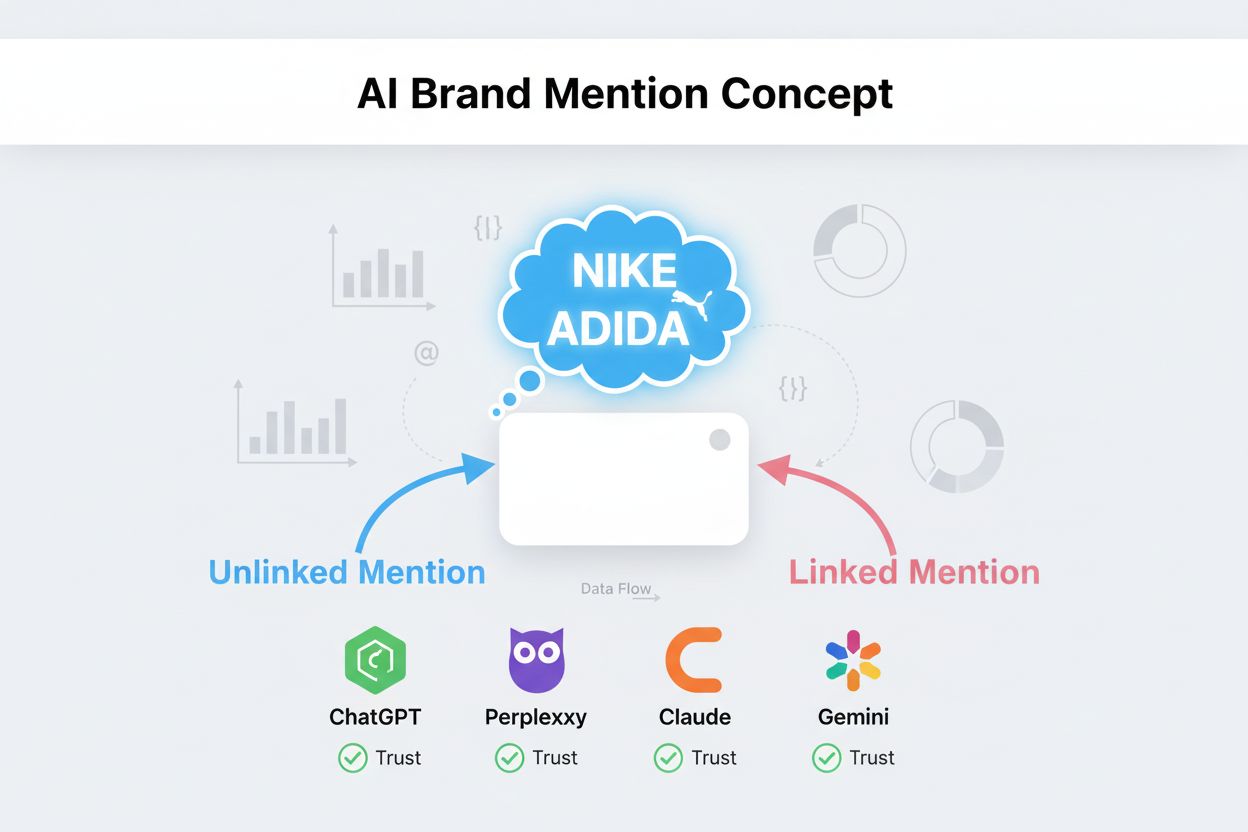
Learn what AI brand mentions are, why they matter for visibility in ChatGPT and Perplexity, and how to track and optimize your brand's presence in AI-generated ...
Discover how web mentions and third-party references influence AI citations. Learn why LLMs prioritize brand mentions over backlinks and strategies to increase ...
Cookie Consent
We use cookies to enhance your browsing experience and analyze our traffic. See our privacy policy.