
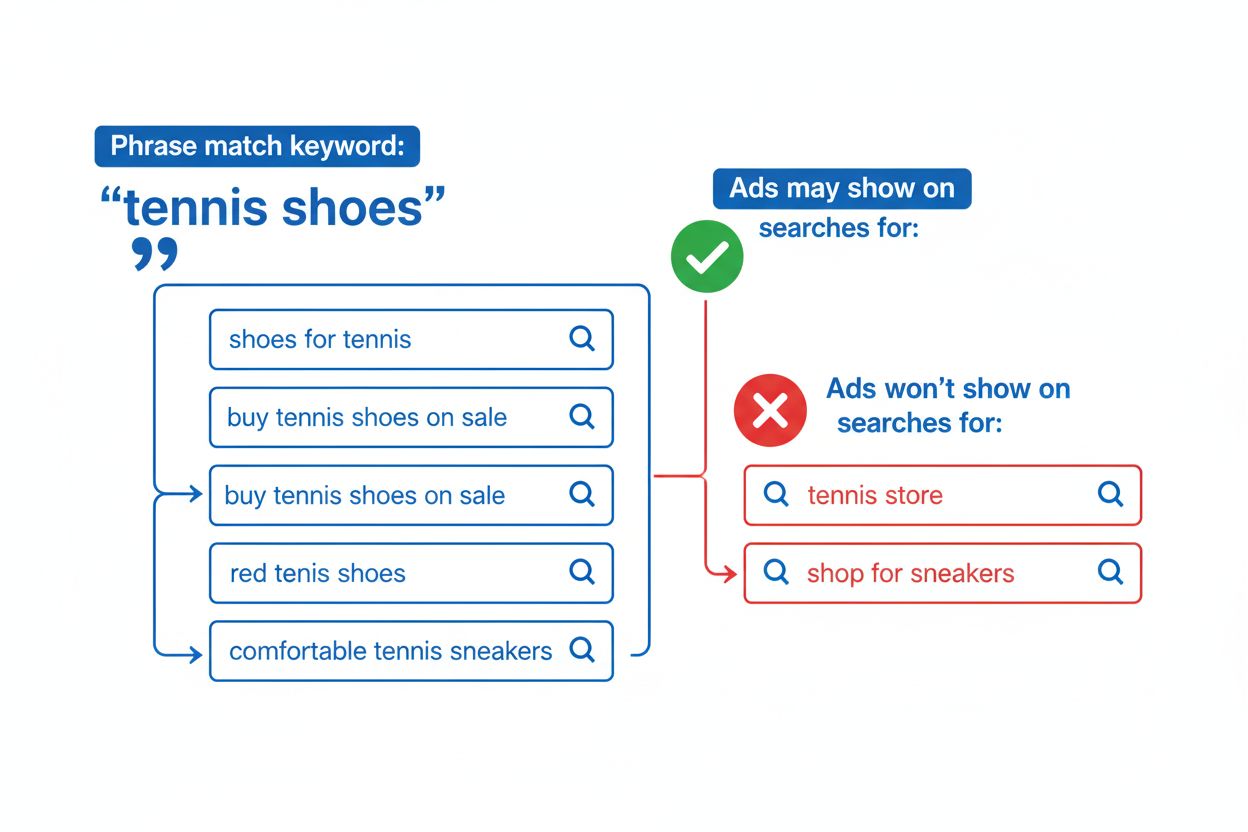
Phrase Match
Phrase match is a Google Ads keyword matching type that displays ads for searches containing your phrase in order. Learn how it works, benefits, and best practi...
15 min read
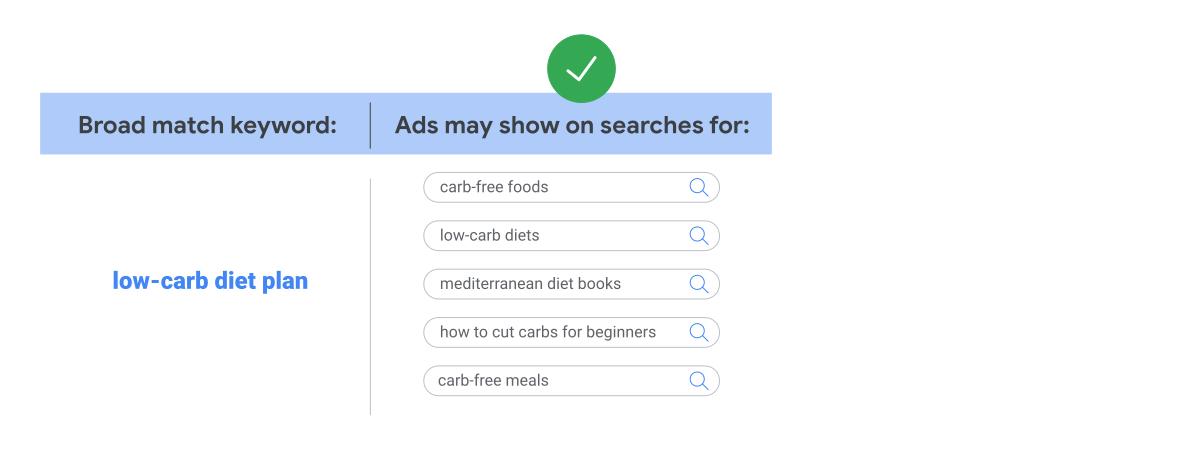
Broad match is a keyword matching type in search advertising that allows ads to appear on searches related to a keyword, including synonyms, variations, misspellings, and related terms. It is the default match type in Google Ads and other PPC platforms, providing the widest reach but requiring careful management with negative keywords and Smart Bidding strategies.
Broad match is a keyword matching type in search advertising that allows ads to appear on searches related to a keyword, including synonyms, variations, misspellings, and related terms. It is the default match type in Google Ads and other PPC platforms, providing the widest reach but requiring careful management with negative keywords and Smart Bidding strategies.
Broad match is a keyword matching type used in search advertising platforms like Google Ads, Microsoft Ads, and Amazon Ads that allows advertisements to appear on searches related to a keyword, including synonyms, variations, misspellings, related terms, and searches with different word orders. It is the default match type for all keywords in Google Ads, meaning that when you create a new keyword without specifying a match type, it automatically defaults to broad match. This matching option provides advertisers with the widest possible reach, enabling ads to appear on a comprehensive range of user searches that the search engine’s algorithm deems relevant to the advertiser’s keyword, even if those searches don’t contain the exact keyword terms. The primary advantage of broad match is its ability to help advertisers discover new, high-intent customer searches they might not have anticipated, while simultaneously reducing the time and effort required to build extensive keyword lists manually.
The concept of broad match emerged in the early days of pay-per-click (PPC) advertising as search engines recognized that users often search using different terminology than advertisers might predict. Around 2006, Google introduced expanded broad match, which significantly expanded the algorithm’s ability to match ads to related searches beyond simple keyword variations. This evolution reflected Google’s growing investment in machine learning and artificial intelligence to improve the relevance of search results and advertisements. Over the past two decades, broad match has become increasingly sophisticated, incorporating contextual signals such as user search history, landing page content, ad group themes, and device information to determine relevance. According to research from Adalysis analyzing 16,825 search campaigns, broad match remains a powerful tool when paired with modern bidding strategies, though it requires careful management. The shift toward AI-powered broad match has been particularly pronounced since 2021, when Google retired the broad match modifier (BMM) and began consolidating keyword matching around three core types: broad match, phrase match, and exact match. Today, broad match represents Google’s vision for the future of search advertising, where machine learning algorithms handle the complexity of query matching rather than advertisers manually building restrictive keyword lists.
Broad match operates through a sophisticated machine learning algorithm that analyzes multiple signals to determine whether a user’s search query is relevant to an advertiser’s keyword. When you add a keyword to a broad match campaign, Google’s system doesn’t simply look for exact word matches; instead, it evaluates the intent behind the search query and compares it to the intent of your keyword. For example, if your broad match keyword is “tennis shoes,” your ads may appear on searches for “tennis sneakers,” “athletic footwear,” “running shoes for tennis,” “best tennis shoe brands,” or even “how to choose tennis shoes.” The algorithm considers factors including synonyms (shoes → footwear), singular and plural forms (shoe → shoes), misspellings and typos (tenis → tennis), word order variations (shoes tennis → tennis shoes), and related searches that share similar intent. Google’s system also takes into account the content of your landing pages and the other keywords in your ad group to better understand the context and intent of your business offering. Additionally, user search behavior plays a role—if many users who search for a particular term also convert on your website, Google’s algorithm learns to match that term more frequently. The platform continuously refines these matches based on performance data, meaning that broad match becomes more effective over time as the algorithm learns which types of searches lead to conversions for your specific business.
| Aspect | Broad Match | Phrase Match | Exact Match |
|---|---|---|---|
| Reach | Widest reach; matches related searches, synonyms, variations | Medium reach; matches searches with keyword meaning in same order | Narrowest reach; matches searches with same meaning or intent |
| Control | Lowest advertiser control; algorithm-driven | Medium control; some restrictions on word order | Highest advertiser control; most restrictive |
| Click-Through Rate (CTR) | Lower CTR due to broader matching | Medium CTR | Highest CTR; most relevant traffic |
| Conversion Rate | Medium conversion rate | Lower conversion rate (recent data) | Highest conversion rate |
| Cost Per Acquisition (CPA) | Often higher CPA; requires Smart Bidding | Higher CPA than exact match | Lowest CPA; most efficient |
| Revenue Per Conversion | Can deliver higher revenue per conversion with Smart Bidding | Lower revenue per conversion | Consistent but lower volume |
| Impressions | Highest impression volume | Medium impression volume | Lowest impression volume |
| Best For | B2C campaigns with conversion data; volume-focused strategies | Legacy campaigns; specific use cases | B2B campaigns; niche markets; high-value leads |
| Requires Smart Bidding | Yes, critical for performance | Recommended | Recommended but not essential |
| Syntax | Plain text (e.g., tennis shoes) | Quotation marks (e.g., “tennis shoes”) | Square brackets (e.g., [tennis shoes]) |
Modern broad match has been fundamentally transformed by advances in artificial intelligence and machine learning. Google’s latest broad match implementation uses sophisticated neural networks to understand user intent at a level far beyond simple keyword matching. The algorithm now analyzes contextual signals including the user’s device type, geographic location, time of day, search history, and even the content of websites they’ve recently visited. According to Google’s Search Automation technical guide, the platform uses these signals to ensure that advertisers only compete in relevant auctions at appropriate bid levels for each unique user and query. This AI-driven approach means that broad match can now identify high-intent searches that would be impossible to predict manually, making it particularly valuable for advertisers with substantial conversion data. The integration of Smart Bidding strategies—such as Target CPA, Target ROAS, and Maximize Conversion Value—with broad match has created a powerful combination where the algorithm not only identifies relevant searches but also optimizes bids in real-time based on predicted conversion likelihood. Research from Adalysis demonstrates that under Max Conversion Value bidding, broad match outperformed other match types in delivering higher revenue per conversion, despite often having higher cost-per-acquisition figures. This counterintuitive finding highlights how AI-powered broad match, when properly configured, can drive business results that extend beyond simple efficiency metrics.
Understanding the types of searches that broad match captures is essential for effective campaign management. Synonyms represent one of the most common variations—if your keyword is “running shoes,” broad match will match searches for “jogging shoes,” “athletic shoes,” or “sneakers.” Misspellings and typos are automatically included, so searches for “runing shoes” or “runnng shoes” will still trigger your ads. Related terms that share similar intent are matched, meaning a keyword like “digital marketing services” might match searches for “online marketing agency” or “internet marketing consultant.” Word order variations are handled flexibly, so “shoes tennis” will match the same way as “tennis shoes.” Singular and plural forms are treated as equivalent, and different tenses of verbs are recognized. Additionally, broad match can match searches that include additional context or modifiers—for example, “best tennis shoes for clay courts” or “affordable tennis shoes under $100” would match a broad match keyword of “tennis shoes.” The algorithm also considers search intent modifiers like “how to,” “near me,” “reviews,” or “buy,” recognizing that these represent different stages of the customer journey but may still be relevant to your business. This comprehensive approach to matching means that broad match campaigns can capture a diverse range of customer searches, from early-stage research queries to high-intent purchase searches, making it particularly valuable for businesses seeking to maximize reach and discover new customer segments.
Successfully managing broad match campaigns requires a strategic approach that balances reach with relevance. The first and most critical best practice is to implement Smart Bidding, which Google emphasizes as essential for broad match success. Smart Bidding algorithms analyze contextual signals at auction time to ensure you’re bidding appropriately for each unique query, preventing wasted spend on irrelevant clicks while maximizing conversions or revenue. The second key practice is to build and maintain a comprehensive negative keyword list. By regularly reviewing your search terms report—which shows the actual searches that triggered your ads—you can identify irrelevant queries and add them as negative keywords to prevent future wasted impressions. For example, if you sell premium tennis shoes but notice searches for “cheap tennis shoes” or “discount tennis shoes” are triggering your ads, you should add these as negative keywords. The third best practice is to monitor search term reports consistently, ideally weekly or bi-weekly, to identify new negative keyword opportunities and discover unexpected high-performing search terms that could become new keywords. Fourth, structure your ad groups thoughtfully by grouping related keywords together, as Google uses ad group context to better understand your business intent. Fifth, optimize your landing pages to clearly communicate your value proposition, as Google’s algorithm considers landing page content when determining relevance. Sixth, use conversion tracking accurately so that Google’s machine learning has sufficient data to optimize effectively—without proper conversion tracking, Smart Bidding cannot function optimally. Finally, test broad match gradually by starting with a subset of keywords or a dedicated campaign to understand how it performs for your specific business before scaling broadly.
The relationship between broad match and negative keywords is fundamental to campaign success. Because broad match casts such a wide net, negative keywords serve as the essential counterbalance, allowing advertisers to exclude irrelevant searches while maintaining the reach benefits of broad match. Think of broad match as a fishing net with large holes that catches many fish (searches), and negative keywords as a filter that removes the unwanted catches. When you add a negative keyword, you’re telling the search engine: “Don’t show my ad for this search term.” Negative keywords can be applied at different match type levels themselves—broad match negative keywords exclude any search containing that term in any form, phrase match negative keywords exclude searches containing that phrase in that order, and exact match negative keywords exclude only that exact search. Most advertisers use a combination of all three negative keyword match types to create a layered exclusion strategy. For example, a luxury watch retailer might add “cheap,” “discount,” and “budget” as broad match negative keywords to exclude price-sensitive searchers, while adding “fake watches” or “counterfeit” as exact match negative keywords to exclude searches for illegal products. The challenge with negative keywords is discovering all the irrelevant searches before they waste budget—this is where regular search term report analysis becomes critical. Many successful advertisers maintain a master negative keyword list at the account level that applies across all campaigns, supplemented by campaign-specific and ad group-specific negative keywords for more granular control. According to industry research, accounts that actively manage negative keywords see significant improvements in cost-per-acquisition and overall campaign efficiency, making this practice one of the highest-ROI optimization activities available to PPC professionals.
Measuring the performance of broad match campaigns requires understanding how this match type affects key advertising metrics differently than more restrictive match types. According to comprehensive research from Adalysis analyzing over 16,000 search campaigns, exact match consistently delivers the highest click-through rates (CTRs), conversion rates, and return on ad spend (ROAS), but with significantly fewer impressions. Broad match, by contrast, generates substantially more impressions and clicks but typically at lower conversion rates and higher cost-per-acquisition. However, the research revealed a surprising finding: under Max Conversion Value bidding strategies, broad match actually delivered higher revenue per conversion than exact match, despite the higher CPA. This suggests that broad match, when paired with appropriate bidding strategies, can drive higher-value conversions even if the conversion rate is lower. The key performance indicators (KPIs) to monitor for broad match campaigns include: impression share (the percentage of available impressions your ads received), click-through rate (CTR), conversion rate, cost-per-click (CPC), cost-per-acquisition (CPA), return on ad spend (ROAS), and revenue per conversion. Additionally, tracking search term performance is critical—identifying which specific searches are driving conversions versus which are wasting budget helps inform negative keyword strategy. Many advertisers also monitor quality score, which Google assigns based on expected CTR, ad relevance, and landing page experience. For broad match campaigns specifically, it’s important to track performance by bidding strategy (Smart Bidding vs. manual), as the same broad match keywords may perform very differently depending on the bidding approach. Finally, attribution modeling becomes important with broad match, as the wider range of searches may include both high-intent and low-intent queries, and understanding which searches contribute to conversions across the customer journey helps optimize budget allocation.
While Google Ads is the most prominent platform using broad match, the concept extends across multiple advertising ecosystems. Microsoft Ads (formerly Bing Ads) implements broad match similarly to Google, allowing ads to appear on related searches including synonyms and variations. Amazon Ads uses broad match for sponsored product campaigns, matching shopping queries that are related to the advertiser’s keywords, though the matching algorithm is optimized for e-commerce intent. Apple Search Ads also employs broad match as a default option for app promotion campaigns. Each platform’s broad match algorithm has been trained on its own user base and search patterns, meaning that the same keyword may match differently across platforms. For example, a broad match keyword on Google might match different variations than the same keyword on Microsoft Ads, due to differences in user search behavior and the platforms’ respective machine learning models. Additionally, AI-powered search platforms like Perplexity, ChatGPT, and Google’s AI Overviews are beginning to incorporate advertising and sponsored content, and understanding how these platforms match queries to advertiser content is becoming increasingly important. For brands using AmICited to monitor their appearance across AI search platforms, understanding broad match principles is valuable because it helps predict where brand mentions and competitor content might appear in AI-generated responses. The concept of broad matching—finding related content and variations—is fundamental to how AI systems retrieve and rank information, making broad match principles relevant even beyond traditional PPC advertising.
The broad match modifier (BMM) was a keyword match type that existed between broad match and phrase match, offering advertisers more control than broad match while maintaining more reach than phrase match. BMM keywords were created by adding a plus sign (+) before words that must be included in the search query, such as “+tennis +shoes,” which would match searches containing both “tennis” and “shoes” in any order. BMM was popular among advertisers who wanted to balance reach with relevance, particularly in the era before modern Smart Bidding algorithms. However, in February 2021, Google announced that it would begin incorporating BMM behaviors into phrase match, and by July 2021, BMM was fully retired. Existing BMM keywords were automatically converted to expanded phrase match. This consolidation reflected Google’s strategic shift toward simplifying keyword matching and relying more heavily on machine learning algorithms rather than advertiser-specified match type restrictions. The retirement of BMM was controversial in the PPC community, as many advertisers felt it reduced their control over keyword matching. However, Google’s position was that modern Smart Bidding algorithms, combined with improved broad match capabilities, could achieve better results than the manual control that BMM provided. For advertisers who relied heavily on BMM, the transition required either adopting broad match with Smart Bidding or shifting to exact match for tighter control. This evolution demonstrates how the advertising industry is moving toward greater automation and AI-driven optimization, with less reliance on manual keyword management.
For organizations like AmICited that monitor brand appearances across AI search platforms and PPC networks, understanding broad match is crucial for comprehensive brand protection and competitive intelligence. When competitors bid on broad match keywords related to your brand, their ads may appear on searches that include your brand name plus related terms, such as “your brand vs. competitor” or “your brand alternative.” Similarly, when tracking where your own brand appears in AI-generated search results from platforms like Perplexity, ChatGPT, Google AI Overviews, and Claude, the concept of broad matching helps explain why your brand might appear in responses to queries that don’t explicitly mention your brand name. AI systems use broad matching principles—identifying related concepts, synonyms, and contextually relevant information—to retrieve and rank content in their responses. For example, if your brand is a leading provider of “project management software,” an AI system might include your brand in responses to queries about “team collaboration tools” or “workflow automation platforms,” even though those exact terms weren’t in the original query. This makes broad match understanding essential for brands seeking to monitor their competitive positioning in AI search results. Additionally, understanding broad match helps brands identify opportunities to create content that ranks for related search variations, ensuring visibility across the full spectrum of customer search intent. For PPC advertisers, monitoring competitor broad match bidding strategies—identifying which keywords competitors are bidding on broadly—provides valuable competitive intelligence about their target customer segments and market positioning.
The future of broad match is inextricably linked to the evolution of artificial intelligence and machine learning in search advertising. Google has signaled its intention to move toward even greater automation, with initiatives like AI Max for Search campaigns that treat all keywords as broad match and rely entirely on machine learning for query matching and bid optimization. This represents a significant shift from the traditional keyword-centric model toward an intent-centric model where advertisers specify their business goals and target audiences, and AI systems handle the complexity of matching user queries to advertiser offerings. Industry experts predict that within the next few years, the distinction between broad match, phrase match, and exact match may become less relevant as AI systems become sophisticated enough to understand intent with near-perfect accuracy. However, this evolution also raises important questions about advertiser control, budget efficiency, and the ability to exclude irrelevant traffic. The rise of generative AI and large language models is also influencing how search works—as AI-powered search platforms like Perplexity and ChatGPT gain market share, the traditional keyword-based matching model may evolve into a more semantic, meaning-based matching approach. For brands and advertisers, this means that understanding broad match principles today is preparation for a future where AI-driven matching becomes the default across all search platforms. Additionally, as privacy regulations like GDPR and CCPA limit the data available to advertisers, machine learning algorithms will need to become even more sophisticated at inferring user intent from limited signals, making broad match’s AI-powered approach increasingly valuable. The convergence of these trends suggests that broad match will remain central to search advertising strategy, but with even greater reliance on automation and AI optimization.
Broad match shows ads on searches related to your keyword, including synonyms, variations, and related terms, capturing the widest range of queries. Exact match only shows ads on searches with the same meaning or intent as your keyword, providing tighter control but reaching fewer searches. According to Adalysis research, exact match delivers higher click-through rates and conversion rates, while broad match can generate higher revenue per conversion when paired with Smart Bidding strategies.
Broad match allows ads to appear on searches that are loosely related to your keyword, even if the exact words aren't present. Phrase match is more restrictive—it shows ads only when the search includes the meaning of your keyword phrase in the same order, with possible variations before or after. Recent studies show that phrase match has become less precise over time and often behaves similarly to broad match, making it less reliable for advertisers seeking precise targeting.
Broad match variations include synonyms (tennis shoes → tennis sneakers), misspellings (tennis shoes → tenis shoes), related terms (tennis shoes → athletic footwear), different word orders (tennis shoes → shoes tennis), and searches with additional context. Google's machine learning algorithm identifies these variations based on user search behavior, landing page content, and other contextual signals to determine relevance and intent.
Smart Bidding is critical with broad match because every search query is different and requires unique bid adjustments based on contextual signals present at auction time. Smart Bidding uses machine learning to analyze factors like device, location, time of day, and user behavior to ensure you're bidding appropriately for each query. Without Smart Bidding, broad match can waste budget on irrelevant clicks; with it, broad match can deliver higher revenue per conversion despite higher CPAs.
Negative keywords tell search engines not to show your ads for specific search terms. They are essential for broad match campaigns because broad match's wide reach can capture irrelevant searches. By building a comprehensive negative keyword list based on search term reports, you can exclude unwanted traffic while maintaining the reach benefits of broad match. This strategy helps improve campaign efficiency and prevents wasted ad spend on non-converting searches.
Google has significantly enhanced broad match with AI and machine learning capabilities, making it more intelligent at identifying relevant searches. Modern broad match now considers user search history, landing page content, ad group context, and other signals to improve relevance. This evolution has made broad match more effective for advertisers with sufficient conversion data, particularly in B2C campaigns where Google's AI can learn patterns and find high-intent customers automatically.
Broad match modifier (BMM) was a keyword match type that gave advertisers more control than broad match but more reach than phrase match. In February 2021, Google began incorporating BMM behaviors into phrase match, and as of July 2021, BMM was fully retired. Existing BMM keywords are now treated as expanded phrase match. This change pushed advertisers to choose between broad match (with Smart Bidding) or exact match for their campaigns.
For platforms like AmICited that monitor brand mentions across AI search engines and PPC platforms, broad match is significant because it determines how widely your ads appear for related searches. Understanding broad match variations helps brands track where their ads appear beyond exact brand terms, identify competitor bidding on brand-adjacent keywords, and monitor how AI systems match user queries to advertiser keywords. This is crucial for comprehensive brand protection and competitive intelligence.
Start tracking how AI chatbots mention your brand across ChatGPT, Perplexity, and other platforms. Get actionable insights to improve your AI presence.
Phrase match is a Google Ads keyword matching type that displays ads for searches containing your phrase in order. Learn how it works, benefits, and best practi...
Exact match is a precise keyword matching method in search advertising and SEO that displays results only for queries matching specified phrases. Learn how it w...

Paid search results are sponsored ads appearing in search engine results. Learn how PPC advertising works, its ROI impact, and why monitoring paid search visibi...