
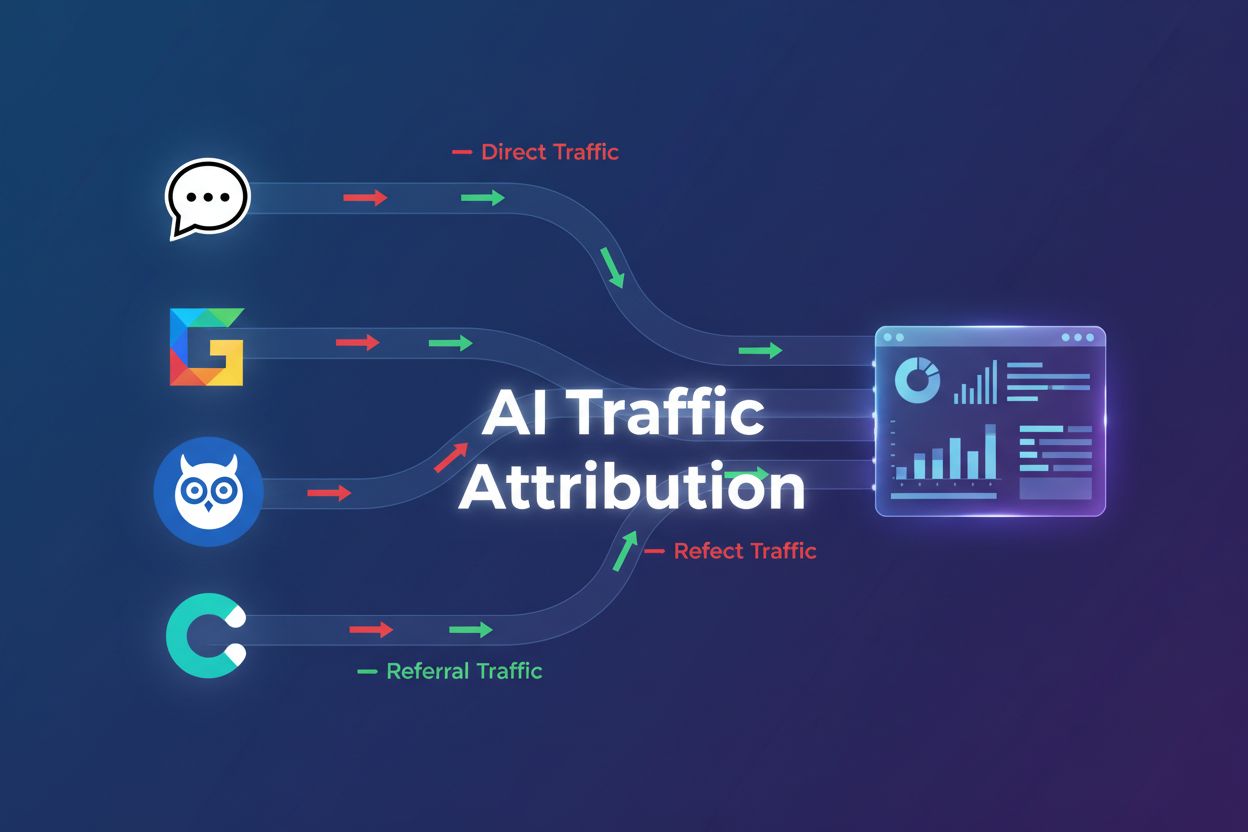
Why Free ChatGPT Users Show as Direct Traffic
Discover why ChatGPT traffic appears as direct traffic in GA4, how to identify hidden AI traffic, and proven methods to track and optimize for AI-driven visitor...
8 min read
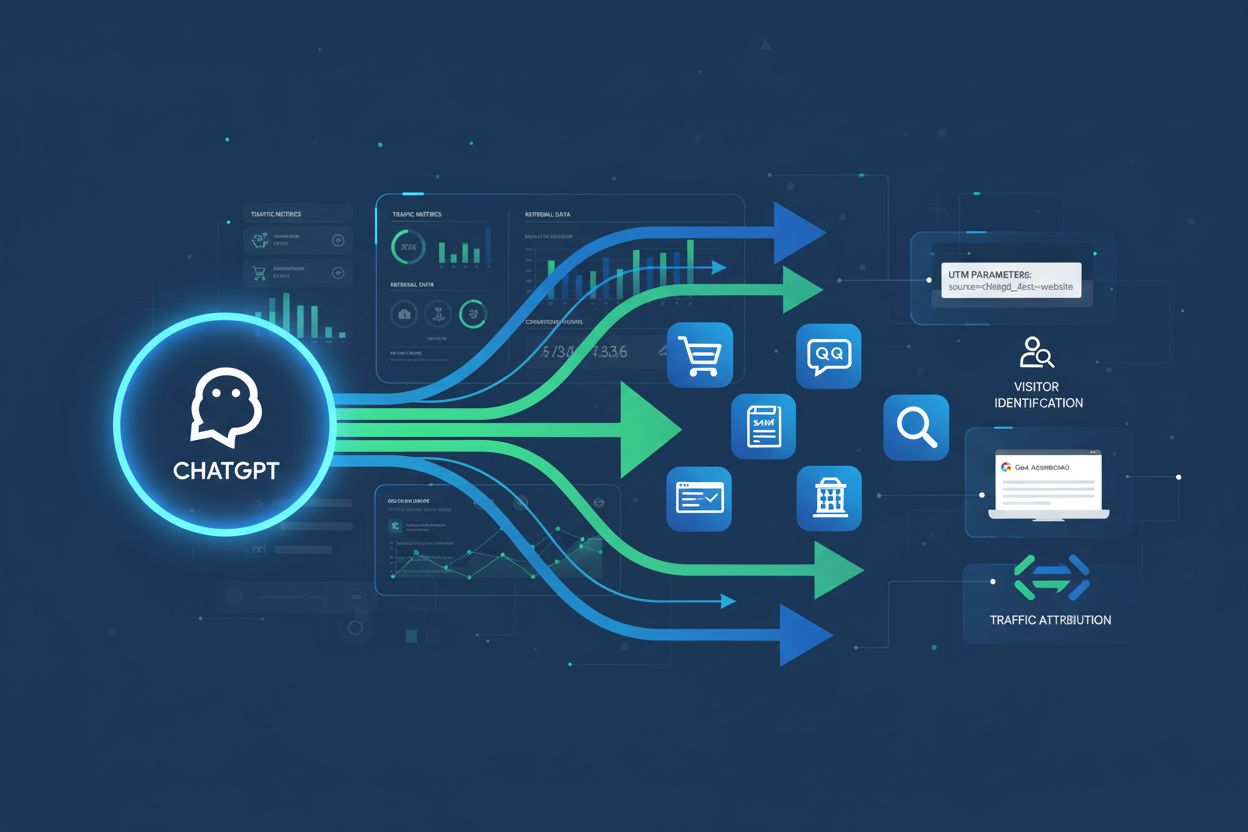
ChatGPT Traffic refers to website visitors arriving from OpenAI’s ChatGPT platform through links, citations, or recommendations provided in AI-generated responses. This emerging traffic source has grown significantly, with ChatGPT sending 400 million visits weekly and representing up to 20% of referral traffic for major retailers like Walmart, making it a critical channel for monitoring and optimization in the AI-driven search landscape.
ChatGPT Traffic refers to website visitors arriving from OpenAI's ChatGPT platform through links, citations, or recommendations provided in AI-generated responses. This emerging traffic source has grown significantly, with ChatGPT sending 400 million visits weekly and representing up to 20% of referral traffic for major retailers like Walmart, making it a critical channel for monitoring and optimization in the AI-driven search landscape.
ChatGPT Traffic refers to website visitors who arrive at your site through links, citations, or recommendations provided within OpenAI’s ChatGPT platform. When users ask ChatGPT questions and receive responses that include links to external websites, clicks on those links generate referral traffic. This traffic source has emerged as a significant discovery channel in the AI-driven search landscape, fundamentally changing how users find information and products online. Unlike traditional search engine traffic or social media referrals, ChatGPT Traffic represents high-intent visitors who have already expressed specific information needs through their conversational queries. The scale of this phenomenon is substantial: ChatGPT generates approximately 400 million visits weekly, with major retailers like Walmart now receiving up to 20% of their referral traffic from the platform, making it impossible for data-driven organizations to ignore.
The emergence of ChatGPT Traffic represents one of the most significant shifts in digital discovery since the rise of search engines. ChatGPT receives 5.8 billion monthly visits as of September 2025, up 7.6% from 5.39 billion in the previous period, demonstrating consistent growth in user engagement. For e-commerce retailers specifically, the impact has been transformative: Walmart receives 20% of its referral traffic from ChatGPT, Etsy receives over 20%, Target receives nearly 15%, and eBay receives 10%. These statistics represent a fundamental shift in how consumers discover products and services. Research from OpenAI’s Economic Research team and Harvard economist David Deming found that approximately 2% of all ChatGPT queries involve shopping—roughly 50 million shopping queries per day. With 2.5 billion prompts flowing through ChatGPT daily, even this small percentage translates into tens of millions of potential customer interactions. The data reveals that users are asking ChatGPT questions like “recommend a good laptop under $1,000” or “how much are Nikes,” effectively using the platform as a replacement for Google search in product discovery scenarios.
One of the most significant challenges with ChatGPT Traffic is that much of it remains invisible in standard analytics platforms, a phenomenon known as “dark traffic.” When ChatGPT links don’t include UTM parameters or referral data, traffic appears as “Direct” in Google Analytics 4, making it impossible to distinguish from users who typed your URL directly into their browser. This attribution problem occurs because free ChatGPT users don’t send referrer data when clicking links, and ChatGPT’s JavaScript-heavy interface handles referral information differently across browsers like Chrome, Firefox, Safari, and Edge. The technical complexity is compounded by the fact that different browsers have varying cross-domain referral policies, and ChatGPT’s implementation of referrer policies affects what information reaches your server. Companies implementing proper tracking have discovered that they were already receiving substantial ChatGPT Traffic that went completely undetected. One organization reported acquiring nearly half a million users from ChatGPT in just 12 months once they implemented proper attribution tracking, with growth accelerating month over month. This hidden traffic represents a massive missed opportunity for businesses that haven’t configured their analytics to capture it.
Implementing proper ChatGPT Traffic tracking requires a multi-layered approach combining Google Analytics 4 configuration, Google Tag Manager setup, and potentially advanced fingerprinting techniques. The first step is to create a custom channel group in GA4 by navigating to Admin > Data Display > Channel Groups and selecting “Create new channel group.” Name this channel “AI Traffic” or “ChatGPT Traffic” and define the traffic sources using regex patterns that match ChatGPT’s domain variations. A comprehensive regex pattern should include: .*chatgpt.*|.*openai.*|.*gpt.*|.*gemini.*|.*perplexity.*|.*claude.*|.*copilot.*. Once configured, this custom channel will retroactively apply to historical data in GA4, allowing you to see how much traffic you’ve been receiving from AI sources all along. For more granular tracking, use Google Tag Manager to create referrer-based triggers that fire when the referrer contains “chat.openai.com,” enabling you to track specific user behaviors after they arrive from ChatGPT. You can also set up custom events in GTM to track form submissions, content downloads, or product views specifically from ChatGPT visitors, providing deeper insights into conversion patterns. Additionally, look in your Traffic Acquisition reports for “chat.openai.com” or “chatgpt.com” in the session source/medium dimension to identify traffic that arrives with proper referrer information intact.
| Attribute | ChatGPT Traffic | Perplexity Traffic | Google AI Overviews | Claude Traffic |
|---|---|---|---|---|
| Monthly Visits to Platform | 5.8 billion | 500+ million | Integrated in Google Search | Growing but smaller |
| Referral Traffic Visibility | Often appears as Direct | Partially visible | Minimal direct referrals | Emerging channel |
| Tracking Difficulty | High (dark traffic) | Medium | Very High | Medium |
| E-commerce Impact | 10-20% of referral traffic | 2-5% of referral traffic | Indirect (via Google) | <1% currently |
| User Intent Level | Very High | High | Medium-High | High |
| Attribution Method | UTM parameters, GA4 filters | Custom channel groups | Server logs, referrer analysis | GA4 custom events |
| Monetization Status | In development | Affiliate model | Integrated with Google | Early stage |
| Content Optimization Focus | Authority, citations, depth | Answer optimization | Featured snippet signals | Factual accuracy |
Understanding ChatGPT Traffic requires understanding how ChatGPT decides which sources to cite in its responses. Research analyzing 129,000 domains across 216,524 pages identified the top factors influencing ChatGPT citations. Link diversity showed the clearest correlation with citations: sites with up to 2,500 referring domains averaged 1.6 to 1.8 citations, while those with over 350,000 referring domains averaged 8.4 citations. A critical threshold exists at 32,000 referring domains, where citations nearly doubled from 2.9 to 5.6. Domain Trust scores followed a similar pattern, with sites scoring 91-96 averaging 6 citations and those scoring 97-100 averaging 8.4 citations. Interestingly, .gov and .edu domains didn’t automatically outperform commercial sites—government and educational domains averaged 3.2 citations compared to 4.0 for commercial sites, suggesting that content quality matters more than domain type. Domain traffic ranked as the second most important factor, though the correlation only appeared at high traffic levels. Sites receiving under 190,000 monthly visitors averaged 2 to 2.9 citations regardless of exact traffic volume, but once crossing 190,000 monthly visitors, traffic correlated strongly with increased citations. Sites with over 10 million monthly visitors averaged 8.5 citations. This suggests that ChatGPT weighs both authority signals and actual user engagement when deciding which sources to recommend.
Creating content that generates ChatGPT Traffic requires a fundamentally different approach than traditional SEO optimization. Content depth matters significantly: articles under 800 words averaged 3.2 citations, while those over 2,900 words averaged 5.1 citations. However, length alone isn’t sufficient—structure and section length are equally important. Pages with section lengths of 120 to 180 words between headings performed best, averaging 4.6 citations, while extremely short sections under 50 words averaged only 2.7 citations. This suggests ChatGPT prefers content that provides substantive explanations rather than bullet-point summaries. Expert quotes and data significantly boost citation likelihood: pages with expert quotes averaged 4.1 citations versus 2.4 for those without, and content with 19 or more statistical data points averaged 5.4 citations compared to 2.8 for pages with minimal data. Content freshness produced one of the clearest findings: pages updated within three months averaged 6 citations, while outdated content averaged 3.6. Surprisingly, question-style headings underperformed straightforward headings, earning 3.4 citations versus 4.3, contradicting standard voice search optimization advice and suggesting AI models prefer direct topical labeling. Additionally, pages with FAQ sections actually received fewer citations (3.8) than those without (4.1), though this may reflect that FAQs often appear on simpler support pages that naturally earn fewer citations overall.
Beyond traditional SEO metrics, ChatGPT Traffic correlates strongly with brand presence on community platforms and review sites. Research revealed that Quora presence showed remarkable correlation with citations: domains with minimal Quora presence (up to 33 mentions) averaged 1.7 citations, while heavy Quora presence (6.6 million mentions) corresponded to 7.0 citations. Reddit engagement showed similar patterns, with domains having over 10 million mentions averaging 7 citations compared to 1.8 for those with minimal activity. This finding is particularly relevant for smaller, less-established websites that may lack extensive backlink profiles. Engaging authentically on Quora and Reddit offers a viable path to building authority signals that ChatGPT recognizes. Review platform presence also correlated with increased citations: domains listed on multiple review platforms like Trustpilot, G2, Capterra, Sitejabber, and Yelp earned 4.6 to 6.3 citations on average, while those absent from such platforms averaged only 1.8 citations. This suggests that ChatGPT evaluates brand trustworthiness not just through backlinks and traffic, but through presence in established community spaces where users actively share experiences and recommendations. For businesses building ChatGPT Traffic strategies, this means investing in community engagement and reputation management is as important as traditional content optimization.
Page speed emerged as a significant factor influencing ChatGPT Traffic and citations. Pages with First Contentful Paint under 0.4 seconds averaged 6.7 citations, while slower pages (over 1.13 seconds) averaged only 2.1 citations. Speed Index showed similar patterns, with sites maintaining indices below 1.14 seconds performing reliably well, while those above 2.2 seconds experienced steep decline in citation rates. However, one counterintuitive finding emerged: pages with the fastest Interaction to Next Paint scores (under 0.4 seconds) actually received fewer citations (1.6 average) than those with moderate INP scores (0.8 to 1.0 seconds, averaging 4.5 citations). Researchers suggested that extremely simple or static pages may not signal the depth and authority that ChatGPT looks for in sources. This implies that while performance matters, overly simplified pages optimized purely for speed may underperform in AI citation rankings. URL structure also influenced citation likelihood in unexpected ways: pages with low semantic relevance between URL and target keyword (0.00 to 0.57 range) averaged 6.4 citations, while those with highest semantic relevance (0.84 to 1.0) averaged only 2.7 citations. Similarly, titles with low keyword matching averaged 5.9 citations versus 2.8 for highly keyword-optimized titles. This suggests ChatGPT prefers URLs and titles that clearly describe overall topics rather than those strictly optimized for single keywords, indicating that topical clarity matters more than keyword density in AI-driven discovery.
The trajectory of ChatGPT Traffic suggests fundamental changes ahead in how businesses acquire customers and how users discover information. Currently, retailers enjoy free high-intent traffic from ChatGPT, but this landscape is shifting. OpenAI is reportedly developing integrated checkout functionality within ChatGPT, and industry analysts predict the company will eventually monetize this traffic through affiliate fees, advertising, or transaction fees. Financial Times reported that OpenAI is working on payment systems that would allow users to complete purchases directly within ChatGPT, fundamentally changing the economics of AI-driven traffic. Bain & Co. projects that by 2030, firms will require roughly $2 trillion annually to cover AI computing needs, but revenues are expected to lag at $800 billion, creating pressure on AI companies to monetize traffic sources like ChatGPT. This monetization will likely reduce the free referral traffic currently flowing to retailers, making it critical for businesses to establish strong authority and citation patterns now while traffic remains free. Additionally, as more AI platforms emerge—including Perplexity, Claude, Gemini, and specialized shopping agents—the competitive landscape for AI citations will intensify. Businesses that invest in Generative Engine Optimization (GEO) and Answer Engine Optimization (AEO) strategies now will be better positioned to maintain visibility as AI becomes the primary discovery mechanism. The shift from click-based economics to AI-driven recommendations represents a paradigm change comparable to the rise of Google search, and organizations that understand and optimize for ChatGPT Traffic today will have significant competitive advantages in the AI-native future.
ChatGPT Traffic represents visitors arriving at your website through links or citations provided in ChatGPT responses. It matters because ChatGPT generates 400 million visits weekly globally, and for major retailers like Walmart, it now accounts for up to 20% of referral traffic. This high-intent traffic source is increasingly important as AI-driven search becomes a primary discovery method for consumers seeking product recommendations and information.
ChatGPT sends approximately 400 million visits weekly, with 5.8 billion monthly visits to the platform as of September 2025. For e-commerce retailers, the impact is substantial: Walmart receives 20% of its referral traffic from ChatGPT, Etsy receives over 20%, Target receives nearly 15%, and eBay receives 10%. However, referral traffic overall represents less than 5% of total site visits for most retailers, though it's growing rapidly.
ChatGPT traffic frequently appears as 'Direct' traffic because free ChatGPT users don't send referrer data when clicking links, and ChatGPT's JavaScript-based interface handles referral information differently across browsers. Additionally, without proper UTM parameter configuration, ChatGPT links lack attribution signals. This creates 'dark traffic' that remains invisible unless you implement specific tracking methods like GA4 filters for chat.openai.com or custom GTM triggers.
Research analyzing 129,000 domains identified that referring domain diversity is the strongest predictor of ChatGPT citations, with sites having 350,000+ referring domains averaging 8.4 citations. Domain Trust scores above 91 also correlate strongly with citations. Content depth matters—articles over 2,900 words average 5.1 citations versus 3.2 for content under 800 words. Fresh content updated within three months averages 6 citations, and pages with 19+ statistical data points average 5.4 citations.
Set up a custom channel group in GA4 by navigating to Admin > Data Display > Channel Groups and creating a new channel named 'AI Traffic.' Define ChatGPT sources using regex patterns like .*chatgpt.*|.*openai.* in the session source/medium field. Alternatively, look for 'chat.openai.com' or 'chatgpt.com' in your Traffic Acquisition reports. You can also use Google Tag Manager to create referrer-based triggers that fire when the referrer contains 'chat.openai.com' for more granular tracking.
ChatGPT traffic differs from traditional referral traffic in several ways: it often lacks referrer data, making it appear as Direct traffic; it represents high-intent users who have already expressed specific needs through their AI queries; and it's driven by AI recommendations rather than human editorial decisions. Additionally, ChatGPT traffic is more volatile and subject to changes in AI algorithms, whereas traditional referral traffic from established websites tends to be more stable and predictable.
OpenAI is reportedly developing payment and checkout systems within ChatGPT, suggesting that free referral traffic may not last indefinitely. Financial Times reported that OpenAI is working on integrated checkout functionality, and industry analysts predict the company will eventually monetize this traffic through affiliate fees, advertising, or transaction fees. Currently, retailers enjoy free high-intent traffic, but this is expected to change as ChatGPT implements revenue-generating mechanisms.
Start tracking how AI chatbots mention your brand across ChatGPT, Perplexity, and other platforms. Get actionable insights to improve your AI presence.
Discover why ChatGPT traffic appears as direct traffic in GA4, how to identify hidden AI traffic, and proven methods to track and optimize for AI-driven visitor...
Discover why AI chatbots like ChatGPT and Perplexity are sending traffic that appears as 'direct' in your analytics. Learn how to detect and measure unattribute...

Learn how to track AI search traffic in GA4, monitor ChatGPT and Perplexity referrals, and measure AI visibility across platforms. Complete guide to AI traffic ...
Cookie Consent
We use cookies to enhance your browsing experience and analyze our traffic. See our privacy policy.