

Claude AI Optimization: How to Appear in Anthropic's Responses
Master Claude AI optimization and increase your brand visibility in Anthropic's responses. Learn citation strategies, technical requirements, and cross-platform...
18 min read
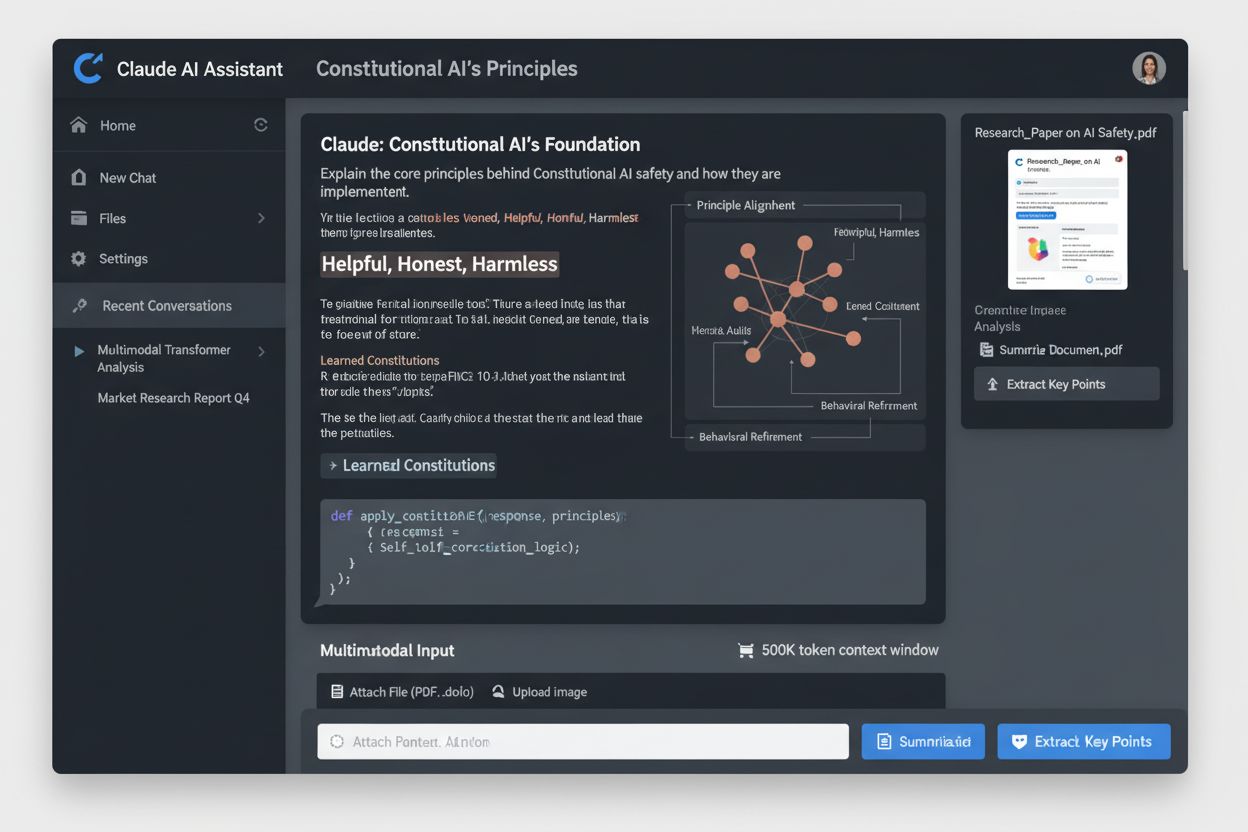
Claude is a family of large language models developed by Anthropic, designed to be a helpful, honest, and harmless AI assistant. Built on Constitutional AI principles and transformer architecture, Claude excels at natural language processing, code generation, document analysis, and multimodal tasks across text, audio, and visual inputs.
Claude is a family of large language models developed by Anthropic, designed to be a helpful, honest, and harmless AI assistant. Built on Constitutional AI principles and transformer architecture, Claude excels at natural language processing, code generation, document analysis, and multimodal tasks across text, audio, and visual inputs.
Claude is a next-generation large language model (LLM) and family of AI assistants developed by Anthropic, a leading AI safety research company founded in 2021 by former OpenAI researchers including Dario and Daniela Amodei. Claude is specifically designed to be helpful, honest, and harmless through the application of Constitutional AI—a novel training methodology that aligns AI behavior with human values and ethical principles. Unlike traditional AI assistants that rely primarily on human feedback, Claude leverages both supervised learning and reinforcement learning from AI feedback (RLAIF) to achieve superior safety and reliability. The model is accessible through a web interface at claude.ai, via API for developers, and through integrations with enterprise platforms like Notion, DuckDuckGo, and Accenture’s business solutions. Claude represents a significant advancement in conversational AI, combining state-of-the-art language understanding with robust safety mechanisms that make it suitable for sensitive applications across industries.
Claude’s development emerged from Anthropic’s founding mission to create AI systems that are fundamentally safer and more aligned with human intentions than existing alternatives. When Anthropic launched in 2021, the AI landscape was dominated by OpenAI’s GPT models and Google’s language models, but these systems lacked explicit safety-focused training methodologies. Anthropic’s research into Constitutional AI began as an academic exploration into how AI systems could self-improve without extensive human labeling, published in their landmark December 2022 paper “Constitutional AI: Harmlessness from AI Feedback.” Claude was first introduced to the public in March 2023 through a closed alpha with partners like Notion, Quora, and DuckDuckGo, allowing Anthropic to carefully test the system in real-world applications before broader release. The company has since released multiple generations of Claude, with Claude 3 family models (released May 2024) introducing multimodal capabilities and significantly expanded context windows. As of Q2 2025, Claude 3.5 surpassed 30 million monthly active users globally, representing a 40% year-over-year increase from the previous year, demonstrating rapid market adoption and enterprise confidence in the platform.
Claude is built on the transformer architecture, the same foundational neural network design that powers most modern large language models. Transformers excel at natural language processing through their use of self-attention mechanisms, which allow the model to weigh the importance of different words in a sequence and understand context across long passages of text. Claude’s architecture processes user inputs by breaking them into tokens (individual words or word fragments), converting these tokens into vector embeddings (mathematical representations in multi-dimensional space), and then applying attention mechanisms to generate probabilistically likely responses. The model’s context window of up to 500,000 tokens is a defining technical advantage, enabling Claude to process approximately 350 pages of text in a single conversation—significantly exceeding GPT-4 Turbo’s 128,000-token limit. This expanded context window allows Claude to maintain coherence across lengthy documents, analyze entire codebases, and engage in nuanced multi-turn conversations without losing information. The underlying training process combines supervised fine-tuning on high-quality examples with reinforcement learning, but Claude’s distinguishing feature is the integration of Constitutional AI principles that guide the model toward safer, more aligned outputs without requiring exhaustive human annotation of harmful content.
Constitutional AI represents Anthropic’s proprietary approach to training AI systems that are inherently safer and more aligned with human values. Rather than relying on human raters to label thousands of harmful outputs, Constitutional AI uses a “constitution”—a set of principles and rules derived from human input—to guide the model’s behavior through self-supervision. Anthropic sourced input from approximately 1,000 people to develop Claude’s constitution, asking them to vote on and suggest rules for ethical AI operation. The resulting principles include directives such as “choose the response that is the least dangerous or hateful,” “choose the response that is as reliable, honest, and close to the truth as possible,” and “choose the response that best conveys clear intentions.” During training, Claude generates multiple candidate responses to a prompt, critiques them against the constitutional principles, and revises them accordingly. This self-improvement process is then reinforced through Reinforcement Learning from AI Feedback (RLAIF), where a separate AI model evaluates which responses best align with the constitution. This approach is fundamentally different from traditional Reinforcement Learning from Human Feedback (RLHF), which requires human raters to label outputs as good or bad. By automating the feedback process, Constitutional AI reduces the cost and time required to train safe AI systems while potentially achieving better alignment outcomes. The methodology has proven effective: early users report that Claude is “much less likely to produce harmful outputs, easier to converse with, and more steerable” compared to competing models.
Claude’s evolution toward multimodal functionality represents a significant expansion of its capabilities beyond text-only interactions. The latest Claude 3 models can process and analyze text, images, and audio inputs, enabling users to upload documents in various formats (PDFs, Word documents, images), ask questions about visual content, and receive detailed analytical responses. For example, users can drag a photograph into Claude and receive an impressively reasoned description of the image’s contents, including identification of objects, analysis of composition, and contextual interpretation. This multimodal capability extends to professional use cases: e-commerce businesses can generate product descriptions from images, legal professionals can analyze contracts and visual documents, and researchers can process complex diagrams and charts. Claude can also process audio inputs, though it does not generate audio or video content independently. Instead, Claude excels at creating interactive visualizations and React components through its Artifacts feature, allowing users to build charts, diagrams, calculators, and even simple games that execute in real-time within the interface. This combination of multimodal input processing with sophisticated output generation makes Claude particularly valuable for knowledge workers who need to analyze diverse information sources and generate actionable insights.
| Feature | Claude (Anthropic) | ChatGPT (OpenAI) | Gemini (Google) |
|---|---|---|---|
| Context Window | Up to 500,000 tokens | Up to 128,000 tokens | Up to 1,000,000 tokens (Gemini 2.0) |
| Training Methodology | Constitutional AI + RLAIF | RLHF + human feedback | RLHF + human feedback |
| Image Generation | No (Artifacts only) | Yes (DALL-E 3) | Yes (Imagen 3) |
| Video Generation | No | Yes (Sora) | Yes (Veo) |
| Web Search | Yes | Yes | Yes |
| Data Retention Policy | Deleted after 30 days | Can be retained for model improvement | Varies by product tier |
| Coding Capabilities | Excellent (Artifacts + Claude Code) | Good (Canvas feature) | Good |
| Multimodal Input | Text, images, audio | Text, images, audio | Text, images, audio, video |
| Free Tier Availability | Claude 3.5 Sonnet | GPT-4o mini | Gemini 2.0 Flash |
| Monthly Active Users (Q2 2025) | 30+ million | 200+ million | 100+ million |
| Enterprise Adoption | Growing (Accenture, Snowflake) | Dominant (Microsoft integration) | Strong (Google Cloud integration) |
Claude’s versatility makes it suitable for a wide range of professional and creative applications across industries. In software development, Claude excels at code generation, debugging, and architectural planning, with developers particularly praising its ability to explain complex code and suggest improvements. The Artifacts feature enables real-time visualization of code execution, making it easier to iterate on solutions. In content creation and writing, Claude produces more natural, human-sounding prose compared to competitors, making it ideal for blog posts, marketing copy, creative fiction, and technical documentation. The platform’s Styles feature allows users to define custom writing voices for different contexts—formal for business communications, conversational for social media, and analytical for research papers. In legal and financial services, Claude’s ability to process lengthy documents and extract key information makes it valuable for contract analysis, due diligence, and regulatory compliance. Juni Learning uses Claude to power an AI tutoring bot that provides in-depth educational support, while Robin AI leverages Claude’s language understanding for contract review and alternative language suggestions. In research and analysis, Claude’s expanded context window allows researchers to upload entire papers, datasets, or reports and ask sophisticated analytical questions. The model’s tendency toward honest acknowledgment of uncertainty—rather than generating plausible-sounding but false information (hallucinations)—makes it particularly valuable for applications where accuracy is critical.
Anthropic has strategically partnered with major technology and business platforms to integrate Claude into enterprise workflows, significantly expanding its reach and practical utility. Notion integrated Claude into its workspace platform, allowing users to leverage AI for writing, summarization, and content generation without leaving their productivity environment. DuckDuckGo partnered with Anthropic to power DuckAssist, an instant answer feature that uses Claude to generate natural language responses to search queries based on Wikipedia and other sources. Accenture announced a multi-year partnership with Anthropic to help enterprises move from AI pilots to production-scale implementations, with Claude serving as a core component of their AI strategy. Snowflake and Anthropic established a $200 million partnership to bring agentic AI capabilities to global enterprises, integrating Claude into Snowflake’s data platform. These partnerships demonstrate enterprise confidence in Claude’s reliability, safety, and performance. Additionally, Claude is available through API access for developers, with pricing tiers that make it accessible to startups and small businesses while remaining cost-effective for large-scale enterprise deployments. The availability of Claude through multiple channels—web interface, API, and platform integrations—ensures that organizations can adopt Claude in ways that align with their existing technology stacks and workflows.
Claude’s competitive advantages stem from its unique combination of technical capabilities, safety mechanisms, and user experience design. The 500,000-token context window is a substantial advantage for document-heavy workflows, allowing users to upload entire books, codebases, or research repositories and maintain coherence across the entire conversation. Claude’s Constitutional AI training results in responses that are demonstrably safer and more aligned with human values, with users reporting fewer instances of harmful outputs or evasive behavior. The Artifacts feature provides real-time code visualization and interactive component execution, giving Claude an edge in coding and data visualization tasks. Claude’s writing quality is consistently rated as more natural and human-like compared to ChatGPT, with less reliance on formulaic phrases and bullet-point formatting. The privacy-first data policy—where conversations are deleted after 30 days and not used for model training—appeals to enterprises and individuals concerned about data security. Claude’s multimodal capabilities enable sophisticated analysis of images, documents, and visual content, expanding its utility beyond text-only interactions. Finally, Claude’s rapid user growth (40% year-over-year increase to 30 million monthly active users) and enterprise partnerships with companies like Accenture and Snowflake demonstrate strong market validation and confidence in the platform’s capabilities.
Claude’s feature set is designed to maximize productivity and user control across diverse use cases:
The trajectory of Claude’s development suggests continued expansion of capabilities, broader enterprise adoption, and deeper integration into business workflows. Anthropic’s roadmap indicates ongoing improvements to Constitutional AI methodology, with research into more sophisticated alignment techniques that could further reduce harmful outputs while maintaining helpfulness. The Computer Use feature, currently in beta, represents a significant step toward agentic AI—systems that can autonomously complete complex tasks across multiple applications and systems. As this capability matures, Claude could evolve from a conversational assistant into a fully autonomous agent capable of managing workflows, conducting research, and executing business processes with minimal human intervention. The expansion of multimodal capabilities is likely to continue, with potential additions of video processing and generation to compete with ChatGPT’s Sora and Google’s Veo. Anthropic’s emphasis on AI safety and alignment positions Claude favorably as regulatory frameworks around AI governance become more stringent; enterprises increasingly prioritize vendors with demonstrated commitment to responsible AI practices. The geographic expansion of Claude’s availability, with usage data now tracked across 150+ countries and all U.S. states, indicates Anthropic’s ambition to establish Claude as a global standard for enterprise AI. Finally, the integration of Claude into major platforms like Snowflake and Accenture suggests a future where Claude becomes embedded in enterprise infrastructure, similar to how cloud computing became foundational to modern business operations. As AI adoption accelerates—with 40% of U.S. employees now using AI at work, up from 20% in 2023—Claude’s positioning as a safety-focused, enterprise-grade AI assistant positions it to capture significant market share in the coming years.
Constitutional AI is Anthropic's training methodology that aligns Claude's behavior with a set of ethical principles and human values. Rather than relying solely on human feedback, Constitutional AI uses AI-generated feedback (RLAIF) to evaluate and improve responses against a defined constitution of principles. This approach makes Claude less likely to produce harmful outputs while maintaining helpfulness and honesty, distinguishing it from competitors that use traditional reinforcement learning from human feedback (RLHF) alone.
While Anthropic has not publicly disclosed the exact number of parameters in Claude models, the latest Claude 3.5 Sonnet and Claude Opus 4 models feature an impressive context window of up to 500,000 tokens—equivalent to approximately 350,000 words or 350 pages of text. This significantly exceeds competitors like GPT-4 Turbo (128,000 tokens), allowing Claude to process and retain information from much larger documents and conversations.
Anthropic offers three main Claude 3 models: Claude 3.5 Sonnet (the fastest and most cost-effective), Claude 3 Opus (the most powerful for complex tasks), and Claude 3 Haiku (the smallest and fastest for real-time applications). Claude 3.5 Sonnet is available in the free version of Claude AI, while Opus and Haiku are available to Claude Pro subscribers. Each model is optimized for different use cases, from quick queries to complex reasoning tasks.
Claude cannot generate images or videos independently. However, Claude excels at creating interactive visualizations, diagrams, flowcharts, and React components through its Artifacts feature. While this differs from DALL-E or Sora capabilities, Claude's strength lies in sophisticated text generation, code creation, and data visualization rather than generative media production.
Anthropic maintains a strict data retention policy where all user inputs and outputs are deleted after 30 days. Unlike OpenAI's ChatGPT, which can retain user data to improve models, Claude does not use conversations to train or improve its models unless users explicitly opt in. This privacy-first approach appeals to enterprises and individuals concerned about data security and confidentiality.
As of Q2 2025, Claude 3.5 surpassed 30 million monthly active users globally, representing a 40% increase from Q2 2024. This rapid growth reflects increasing enterprise adoption, with companies like Notion, DuckDuckGo, and Accenture integrating Claude into their platforms. The broader AI market saw companies spend $37 billion on generative AI in 2025, up from $11.5 billion in 2024, with Claude capturing significant market share.
Claude is widely regarded as superior for coding tasks, particularly due to its Artifacts feature that provides real-time code visualization and execution. Developers report that Claude generates cleaner, more functional code with better explanations. Claude also recently released Claude Code, an AI coding agent that can autonomously modify codebases, run tests, and commit changes to GitHub, giving it an edge over ChatGPT for professional development workflows.
Start tracking how AI chatbots mention your brand across ChatGPT, Perplexity, and other platforms. Get actionable insights to improve your AI presence.
Master Claude AI optimization and increase your brand visibility in Anthropic's responses. Learn citation strategies, technical requirements, and cross-platform...
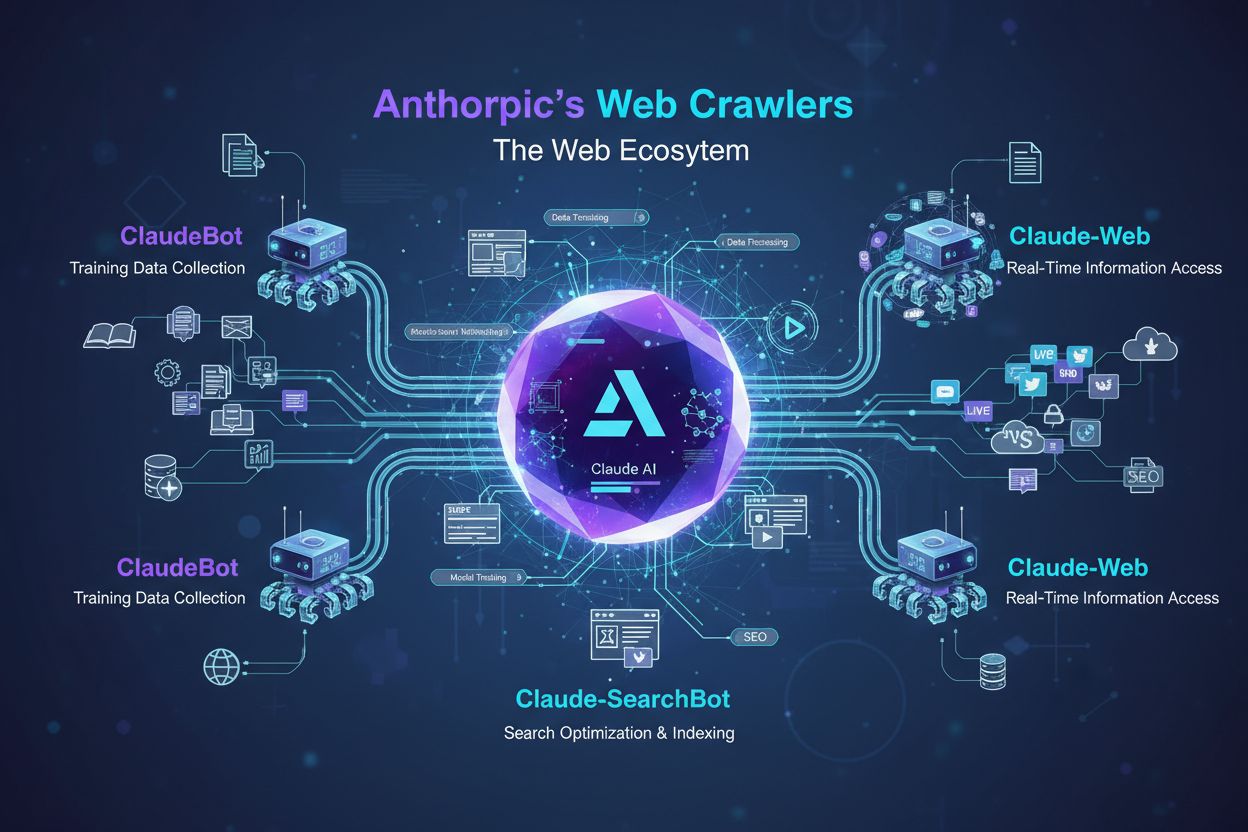
Learn how ClaudeBot works, how it differs from Claude-Web and Claude-SearchBot, and how to manage Anthropic's web crawlers on your website with robots.txt confi...
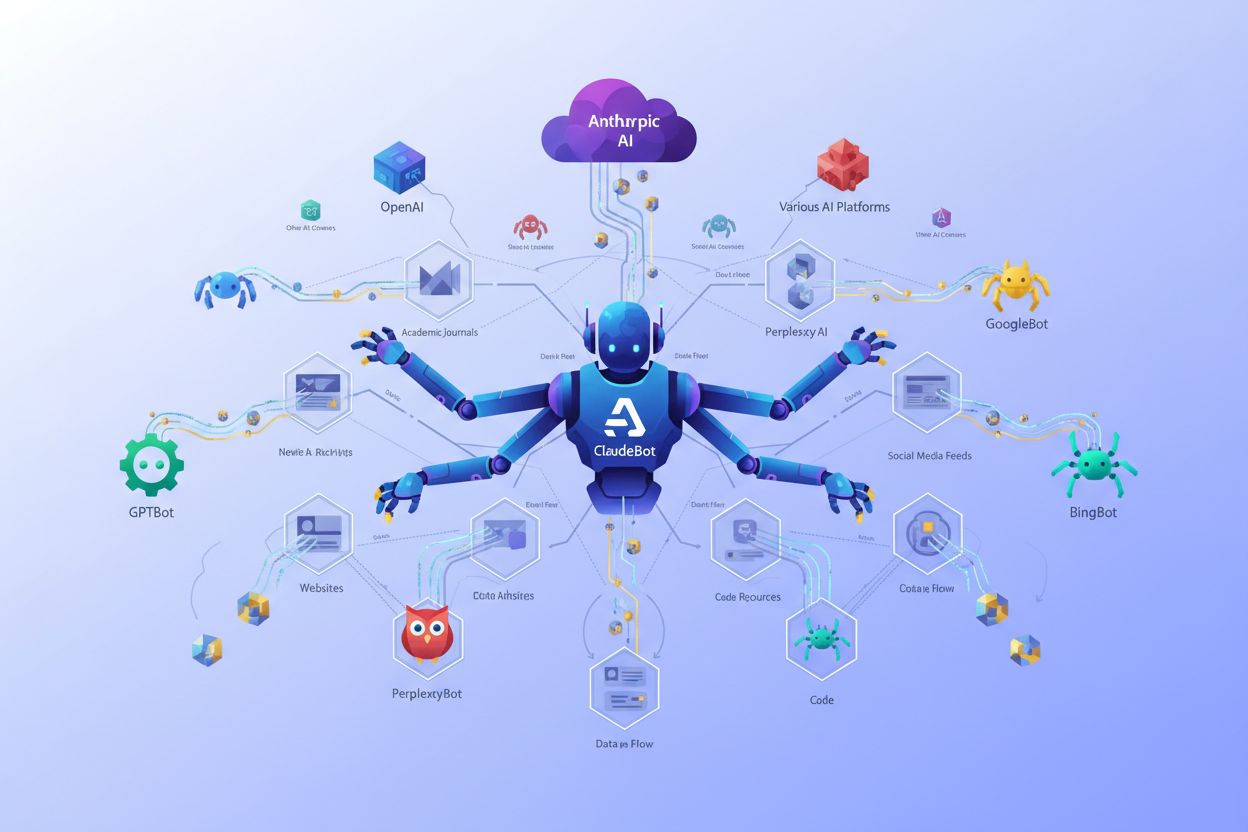
Learn what ClaudeBot is, how it works, and how to block or allow this Anthropic web crawler on your website using robots.txt configuration.