
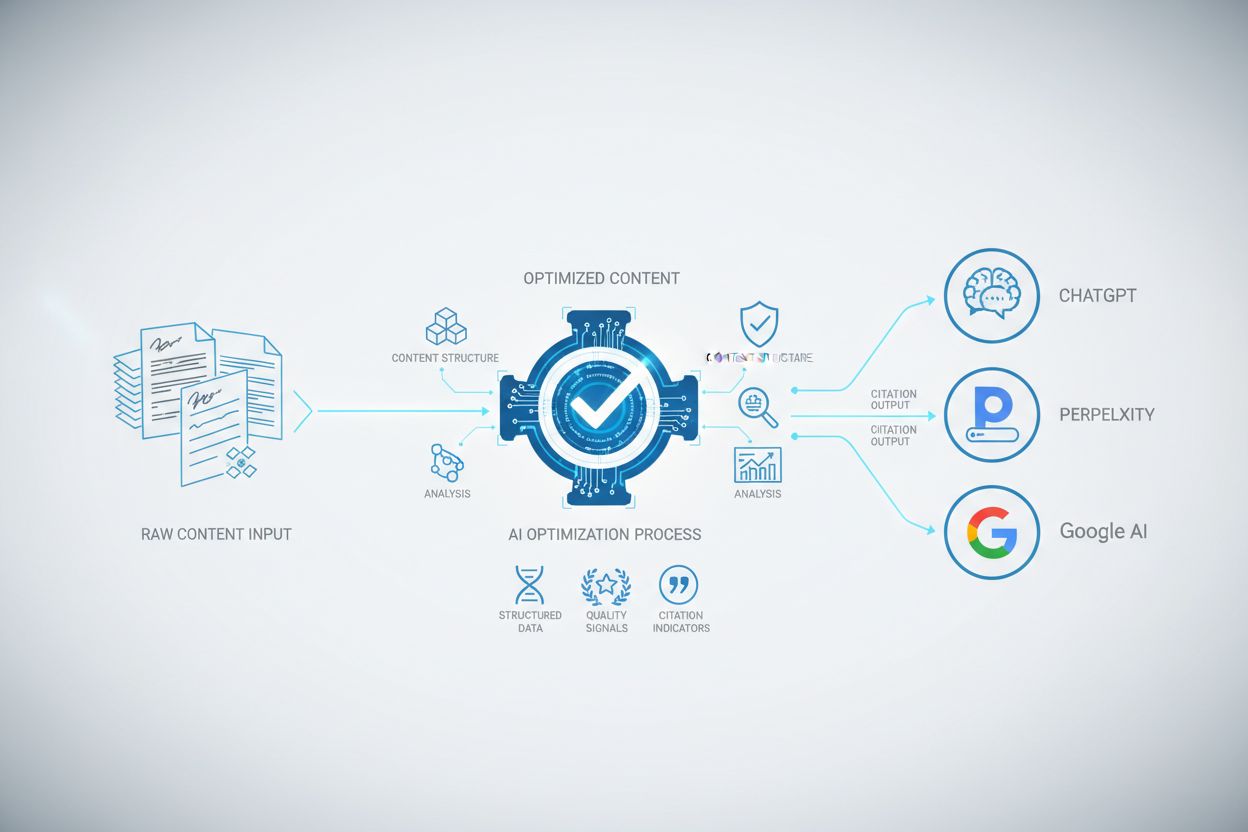
AI Content Optimization Platform
Learn what AI Content Optimization Platforms are, how they work, and why they're essential for visibility in ChatGPT, Perplexity, and Google AI Overviews. Disco...
8 min read

Clearscope is an AI-powered content optimization and research platform that uses natural language processing to analyze competitor content and provide real-time recommendations for creating SEO-optimized content. The tool helps writers, marketers, and SEO strategists improve content quality, search rankings, and organic traffic through data-driven insights and automated content grading.
Clearscope is an AI-powered content optimization and research platform that uses natural language processing to analyze competitor content and provide real-time recommendations for creating SEO-optimized content. The tool helps writers, marketers, and SEO strategists improve content quality, search rankings, and organic traffic through data-driven insights and automated content grading.
Clearscope is an AI-powered content optimization and research platform that combines natural language processing (NLP) with competitive analysis to help writers, marketers, and SEO strategists create search engine-optimized content. Founded in 2016, the platform analyzes the top-ranking pages for any target keyword and provides real-time, data-driven recommendations for improving content quality, relevance, and search visibility. Unlike traditional keyword research tools, Clearscope goes beyond simple term matching to understand search intent, identify topical gaps, and extract semantic relationships that influence ranking potential. The platform assigns a content grade (ranging from A+ to F) that reflects how well your content aligns with top-performing competitors, enabling users to optimize with confidence rather than guesswork. Clearscope integrates seamlessly with Google Docs, WordPress, Google Search Console, and Microsoft Word, making it a workflow-agnostic solution for content teams of all sizes.
The content optimization space has undergone dramatic transformation over the past decade. In the early days of SEO, keyword stuffing and basic term frequency analysis dominated strategy. However, as search algorithms became more sophisticated—particularly with Google’s introduction of RankBrain and subsequent AI-driven updates—the industry recognized that content quality, user experience, and topical authority matter far more than raw keyword density. According to industry research, the global AI-powered content creation market was valued at $2.15 billion in 2024 and is projected to reach $10.59 billion by 2033, representing a compound annual growth rate of approximately 18%. This explosive growth reflects enterprise recognition that AI-assisted content optimization directly impacts competitive positioning and organic traffic acquisition.
Clearscope emerged during this transition, positioning itself as a solution to the “content optimization guesswork” that plagued marketers. The platform’s founding principle was straightforward: if you could analyze what Google’s top-ranking pages contain—their keyword distribution, semantic themes, question coverage, and structural patterns—you could provide writers with a blueprint for creating content that satisfies both algorithmic requirements and user intent. This approach proved revolutionary because it shifted focus from “what keywords should I use?” to “what information does my audience actually need?” Over the years, Clearscope has expanded beyond traditional Google SEO to address emerging search channels, including AI search engines like ChatGPT, Perplexity, and Google AI Overviews, recognizing that content discoverability now spans multiple platforms.
Clearscope’s technical foundation rests on three industry-leading natural language processing engines: Google Cloud Natural Language, IBM Watson, and OpenAI’s language models. When a user generates a content report for a target keyword, Clearscope’s algorithm performs the following sequence: First, it crawls and analyzes the top 30 ranking pages in Google’s search engine results pages (SERPs) for that keyword. Second, it processes this content through its NLP models to extract latent semantic indexing (LSI) keywords—semantically related terms that appear frequently in high-ranking content. Third, it identifies common themes, structural patterns, and frequently asked questions that appear across top-ranking pages. Fourth, it calculates optimal metrics like word count, heading structure, and readability targets based on competitor analysis.
The platform then generates a content brief that includes: related keywords ranked by importance, common reader questions extracted from “People Also Ask” sections, external links frequently cited by competitors, recommended heading structure, and a content grade target based on competitor performance. As users write, Clearscope provides real-time feedback through its editor interface, tracking keyword usage, readability scores (using the Flesch Reading Ease formula), and overall content grade. The grading algorithm considers multiple factors including keyword distribution, semantic coverage, content length, heading optimization, and topical comprehensiveness. Importantly, Clearscope’s AI continuously monitors published content, updating grades as search algorithms evolve and user intent shifts—a critical feature because search intent for keywords like “coda” can change dramatically (from software platform to film title and back) within months.
| Feature | Clearscope | MarketMuse | Surfer SEO | Frase |
|---|---|---|---|---|
| Primary Focus | Content optimization & monitoring | Topic research & content strategy | On-page SEO & content planning | Content brief generation |
| Real-time Content Grading | Yes (A+ to F scale) | Yes (content score) | Yes (detailed breakdown) | Yes (content score) |
| Google Docs Integration | Excellent (reliable, real-time) | Limited | Limited | Good |
| Content Inventory Monitoring | Yes (automatic with GSC) | Yes (with authority tracking) | Audit tool only (manual) | Limited |
| Keyword Research Tool | Basic (Topic Research) | Advanced (separate application) | Advanced (with Chrome extension) | Integrated |
| Backlink Analysis | No | No | No | No |
| AI Content Generation | Yes (with human control) | Yes | Yes (with Jasper integration) | Yes |
| Ease of Use (G2 Rating) | 9.6/10 | 8.8/10 | 9.4/10 | 8.5/10 |
| Starting Price | $189/month | $199/month | $99/month | $99/month |
| Best For | Content optimization at scale | Topic-based strategy | Solopreneurs & agencies | Quick content briefs |
Organizations across industries have documented substantial returns from implementing Clearscope. Optimizely, a digital experience platform, achieved a 52% increase in organic traffic to content optimized through Clearscope by simply following the platform’s recommendations. Close, a sales engagement platform, exceeded its growth targets by achieving a 40% rise in organic traffic within four months of implementing Clearscope’s optimization workflow. Most dramatically, Paired, a B2B SaaS company, boosted organic traffic by more than 2,000% in less than a year using Clearscope as a core component of their content strategy. These results aren’t anomalies—they reflect a consistent pattern where content optimized to Clearscope’s A- grade or higher correlates with measurable ranking improvements and traffic gains.
The platform’s Content Inventory feature provides additional business intelligence by calculating “SEO Value”—the dollar equivalent of organic traffic based on Google Ads cost-per-click data. This metric helps marketing teams justify content investments to leadership by demonstrating that organic traffic worth $X would cost $Y in paid advertising to acquire. For example, a company generating $50,000 in monthly SEO value can immediately communicate that maintaining and optimizing that content is equivalent to running a $50,000/month paid search campaign. This financial framing has proven instrumental in securing budget for content teams and demonstrating the ROI of tools like Clearscope.
Clearscope’s original focus was optimizing content for Google’s traditional search results, and it remains exceptionally effective for that purpose. However, the platform has evolved to address the seismic shift toward AI-powered search engines. Google’s introduction of AI Overviews (formerly SGE), combined with the rise of ChatGPT, Claude, and Perplexity as primary search interfaces for millions of users, has fundamentally changed content strategy. Clearscope’s new Expand feature specifically addresses this shift by helping brands build authority across AI chatbots. The platform analyzes how AI systems cite and reference content, enabling marketers to optimize for AI discoverability alongside traditional SEO.
This dual-channel approach is critical because AI search engines operate on different principles than Google’s algorithm. While Google ranks pages based on links, domain authority, and on-page signals, AI systems prioritize authoritative, comprehensive, and well-cited content. Clearscope’s recommendations—emphasizing topical depth, question coverage, and expert citations—align naturally with what AI systems consider authoritative. Users who optimize content through Clearscope for Google often find their content also performs well in AI search results, creating a compounding effect where a single piece of optimized content drives traffic from multiple discovery channels.
Successful Clearscope implementation requires understanding how the platform fits into broader content workflows. The most effective approach involves three phases: discovery, creation, and monitoring. In the discovery phase, teams use Clearscope’s Topic Research feature to identify high-impact keywords and topics aligned with business objectives. This generates a prioritized content calendar based on search volume, intent, and competitive opportunity. In the creation phase, writers generate Clearscope reports for each target keyword and use the platform’s Google Docs integration to write content with real-time optimization feedback. This integration is particularly powerful because it eliminates context-switching—writers see keyword recommendations, content grades, and readability scores directly within their familiar Google Docs environment.
The monitoring phase leverages Clearscope’s Content Inventory dashboard, which automatically tracks all published pages and identifies optimization opportunities. The platform flags “Striking Distance” queries—keywords where your content ranks in positions 6-10 and could move to the top 3 with minor optimizations. It also identifies content experiencing decay (losing clicks over time) and recommends refresh priorities. Teams that implement this three-phase workflow consistently report 2-3x improvements in content ROI compared to those using Clearscope sporadically. Additionally, Clearscope’s shareable draft links enable collaboration with external writers and agencies without requiring them to purchase accounts, reducing friction in distributed content teams.
The content optimization landscape is entering a new era where generative AI and multi-channel search fundamentally reshape how content is discovered and consumed. Clearscope’s evolution reflects this shift. The platform’s expansion into AI search engine optimization signals recognition that traditional Google SEO, while still critical, no longer represents the complete picture of content discoverability. As AI systems become primary search interfaces for increasing segments of the population, content optimization strategies must account for how AI systems evaluate, cite, and recommend content.
Looking forward, several trends will likely shape Clearscope’s development and the broader content optimization market. First, AI search engine optimization will become as important as Google SEO, requiring tools to optimize for both algorithmic ranking and AI citation patterns. Second, topical authority and E-E-A-T signals (Expertise, Experience, Authoritativeness, Trustworthiness) will become increasingly central to ranking, pushing tools to emphasize comprehensive coverage and expert credibility over keyword density. Third, real-time content monitoring will shift from monthly or quarterly reviews to continuous optimization, with AI systems automatically identifying and recommending updates. Fourth, personalization and intent-based optimization will move beyond one-size-fits-all content grades to audience-specific recommendations based on user segments and search context.
The integration of large language models into content optimization platforms will also accelerate, though with important caveats. While AI-generated content remains controversial for quality and authenticity reasons, AI-assisted content optimization—where humans maintain creative control while AI handles research, analysis, and recommendation—will become standard. Clearscope’s approach of keeping humans in the loop at every step (intent selection, outline approval, tone setting) represents the likely future of responsible AI in content creation. Finally, as content monitoring platforms like AmICited track where brands appear in AI responses, the feedback loop between content optimization and AI discoverability will tighten, enabling marketers to measure whether optimized content actually achieves visibility in AI search results.
The convergence of these trends suggests that content optimization tools will evolve from static grading systems into dynamic, multi-channel discoverability platforms. Clearscope’s positioning at this intersection—combining traditional SEO optimization with emerging AI search capabilities—positions it well for this transition. Organizations that master content optimization across both Google and AI search channels will gain significant competitive advantages in organic traffic acquisition and brand visibility.
Clearscope leverages world-class NLP models from Google Cloud Natural Language, IBM Watson, and OpenAI to analyze the top 30 ranking pages for any target keyword. The AI algorithm extracts overlying themes, identifies essential questions, and determines semantic relationships between terms. This enables the platform to provide recommendations that optimize content for both search engine algorithms and human readers, moving beyond simple keyword matching to understand search intent and topical relevance.
While MarketMuse and Surfer SEO offer broader SEO suites with additional features like backlink tracking and keyword research, Clearscope focuses specifically on content optimization with exceptional ease of use. Clearscope's Google Docs integration is more reliable than competitors, its content grading system directly correlates with ranking improvements, and it maintains a streamlined interface. However, Clearscope lacks comprehensive backlink analysis and requires users to pair it with dedicated keyword research tools for complete SEO strategy.
Case studies show significant results: Optimizely achieved a 52% increase in organic traffic to optimized content, Close saw a 40% rise in organic traffic within four months, and Paired boosted organic traffic by over 2,000% in less than a year. However, results depend on content quality, existing SEO foundation, and how thoroughly users implement Clearscope's recommendations. The platform works best when optimizing existing underperforming content or creating new content for competitive keywords.
Clearscope integrates seamlessly with Google Docs, WordPress, Microsoft Word, and Google Search Console. The Google Docs integration is particularly powerful, allowing real-time content grading, keyword recommendations, and readability scores directly within your document. This eliminates context-switching between tools and enables collaborative writing with external writers who don't need Clearscope accounts. The Google Search Console integration provides content inventory tracking and SEO value metrics showing the dollar equivalent of organic traffic.
Clearscope's content grade (A+ through F) measures how well your content aligns with top-ranking pages for your target keyword across factors like keyword usage, word count, readability, and topical coverage. The platform recommends targeting at least an A- grade. Users consistently report that achieving higher content grades correlates with improved search rankings and organic traffic. The grading system is dynamic, continuously updating as search algorithms and user intent evolve.
Clearscope's Content Inventory feature integrates with Google Search Console to automatically monitor all published pages and track their performance. The platform identifies 'Striking Distance' queries—keywords where your content is close to ranking higher with minor optimizations. It also flags content experiencing decay (losing clicks over time) and provides internal linking opportunities. This continuous monitoring helps teams prioritize which existing content to refresh for maximum ROI.
Clearscope has evolved beyond traditional Google SEO to address the rise of AI search engines. The platform now includes an 'Expand' feature designed to help brands build authority across AI chatbots like ChatGPT, Claude, and Perplexity. This reflects the broader shift in search behavior, where AI systems increasingly cite and reference authoritative content sources. Optimizing with Clearscope helps ensure your content appears in both traditional search results and AI-generated responses.
Start tracking how AI chatbots mention your brand across ChatGPT, Perplexity, and other platforms. Get actionable insights to improve your AI presence.
Learn what AI Content Optimization Platforms are, how they work, and why they're essential for visibility in ChatGPT, Perplexity, and Google AI Overviews. Disco...

Learn how glossary pages enhance AI visibility by providing structured content, establishing authority, and improving citations in AI-generated answers. Discove...

Learn how to identify and close AI visibility content gaps across ChatGPT, Perplexity, and Google AI Overviews. Discover analysis methods and tools to improve y...