
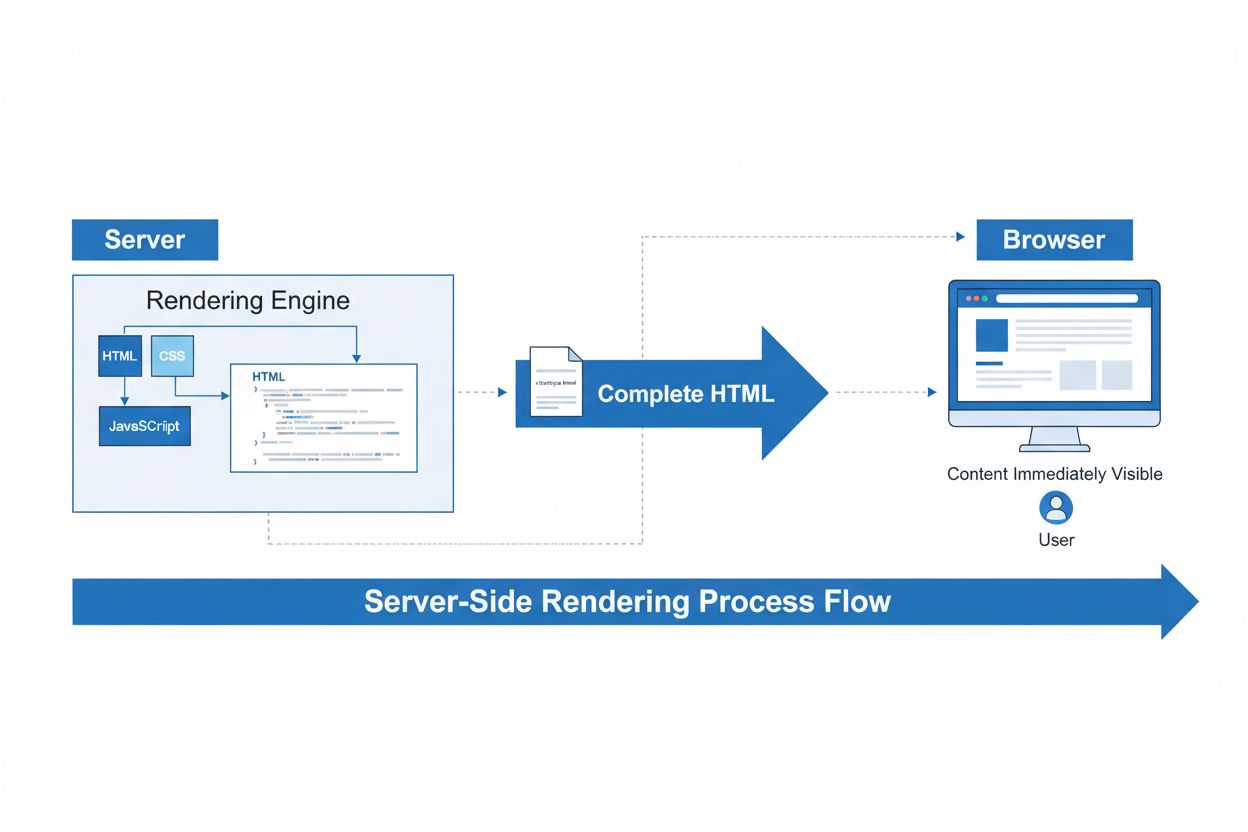
Server-Side Rendering (SSR)
Server-Side Rendering (SSR) is a web technique where servers render complete HTML pages before sending them to browsers. Learn how SSR improves SEO, page speed,...
11 min read
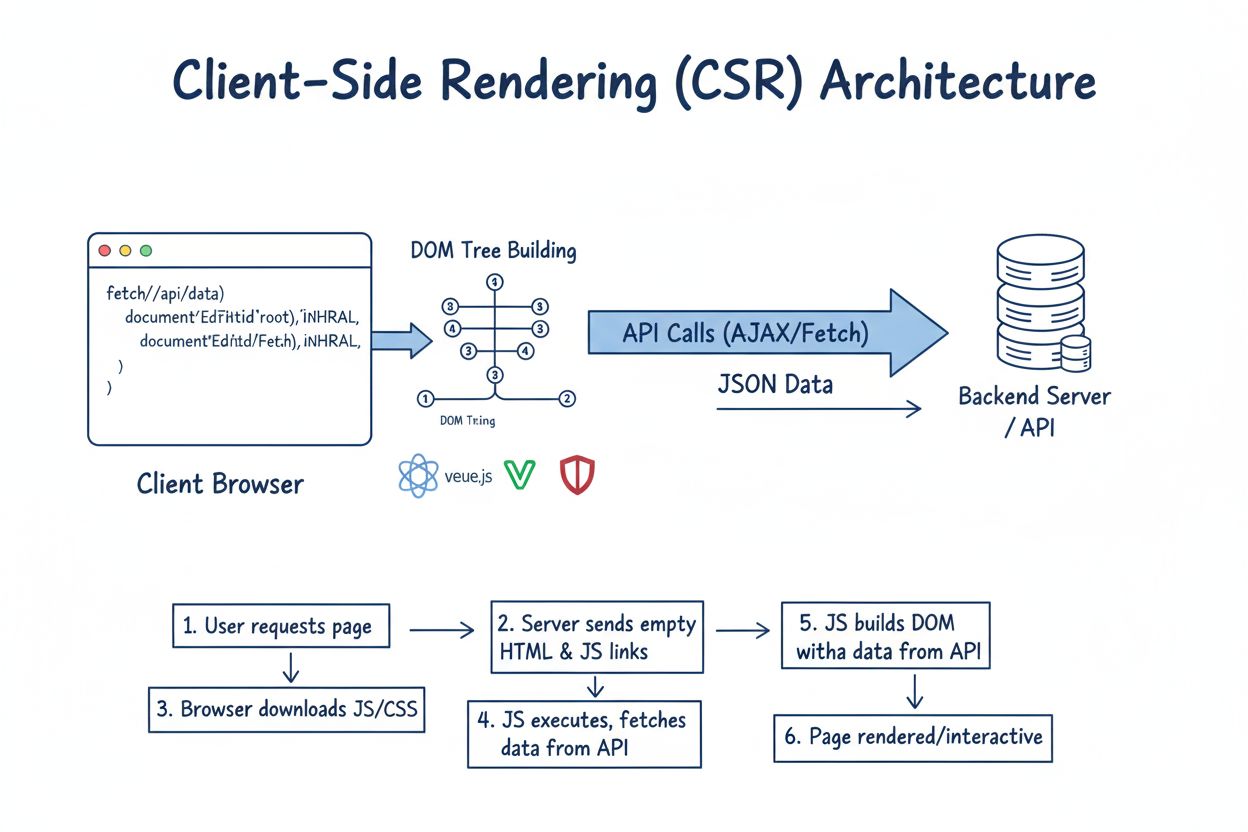
Client-Side Rendering (CSR) is a web development approach where the browser executes JavaScript to render and display web page content dynamically, rather than receiving pre-rendered HTML from the server. This technique enables interactive, real-time user experiences but can impact initial page load times and search engine indexing.
Client-Side Rendering (CSR) is a web development approach where the browser executes JavaScript to render and display web page content dynamically, rather than receiving pre-rendered HTML from the server. This technique enables interactive, real-time user experiences but can impact initial page load times and search engine indexing.
Client-Side Rendering (CSR) is a web development architecture where the browser executes JavaScript code to render and display web page content dynamically, rather than receiving fully-rendered HTML from the server. In this approach, the server sends a minimal HTML shell containing links to JavaScript files, and the browser is responsible for fetching data from APIs, building the Document Object Model (DOM), and rendering the complete user interface. This technique has become fundamental to modern web development, powering interactive applications, Single Page Applications (SPAs), and Progressive Web Apps (PWAs) that require real-time updates and seamless user interactions. CSR represents a fundamental shift in how web applications are architected, moving computational responsibility from centralized servers to distributed client devices, enabling richer, more responsive user experiences while introducing new challenges for performance optimization and search engine visibility.
The emergence of Client-Side Rendering reflects the evolution of web development from static document delivery to dynamic application platforms. When JavaScript was introduced in 1996, it was primarily used for simple form validation and basic interactivity. However, as web applications became increasingly complex, developers recognized the limitations of server-side rendering for highly interactive experiences. The introduction of AJAX (Asynchronous JavaScript and XML) in the early 2000s marked a turning point, enabling asynchronous data fetching without full page reloads. This innovation paved the way for modern CSR frameworks. The release of jQuery (2006) simplified DOM manipulation, followed by the emergence of AngularJS (2010), which introduced the concept of two-way data binding and component-based architecture. React (2013), developed by Facebook, revolutionized CSR by introducing the Virtual DOM concept, which optimizes rendering performance through efficient DOM diffing algorithms. Today, approximately 98.7% of websites use JavaScript as a client-side programming language, with CSR being the dominant approach for building modern web applications. According to the 2024 State of Frontend report, 69.9% of developers actively use React, demonstrating the widespread adoption of CSR frameworks in professional development environments.
The Client-Side Rendering process follows a specific sequence of steps that fundamentally differs from traditional server-side approaches. When a user requests a webpage, the server responds with a minimal HTML file containing a root element (typically a <div id="root"></div>) and links to external JavaScript bundles. The browser then downloads these JavaScript files, which contain the application logic, component definitions, and rendering instructions. Once the JavaScript is parsed and executed, the browser makes API calls to fetch the necessary data from backend services. The JavaScript framework (such as React, Vue.js, or Angular) then processes this data and dynamically constructs the DOM tree, transforming the empty HTML shell into a fully interactive user interface. This entire process happens in the user’s browser, meaning the rendering workload is distributed across millions of client devices rather than concentrated on a single server. The browser’s rendering engine then paints the DOM elements to the screen, and the application becomes interactive. Subsequent user interactions—such as clicking buttons, submitting forms, or navigating between pages—are handled entirely by the JavaScript application without requiring full page reloads, resulting in smooth, app-like experiences that feel responsive and immediate.
| Aspect | Client-Side Rendering (CSR) | Server-Side Rendering (SSR) | Static Site Generation (SSG) |
|---|---|---|---|
| Rendering Location | Browser (client device) | Web server | Build time (pre-generated) |
| Initial Page Load | Slower (requires JS download/execution) | Faster (HTML pre-rendered) | Fastest (static HTML served) |
| SEO Performance | Challenging (requires JS indexing) | Excellent (full HTML available) | Excellent (static HTML indexed) |
| Interactivity | Highly interactive, real-time updates | Limited interactivity | Limited interactivity |
| Server Load | Minimal (rendering on client) | High (rendering on server) | Minimal (static files only) |
| Dynamic Content | Excellent (real-time data fetching) | Good (server-generated) | Limited (requires rebuild) |
| Best Use Cases | SPAs, dashboards, real-time apps | Content sites, blogs, e-commerce | Documentation, marketing sites |
| Framework Examples | React, Vue.js, Angular, Svelte | Next.js, Nuxt, FastBoot | Hugo, Jekyll, Gatsby, Astro |
| Time to Interactive (TTI) | Slower (depends on JS complexity) | Moderate | Fast (minimal JS needed) |
| Scalability | Excellent (distributed rendering) | Moderate (server-dependent) | Excellent (CDN-friendly) |
Modern Client-Side Rendering relies on sophisticated JavaScript frameworks that abstract away the complexity of DOM manipulation and state management. React, developed by Facebook and now maintained by Meta, uses a Virtual DOM architecture that creates an in-memory representation of the actual DOM. When state changes occur, React compares the new Virtual DOM with the previous version, identifies the minimal set of changes needed, and updates only those specific DOM elements. This approach dramatically improves performance compared to naive DOM manipulation. Vue.js, created by Evan You, offers a more approachable learning curve while providing similar capabilities through reactive data binding and component-based architecture. Angular, maintained by Google, provides a comprehensive, opinionated framework with built-in features for routing, HTTP client functionality, and form handling, making it particularly suitable for large-scale enterprise applications. Svelte, developed by Rich Harris, takes a different approach by compiling components to vanilla JavaScript at build time, eliminating the need for a runtime library and resulting in smaller bundle sizes and faster performance. Each framework implements CSR differently, but they all share the common principle of moving rendering logic to the browser and managing application state through JavaScript. The choice of framework significantly impacts application performance, developer experience, and long-term maintainability, making framework selection a critical architectural decision.
Client-Side Rendering presents distinct performance characteristics that require careful optimization to deliver acceptable user experiences. The initial page load time is typically slower than server-side rendering because the browser must download JavaScript bundles (often ranging from 50KB to several megabytes), parse and execute them, and then fetch data from APIs before rendering any content. This delay is often perceived by users as a blank page or loading spinner, potentially leading to higher bounce rates. However, once the initial JavaScript is loaded and cached, subsequent page navigations can be significantly faster because the application can update the DOM without requiring full page reloads. Modern optimization techniques address these challenges: code splitting divides JavaScript into smaller chunks that load only when needed, lazy loading defers the loading of non-critical resources, tree-shaking removes unused code during the build process, and minification reduces file sizes. Service Workers enable offline functionality and faster repeat visits through intelligent caching strategies. According to the 2024 HTTP Archive Performance report, websites with optimized CSR implementations achieve 68% good visual stability on desktop and 51% on mobile, demonstrating that performance challenges can be effectively mitigated through proper optimization. Tools like Google Lighthouse, WebPageTest, and Chrome DevTools provide detailed performance metrics and recommendations for CSR optimization, enabling developers to identify bottlenecks and implement targeted improvements.
Client-Side Rendering presents significant challenges for search engine optimization because traditional search engine crawlers struggle to execute JavaScript and index dynamically-rendered content. While Google has improved its JavaScript rendering capabilities over the years, many search engines and AI-powered systems still find it easier to index server-side rendered HTML. The indexing process for CSR websites typically involves additional steps: search engines must execute JavaScript, wait for API calls to complete, and then parse the rendered DOM—a process that is more resource-intensive and time-consuming than simply parsing static HTML. This complexity can result in delayed indexing, incomplete content discovery, and lower search rankings. Dynamic rendering is one solution where websites serve pre-rendered HTML to search engine crawlers while serving CSR to regular users, but this approach adds complexity and maintenance overhead. For websites where search visibility is critical—such as blogs, news sites, e-commerce platforms, and content marketing properties—Server-Side Rendering (SSR) or Static Site Generation (SSG) are often more appropriate choices. However, for applications where search visibility is less critical, such as internal dashboards, chat applications, and authenticated user portals, CSR remains the optimal choice due to its superior interactivity and real-time capabilities. Organizations must carefully evaluate their specific requirements and consider hybrid approaches that combine CSR for interactive components with SSR or SSG for content-heavy pages.
The rise of AI-powered search engines like Perplexity, ChatGPT, and Google AI Overviews introduces new considerations for CSR websites. These AI systems must execute JavaScript to access content rendered on the client side, which is more resource-intensive than parsing pre-rendered HTML. Research indicates that AI chatbots drive 95-96% less referral traffic to publishers than traditional Google search, partly due to indexing challenges with JavaScript-heavy websites. CSR-rendered content may be incompletely indexed by AI systems, resulting in reduced visibility in AI-generated responses and citations. This is particularly important for organizations using AmICited to monitor their brand and domain appearances in AI responses. When content is rendered client-side, AI systems may struggle to properly extract and cite information, potentially leading to missed opportunities for brand visibility in the rapidly growing AI search landscape. According to McKinsey research, half of consumers are now using AI-powered search, and this trend is expected to impact $750 billion in revenue by 2028. Organizations must therefore consider how their rendering strategy affects visibility not just in traditional search engines, but also in emerging AI search platforms. Implementing proper meta tags, structured data (Schema.org), and ensuring that critical content is accessible to JavaScript-executing crawlers can improve CSR content’s visibility in AI search results.
Client-Side Rendering offers compelling advantages for specific use cases and application types. The most significant benefit is reduced server load—since rendering happens on client devices, servers can focus on data retrieval, business logic, and API requests rather than generating HTML for each request. This distributed rendering model enables exceptional scalability, allowing applications to serve millions of concurrent users without proportional increases in server infrastructure. Enhanced interactivity is another major advantage; CSR applications can respond to user actions in real-time without full page reloads, creating smooth, responsive experiences that rival native applications. This capability is essential for applications like collaborative tools, real-time dashboards, chat applications, and social media platforms where instant feedback is critical to user satisfaction. Improved developer experience is facilitated by modern CSR frameworks that provide powerful abstractions for state management, component composition, and routing. Developers can build complex applications more efficiently using declarative syntax and reusable components. Offline functionality is possible with CSR through Service Workers and local storage, enabling applications to function even when network connectivity is temporarily unavailable. Faster subsequent page navigations occur because the JavaScript application can update the DOM without requiring full page reloads, resulting in perceived performance improvements after the initial load. For applications prioritizing user engagement and interactivity, CSR delivers measurable business benefits through increased user satisfaction, higher retention rates, and improved conversion metrics.
Despite its advantages, Client-Side Rendering has significant limitations that make it unsuitable for certain applications. Slower initial page load times represent the most visible disadvantage—users often encounter blank pages or loading spinners while JavaScript downloads and executes, potentially leading to higher bounce rates and reduced user satisfaction. Poor SEO performance is a critical limitation for content-focused websites; search engines struggle to index JavaScript-rendered content, resulting in lower search rankings and reduced organic traffic. This limitation is particularly problematic for e-commerce sites, blogs, news publications, and marketing websites where search visibility directly impacts business revenue. Dependency on user device performance means that older devices or those with limited processing power may struggle to render complex CSR applications, resulting in inconsistent user experiences across different devices and browsers. Accessibility challenges can arise if CSR applications are not carefully implemented with proper ARIA attributes, keyboard navigation, and focus management. Larger JavaScript bundles increase bandwidth consumption and can negatively impact performance on slower network connections, particularly affecting mobile users in regions with limited connectivity. Complexity in debugging increases because errors can occur at multiple stages (download, parsing, execution, API calls), making it harder to diagnose and resolve issues. Security considerations require careful attention because client-side code is visible to users and can be manipulated, necessitating server-side validation and security measures. These limitations make CSR less suitable for websites where performance, SEO, and accessibility are paramount concerns.
Successful Client-Side Rendering implementations require adherence to established best practices and careful architectural decisions. Code splitting should be implemented to divide JavaScript into smaller chunks that load only when needed, reducing initial bundle size and improving Time to First Byte (TTFB). Lazy loading of images, components, and routes defers the loading of non-critical resources until they’re actually needed. Performance monitoring through tools like Google Lighthouse, WebPageTest, and real user monitoring (RUM) solutions provides visibility into actual performance metrics and identifies optimization opportunities. Accessibility must be prioritized from the start, including proper semantic HTML, ARIA attributes, keyboard navigation support, and focus management. SEO optimization for CSR applications involves implementing proper meta tags, structured data, Open Graph tags, and ensuring that critical content is accessible to search engine crawlers. Error handling and resilience should be implemented to gracefully handle API failures, network timeouts, and JavaScript errors. State management should be carefully designed using solutions like Redux, Vuex, or Zustand to prevent bugs and improve maintainability. Testing should include unit tests, integration tests, and end-to-end tests to ensure application reliability. Progressive enhancement principles suggest building applications that work without JavaScript and then enhancing them with interactive features, improving resilience and accessibility. Bundle analysis tools help identify and eliminate unnecessary dependencies, reducing overall application size. Organizations should also consider hybrid rendering approaches that combine CSR for interactive components with SSR or SSG for content-heavy pages, optimizing for both performance and interactivity.
The landscape of Client-Side Rendering continues to evolve with emerging technologies and changing user expectations. Edge computing and edge rendering represent a significant trend where rendering logic is moved to edge servers closer to users, combining benefits of both CSR and SSR. Streaming Server-Side Rendering (Streaming SSR) enables servers to send HTML progressively as it’s generated, improving perceived performance while maintaining SEO benefits. Partial Hydration and Progressive Hydration techniques optimize the hydration process (converting static HTML to interactive applications) by only hydrating components that need interactivity, reducing JavaScript overhead. Web Components and Micro Frontends architectures enable more modular, scalable applications by breaking monolithic CSR applications into smaller, independently deployable components. AI-assisted development tools are emerging to help developers optimize CSR applications automatically, identifying performance bottlenecks and suggesting improvements. WebAssembly (WASM) integration enables computationally intensive operations to run at near-native speeds in the browser, expanding the possibilities for CSR applications. Improved AI search engine support is likely as AI systems become more sophisticated at executing and indexing JavaScript-rendered content, potentially reducing the SEO disadvantages of CSR. Framework consolidation may occur as the ecosystem matures, with fewer but more powerful frameworks dominating the landscape. Performance-first frameworks like Astro, Qwik, and Fresh are gaining traction by prioritizing performance and minimal JavaScript by default. Organizations should monitor these trends and evaluate how emerging technologies might improve their CSR implementations and address current limitations. The future of web development likely involves intelligent hybrid approaches that automatically select the optimal rendering strategy based on content type, user context, and performance requirements.
For organizations using AmICited to track brand and domain appearances in AI-powered search systems, understanding Client-Side Rendering is crucial. CSR-rendered content may not be fully indexed by AI systems like Perplexity, ChatGPT, and Google AI Overviews, potentially affecting how your brand appears in AI-generated responses. AmICited’s monitoring capabilities help you understand how your CSR-rendered pages are being indexed and cited by AI systems, providing actionable insights into your visibility in the emerging AI search landscape. By tracking which of your CSR pages appear in AI responses and analyzing citation patterns, you can optimize your rendering strategy to ensure maximum visibility. This might involve implementing dynamic rendering for critical pages, improving meta tags and structured data, or considering hybrid rendering approaches that combine CSR with SSR for better AI indexing. As AI search continues to grow—with 50% of consumers already using AI-powered search—ensuring your CSR content is properly indexed and cited becomes increasingly important for maintaining brand visibility and driving qualified traffic from AI search systems.
In Client-Side Rendering (CSR), the browser receives a minimal HTML file and uses JavaScript to build the DOM and fetch data from APIs, rendering content dynamically. Server-Side Rendering (SSR) generates the complete HTML on the server before sending it to the browser. CSR offers better interactivity and reduced server load, while SSR provides faster initial page loads and better SEO performance. The choice between them depends on your application's specific requirements for performance, interactivity, and search visibility.
CSR provides several key benefits: reduced server load since rendering happens in the browser, enhanced interactivity with real-time updates without full page reloads, improved user experience through smooth transitions and dynamic content updates, and better scalability for applications with frequent content changes. Additionally, CSR enables developers to build Single Page Applications (SPAs) and Progressive Web Apps (PWAs) that feel native-like and responsive to user interactions.
CSR has notable drawbacks including slower initial page load times as browsers must download and execute JavaScript before rendering content, poor SEO performance since search engines struggle to index JavaScript-rendered content, dependency on user device performance which can cause issues on older or low-powered devices, and potential accessibility challenges if not implemented carefully. These limitations make CSR less suitable for content-heavy websites, blogs, and e-commerce platforms that prioritize search visibility.
Client-Side Rendering presents challenges for AI-powered search engines like Perplexity, ChatGPT, and Google AI Overviews because they must execute JavaScript to access content, which is more resource-intensive than parsing pre-rendered HTML. This can result in incomplete or delayed indexing of CSR-based content, potentially reducing visibility in AI search results. Organizations using AmICited can monitor how their CSR-rendered content appears in AI responses and adjust their rendering strategy accordingly to ensure proper citation and visibility.
The most popular frameworks for CSR include React (used by 69.9% of developers according to 2024 surveys), Vue.js (known for simplicity and flexibility), Angular (comprehensive framework with TypeScript support), and Svelte (optimized for performance with smaller bundle sizes). Each framework offers different approaches to component management, state handling, and rendering optimization. The choice depends on project requirements, team expertise, and performance goals.
Yes, CSR can be optimized for SEO through several techniques: implementing dynamic rendering to serve pre-rendered HTML to search engines, using server-side rendering for critical pages, implementing proper meta tags and structured data, ensuring JavaScript is properly configured for crawling, and using tools like Google Lighthouse to monitor performance. However, for maximum SEO benefit, hybrid approaches combining CSR with SSR or Static Site Generation (SSG) are often more effective.
Approximately 98.7% of websites use JavaScript as a client-side programming language, with CSR being a dominant approach for modern web applications. React alone is used by 69.9% of developers building CSR applications. However, the adoption varies by website type—content-focused sites tend to use SSR or static generation, while interactive applications and SPAs predominantly rely on CSR for their dynamic functionality.
CSR impacts key performance metrics differently: First Contentful Paint (FCP) and Largest Contentful Paint (LCP) are typically slower because the browser must download and execute JavaScript before rendering content. However, subsequent page navigations can be faster due to optimizations and cached resources. Time to Interactive (TTI) depends on JavaScript complexity. Modern optimization techniques like code splitting, lazy loading, and tree-shaking can significantly improve CSR performance metrics.
Start tracking how AI chatbots mention your brand across ChatGPT, Perplexity, and other platforms. Get actionable insights to improve your AI presence.
Server-Side Rendering (SSR) is a web technique where servers render complete HTML pages before sending them to browsers. Learn how SSR improves SEO, page speed,...

Learn how server-side rendering enables efficient AI processing, model deployment, and real-time inference for AI-powered applications and LLM workloads.
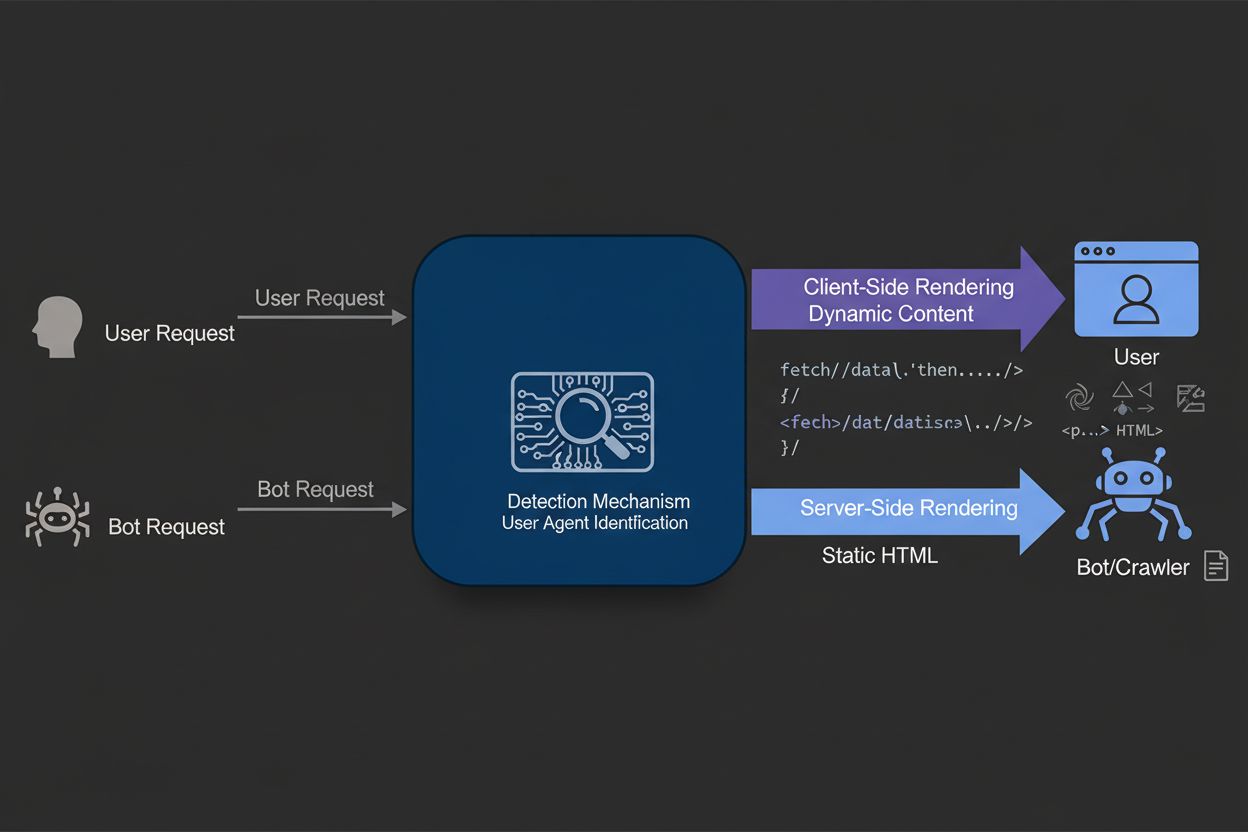
Dynamic rendering serves static HTML to search engine bots while delivering client-side rendered content to users. Learn how this technique improves SEO, crawl ...
Cookie Consent
We use cookies to enhance your browsing experience and analyze our traffic. See our privacy policy.