
AI Visibility Center of Excellence
Learn what an AI Visibility Center of Excellence is, its key responsibilities, monitoring capabilities, and how it enables organizations to maintain transparenc...
8 min read
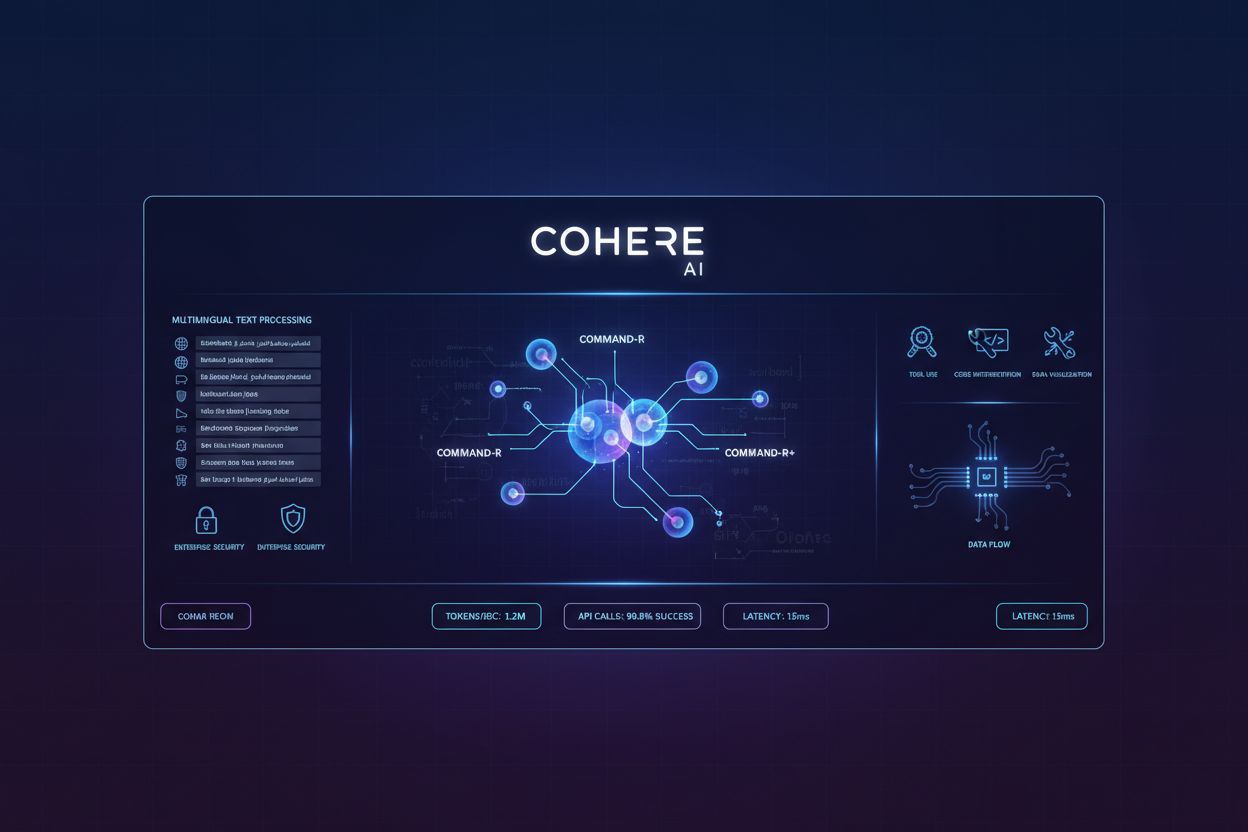
Cohere is an enterprise-focused AI company that develops the Command family of large language models and operates a web crawler for collecting training data. The platform provides secure, customizable AI solutions for businesses, including text generation, semantic search, and retrieval-augmented generation capabilities. Cohere’s technology powers AI agents, workflow automation, and content creation at scale across multiple industries.
Cohere is an enterprise-focused AI company that develops the Command family of large language models and operates a web crawler for collecting training data. The platform provides secure, customizable AI solutions for businesses, including text generation, semantic search, and retrieval-augmented generation capabilities. Cohere's technology powers AI agents, workflow automation, and content creation at scale across multiple industries.
Cohere is an enterprise-focused artificial intelligence company that specializes in developing powerful language models and AI solutions designed specifically for business applications. Founded with a mission to make advanced AI accessible and secure for enterprises, Cohere has positioned itself as a leader in providing customizable, production-ready AI technology that prioritizes data security and organizational control. The company’s core offering centers on the Command family of language models, which are engineered to handle complex business workflows including content generation, retrieval-augmented generation (RAG), tool use, and agentic AI applications. Unlike consumer-focused AI platforms, Cohere emphasizes enterprise-grade security, private deployment options, and the ability to customize models on proprietary data. The company serves a diverse range of industries including financial services, healthcare, technology, manufacturing, and the public sector, with notable customers including Oracle, Fujitsu, Notion, Dell Technologies, RBC, SAP, and Salesforce.
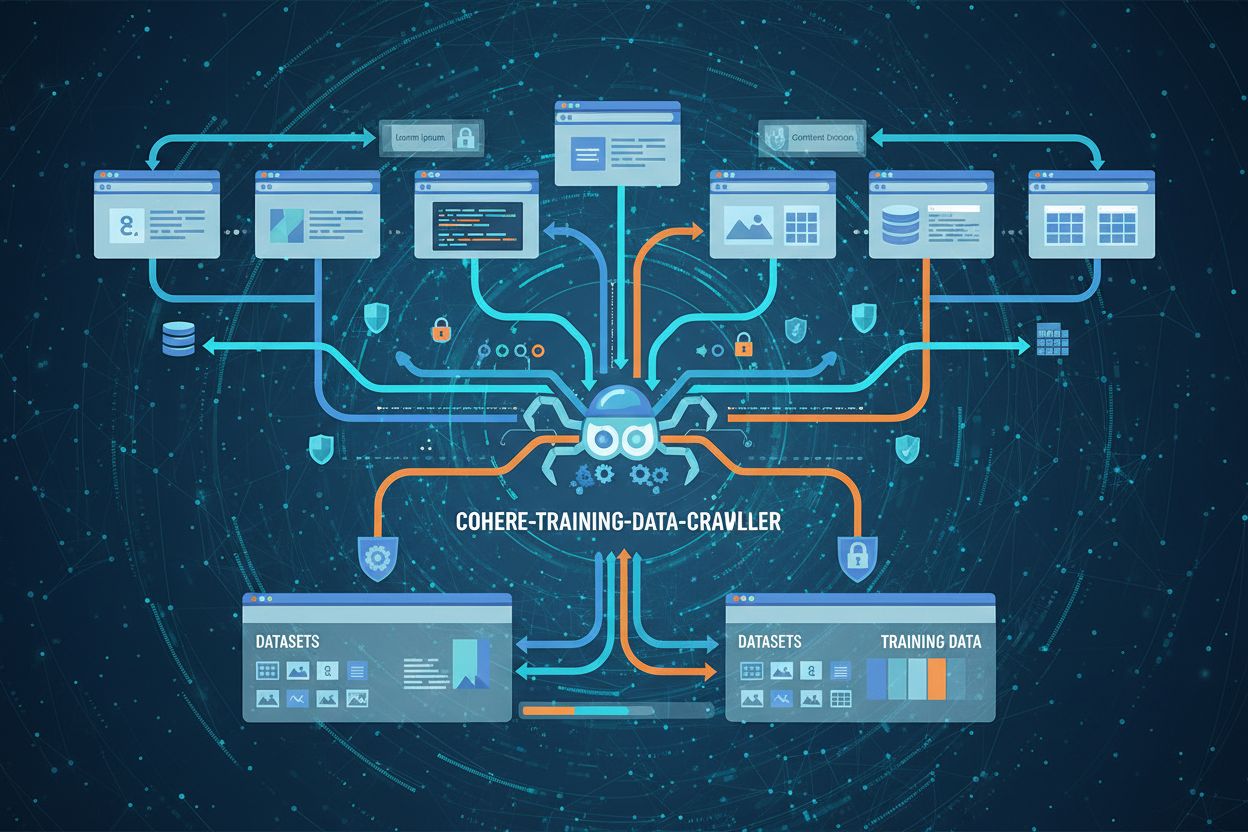
The cohere-training-data-crawler is a web crawler operated by Cohere to systematically download and collect publicly available content from websites for training its large language models. Unlike traditional search engine crawlers that index content to help users find information through search results, Cohere’s crawler specifically targets content for machine learning purposes, downloading entire pages and documents to build training datasets. This distinction is crucial: search engine crawlers (like Googlebot) create indexes for retrieval, while AI data scrapers like cohere-training-data-crawler collect raw content to improve model capabilities. The crawler operates with less transparency than search engines regarding site selection criteria, crawling frequency, and data usage priorities. Website owners can block the crawler through robots.txt configuration by adding the rule “User-agent: cohere-training-data-crawler” followed by “Disallow: /”, though implementation of blocking methods varies in effectiveness.
Key characteristics of the cohere-training-data-crawler:
The Command family represents Cohere’s flagship suite of generative language models, each optimized for specific enterprise use cases and performance requirements. These models are instruction-following conversational models that excel at understanding complex business tasks and generating high-quality text outputs. The family includes multiple variants designed to balance performance, speed, and cost-effectiveness, allowing organizations to choose the model that best fits their specific needs. Command models support advanced capabilities including tool use (enabling AI agents to interact with external systems), retrieval-augmented generation (RAG) for grounding responses in proprietary data, multilingual processing across 23 languages, and agentic AI for autonomous workflow automation. The latest iteration, Command A, represents Cohere’s most performant model to date, featuring a 256K context length, requiring only two GPUs for deployment, and delivering 150% higher throughput compared to previous versions.
| Model Name | Release | Key Capabilities | Context Length | Best For |
|---|---|---|---|---|
| Command A | 2025 | Tool use, agents, RAG, multilingual, reasoning | 256K | Complex enterprise workflows, agentic AI |
| Command R7B | 2024 | RAG, tool use, agents, reasoning | 128K | Fast, efficient enterprise applications |
| Command R+ | 2024 | Complex RAG, multi-step tool use | 128K | Advanced retrieval and reasoning tasks |
| Command R | 2024 | Conversational, language tasks, coding | 128K | General-purpose enterprise applications |
| Aya Expanse | 2024 | Multilingual (23 languages) | 128K | Global enterprises, non-English content |
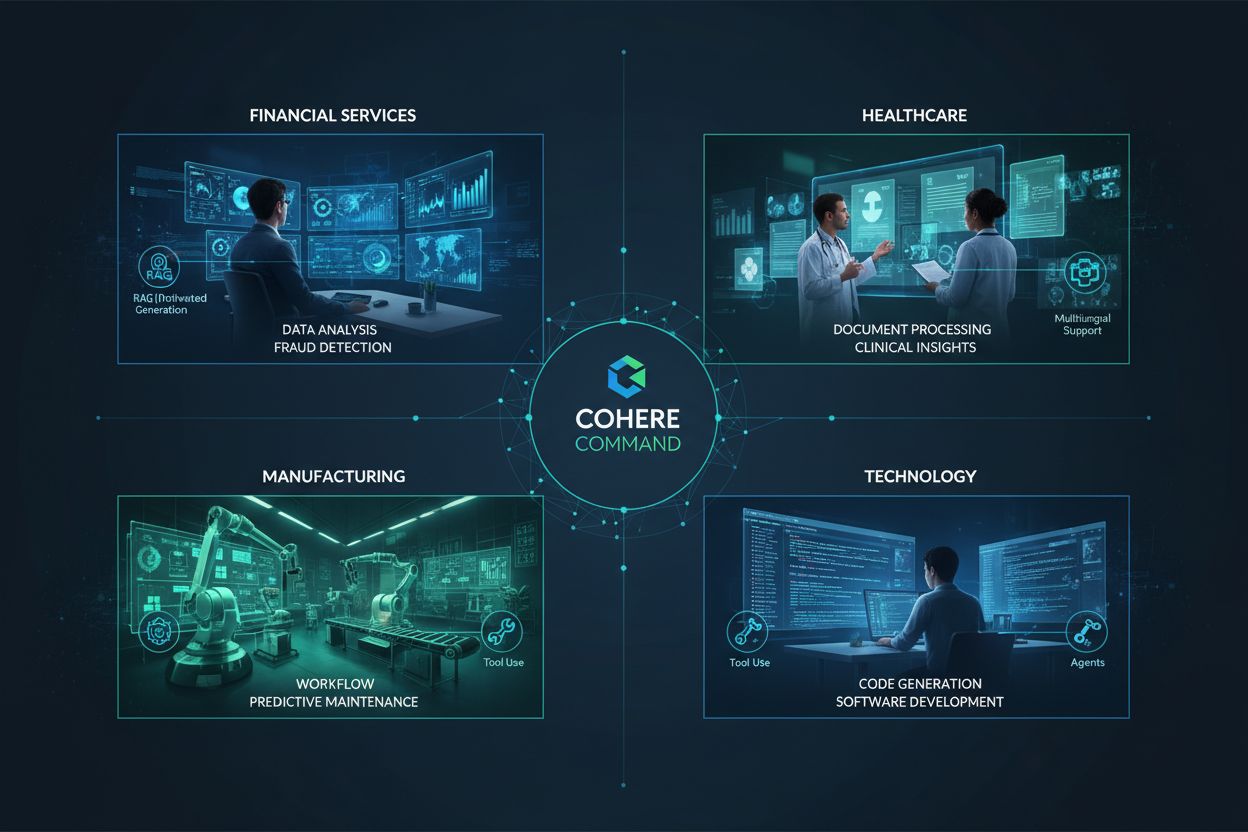
Cohere’s Command models power diverse enterprise applications across multiple industries, enabling organizations to automate complex workflows and enhance productivity at scale. In financial services, institutions use Command models for automated report generation, financial analysis, customer communication, and compliance documentation, with customers like RBC and other major banks leveraging the technology for high-volume content creation. Healthcare organizations employ Cohere’s models for medical document processing, patient Q&A systems, clinical note generation, and research paper analysis, where the ability to handle specialized terminology and maintain accuracy is critical. Technology companies use Command for code generation, documentation creation, API integration, and developer productivity tools, with Notion integrating Cohere’s capabilities into their platform. Manufacturing and logistics sectors benefit from workflow automation, supply chain optimization, and operational documentation generation. Fujitsu, a major technology conglomerate, partnered with Cohere to provide secure enterprise LLMs to businesses globally, emphasizing the importance of security and customization in enterprise AI adoption. The North platform, powered by Command models, represents Cohere’s integrated solution for workplace productivity, combining AI agents, intelligent search, and generative capabilities in a single enterprise-ready system.
The operation of the cohere-training-data-crawler raises important considerations for website owners, content creators, and organizations concerned about data usage and attribution. While the crawler targets publicly available content, the collection of this data for AI model training differs fundamentally from traditional web indexing, as the content becomes part of proprietary training datasets with limited transparency about how it will be used or attributed. Content creators may have legitimate concerns about their work being used to train commercial AI systems without explicit permission or compensation, particularly for creative, journalistic, or specialized professional content. The ethical implications extend beyond individual websites to broader questions about AI training data sourcing, attribution practices, and the rights of content creators in an AI-driven economy.
Practical considerations for managing the cohere-training-data-crawler:
Cohere differentiates itself from major AI competitors like OpenAI, Google, and Anthropic through its explicit focus on enterprise needs, security, and customization capabilities. While OpenAI’s ChatGPT and Google’s Gemini target consumer and general-purpose markets, Cohere has strategically positioned itself as the enterprise AI platform, offering features that large organizations demand: private deployments within dedicated virtual private clouds (VPCs), on-premises deployment options for air-gapped environments, and the ability to fine-tune models on proprietary data without exposing sensitive information to third parties. Cohere’s multilingual capabilities through the Aya family of models, supporting 23 languages, provide significant advantages for global enterprises operating across multiple regions and languages. The company’s emphasis on tool use and agentic AI enables sophisticated workflow automation that goes beyond simple text generation, allowing AI systems to interact with business applications, databases, and external APIs. Deployment flexibility across multiple platforms—including Amazon Bedrock, Azure AI Foundry, Oracle GenAI Service, and SageMaker—ensures that enterprises can integrate Cohere models into their existing technology stacks without vendor lock-in. The combination of security-first architecture, customization options, multilingual support, and enterprise-grade reliability positions Cohere as the preferred choice for organizations prioritizing data protection, compliance, and operational control over consumer-facing AI capabilities.
Cohere is an enterprise-focused AI company that develops large language models and AI solutions for businesses. The company provides the Command family of language models, which power applications like AI agents, content generation, and retrieval-augmented generation (RAG). Cohere also operates a web crawler called cohere-training-data-crawler that collects publicly available content to train its AI models.
Unlike search engine crawlers that index content for retrieval in search results, the cohere-training-data-crawler downloads content specifically for training machine learning models. Search engine crawlers help users find information, while Cohere's crawler collects data to improve AI model capabilities. The crawler operates with less transparency about site selection and crawling frequency compared to traditional search engines.
The Command family includes multiple language models like Command A, Command R, and Command R+, each optimized for different use cases. These models excel at tool use, agents, retrieval-augmented generation (RAG), and multilingual tasks. Command A is Cohere's latest and most performant model, supporting 256K context length and handling complex reasoning, code generation, and enterprise workflows.
You can block the cohere-training-data-crawler by adding a robots.txt rule: User-agent: cohere-training-data-crawler followed by Disallow: /. However, most reputable companies honor these directives, and you may need server-level restrictions for complete blocking. Tools like Dark Visitors provide Agent Analytics to monitor crawler visits and verify whether your robots.txt rules are being respected.
Cohere serves multiple industries including financial services (data analysis and reporting), healthcare (document processing and Q&A), technology (code generation and automation), manufacturing (workflow automation), and public sector (information retrieval). Customers like Oracle, Fujitsu, Notion, and Salesforce use Cohere for content generation, search, customer service automation, and enterprise AI applications.
Cohere differentiates itself through enterprise focus, offering private deployments, customization options, and strong security features. While OpenAI and Google focus on consumer-facing AI, Cohere specializes in business solutions with flexible deployment options. Cohere supports 23 languages with Aya Expanse and emphasizes tool use and agent capabilities, making it particularly strong for enterprise automation and multilingual applications.
The crawler collects publicly available content for training AI models, which raises questions about attribution and how your content might be used in AI-generated outputs. While the content is publicly accessible, you may want to block the crawler if concerned about compensation, attribution, or how your creative work appears in AI systems. Cohere's transparency about the crawler's purpose helps website owners make informed decisions about blocking it.
Yes, Cohere offers API access to its models through various platforms including their proprietary dashboard, Amazon Bedrock, Amazon SageMaker, Microsoft Azure, and Oracle GenAI Service. Businesses can integrate Command models for text generation, Embed models for semantic search, and Rerank models for result refinement. Cohere also offers private deployments and customization options for enterprise customers with specific security or performance requirements.
Track mentions of your brand across AI platforms like ChatGPT, Perplexity, and Google AI Overviews. Get insights into how AI systems cite and reference your content.
Learn what an AI Visibility Center of Excellence is, its key responsibilities, monitoring capabilities, and how it enables organizations to maintain transparenc...

Enterprise AI search strategy: integration, governance, ROI metrics. Learn how large organizations implement AI search platforms for ChatGPT, Perplexity, and in...

Learn what agentic AI is, how autonomous AI agents work, their real-world applications, benefits, and challenges. Discover how agentic AI is transforming enterp...
Cookie Consent
We use cookies to enhance your browsing experience and analyze our traffic. See our privacy policy.