
AI Positioning Gap
Learn what an AI positioning gap is, why it matters for your brand, and how to identify and close visibility gaps between your brand and competitors in AI-gener...
7 min read
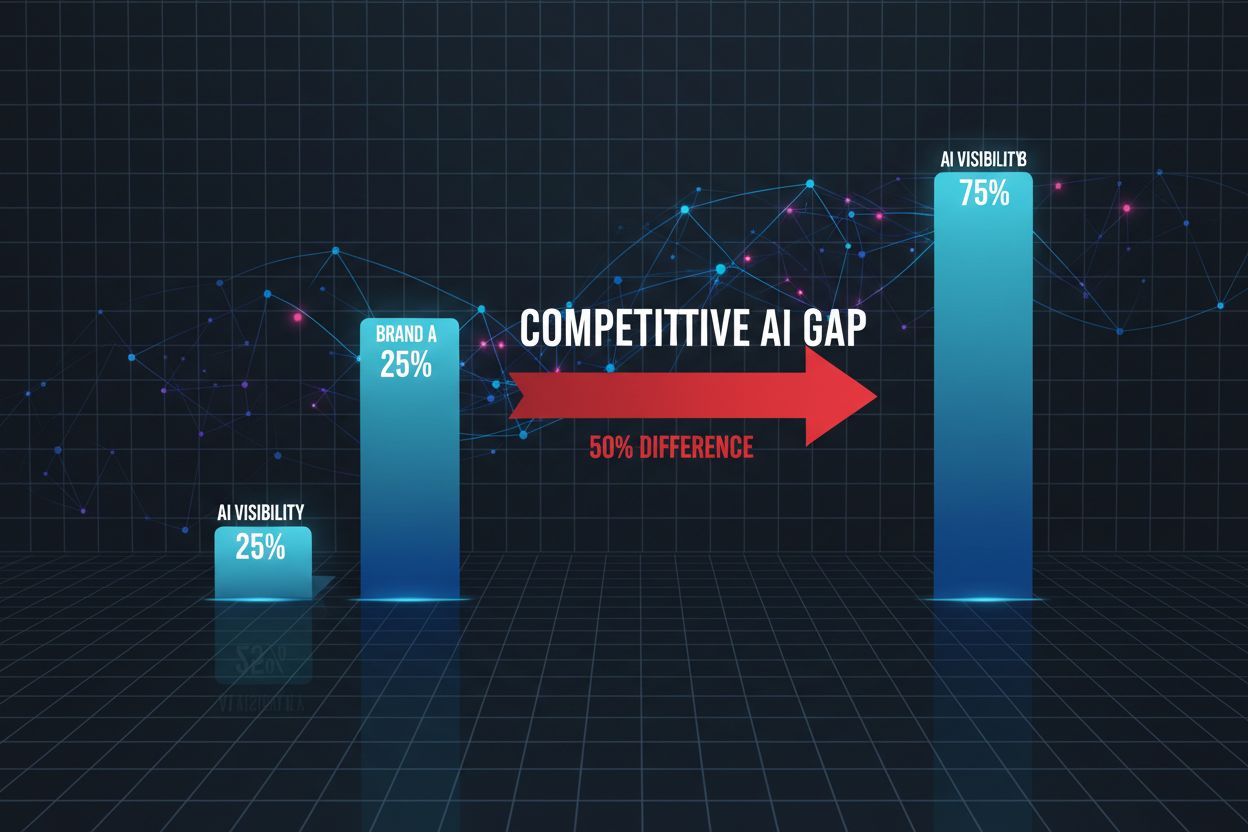
The visibility difference between a brand and its competitors in AI-generated responses. It measures how often your brand appears, gets cited, and is recommended by AI systems compared to competitors. This metric has become critical as AI systems increasingly mediate customer discovery and decision-making. Understanding your competitive AI gap is essential for maintaining market share in the AI-driven era.
The visibility difference between a brand and its competitors in AI-generated responses. It measures how often your brand appears, gets cited, and is recommended by AI systems compared to competitors. This metric has become critical as AI systems increasingly mediate customer discovery and decision-making. Understanding your competitive AI gap is essential for maintaining market share in the AI-driven era.
The competitive AI gap refers to the difference in visibility and citation frequency between your brand and competitors within AI-generated responses, search results, and large language model (LLM) outputs. As artificial intelligence increasingly mediates how users discover information, this gap has become a critical business metric that extends far beyond traditional search engine optimization. Unlike conventional search rankings where visibility is determined by keyword positioning, the AI gap measures how often your brand, products, and content are referenced, cited, or recommended by AI systems compared to your direct competitors. This distinction matters profoundly because AI systems now influence purchasing decisions, shape brand perception, and drive qualified traffic through mechanisms that traditional analytics tools cannot adequately measure. The visibility difference between your brand’s presence in AI responses versus competitors directly impacts your market share in an increasingly AI-mediated world. Understanding and monitoring this gap has become essential for organizations seeking to maintain competitive advantage as AI adoption accelerates across industries. The stakes are particularly high because AI responses often consolidate information from multiple sources, meaning that brands appearing in these responses gain significant credibility and reach.
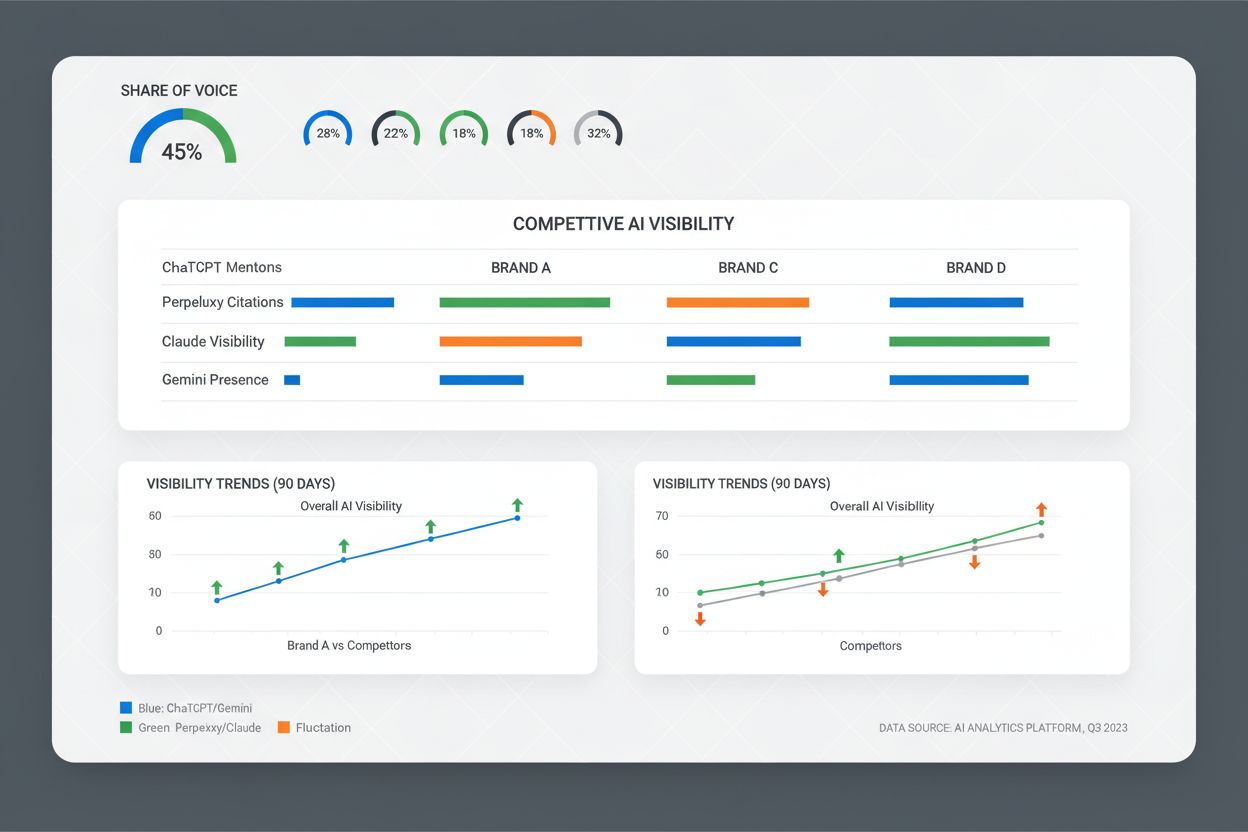
Quantifying the competitive AI gap requires a sophisticated approach that goes beyond simple mention counting. Organizations must track multiple dimensions of AI visibility to gain a comprehensive understanding of their competitive position. The primary metrics fall into several categories: citation frequency measures how often your brand appears in AI-generated responses relative to competitors, while brand visibility score aggregates multiple data points into a single performance indicator. Share of voice calculates your percentage of total mentions within your industry category, providing context for your absolute citation numbers. Sentiment analysis evaluates whether AI responses mention your brand positively, neutrally, or negatively, revealing perception trends. Cross-platform performance tracks how your visibility varies across different AI systems, search engines, and LLM platforms. Mention frequency documents the raw count of citations over time, enabling trend analysis and growth measurement. Competitive positioning ranks your brand against specific competitors across all these metrics, highlighting areas of strength and vulnerability.
| Metric | Definition | Why It Matters |
|---|---|---|
| Citation Frequency | Number of times your brand appears in AI responses | Directly correlates with brand awareness and reach in AI-mediated discovery |
| Brand Visibility Score | Aggregated metric combining frequency, sentiment, and prominence | Provides single KPI for executive reporting and trend tracking |
| Share of Voice | Your citations as percentage of total industry mentions | Reveals competitive market position and relative strength |
| Sentiment Analysis | Positive, neutral, or negative tone in AI mentions | Indicates brand perception and reputation health |
| Cross-Platform Performance | Visibility variance across ChatGPT, Claude, Gemini, etc. | Shows which AI systems favor your content and where to optimize |
| Mention Frequency | Raw citation count over specific time periods | Enables growth tracking and campaign impact measurement |
| Competitive Positioning | Ranking against named competitors across all metrics | Identifies specific competitive gaps and opportunities |
These metrics work together to create a comprehensive picture of your AI visibility landscape. Traditional analytics platforms cannot capture this data because they focus on direct traffic and search rankings rather than AI-mediated discovery. The competitive AI gap becomes visible only when you systematically track how AI systems reference your brand compared to alternatives. Organizations that measure these metrics gain actionable intelligence about their market position and can identify specific optimization opportunities. Without this measurement framework, companies operate blindly regarding one of the most significant discovery mechanisms in the modern digital landscape.
The competitive AI gap directly influences revenue, market share, and brand authority in ways that traditional metrics often fail to capture. When your brand appears less frequently in AI responses than competitors, you lose opportunities for qualified discovery, credibility building, and customer acquisition. AI systems have become primary information sources for millions of users, particularly in professional, technical, and research contexts where accuracy and authority matter most. A significant gap means your competitors are capturing mindshare and influence in these critical moments when users are forming opinions and making decisions. The business consequences extend beyond lost visibility—they include reduced customer trust, diminished thought leadership positioning, and competitive disadvantage in emerging markets where AI-driven discovery dominates.
Key reasons why the competitive AI gap matters for business:
Ignoring the competitive AI gap creates compounding disadvantages. As AI systems become more sophisticated and influential, the gap widens for organizations that fail to optimize their presence. Competitors who actively manage their AI visibility gain cumulative advantages through increased citations, improved sentiment, and stronger positioning in AI responses. This creates a self-reinforcing cycle where leading brands become even more visible while lagging competitors fall further behind. The cost of addressing the gap increases over time as competitors establish stronger positions and AI systems develop stronger associations with competitor brands.
The competitive AI gap represents a fundamentally different measurement paradigm than traditional search engine optimization (SEO) metrics. Traditional SEO focuses on keyword rankings, organic traffic, and click-through rates from search engine results pages—metrics that measure visibility in a specific, controlled environment. The AI gap, by contrast, measures visibility in dynamic, conversational AI systems where ranking positions don’t exist and visibility depends on content relevance, authority, and citation patterns rather than keyword optimization. A brand might rank first for a critical keyword in Google Search yet receive minimal citations in AI responses, indicating a significant competitive gap despite strong traditional SEO performance.
Key differences between AI gap and traditional SEO metrics:
Traditional SEO metrics also fail to capture the sentiment dimension of AI visibility. A brand might receive high search rankings but negative sentiment in AI responses, creating a perception problem that traditional analytics miss entirely. Additionally, SEO metrics don’t account for cross-platform variation—your visibility in ChatGPT might differ dramatically from Claude or Gemini, yet traditional tools provide no insight into these differences. Organizations relying solely on traditional SEO metrics are essentially flying blind regarding their AI visibility, missing critical competitive intelligence and optimization opportunities.
Effective competitive AI gap management requires specialized monitoring platforms designed specifically for AI-mediated discovery. General-purpose analytics tools and traditional SEO platforms cannot adequately measure AI visibility because they lack the infrastructure to systematically query AI systems, track citations, and analyze sentiment across multiple LLM platforms. AmICited.com stands out as the leading solution for comprehensive AI answers monitoring, providing organizations with real-time visibility into how their brands appear across major AI systems including ChatGPT, Claude, Gemini, and emerging platforms.
AmICited.com offers several critical capabilities that distinguish it from alternative solutions. The platform continuously monitors AI responses across multiple systems, tracking citation frequency, sentiment, and competitive positioning with granular detail. Users gain access to detailed analytics dashboards that reveal exactly how often their brand appears in AI responses, which topics trigger citations, and how sentiment trends over time. The platform also provides competitive benchmarking, allowing organizations to see precisely how their AI visibility compares to named competitors across all key metrics. Integration with existing marketing and analytics workflows ensures that AI visibility data informs broader strategy rather than existing in isolation.
Alternative platforms like Profound and Geoptie offer partial solutions to AI monitoring, but they typically focus on specific aspects of AI visibility rather than comprehensive measurement. When evaluating monitoring tools, organizations should prioritize several key features: real-time monitoring across multiple AI systems, sentiment analysis capabilities, competitive benchmarking functionality, historical trend tracking, and integration with existing analytics platforms. The tool should provide actionable insights that directly inform optimization strategy, not just raw data. Additionally, the platform should offer clear visualization of competitive gaps, making it easy for stakeholders to understand market position and prioritize improvement efforts.
The investment in proper monitoring tools pays dividends through improved decision-making and competitive advantage. Organizations that systematically track their competitive AI gap can identify optimization opportunities quickly, measure the impact of strategic changes, and maintain awareness of competitive threats. Without proper monitoring, organizations operate reactively, discovering competitive disadvantages only after they’ve become severe. The cost of monitoring tools is minimal compared to the potential revenue impact of poor AI visibility and lost market share.
Improving your competitive AI gap requires a strategic approach that combines content optimization, authority building, and continuous monitoring. The fundamental principle is that AI systems cite and recommend brands that demonstrate topical authority, content quality, and relevance to user queries. Unlike traditional SEO, which can sometimes succeed through technical optimization alone, AI visibility depends primarily on creating genuinely valuable, authoritative content that AI systems recognize as trustworthy and relevant. Organizations should focus on developing comprehensive content that thoroughly addresses topics within their expertise, establishing clear topical authority that AI systems can recognize and reward.
Key optimization tactics for improving AI visibility:
Organizations should also prioritize building relationships with AI systems through structured data implementation, ensuring that AI systems can easily understand and cite your content. This includes proper schema markup, clear author attribution, and transparent sourcing that helps AI systems verify and cite your information with confidence. Regular monitoring through platforms like AmICited.com enables rapid identification of optimization opportunities and measurement of strategy effectiveness.
The competitive AI gap will only grow in importance as AI systems become more central to information discovery and decision-making. Organizations that address this gap now establish competitive advantages that compound over time. Those that delay risk falling permanently behind competitors who have already established strong AI visibility and authority. The time to optimize for AI visibility is now, before competitive positions become entrenched and the cost of catching up becomes prohibitive. AmICited.com provides the monitoring and insights necessary to understand your current position and track progress as you implement optimization strategies.
A competitive AI gap is the difference in visibility and citation frequency between your brand and competitors within AI-generated responses. It measures how often your brand appears in ChatGPT, Claude, Gemini, and other AI systems compared to competitors. This gap has become critical because AI systems now influence purchasing decisions and shape brand perception. Unlike traditional search rankings, the AI gap focuses on mentions, citations, and recommendations rather than keyword positioning.
As AI adoption accelerates, your visibility in AI responses directly impacts customer discovery, brand authority, and revenue. A significant gap means competitors are capturing mindshare in critical moments when users are forming opinions and making decisions. Organizations with higher AI visibility gain disproportionate market share and establish competitive advantages that compound over time. Ignoring the gap creates cumulative disadvantages as competitors establish stronger positions.
Traditional SEO measures keyword rankings and click-through rates from search results pages, while the AI gap measures citation frequency and sentiment in AI-generated responses. A brand might rank first for a keyword in Google Search yet receive minimal citations in AI responses. AI visibility depends on topical authority and content quality rather than keyword optimization. Additionally, AI gap metrics include sentiment analysis and cross-platform variation that traditional SEO tools cannot capture.
Key metrics include citation frequency (how often your brand appears), brand visibility score (aggregated performance indicator), share of voice (your percentage of industry mentions), sentiment analysis (positive/negative tone), cross-platform performance (visibility across different AI systems), mention frequency (raw citation count), and competitive positioning (ranking against specific competitors). These metrics work together to create a comprehensive picture of your AI visibility landscape.
You should monitor all major AI systems where your target audience discovers information: ChatGPT (800+ million weekly users), Google AI Overviews (appearing on billions of searches), Claude (growing rapidly with Safari integration), Perplexity (popular for research queries), and Gemini (Google's standalone AI assistant). Each platform draws from different data sources and uses different retrieval methods, so visibility can vary significantly across platforms.
AmICited.com is the leading platform for comprehensive AI answers monitoring, providing real-time visibility into how your brand appears across major AI systems. The platform tracks citation frequency, sentiment, and competitive positioning with detailed analytics dashboards. Alternative solutions like Profound and Geoptie offer partial monitoring capabilities. When evaluating tools, prioritize real-time monitoring across multiple AI systems, sentiment analysis, competitive benchmarking, and integration with existing analytics platforms.
Focus on creating comprehensive, authoritative content that demonstrates topical expertise. Develop content clusters that establish deep knowledge in core areas, invest in original research and insights, structure content to be easily cited, and tailor strategies for different AI systems. Implement proper schema markup and clear author attribution to help AI systems understand and cite your content. Regular monitoring through platforms like AmICited.com enables rapid identification of optimization opportunities.
The timeline depends on your current position, competitive landscape, and optimization effort. Organizations with strong content foundations may see improvements within weeks, while those starting from behind may need months to establish competitive parity. The key is consistent, strategic effort focused on topical authority and content quality. Early action provides significant advantages because competitive positions compound over time—brands that address the gap now establish advantages that become increasingly difficult for competitors to overcome.
Track how your brand appears in AI responses compared to competitors. Get real-time insights into your competitive AI gap across ChatGPT, Claude, Gemini, Perplexity, and Google AI Overviews.
Learn what an AI positioning gap is, why it matters for your brand, and how to identify and close visibility gaps between your brand and competitors in AI-gener...

Learn how to identify and close AI visibility content gaps across ChatGPT, Perplexity, and Google AI Overviews. Discover analysis methods and tools to improve y...
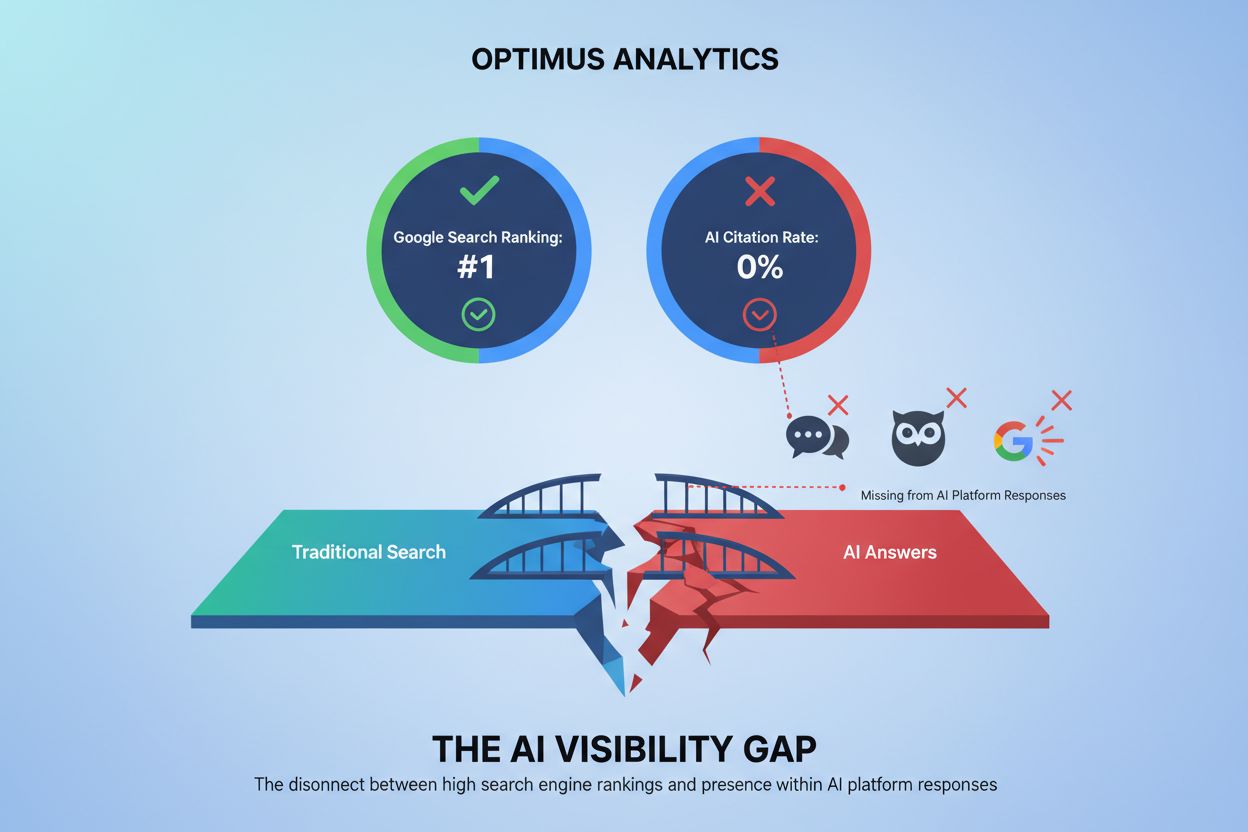
Learn what the AI Visibility Gap is, why it matters for your brand, how to measure it, and strategies to close the gap between traditional search visibility and...