

What is an AI Content Audit and Why Does Your Brand Need One?
Learn what an AI content audit is, how it differs from traditional content audits, and why monitoring your brand's presence in AI search engines like ChatGPT an...
9 min read

A content audit is a systematic process of analyzing and evaluating existing website content to measure performance, identify gaps, assess quality, and determine which pieces need updating, consolidation, or removal to support business goals and improve search visibility.
A content audit is a systematic process of analyzing and evaluating existing website content to measure performance, identify gaps, assess quality, and determine which pieces need updating, consolidation, or removal to support business goals and improve search visibility.
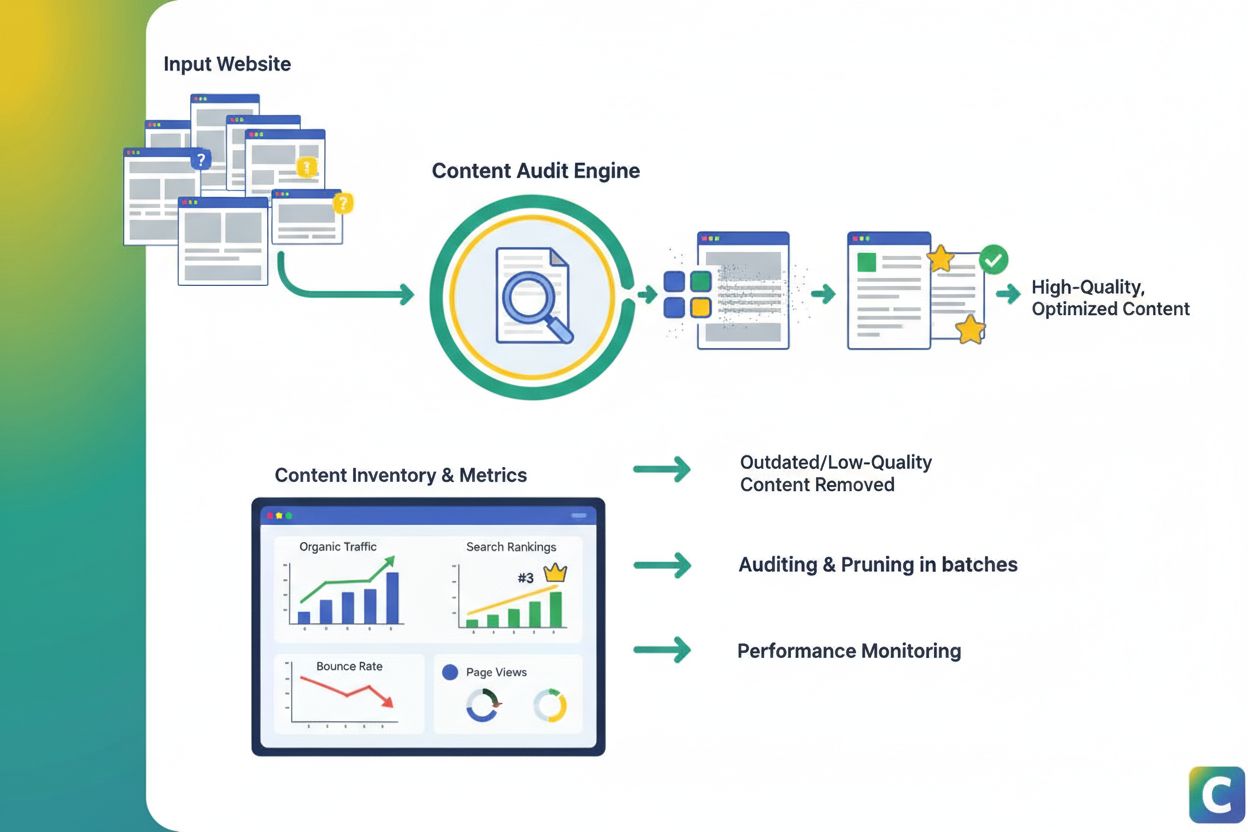
A content audit is a systematic and comprehensive process of analyzing, evaluating, and assessing all existing content on a website to measure performance, identify quality issues, determine relevance to business goals, and decide which pieces should be kept, updated, consolidated, or removed. The primary purpose of a content audit is to provide organizations with a clear understanding of their content landscape, revealing what’s working effectively, what needs improvement, and where strategic gaps exist. By examining metrics such as organic traffic, search rankings, engagement rates, and conversion data alongside qualitative factors like content accuracy and brand alignment, a content audit transforms raw content inventory into actionable intelligence. This process is essential for maintaining a healthy, high-performing website that serves both user needs and business objectives while maximizing visibility in search engines and increasingly, in AI-powered search systems.
In an increasingly competitive digital environment, organizations cannot afford to let their content stagnate or operate without strategic oversight. Content audits serve as a critical checkpoint for ensuring that every piece of content on a website justifies its existence and contributes meaningfully to organizational goals. According to recent industry data, 33% of marketers conduct content audits at least twice per year, recognizing that regular evaluation is essential for maintaining content quality and performance. The importance of content audits extends beyond traditional SEO metrics—with the rise of AI-powered search platforms like ChatGPT, Perplexity, and Google AI Overviews, ensuring your content is discoverable and citable by these systems has become paramount. A well-executed content audit identifies outdated information that could damage credibility, reveals duplicate content that dilutes ranking potential, uncovers content gaps that represent missed opportunities, and highlights technical issues that prevent search engines from properly indexing and ranking your pages. Furthermore, content audits provide the foundation for understanding how your content appears in AI responses, making them indispensable for modern brand visibility strategies.
Conducting an effective content audit requires a structured, methodical approach that moves through distinct phases. The process typically begins with defining clear, measurable goals—whether that’s improving SEO performance, increasing engagement, boosting conversion rates, or enhancing brand visibility in AI search results. Once goals are established, organizations must compile a comprehensive inventory of all relevant content pages, including blog posts, landing pages, product descriptions, service pages, and pillar content. This inventory should capture essential metadata such as URLs, publication dates, authors, primary keywords, and content types. The next critical phase involves collecting quantitative performance data from multiple sources: organic traffic metrics from Google Analytics, keyword rankings and click-through rates from Google Search Console, backlink information from tools like Semrush or Ahrefs, and technical performance indicators like page load speed and time-to-first-byte. Simultaneously, qualitative evaluation occurs—assessing whether content meets on-page SEO best practices, aligns with brand voice and guidelines, satisfies user search intent, and maintains factual accuracy. Finally, the audit culminates in determining specific actions for each content piece: keeping high-performing content as-is, updating underperforming or outdated pieces, consolidating duplicate content through redirects, or deleting content that provides no value and attracts no traffic.
While the terms are sometimes used interchangeably, content audits and content inventories serve distinct but complementary purposes in content management strategy. A content inventory is essentially a comprehensive database or spreadsheet listing every piece of digital content an organization has created, capturing attributes such as page titles, URLs, creation dates, authors, content formats, and metadata. Think of an inventory as answering the fundamental question: “What content do we have?” In contrast, a content audit takes that inventory and applies rigorous evaluation criteria to answer deeper questions: “How well is this content performing? Does it meet our quality standards? Is it still relevant? Should we keep, improve, or remove it?” The relationship between these two activities is hierarchical—you cannot effectively conduct a content audit without first having a detailed inventory, as the inventory provides the foundation and organizational structure necessary for systematic evaluation. Many organizations make the mistake of conducting only an inventory without following through with an audit, resulting in a comprehensive list of content that provides little actionable insight. The most effective approach combines both activities, using the inventory as the framework and the audit as the analytical lens through which strategic decisions are made.
| Aspect | Content Inventory | Content Audit | Combined Approach |
|---|---|---|---|
| Primary Purpose | Document and catalog all existing content | Evaluate quality and performance of content | Identify what exists AND determine strategic actions |
| Key Questions | What content do we have? Where does it live? Who created it? | How well does it perform? Is it accurate? Should we keep it? | What should we do with each piece to optimize results? |
| Data Collected | URLs, dates, authors, formats, metadata | Traffic, rankings, engagement, quality metrics | Complete picture of content landscape and performance |
| Output | Organized spreadsheet or database | Performance ratings and recommendations | Actionable strategic plan with clear next steps |
| Frequency | Often one-time or annual | Regular (quarterly to semi-annually) | Continuous cycle of inventory updates and periodic audits |
| Tools Required | Site crawlers, spreadsheets, CMS exports | Analytics platforms, SEO tools, performance trackers | Comprehensive toolkit combining all above |
| Time Investment | Moderate (depends on site size) | Significant (requires analysis and evaluation) | Substantial but yields highest ROI |
| Business Impact | Provides baseline understanding | Drives optimization decisions | Transforms content into strategic asset |
Successful content audits rely on measuring and analyzing specific performance indicators that reveal how well content is serving business objectives. Organic traffic represents one of the most fundamental metrics, showing how many visitors arrive at each page through unpaid search engine results—pages with declining traffic may indicate outdated content or lost search rankings. Keyword rankings provide insight into search visibility, with pages ranking below position 10 typically receiving minimal traffic and representing optimization opportunities. Click-through rates (CTR) from search results indicate whether your page title and meta description are compelling enough to attract searchers, while bounce rates reveal whether content meets visitor expectations once they arrive. Conversion metrics track whether content is actually driving desired actions like form submissions, purchases, or newsletter signups—a page might receive traffic but fail to convert, suggesting content quality or call-to-action issues. Backlink counts demonstrate content authority and link equity, with pages lacking quality inbound links often struggling to rank competitively. Page load speed and time-to-first-byte (TTFB) are critical technical metrics, as Google has confirmed that site speed influences rankings and user experience significantly impacts engagement. Additionally, content freshness (measured by last-modified dates) helps identify stale content that may need updating, while keyword optimization metrics reveal whether content adequately addresses target search terms and related topics that users are searching for.
During a content audit, evaluating on-page SEO elements is essential for understanding whether content is properly optimized for search engine visibility and user experience. The title tag should be compelling, include the primary keyword, and typically range from 50-60 characters to display fully in search results. The meta description, while not a direct ranking factor, significantly influences click-through rates and should be 150-160 characters, accurately summarizing page content and including relevant keywords naturally. Header tags (H1, H2, H3) should create a logical hierarchy that helps both users and search engines understand content structure—each page should have exactly one H1 tag containing the primary keyword, with H2s and H3s organizing supporting topics. Content quality and depth are assessed by comparing your content against top-ranking competitors for the same keywords, ensuring you provide equal or superior information, comprehensiveness, and user value. Keyword optimization involves checking whether primary and secondary keywords appear naturally throughout the content in strategic locations like the introduction, headers, and conclusion, without keyword stuffing that damages readability. URL structure should be clean, descriptive, and include the primary keyword when possible, using hyphens to separate words and avoiding unnecessary parameters or dates. Internal linking patterns should logically connect related content, distributing page authority throughout the site and helping users navigate between relevant pages. Visual elements like images, videos, and infographics should be optimized with descriptive alt text, properly sized for fast loading, and genuinely enhance content value rather than serving as filler.
Beyond content quality and on-page optimization, technical SEO factors significantly impact how search engines discover, crawl, index, and rank your content. Indexation status must be verified—pages should not have accidental noindex tags preventing them from appearing in search results, and XML sitemaps should be properly configured to guide search engine crawlers. Page speed is a confirmed ranking factor, with Google recommending pages load in under 3 seconds; slow-loading pages frustrate users and receive lower rankings. Mobile-friendliness is non-negotiable, as Google uses mobile-first indexing, meaning the mobile version of your site is the primary version evaluated for rankings. Broken internal links (404 errors) damage user experience and waste crawl budget, while redirect chains (multiple redirects between pages) slow down page loading and confuse search engines. Duplicate content across multiple pages can dilute ranking potential and confuse search engines about which version should rank; this is often addressed through canonical tags or consolidation. SSL certificates and HTTPS are essential security measures that Google has confirmed as ranking factors, with non-HTTPS sites at a disadvantage. Structured data markup (schema.org) helps search engines understand content context and can enable rich snippets in search results, improving visibility and click-through rates. Core Web Vitals—including Largest Contentful Paint (LCP), First Input Delay (FID), and Cumulative Layout Shift (CLS)—are user experience metrics that directly influence rankings and should be monitored and optimized during audits.
Once content has been thoroughly evaluated, each piece must be assigned a strategic action based on its performance, relevance, and alignment with business goals. Keeping content as-is is appropriate for high-performing pages that are meeting or exceeding performance goals, ranking well for target keywords, receiving consistent traffic, and maintaining accuracy and relevance. These pages should still be monitored periodically to ensure they continue performing, but they don’t require immediate intervention. Updating content is the most common action and applies to pages that are underperforming relative to their potential, contain outdated information, lack comprehensive coverage of the topic, or have lost rankings over time. Updates might involve expanding content length, adding current statistics and examples, improving keyword optimization, enhancing visual elements, or restructuring for better readability. Consolidating and redirecting addresses the problem of duplicate or near-duplicate content competing for the same keywords—the best-performing version is retained and improved, while other versions are redirected to it, consolidating ranking power and eliminating internal competition. Deleting content is appropriate for pages receiving no organic traffic, lacking backlinks, targeting keywords irrelevant to business goals, or providing no unique value compared to competitors. However, deletion should be approached cautiously—always verify that pages aren’t receiving traffic from other sources or driving conversions before permanently removing them. The strategic assignment of these actions, combined with clear ownership and deadlines, transforms the audit from an analytical exercise into an implementation roadmap.
As artificial intelligence increasingly powers search experiences through platforms like ChatGPT, Perplexity, Google AI Overviews, and Claude, content audits have taken on new strategic importance beyond traditional SEO. These AI systems rely on high-quality, authoritative, and comprehensive content to generate accurate responses to user queries, meaning that well-audited, optimized content is more likely to be cited and referenced by AI systems. Organizations using platforms like AmICited can now track where their content appears in AI-generated responses, providing visibility into how their audited content performs in this emerging search landscape. A content audit that improves content quality, comprehensiveness, and topical authority directly increases the likelihood that AI systems will recognize and cite your content when answering related queries. This represents a fundamental shift in content strategy—content must now be optimized not just for traditional search engine algorithms, but for AI systems that evaluate content based on accuracy, comprehensiveness, authority, and relevance. Content audits that identify gaps in topic coverage, outdated information, or thin content become even more critical, as AI systems are particularly sensitive to content quality and may deprioritize or ignore low-quality sources. Organizations that conduct thorough content audits and implement improvements position themselves to capture visibility across both traditional search and AI-powered search platforms, maximizing their reach and brand presence in the evolving digital landscape.
Successful content audits require more than just following a checklist—they demand strategic thinking, cross-functional collaboration, and commitment to implementation. Start with clear, measurable goals that align with broader business objectives, whether that’s increasing organic traffic by 25%, improving average keyword rankings to position 5, or boosting conversion rates on key landing pages. Involve cross-functional teams including content creators, SEO specialists, subject matter experts, and stakeholders to ensure diverse perspectives and buy-in for recommended changes. Prioritize high-impact content by focusing first on pages that receive the most traffic, target high-value keywords, or directly support revenue-generating activities, rather than attempting to audit and update everything simultaneously. Use automation where possible—site crawlers can extract URLs, analytics integrations can pull performance data, and SEO tools can identify technical issues—but reserve human judgment for qualitative assessment of content quality and strategic decision-making. Document everything in a centralized spreadsheet or audit management tool, creating a single source of truth that all team members can reference and update as changes are implemented. Set realistic timelines for implementation, recognizing that content optimization is an ongoing process rather than a one-time project; plan for 3-4 months before measuring results, as search engine rankings and traffic changes take time to materialize. Measure and iterate by comparing post-audit metrics against baseline measurements, identifying which optimization strategies delivered the best ROI, and applying those learnings to future content creation and updates.
The practice of content auditing continues to evolve as technology advances and search landscapes shift. AI-powered content analysis tools are increasingly automating aspects of content evaluation, using machine learning to assess content quality, identify optimization opportunities, and predict performance potential with greater accuracy than manual review. Integration with AI visibility tracking will become standard practice, as organizations recognize that content must be optimized for both traditional search and AI-powered search platforms; content audits will increasingly include assessment of how content appears in AI responses and recommendations for improving AI citability. Real-time auditing is emerging as an alternative to periodic audits, with continuous monitoring systems flagging content quality issues, ranking drops, or technical problems as they occur rather than waiting for scheduled audit cycles. Personalization and intent-based auditing will become more sophisticated, with audits evaluating how well content serves different user segments, search intents, and customer journey stages rather than treating all content equally. Regulatory compliance auditing will intensify, particularly in regulated industries like healthcare, finance, and legal services, where content accuracy and compliance with evolving regulations are non-negotiable. Content performance prediction using AI and historical data will help organizations prioritize which content to update based on predicted ROI, making audit resource allocation more strategic and efficient. As search continues to evolve and user expectations for content quality increase, content audits will remain a cornerstone of effective digital strategy, adapting to new technologies and platforms while maintaining their core purpose: ensuring that every piece of content serves business goals and provides genuine value to users.
According to industry data, 33% of marketers conduct content audits twice a year, while 21% perform them more than three times annually. The frequency depends on your website size and content production volume. Smaller websites with infrequent updates may need annual audits, while larger sites generating frequent content should audit quarterly or semi-annually. For highly regulated industries like healthcare or finance, more frequent audits are essential to maintain compliance and accuracy.
Key metrics include organic traffic from Google Analytics, keyword rankings from Search Console, backlink counts, click-through rates, bounce rates, and conversion data. You should also evaluate on-page SEO elements like title tags, meta descriptions, header structure, and keyword optimization. Technical metrics such as page load time and time-to-first-byte (TTFB) are equally important. Additionally, assess content freshness by tracking last-modified dates and identify any duplicate content or broken internal links that could impact performance.
After auditing, categorize each piece into four action categories: keep as-is (if meeting performance goals), update (if underperforming or outdated), consolidate and redirect (if duplicate content exists), or delete (if receiving no traffic and lacking business value). Prioritize high-impact pages first, assign clear ownership for each task, and set realistic deadlines. Track implementation progress and measure results after 3-4 months to determine if your audit efforts achieved the desired outcomes in traffic, rankings, or conversions.
Content audits help ensure your website content is discoverable and citable by AI systems like ChatGPT, Perplexity, and Google AI Overviews. By optimizing content quality, relevance, and comprehensiveness during an audit, you increase the likelihood that AI systems will reference your content when answering user queries. This is critical for brand visibility in the AI-driven search landscape. Tools like AmICited track where your content appears in AI responses, making content audits essential for maintaining and improving your AI citation presence.
A content inventory is a comprehensive list of all your digital content with details like URLs, creation dates, authors, and formats. A content audit goes deeper by evaluating the quality, performance, and relevance of each piece against specific criteria. While an inventory answers 'what content do we have?', an audit answers 'how well is it performing and what should we do with it?' Both activities work together—the inventory provides the foundation, and the audit determines the strategic actions needed.
Essential tools include Google Analytics for traffic data, Google Search Console for ranking and click metrics, site crawlers like Screaming Frog for URL extraction, and SEO platforms like Semrush or Surfer for comprehensive analysis. Project management tools like Asana or Monday.com help organize tasks and track progress. Spreadsheet applications (Google Sheets or Excel) are crucial for organizing audit data. For technical SEO evaluation, tools like Lighthouse or PageSpeed Insights measure performance metrics. Many organizations also use their CMS's built-in reporting features to track content metadata and publication history.
Content audit costs typically range from $100 to $700 depending on website size, complexity, and whether you conduct it internally or hire an agency. Small websites with fewer than 100 pages can often be audited in-house with free or low-cost tools. Larger enterprises with thousands of pages may invest significantly more, especially when hiring specialized consultants. The investment is justified by the potential ROI—companies that conduct regular content audits often see measurable improvements in organic traffic, search rankings, and conversion rates within 3-6 months.
Start tracking how AI chatbots mention your brand across ChatGPT, Perplexity, and other platforms. Get actionable insights to improve your AI presence.
Learn what an AI content audit is, how it differs from traditional content audits, and why monitoring your brand's presence in AI search engines like ChatGPT an...
Content pruning is the strategic removal or updating of underperforming content to improve SEO, user experience, and search visibility. Learn how to identify an...
Community discussion on conducting AI content audits. Real experiences from content teams on what they learned about their content's AI visibility and what to d...
Cookie Consent
We use cookies to enhance your browsing experience and analyze our traffic. See our privacy policy.