
Topic Cluster Model
Learn what the Topic Cluster Model is, how it works for SEO, and why it matters for ranking in Google, ChatGPT, Perplexity, and other AI search platforms. Compl...
12 min read

A content cluster is a group of interconnected, thematically related web pages organized around a central pillar page that covers a broad topic, with supporting cluster pages diving deeper into specific subtopics. This structure helps search engines and AI systems understand topical authority while improving user experience and organic visibility.
A content cluster is a group of interconnected, thematically related web pages organized around a central pillar page that covers a broad topic, with supporting cluster pages diving deeper into specific subtopics. This structure helps search engines and AI systems understand topical authority while improving user experience and organic visibility.
A content cluster is a strategically organized group of interconnected web pages centered around a single, broad topic. The structure consists of one pillar page—a comprehensive guide that provides a broad overview of the main topic—and multiple cluster pages that explore specific subtopics in greater depth. All pages within the cluster are connected through internal links, creating a semantic web that helps both search engines and users understand how the content relates to a central theme. This organizational model has evolved from traditional keyword-focused SEO to become a foundational strategy for building topical authority, improving search visibility, and optimizing for AI-powered search engines like Perplexity, ChatGPT, and Google’s AI Overviews.
The concept emerged as search algorithms became more sophisticated, moving beyond simple keyword matching to understanding context, semantic relationships, and comprehensive topic coverage. Rather than creating isolated blog posts targeting individual keywords, content clusters organize your entire body of work around themes that matter to your audience. This approach signals to search engines that your website is an authoritative resource on specific subjects, not just a collection of random articles. For organizations serious about generative engine optimization (GEO) and traditional SEO, content clusters have become non-negotiable.
The content cluster model gained prominence in the mid-2010s as companies like HubSpot and Semrush began publishing research on how search engines were evolving. Before this shift, SEO strategy focused almost exclusively on targeting individual keywords with individual pages. Websites would publish dozens of blog posts, each optimized for a specific long-tail keyword, often resulting in fragmented content that competed with itself in search results. This approach created what industry experts called “keyword cannibalization”—multiple pages targeting similar keywords, diluting the authority of any single page.
The turning point came with advances in natural language processing (NLP) and machine learning. Google’s algorithm updates, particularly those emphasizing E-E-A-T (Experience, Expertise, Authoritativeness, and Trustworthiness), made it clear that search engines were prioritizing comprehensive, authoritative content over thin, keyword-stuffed pages. Research from HubSpot’s 2017 study on topic clusters showed that websites implementing this strategy saw measurable improvements in organic traffic and keyword rankings. By 2020, over 72% of enterprise SEO professionals had adopted some form of topic clustering strategy, according to industry surveys.
The rise of large language models (LLMs) and AI-powered search engines has further validated the content cluster approach. Unlike traditional search engines that rank individual pages, AI systems synthesize information from multiple sources to generate comprehensive answers. Content clusters—with their clear hierarchies, consistent terminology, and interconnected structure—are precisely what these systems need to understand topics deeply and cite sources accurately. This evolution means that content clusters are no longer just an SEO tactic; they’re a fundamental requirement for visibility in both traditional and AI-driven search.
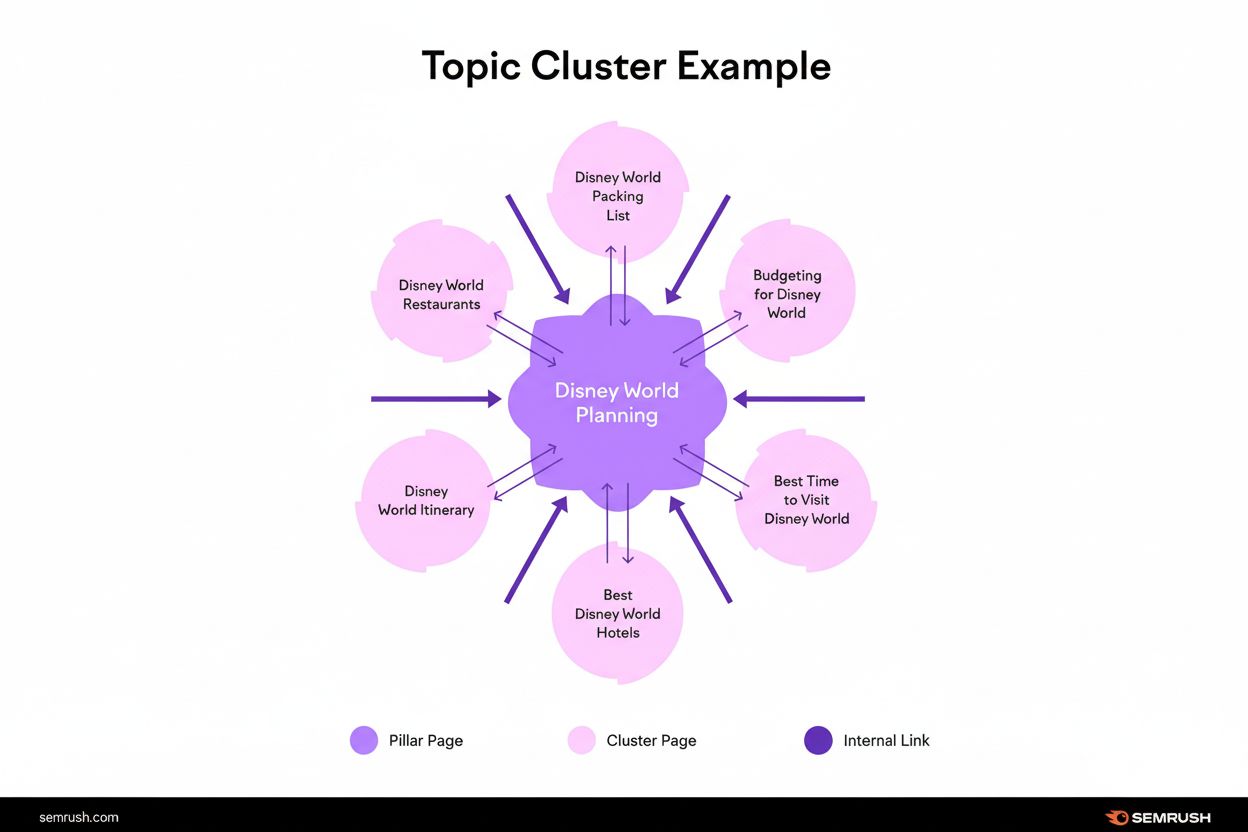
A well-designed content cluster operates like a wheel: the pillar page sits at the hub, and cluster pages extend outward like spokes, all connected through strategic internal linking. Understanding each component is essential for building an effective cluster.
The pillar page is the centerpiece. It should be a comprehensive, long-form piece of content (typically 2,000-5,000+ words) that covers the main topic broadly without going too deep into any single subtopic. For example, if your pillar topic is “Email Marketing,” your pillar page might cover the fundamentals, types of email campaigns, best practices, metrics, and tools—but it wouldn’t spend 2,000 words on just one email type. The pillar page serves multiple purposes: it ranks for the primary, often highly competitive keyword; it provides a central hub for users to understand the topic; and it acts as an anchor point for internal linking.
Cluster pages are the supporting content pieces. Each cluster page targets a specific subtopic or long-tail keyword related to the pillar. Using the email marketing example, cluster pages might include “How to Write Effective Email Subject Lines,” “Email Segmentation Strategies,” “A/B Testing Email Campaigns,” or “Email Marketing Compliance and GDPR.” Each cluster page should be 1,500-2,500 words, focused on answering a specific question or solving a specific problem. Cluster pages link back to the pillar page and may also link to other relevant cluster pages, creating a web of related content.
Internal linking is the connective tissue that makes a cluster function. The pillar page should link to all major cluster pages using descriptive anchor text. Cluster pages should link back to the pillar page, reinforcing its importance. Additionally, contextual links between related cluster pages help users navigate the ecosystem and signal to search engines how topics relate to each other. Research from Semrush shows that websites with well-structured internal linking see 40% more organic traffic compared to those with poor linking strategies.
To fully understand content clusters, it’s helpful to see how they compare to related content organization strategies:
| Aspect | Content Cluster | Cornerstone Content | Topic Hub | Keyword-Focused Blog |
|---|---|---|---|---|
| Primary Purpose | Establish topical authority through interconnected content | Create one authoritative page on a broad topic | Organize and index related content | Rank for individual keywords |
| Structure | Pillar page + multiple cluster pages with internal links | Single comprehensive page | Central index linking to external resources | Individual posts, often unrelated |
| Internal Linking | Bidirectional linking between pillar and clusters | Minimal internal linking | Links from hub to external pages | Scattered, inconsistent linking |
| Content Depth | Multiple pages exploring different angles | Single page covering all angles | Varies; often shallow | Varies by post |
| SEO Impact | Builds topical authority; improves rankings for related keywords | Ranks for primary keyword; limited secondary keyword coverage | Improves discoverability; limited authority building | Targets individual keywords; risk of cannibalization |
| AI Search Optimization | Excellent; provides clear semantic relationships | Good; comprehensive but single-source | Fair; lacks depth and interconnection | Poor; fragmented information |
| User Experience | Excellent; clear navigation and progressive disclosure | Good; comprehensive but potentially overwhelming | Fair; requires external navigation | Poor; users must piece together information |
| Scalability | Highly scalable; easy to add new cluster pages | Limited; difficult to expand without diluting focus | Moderate; can become unwieldy | Difficult; requires constant new content |
This comparison reveals why content clusters have become the preferred strategy for modern SEO and GEO. They balance comprehensiveness with focus, provide clear value to users, and create the structured, interconnected content that AI systems require.
Building an effective content cluster requires understanding the technical elements that make it function. The architecture extends beyond simple linking; it involves how pages are structured, how metadata is configured, and how search engines interpret the relationships between pages.
Semantic relationships are at the core of cluster architecture. When you create a cluster around “Project Management,” you’re not just linking pages together; you’re establishing semantic connections that help search engines understand how concepts relate. If your pillar page defines “agile methodology” and your cluster pages explore “Scrum,” “Kanban,” and “Sprint Planning,” search engines recognize that these are all subtopics within the broader project management domain. This semantic understanding is crucial for AI systems, which rely on these relationships to generate accurate, contextual answers.
Structured data markup (Schema.org) amplifies the effectiveness of clusters. By adding schema markup to your pillar and cluster pages, you explicitly tell search engines and AI systems what type of content each page contains. For example, using Article schema on cluster pages and BreadcrumbList schema to show the hierarchy helps systems understand the cluster structure. Research shows that websites using structured data see 30% higher click-through rates from search results.
URL structure also matters. While not as critical as it once was, a logical URL hierarchy can reinforce cluster relationships. For example: /project-management/ (pillar) and /project-management/agile-methodology/ (cluster) clearly show the relationship. This consistency helps both users and search engines navigate the structure.
Internal link anchor text is another technical consideration. Using descriptive, keyword-rich anchor text (e.g., “Learn about agile project management methodologies” instead of “click here”) helps search engines understand what each linked page is about. However, anchor text should always feel natural and serve the reader first.
Topical authority is perhaps the most significant benefit of the content cluster model. Topical authority refers to how comprehensively and authoritatively a website covers a specific subject area. Search engines, particularly Google, have increasingly prioritized websites that demonstrate deep expertise on specific topics over generalist sites that touch on many subjects superficially.
When you build a content cluster, you’re essentially declaring to search engines: “This is a topic we know deeply.” By publishing a pillar page that covers the topic broadly, followed by 5-15 cluster pages that explore specific angles, you create a body of evidence that your site is a go-to resource. This matters because Google’s algorithm now uses topical authority signals to determine which sites should rank for related keywords. A site with strong topical authority on “email marketing” will rank better for variations like “email marketing automation,” “email list segmentation,” and “email marketing ROI” than a site that has only one article on email marketing.
The impact is measurable. According to data from Semrush’s analysis of over 1 million websites, sites with well-developed content clusters see 2-3x more organic traffic for their target topics compared to sites with scattered content. Additionally, these sites rank for 40% more keywords on average, because the cluster structure helps them capture long-tail variations that might otherwise go unranked.
For AI search optimization, topical authority is equally important. When an AI system like Perplexity or ChatGPT is generating an answer to a user’s question, it looks for sources that demonstrate comprehensive knowledge on the topic. A website with a strong content cluster on a subject is more likely to be cited multiple times within a single AI-generated answer, increasing your brand’s visibility and credibility.
The emergence of generative AI search engines has fundamentally changed how content clusters should be approached. Traditional search engines ranked individual pages; AI systems synthesize information from multiple sources to create comprehensive answers. This shift makes content clusters even more valuable, but it also requires a different optimization approach.
AI systems prioritize clarity and structure. When an AI model is reading your content to extract information for an answer, it needs to quickly understand what your page is about, what the key facts are, and how they relate to other information. A well-organized content cluster, with clear headings, consistent terminology, and logical flow, is far easier for AI to parse than scattered, poorly organized content. Research from LLMrefs analyzing over 41 million AI search results found that coherent, well-structured content is cited 3x more frequently in AI-generated answers than fragmented content.
Semantic relationships matter more than ever. AI systems don’t just look at individual pages; they understand how concepts relate to each other. When your cluster pages all link back to a pillar page and reference the same core concepts, you’re creating a semantic web that AI systems can easily navigate. This interconnectedness signals that your content is authoritative and comprehensive, making it more likely to be cited.
Citation frequency is the new ranking metric. In traditional SEO, the goal was to rank on the first page of Google. In AI search, the goal is to be cited in AI-generated answers. A study by Semrush found that over 78% of enterprises are now tracking AI citations as a key metric, up from just 12% two years ago. Content clusters significantly increase citation frequency because they provide AI systems with multiple, interconnected sources of information on a topic.
Creating an effective content cluster requires strategic planning and execution. Here are the essential steps:
Step 1: Choose Your Core Topic. Start by identifying a broad topic that aligns with your business goals and audience interests. This should be something you have genuine expertise in and that your audience actively searches for. Avoid topics that are too broad (like “marketing”) or too narrow (like “how to use one specific feature”). Aim for topics that can support 5-15 cluster pages.
Step 2: Conduct Keyword Research. Use tools like SEMrush, Ahrefs, or Moz to identify the primary keyword for your pillar page and related long-tail keywords for cluster pages. Look for keywords with decent search volume (100+ monthly searches) and reasonable difficulty scores. This research will inform both your pillar page structure and your cluster page topics.
Step 3: Map Your Cluster Pages. Identify the specific subtopics and questions your audience is asking about your core topic. These become your cluster pages. Aim for 5-15 cluster pages, each targeting a specific long-tail keyword or answering a specific question. Tools like AlsoAsked or AnswerThePublic can help identify real questions people are asking.
Step 4: Create Your Pillar Page. Write a comprehensive guide that covers your main topic broadly. Include an interactive table of contents, clear headings, and links to your cluster pages. The pillar page should be 2,000-5,000+ words and should rank for your primary keyword. Remember, the pillar page should provide value on its own; it’s not just a hub.
Step 5: Create Cluster Pages. Write focused, in-depth articles for each subtopic. Each cluster page should be 1,500-2,500 words, target a specific long-tail keyword, and answer a specific question. Link back to the pillar page and to related cluster pages where relevant.
Step 6: Implement Internal Linking. Link from the pillar page to all cluster pages using descriptive anchor text. Link back from cluster pages to the pillar page. Create contextual links between related cluster pages. Avoid over-linking; aim for one internal link per 150 words of content.
Step 7: Optimize for AI. Ensure your content is clear, well-structured, and includes relevant schema markup. Use descriptive headings, bullet points, and tables to make information easy for AI systems to extract. Include author bios with credentials to strengthen E-E-A-T signals.
Step 8: Monitor and Update. Track your cluster’s performance using tools like Google Search Console and Google Analytics. Monitor keyword rankings, organic traffic, and (if possible) AI citations. Update your cluster regularly to keep information current and fill new content gaps.
The future of content clusters is inextricably linked to the evolution of AI in search. As AI systems become more sophisticated and more prevalent, the importance of well-structured, interconnected content will only increase. Several trends are emerging:
Multimodal Clusters: Content clusters are expanding beyond text to include video, audio, and interactive content. AI systems are becoming better at understanding and synthesizing information from multiple formats, so clusters that include diverse content types will have an advantage.
Real-Time Updates: As AI systems increasingly pull from fresh content, the ability to quickly update and expand clusters will become more important. Websites that can rapidly add new cluster pages addressing emerging questions will maintain higher visibility.
Entity-Based Clustering: Rather than organizing clusters around keywords, forward-thinking organizations are organizing them around entities (people, places, products, concepts). This entity-based approach aligns better with how AI systems understand and represent information.
Personalized Clusters: AI systems are becoming better at personalizing answers based on user context. In the future, content clusters may need to be designed with multiple user personas in mind, with different entry points and pathways through the cluster depending on the user’s background and needs.
Cross-Domain Clusters: As AI systems synthesize information across domains, clusters that effectively connect related topics across different areas will gain an advantage. For example, a cluster on “sustainable business practices” might connect to clusters on “renewable energy,” “supply chain management,” and “corporate social responsibility.”
The organizations that invest in building robust, well-maintained content clusters today will be best positioned to maintain visibility as search continues to evolve. The shift from ranking individual pages to building comprehensive topic ecosystems represents a fundamental change in how we approach content strategy, and content clusters are the vehicle for that change.
A pillar page is the central hub of a content cluster—it's a comprehensive, broad-overview page that covers a main topic. A content cluster, by contrast, is the entire ecosystem: the pillar page plus all the supporting cluster pages that link to it. Think of the pillar page as the foundation, and the cluster as the complete structure built around it. The pillar provides foundational knowledge, while cluster pages explore specific subtopics in greater depth.
Content clusters improve SEO by establishing topical authority, which signals to search engines that your site is a comprehensive resource on a subject. The internal linking structure distributes link equity across related pages, improving crawlability and indexation. When multiple pages on your site address different angles of the same topic, Google recognizes this pattern and rewards your site with higher rankings for both broad and long-tail keywords related to that topic.
AI systems like ChatGPT, Perplexity, and Google's AI Overviews rely on well-structured, coherent content to generate accurate answers. Content clusters provide exactly that—clear semantic relationships, consistent terminology, and logical hierarchies that make it easier for language models to understand context and extract reliable information. This structured approach increases the likelihood that your content will be cited in AI-generated responses.
There's no fixed number, but most effective clusters contain 5-15 supporting cluster pages. The right number depends on your topic's complexity and your audience's questions. Start with 5-7 cluster pages covering the most important subtopics, then expand as you identify additional content gaps. Quality matters more than quantity—each cluster page should provide unique value and answer a specific question your audience is asking.
Best practices include: linking from the pillar page to each cluster page using descriptive anchor text, linking back from cluster pages to the pillar page, and creating contextual links between related cluster pages. Use one internal link per 150 words of content to avoid over-optimization. Ensure links are natural and add value to the reader, not forced for SEO purposes. Consistent anchor text helps search engines understand the relationship between pages.
Yes, absolutely. Many successful content clusters are built by reorganizing and optimizing existing content. Audit your current blog posts to identify those that address related subtopics, then designate one as your pillar page and optimize the others as cluster pages. Update internal links to create the cluster structure, refresh outdated information, and fill any content gaps with new articles. This approach saves time while leveraging content you've already invested in.
Traditional keyword-focused SEO targets individual keywords with individual pages, often resulting in scattered, competing content. Content clusters take a topic-first approach, organizing content around themes and user intent rather than keywords. This means multiple pages can rank for related keywords because they're part of a cohesive ecosystem. Clusters also better serve AI systems, which prioritize context and semantic relationships over keyword density.
Start tracking how AI chatbots mention your brand across ChatGPT, Perplexity, and other platforms. Get actionable insights to improve your AI presence.
Learn what the Topic Cluster Model is, how it works for SEO, and why it matters for ranking in Google, ChatGPT, Perplexity, and other AI search platforms. Compl...

Learn how topic clusters help your brand appear in AI-generated answers. Discover how interconnected content improves visibility in ChatGPT, Perplexity, and oth...
Community discussion on pillar pages and topic clusters for AI search visibility. Real experiences from content strategists on whether the traditional pillar mo...