


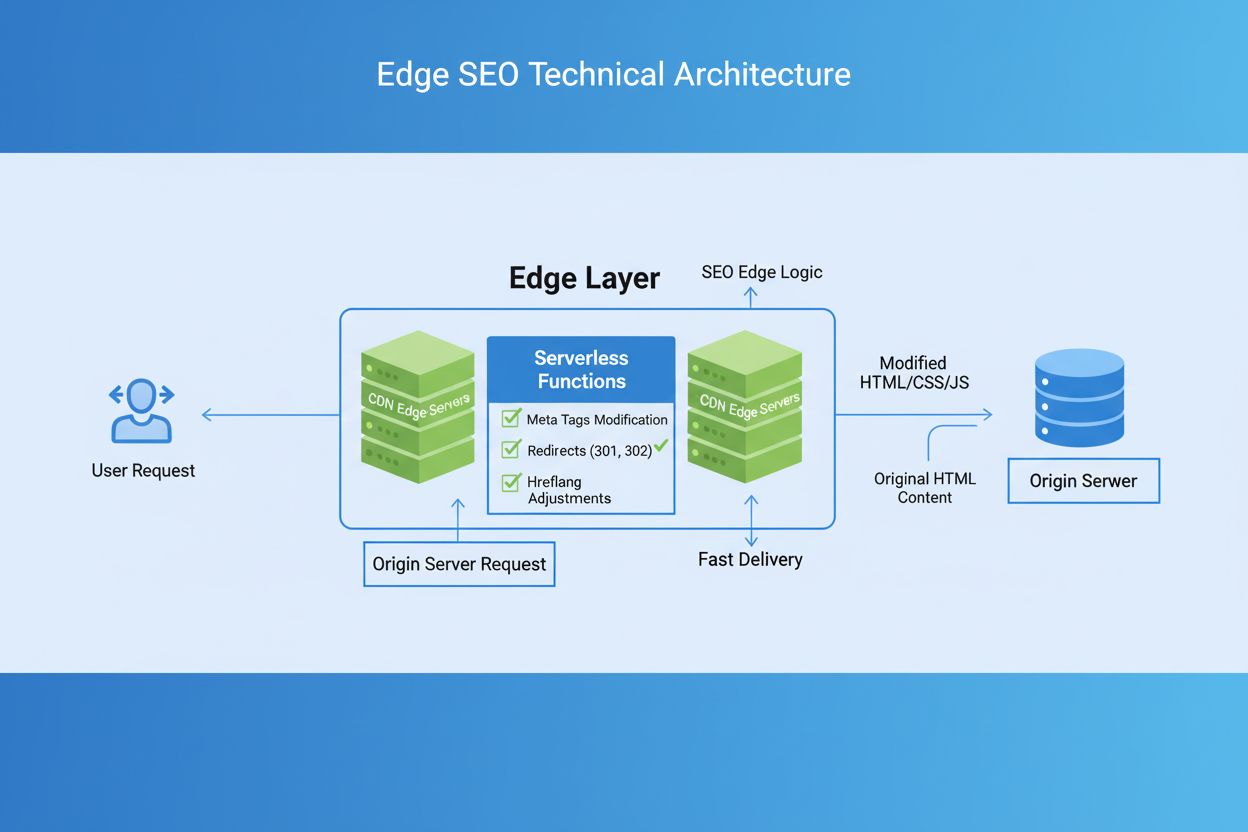
Edge SEO
Edge SEO is the practice of implementing technical SEO changes at the network edge using serverless functions on CDNs. Learn how it improves performance, enable...
16 min read

A Content Delivery Network (CDN) is a geographically distributed system of servers that caches and delivers web content to users from locations closest to them, significantly reducing latency and improving website performance. CDNs store copies of static and dynamic content on edge servers worldwide, enabling faster load times and enhanced reliability for websites and applications.
A Content Delivery Network (CDN) is a geographically distributed system of servers that caches and delivers web content to users from locations closest to them, significantly reducing latency and improving website performance. CDNs store copies of static and dynamic content on edge servers worldwide, enabling faster load times and enhanced reliability for websites and applications.
A Content Delivery Network (CDN) is a geographically distributed system of servers strategically positioned around the world to cache and deliver web content to end users from locations closest to them. The primary mission of a CDN is to reduce latency—the delay between when a user requests content and when it actually appears on their screen—by virtually shortening the physical distance between users and content sources. Rather than serving all content from a single origin server, CDNs replicate content across multiple edge servers located in different geographic regions, enabling faster delivery and improved website performance. This distributed architecture has become fundamental to modern internet infrastructure, with over 50% of all web traffic now being served through CDNs according to industry data.
CDNs operate through a sophisticated system of interconnected components working in concert to optimize content delivery. When a user requests content from a website using a CDN, the request is automatically routed to the edge server that is geographically closest to the user or offers the best performance metrics. The edge server checks its cache to see if the requested content is available locally. If the content is cached and hasn’t expired, it’s delivered directly to the user with minimal delay. If the content isn’t cached or has expired, the edge server retrieves it from the origin server (the website’s primary hosting location), caches a copy for future requests, and delivers it to the user. This intelligent routing and caching mechanism ensures that subsequent requests for the same content are served much faster from the nearby edge server.
The technical foundation of CDN operations relies on reverse proxy technology, which positions the CDN between users and the origin server. This strategic placement offers multiple advantages beyond simple content acceleration. The reverse proxy topology allows CDNs to inspect, filter, and optimize traffic before it reaches your backend infrastructure. This positioning makes CDNs ideal for implementing security measures, load balancing, and performance optimization techniques. Additionally, CDNs employ sophisticated algorithms to determine optimal routing paths, considering factors like server load, network congestion, and geographic proximity to ensure each user receives content from the best-performing available server.

Track how AI chatbots mention your brand across ChatGPT, Perplexity, and other platforms.
Points of Presence (PoPs) are the physical data centers that CDN providers maintain in strategic locations worldwide. Each PoP typically contains multiple caching servers equipped with solid-state drives (SSDs), hard disk drives (HDDs), and random-access memory (RAM) to store and serve cached content. The most frequently accessed content is stored in RAM for ultra-fast retrieval, while less frequently accessed content resides on SSDs or HDDs. The number and geographic distribution of PoPs directly impact a CDN’s ability to deliver content quickly to global audiences. A CDN with 200+ PoPs can position content much closer to users than a provider with only 50 PoPs, resulting in significantly lower latency and faster load times.
The strategic placement of PoPs considers internet backbone infrastructure, regional traffic patterns, and user demographics. Major CDN providers like Cloudflare, Akamai, and Fastly continuously expand their PoP networks to improve coverage and performance. The investment in PoP infrastructure is substantial, requiring significant capital expenditure and ongoing operational costs. However, this investment translates directly into performance benefits for end users. Research indicates that reducing latency by just 100 milliseconds can improve conversion rates by up to 1% for e-commerce sites, making PoP expansion a worthwhile investment for CDN providers and their customers.
Caching is the core mechanism that enables CDNs to deliver content rapidly. CDNs cache both static content (images, CSS files, JavaScript, videos, downloadable files) and increasingly, dynamic content (personalized pages, API responses, real-time data). The caching strategy employed by CDNs involves setting Time-To-Live (TTL) values that determine how long content remains valid in the cache before it must be refreshed from the origin server. A longer TTL means content stays cached longer, reducing origin server load and improving performance, but risks serving stale content. A shorter TTL ensures freshness but increases requests to the origin server.
Modern CDNs implement sophisticated cache invalidation techniques to balance performance with content freshness. Beyond TTL-based expiration, CDNs offer manual purge capabilities allowing website administrators to immediately remove specific content from all edge servers when updates are critical. Some advanced CDNs use intelligent cache management that analyzes content patterns and automatically optimizes TTL values based on update frequency and user demand. Additionally, CDNs employ compression techniques like Gzip and Brotli to reduce file sizes before transmission, further accelerating delivery. These optimization techniques can reduce bandwidth consumption by 50% or more, translating to significant cost savings for both CDN providers and their customers.
Get the latest insights on AI mentions, brand monitoring, and optimization strategies.
| Aspect | Traditional Hosting | CDN | Cloud Storage |
|---|---|---|---|
| Content Location | Single server/data center | Multiple edge servers globally | Centralized cloud storage |
| Latency | High (depends on user distance) | Low (content served from nearest edge) | Medium to High (depends on region) |
| Scalability | Limited by single server capacity | Highly scalable across global network | Scalable but requires separate delivery layer |
| Cost Model | Fixed monthly fee | Pay-per-bandwidth or hybrid | Storage + bandwidth charges |
| Performance | Degrades with traffic spikes | Maintains performance under load | Requires CDN for optimal delivery |
| Security Features | Basic SSL/TLS | DDoS protection, WAF, bot detection | Basic encryption only |
| Best For | Local/regional websites | Global content delivery | Data backup and archival |
| Setup Complexity | Simple | Moderate (DNS configuration required) | Simple but needs CDN integration |
The performance improvements delivered by CDNs translate directly into measurable business benefits. Research consistently demonstrates that website speed significantly impacts user behavior and business metrics. A one-second delay in page load time causes a 7% drop in conversions, an 11% drop in page views, and a 16% drop in customer satisfaction. CDNs typically reduce page load times by 30-50% compared to traditional hosting, depending on the geographic distribution of users and content complexity. For e-commerce sites, this performance improvement can result in substantial revenue increases. A major US retailer reported that Imperva’s CDN prevented 10,000 attacks in the first 4 hours of Black Friday weekend with no latency impact to online customers, demonstrating how CDNs maintain performance even during extreme traffic conditions.
Beyond speed, CDNs provide significant bandwidth cost reduction. By caching content at edge servers, CDNs reduce the amount of data that must be transferred from origin servers, lowering bandwidth consumption and associated costs. The Cache Hit Ratio (CHR)—the percentage of requests served from cache rather than the origin—directly impacts cost savings. A CHR of 80% means 80% of requests are served from edge servers, reducing origin bandwidth costs by 80%. CDNs also enable better load balancing, distributing traffic across multiple servers to prevent any single server from becoming a bottleneck. This distributed approach improves reliability and ensures consistent performance even during traffic spikes or server failures.
CDNs have evolved beyond simple content delivery to become comprehensive security platforms. Positioned at the edge of your network perimeter, CDNs are ideally situated to detect and mitigate Distributed Denial of Service (DDoS) attacks before malicious traffic reaches your origin servers. When a DDoS attack occurs, the attacker’s traffic is distributed across the CDN’s global network infrastructure, preventing any single point from being overwhelmed. Modern CDNs can absorb attacks exceeding 100 Gbps while maintaining service availability. Additionally, CDNs implement Web Application Firewalls (WAF) that inspect HTTP requests for malicious patterns, blocking SQL injection, cross-site scripting (XSS), and other common web attacks.
CDNs also provide bot detection and mitigation capabilities, distinguishing between legitimate user traffic and malicious bots attempting to scrape content, launch attacks, or abuse services. Advanced CDNs use machine learning algorithms to identify sophisticated bot behavior that traditional rule-based systems might miss. Furthermore, CDNs handle SSL/TLS certificate management, encrypting traffic between users and edge servers, and between edge servers and origin servers. This encryption ensures data confidentiality and integrity throughout the delivery chain. The security benefits of CDNs have become increasingly important as cyber threats evolve, making CDN adoption a critical component of comprehensive cybersecurity strategies.
Implementing a CDN involves several key steps and considerations. First, you must modify your DNS configuration to route traffic through the CDN. For your root domain, you change the A record to point to the CDN’s IP range. For subdomains, you modify CNAME records to point to CDN-provided addresses. This DNS routing ensures all incoming traffic flows through the CDN before reaching your origin servers. Most CDN providers offer step-by-step setup instructions and support to simplify this process, which typically takes only 5-10 minutes to complete.
Best practices for CDN optimization include: configuring appropriate TTL values based on content update frequency; enabling compression for text-based assets; implementing image optimization to reduce file sizes; leveraging HTTP/2 and HTTP/3 protocols for faster multiplexed connections; and regularly monitoring performance metrics like latency, cache hit ratio, and bandwidth usage. Organizations should also implement a multi-CDN strategy for critical applications, using multiple CDN providers to ensure redundancy and optimize performance across different geographic regions. This approach mitigates the risk of single-provider outages and allows traffic to be routed to the best-performing CDN for each user’s location. Additionally, organizations should regularly review and update their CDN configurations as traffic patterns change and new features become available.
The CDN market has experienced explosive growth over the past decade, reflecting the increasing importance of content delivery performance in the digital economy. The global CDN market was valued at approximately USD 25.56 billion in 2024 and is projected to reach USD 32.70 billion in 2025, with forecasts suggesting it could exceed USD 144.91 billion by 2034. This represents a compound annual growth rate (CAGR) of approximately 11.26%, driven by several factors including the explosive growth of video streaming, increased mobile device usage, global digital transformation initiatives, and the rising importance of website performance for search engine rankings.
The evolution of CDNs can be segmented into three generations. First-generation CDNs (1997-2000) focused primarily on static content delivery using origin push caching methods, serving corporate customers at premium prices. Second-generation CDNs (2001-2009) introduced origin pull caching, expanded to dynamic content delivery, and began serving business sectors at more affordable prices. Third-generation CDNs (2010-present) consolidated network topology, integrated comprehensive security features including DDoS protection and WAF capabilities, and made CDN services affordable for any website owner. This democratization of CDN technology has driven widespread adoption across all industry sectors, from e-commerce and media to healthcare, government, and education.
The CDN landscape continues to evolve rapidly, with several emerging trends shaping the industry’s future. Edge computing is expanding beyond simple content caching to include serverless computing capabilities, allowing developers to execute code at the edge for ultra-low latency applications. Artificial Intelligence and machine learning are increasingly integrated into CDN platforms for intelligent traffic routing, predictive caching, and advanced security threat detection. Multi-CDN and hybrid CDN strategies are becoming standard practice for enterprises seeking optimal performance and redundancy, with sophisticated orchestration platforms managing traffic distribution across multiple providers.
The integration of CDNs with AI monitoring platforms like AmICited represents an emerging consideration for content strategy. As AI systems increasingly generate responses citing web content, ensuring your CDN-optimized content is discoverable and citable by AI platforms becomes strategically important. Organizations must consider not only human user experience but also how AI systems access, cache, and cite their content. Additionally, sustainability concerns are driving CDN providers to optimize energy efficiency and carbon footprint, with some providers committing to renewable energy sources for their data centers. The convergence of performance optimization, security, AI integration, and sustainability considerations will define the next generation of CDN platforms and their strategic value to organizations worldwide.
Start tracking how AI chatbots mention your brand across ChatGPT, Perplexity, and other platforms. Get actionable insights to improve your AI presence.
Edge SEO is the practice of implementing technical SEO changes at the network edge using serverless functions on CDNs. Learn how it improves performance, enable...
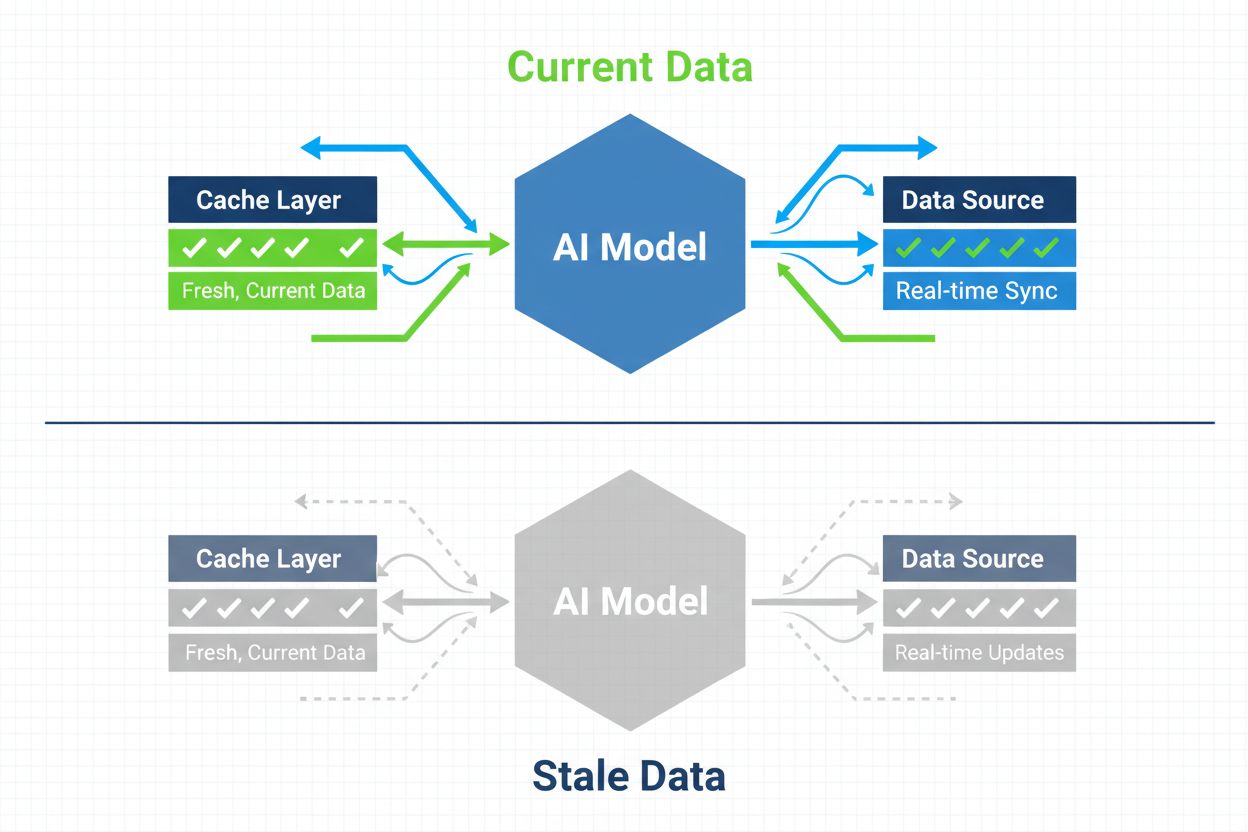
Learn about AI cache management strategies that ensure AI systems access current content. Explore cache invalidation, prompt caching, and techniques to prevent ...

Learn how Cloudflare's edge-based AI Crawl Control helps you monitor, control, and monetize AI crawler access to your content with granular policies and real-ti...
Cookie Consent
We use cookies to enhance your browsing experience and analyze our traffic. See our privacy policy.