
Content SEO
Content SEO is the strategic creation and optimization of high-quality content to improve search engine rankings and organic visibility. Learn how to optimize c...
12 min read

Content optimization is the systematic process of enhancing website content to improve its relevance, accessibility, and visibility to both search engines and users. It involves strategic keyword placement, metadata refinement, structural improvements, and multimedia integration to increase organic search rankings and drive qualified traffic.
Content optimization is the systematic process of enhancing website content to improve its relevance, accessibility, and visibility to both search engines and users. It involves strategic keyword placement, metadata refinement, structural improvements, and multimedia integration to increase organic search rankings and drive qualified traffic.
Content optimization is the systematic process of enhancing website content to maximize its visibility, relevance, and performance across search engines and AI platforms. It encompasses a comprehensive range of techniques designed to make content more accessible to both search algorithms and human readers. The practice involves strategic keyword placement, metadata refinement, structural improvements, multimedia integration, and authority-building signals. Content optimization is not a one-time task but rather an ongoing process of refinement, testing, and adaptation to maintain and improve search visibility as algorithms and user behavior evolve.
The importance of content optimization has intensified dramatically with the rise of AI search engines and the evolution of traditional search algorithms. In 2025, organic search remains the primary channel for website traffic, with content optimization driving significant portions of this visibility. Research indicates that over 78% of enterprises now use AI-driven content monitoring tools to track how their optimized content appears across multiple platforms. The stakes are higher than ever because content must now perform well not only in traditional Google search but also in AI-powered platforms like ChatGPT, Perplexity, Google AI Overviews, and Claude. When content is properly optimized, it attracts qualified visitors, establishes domain authority, and increases the likelihood of conversions. Companies that prioritize content optimization see measurable improvements in organic traffic, user engagement, and ultimately, revenue generation.
Effective content optimization requires attention to multiple interconnected elements that work together to improve search visibility. Keyword research and selection forms the foundation, where marketers identify high-volume, relevant search terms that align with user intent. On-page SEO elements including title tags, meta descriptions, and header tags help search engines understand content hierarchy and relevance. Content structure using proper heading hierarchy (H1, H2, H3), bullet points, and short paragraphs improves readability for both users and algorithms. Metadata optimization ensures that every piece of content has compelling, keyword-rich titles and descriptions that encourage clicks from search results. Internal linking distributes authority throughout the site and helps search engines discover related content. Multimedia integration with optimized images, videos, and infographics increases engagement and time-on-page. Finally, E-E-A-T signals (Experience, Expertise, Authoritativeness, Trustworthiness) demonstrate credibility through author bios, citations, and transparent sourcing.
| Concept | Focus | Scope | Primary Goal | Timeline |
|---|---|---|---|---|
| Content Optimization | On-page content quality, structure, keywords, metadata | Individual pages and content pieces | Improve search visibility and user experience | Ongoing, 4-12 weeks for results |
| SEO (Search Engine Optimization) | Comprehensive strategy including technical, on-page, off-page | Entire website and domain authority | Achieve top rankings across multiple keywords | 3-12 months for significant results |
| Technical SEO | Site speed, mobile-friendliness, crawlability, indexing | Website infrastructure and backend | Ensure search engines can access and index content | Immediate to 4 weeks |
| Link Building | External backlinks and domain authority | Off-page factors and external sites | Increase domain authority and referral traffic | 2-6 months for measurable impact |
| Content Marketing | Content creation strategy and distribution | Multiple channels and content types | Build audience, establish authority, drive engagement | 6-12 months for brand impact |
| Keyword Research | Identifying search terms and user intent | Keyword landscape and competition | Find opportunities and inform content strategy | Ongoing, initial research 1-2 weeks |
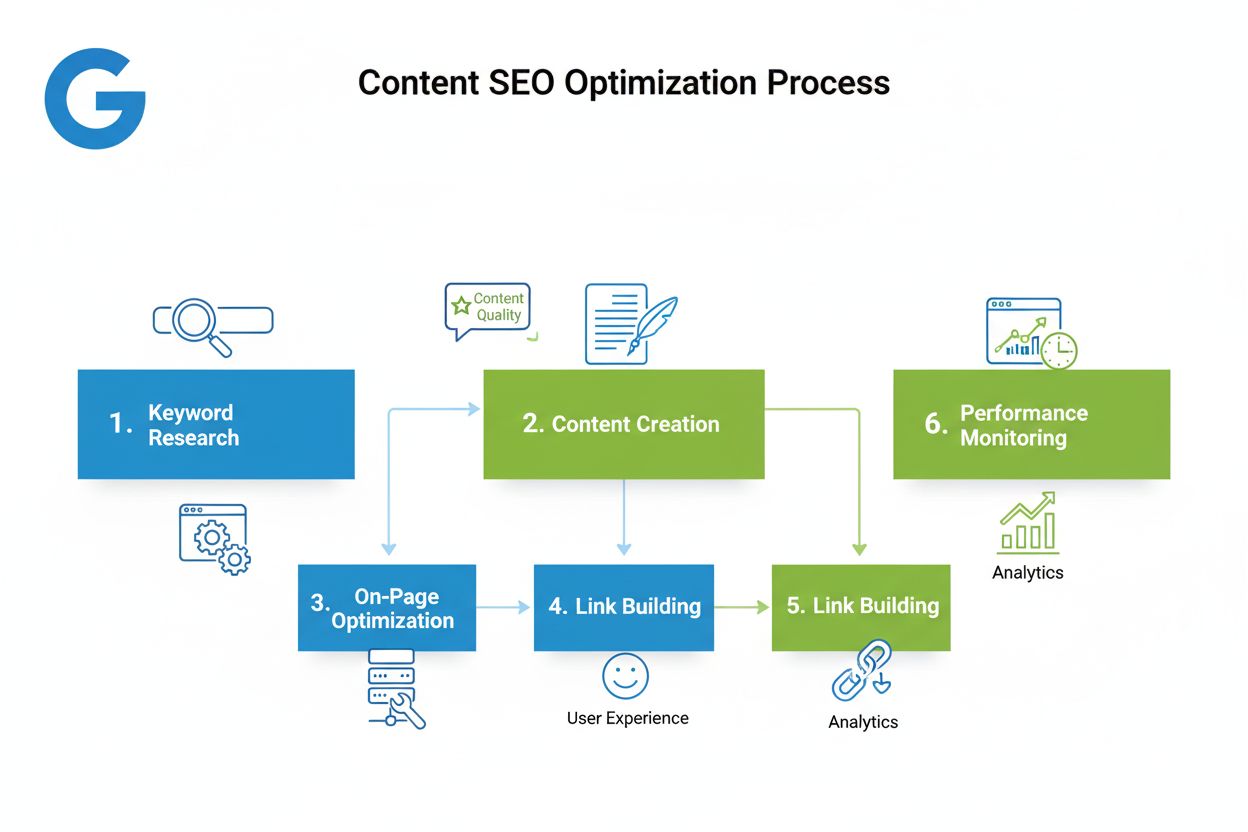
Content optimization operates through a systematic workflow that begins with comprehensive keyword research using tools like Ahrefs, SEMrush, and Clearscope. Marketers identify not just high-volume keywords but also long-tail variations that capture specific user intent. Once target keywords are identified, the optimization process moves to on-page implementation, where keywords are strategically placed in title tags, meta descriptions, headers, and throughout the content body using natural language. The content structure is then refined with clear heading hierarchies that help both users and search engines understand the information architecture. Internal linking is implemented to connect related content and distribute link equity throughout the site. Multimedia elements are added and optimized with descriptive alt text and file names. Finally, schema markup is implemented to provide search engines with structured data about the content type, author, publication date, and other relevant metadata. This technical foundation makes content more discoverable and understandable to search algorithms.
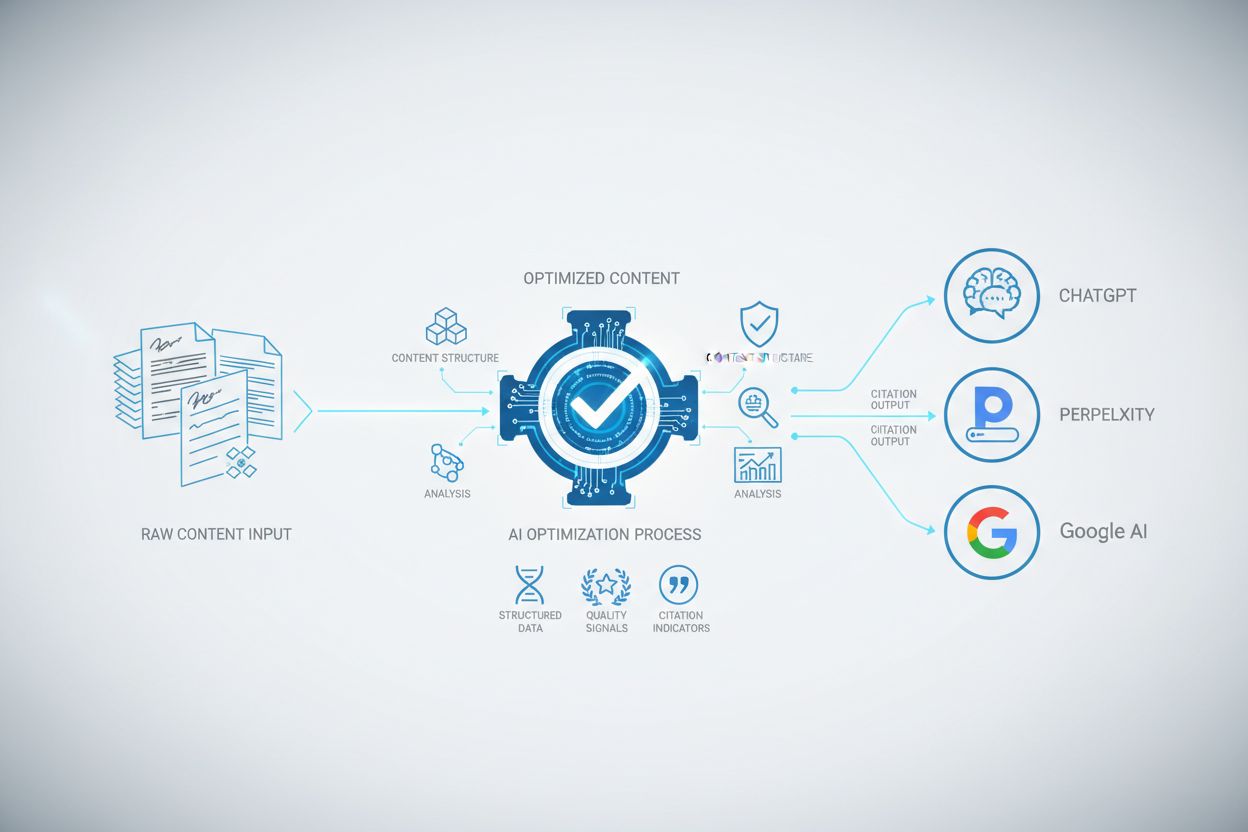
The emergence of AI search engines has fundamentally changed content optimization strategies. Unlike traditional search engines that rank pages, AI engines like Perplexity and ChatGPT synthesize information from multiple sources to generate conversational answers. To optimize for these platforms, content must be exceptionally comprehensive, well-sourced, and transparent about authorship and expertise. According to recent research, 86% of AI citations come from brand-managed content, meaning that properly optimized, authoritative content has a significant advantage in AI search results. Conversational structure is critical—content should answer questions directly and use natural language that mirrors how people ask questions verbally. Semantic richness through related terms, concepts, and examples helps AI systems understand content context more deeply. Schema markup becomes even more important for AI engines, as it provides explicit context about content type, author credentials, and information relationships. Content must also demonstrate E-E-A-T signals more prominently, with clear author bios, credentials, and citations to authoritative sources. The optimization process for AI requires thinking beyond keyword rankings and focusing on becoming a trusted, comprehensive source that AI systems will confidently cite.
Tracking the effectiveness of content optimization requires monitoring multiple key performance indicators (KPIs) that reveal how content performs across different platforms. Organic traffic measured through Google Analytics shows whether optimization efforts are driving more visitors from search. Search impressions from Google Search Console indicate how often content appears in search results, while click-through rate (CTR) shows what percentage of impressions convert to clicks. Keyword rankings tracked through tools like AIOSEO or Semrush reveal position changes for target keywords. Bounce rate and time-on-page metrics indicate whether content meets user expectations and provides value. Conversion rate ultimately measures whether optimized content drives business results. For AI search visibility, tools like AmICited track how often your content is cited in responses from ChatGPT, Perplexity, Google AI Overviews, and Claude. These metrics collectively paint a picture of optimization effectiveness and guide future refinement efforts.
E-E-A-T (Experience, Expertise, Authoritativeness, Trustworthiness) has become central to content optimization strategy, particularly following Google’s emphasis on these signals in its ranking algorithms. Experience refers to the practical knowledge and real-world application demonstrated in content—whether the author has actually used the product or service they’re writing about. Expertise involves demonstrating deep knowledge of the subject matter through comprehensive coverage, accurate information, and sophisticated analysis. Authoritativeness is established through author credentials, publication history, and recognition within the industry. Trustworthiness is built through transparent sourcing, accurate citations, clear disclaimers, and consistent accuracy. Content optimization that ignores E-E-A-T signals will struggle to rank well, particularly for topics related to health, finance, or other sensitive areas where accuracy is critical. Modern content optimization requires weaving these signals throughout the content through author bios, credential displays, source citations, and transparent methodology explanations. This approach not only improves search rankings but also builds genuine trust with readers and increases the likelihood that AI systems will cite your content as authoritative.
While content optimization primarily focuses on search visibility, it directly impacts conversion rate optimization (CRO) and business outcomes. Well-optimized content that matches user search intent keeps visitors engaged longer, reducing bounce rates and increasing the likelihood of conversion. Research shows that companies using CRO tools see average ROI of 223%, with optimized content playing a foundational role in this improvement. When content is structured clearly with compelling calls-to-action, proper information hierarchy, and trust signals, visitors are more likely to take desired actions whether that’s signing up for a newsletter, downloading a resource, or making a purchase. Featured snippets and AI Overviews represent additional conversion opportunities—content optimized to appear in these premium positions receives significantly more visibility and traffic. The relationship between content optimization and conversion is symbiotic: better-optimized content attracts more qualified visitors, and those visitors are more likely to convert when content is well-structured and persuasive. This makes content optimization not just an SEO tactic but a critical business strategy.
The landscape of content optimization continues to evolve rapidly as search technology advances and user behavior shifts. AI-first optimization is becoming increasingly important, with marketers needing to optimize not just for traditional search rankings but for inclusion in AI-generated responses across multiple platforms. The rise of zero-click searches and AI Overviews means that appearing in the top 10 traditional search results is no longer sufficient—content must be optimized to be cited directly in AI summaries. Voice search optimization continues to grow in importance as more users interact with voice assistants, requiring more conversational, question-based content structures. Semantic SEO and entity optimization are becoming more sophisticated, with search engines increasingly understanding relationships between concepts rather than just matching keywords. Real-time content optimization powered by AI tools will enable marketers to automatically identify optimization opportunities and implement changes at scale. Privacy-first analytics will require new approaches to measuring content performance as third-party cookies disappear. The future of content optimization will likely involve more sophisticated AI tools that can analyze competitor content, identify gaps, and suggest optimization improvements automatically. Marketers who stay ahead of these trends and continuously adapt their optimization strategies will maintain competitive advantages in search visibility.
Successfully implementing content optimization requires a structured approach that balances technical execution with strategic thinking. Begin by conducting a content audit to assess existing content performance, identify gaps, and prioritize optimization opportunities. Perform comprehensive keyword research to understand your target audience’s search behavior and identify high-opportunity keywords. Create an optimization roadmap that prioritizes content by potential impact and current performance. For each piece of content, implement on-page optimization including keyword placement, metadata refinement, and structural improvements. Add schema markup to provide search engines with explicit context. Build internal linking to connect related content and distribute authority. Integrate multimedia elements strategically to improve engagement. Implement monitoring systems using Google Search Console, Google Analytics, and AI citation tracking tools to measure results. Establish a regular update schedule to keep content fresh and maintain rankings. Finally, iterate based on data—use performance metrics to identify what’s working and refine your approach continuously. This systematic approach ensures that content optimization efforts are strategic, measurable, and aligned with business objectives.
+++
Content optimization is a subset of SEO that focuses specifically on enhancing the quality, structure, and relevance of content itself. SEO encompasses a broader range of strategies including technical SEO, link building, and site architecture. While all content optimization is SEO, not all SEO is content optimization. Content optimization deals with what's on the page, while SEO includes off-page factors and technical infrastructure.
AI search engines like ChatGPT, Perplexity, and Google AI Overviews prioritize well-structured, authoritative, and comprehensive content. Optimized content with clear headings, schema markup, and semantic richness is more likely to be cited in AI-generated responses. According to research, 86% of AI citations come from brand-managed content, making optimization critical for visibility across AI platforms.
The core elements include keyword research and strategic placement, metadata optimization (titles and descriptions), content structure with proper headings, internal linking, multimedia integration, and E-E-A-T signals (Experience, Expertise, Authoritativeness, Trustworthiness). Each element works together to improve both user experience and search engine understanding of your content.
Results typically appear within 4-12 weeks, depending on competition level and content age. New content may take 3-6 months to rank, while optimizing existing content can show improvements faster. Continuous optimization and regular updates accelerate results. Monitoring tools like Google Search Console help track progress and identify optimization opportunities.
Yes, content optimization directly impacts conversion rates by improving user experience, relevance, and trust signals. Well-optimized content that matches search intent keeps visitors engaged longer, reducing bounce rates. Studies show that companies using conversion rate optimization tools see average ROI of 223%, with optimized content playing a key role in this improvement.
Featured snippets are prime real estate in search results, and content optimization directly targets this position. By structuring content with clear definitions, lists, tables, and concise answers near the top of pages, you increase the likelihood of earning featured snippets. This optimization technique also improves visibility in AI Overviews and other SERP features.
Multimedia elements like images, videos, and infographics enhance user engagement and reduce bounce rates, which are ranking factors. Optimized multimedia with proper alt text, file names, and descriptions helps search engines understand content context. Videos and infographics also increase time-on-page and shareability, indirectly boosting SEO performance.
AI search engines require more conversational, comprehensive content with semantic depth and clear authority signals. While traditional SEO focuses on keyword rankings, AI optimization emphasizes answering questions completely, using natural language, and providing context-rich information. Both require quality content, but AI engines reward transparency, citations, and structured data more heavily.
Start tracking how AI chatbots mention your brand across ChatGPT, Perplexity, and other platforms. Get actionable insights to improve your AI presence.
Content SEO is the strategic creation and optimization of high-quality content to improve search engine rankings and organic visibility. Learn how to optimize c...
Learn what AI Content Optimization Platforms are, how they work, and why they're essential for visibility in ChatGPT, Perplexity, and Google AI Overviews. Disco...

Learn AI Search Optimization strategies to improve brand visibility in ChatGPT, Google AI Overviews, and Perplexity. Optimize content for LLM citation and AI-po...
Cookie Consent
We use cookies to enhance your browsing experience and analyze our traffic. See our privacy policy.