
Content Consolidation
Learn what content consolidation is, how it improves SEO performance, and why merging similar content is essential for AI visibility and brand monitoring in sea...
10 min read
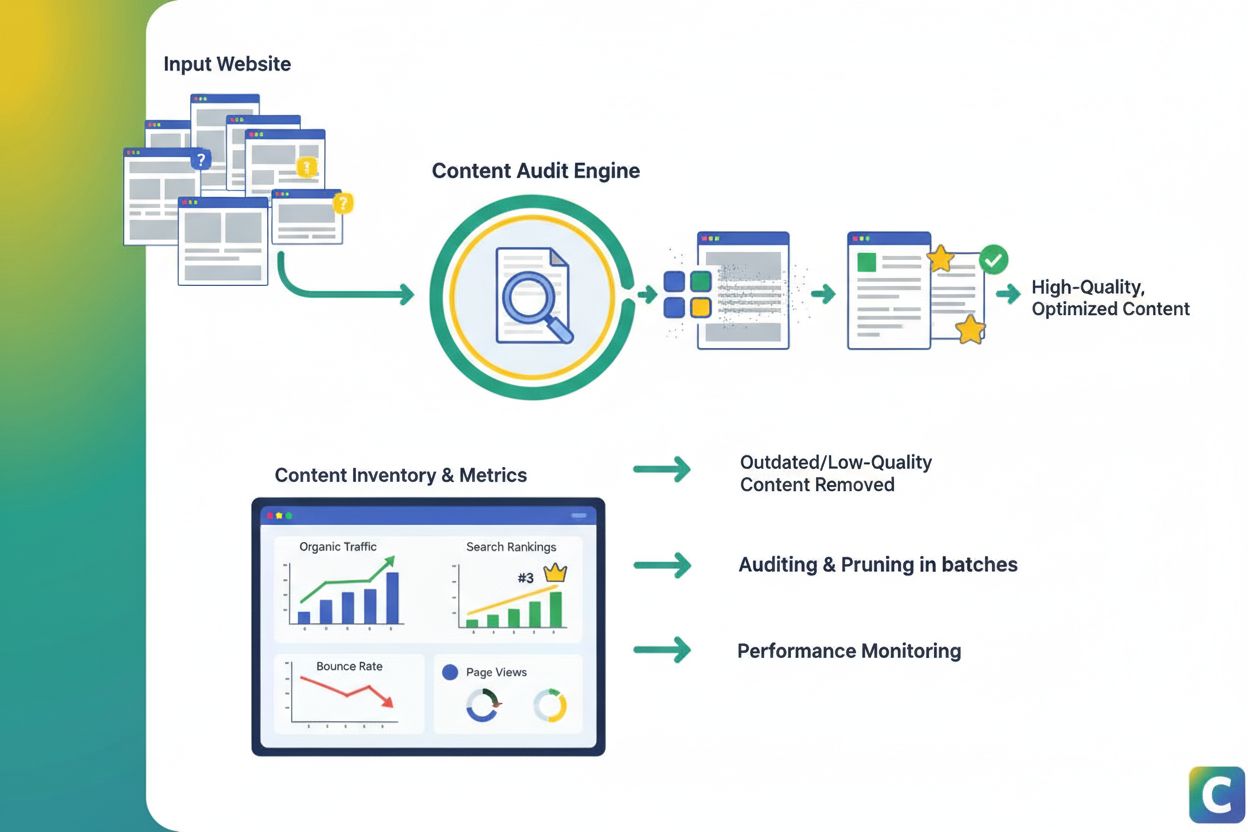
Content pruning is the strategic process of reviewing, updating, or removing underperforming, outdated, or duplicate content from a website to improve SEO performance, user experience, and search engine visibility. This practice involves identifying low-quality pages and deciding whether to refresh, consolidate, deindex, or delete them to enhance overall site quality and crawl efficiency.
Content pruning is the strategic process of reviewing, updating, or removing underperforming, outdated, or duplicate content from a website to improve SEO performance, user experience, and search engine visibility. This practice involves identifying low-quality pages and deciding whether to refresh, consolidate, deindex, or delete them to enhance overall site quality and crawl efficiency.
Content pruning is the strategic process of reviewing, auditing, and refining a website’s content inventory by removing, updating, or consolidating underperforming, outdated, or duplicate pages. The primary goal is to improve overall site quality, enhance user experience, and boost search engine optimization (SEO) performance by ensuring that only valuable, relevant, and accurate content remains visible to both users and search engine crawlers. This practice has become increasingly critical in the modern digital landscape, where websites accumulate content organically over time, often resulting in quality degradation, keyword cannibalization, and wasted crawl budget. Content pruning is not simply about deletion—it’s a comprehensive strategy that involves making deliberate decisions about which content to keep, improve, consolidate, or remove based on performance metrics, business objectives, and strategic value.
The concept of content pruning emerged as search engines evolved their algorithms to prioritize quality over quantity. In the early days of SEO, the prevailing wisdom was that more content always meant better visibility. However, as Google’s algorithms became increasingly sophisticated—particularly with the introduction of the Helpful Content System and E-E-A-T (Experience, Expertise, Authoritativeness, Trustworthiness) guidelines—the industry recognized that low-quality, thin, or outdated content actively harmed website performance. Major algorithm updates, including Google’s core updates, have consistently penalized sites with large volumes of low-value content, forcing digital teams to reconsider their content strategies fundamentally.
The shift toward content pruning accelerated significantly after 2023, when Google emphasized that websites should focus on creating genuinely helpful content rather than maximizing page count. Industry research indicates that over 65% of websites with more than 1,000 pages experience index bloat—a condition where search engines index content that provides minimal value to users. This bloat directly impacts crawl budget efficiency, preventing high-quality content from receiving adequate attention from search engine bots. Additionally, the rise of generative AI platforms like ChatGPT, Perplexity, and Google AI Overviews has introduced a new dimension to content pruning: these systems prioritize fresh, accurate, and comprehensive content, with studies showing that up to 65% of AI search-bot hits target content updated within the last 12 months.
Content pruning has become essential for multiple interconnected reasons. First, it directly impacts search engine rankings by improving site quality signals. When a website contains numerous low-performing pages, search engines interpret this as a sign of lower overall quality, which can suppress rankings across the entire domain. Second, content pruning optimizes crawl budget—a finite resource that determines how many pages Google will crawl during each visit. Large websites with thousands of pages must be strategic about which content receives crawler attention; pruning ensures that high-value pages get prioritized. Third, in the era of AI-powered search, content pruning affects visibility across multiple platforms simultaneously. Removing outdated information and consolidating duplicate content increases the likelihood that AI systems will cite your content as authoritative, directly impacting your brand’s visibility in ChatGPT, Perplexity, Google AI Overviews, and Claude.
Furthermore, content pruning addresses the critical issue of keyword cannibalization, where multiple pages compete for the same keywords, diluting ranking potential. Research from Clearscope and Semrush indicates that websites implementing systematic content pruning strategies see average organic traffic increases of 15-30% within three to six months, along with improved conversion rates and reduced bounce rates. The practice also enhances user experience by removing confusing, outdated, or irrelevant content that frustrates visitors and erodes trust in your brand.
| Aspect | Content Pruning | Content Refresh | Content Consolidation | Content Deletion |
|---|---|---|---|---|
| Definition | Comprehensive audit and optimization of entire content inventory | Updating existing content with new information and improvements | Merging similar or duplicate pages into single resource | Permanently removing pages from website |
| Primary Goal | Improve overall site quality and SEO performance | Maintain relevance and accuracy of existing content | Eliminate keyword cannibalization and strengthen authority | Remove irrelevant or obsolete content |
| Scope | Site-wide or segment-based strategy | Individual page or topic-based | Multiple related pages targeting same keywords | Single or multiple low-value pages |
| Impact on Rankings | Significant positive impact across domain | Moderate to significant improvement for updated pages | High impact on consolidated page rankings | Potential negative if not properly redirected |
| Backlink Handling | Preserves link equity through redirects | Maintains existing backlinks | Consolidates backlinks to single page | Requires 301 redirects to preserve equity |
| Time Investment | High (requires planning and execution) | Moderate (focused updates) | Moderate to high (requires consolidation planning) | Low to moderate (straightforward removal) |
| Best For | Large websites with content decay issues | Maintaining competitive advantage for key pages | Addressing duplicate content and cannibalization | Removing outdated or irrelevant content |
| AI Visibility Impact | Significant (improves freshness and quality signals) | High (updates signal active maintenance) | Moderate (consolidation strengthens authority) | Negative if not handled properly |
Implementing content pruning effectively requires a structured, data-driven approach. The first step is conducting a comprehensive content audit, which involves cataloging all existing content and evaluating performance metrics such as organic traffic, impressions, click-through rates, bounce rates, and conversion data. Tools like Google Analytics, Google Search Console, Semrush, Ahrefs, and Screaming Frog provide essential insights into which pages are underperforming. During this audit phase, you should identify pages with fewer than 100 organic clicks in six months, zero conversions despite being conversion-focused, high impressions but low click-through rates (indicating poor search intent alignment), or outdated information that no longer serves your audience.
The second phase involves identifying the root causes of underperformance. Not all low-traffic pages are candidates for removal; some may have technical issues, poor on-page optimization, or misaligned search intent that can be fixed through refreshing. Others may have strategic value despite low traffic—for example, pages that support internal teams or have high-quality backlinks. This is where content pruning differs from simple deletion: it requires nuanced decision-making. You should evaluate whether each underperforming page should be refreshed (updated with new information and optimized for current search intent), consolidated (merged with similar content), deindexed (kept live but removed from search results), or deleted (permanently removed with proper redirects).
The third phase is taking action based on your analysis. This might involve refreshing outdated blog posts with current statistics and expert insights, consolidating multiple pages targeting the same keywords into a single comprehensive resource, deindexing pages that serve internal purposes but shouldn’t appear in search results, or deleting irrelevant content with proper 301 redirects. Throughout this process, internal linking plays a critical role. When you consolidate or delete pages, you must update internal links to point directly to live pages rather than creating redirect chains, which slow page speed and dilute link equity. The final phase is measuring impact by tracking changes in organic traffic, keyword rankings, impressions, bounce rates, and conversions over at least 30 days to allow metrics to stabilize.
Successful content pruning requires careful attention to technical SEO details. When deleting content, always implement 301 redirects from the deleted URL to the most relevant remaining page. This preserves link equity and prevents 404 errors that harm user experience and SEO. For pages you want to keep live but remove from search results, use the noindex meta tag (<meta name="robots" content="noindex">) rather than deleting them. This is particularly useful for sales landing pages, internal resources, or pages that serve specific audiences but shouldn’t compete in organic search.
Crawl budget optimization is another critical consideration, especially for large websites. Every site has a unique crawl budget determined by factors like domain authority, site size, and update frequency. By removing thin, outdated, or duplicate content, you ensure that Google’s crawlers focus on your highest-quality pages. This is particularly important for enterprise websites with thousands of pages, where crawl budget inefficiency can significantly impact visibility. Additionally, you should monitor your sitemap during content pruning—remove deleted URLs from your XML sitemap to signal to search engines that these pages are no longer part of your site.
Canonical tags also play an important role in content pruning, particularly when consolidating content. If you’re merging two similar pages and changing the URL structure, ensure that canonical tags are properly updated to point to the new consolidated page. This helps search engines understand which version of the content should be indexed and ranked. Finally, maintain a content database or spreadsheet documenting all content changes, including original URLs, target keywords, objectives, and actions taken. This documentation is invaluable for tracking the impact of content pruning efforts and preventing duplicate content creation in the future.
Identifying which content to prune requires analyzing multiple performance metrics simultaneously. Organic traffic is the most obvious metric—pages receiving fewer than 100 clicks in six months are typically candidates for evaluation. However, traffic alone doesn’t tell the complete story. A page with low traffic but high conversions should be kept and improved, not deleted. Impressions versus clicks in Google Search Console reveal another important pattern: high impressions with low clicks indicate that your page is ranking but not fulfilling search intent, suggesting a need for content refresh rather than deletion.
Bounce rate and engagement metrics provide insights into user satisfaction. Pages with bounce rates above 80% and minimal time-on-page suggest that content isn’t meeting user expectations. Backlink data is crucial—pages with high-quality backlinks from authoritative sources should generally be kept and improved rather than deleted, as removing them wastes valuable link equity. Keyword rankings help identify pages that are underperforming for their target keywords; these are often good candidates for refreshing or consolidating with stronger pages.
Tools like Google Search Console provide organic traffic and keyword data, Google Analytics shows user engagement metrics, Semrush and Ahrefs offer comprehensive backlink analysis and competitive insights, and Screaming Frog crawls your site to identify technical issues and content metrics. Many organizations use traffic-weighted scoring models that assign numerical values to different metrics, allowing them to prioritize pruning efforts based on potential impact. For example, you might weight conversion rate more heavily than traffic if lead generation is your primary goal, or prioritize pages with high backlink counts if domain authority is your focus.
Keyword cannibalization is one of the most damaging issues that content pruning addresses. This occurs when multiple pages on your site target the same or very similar keywords, causing them to compete against each other in search results. Instead of strengthening your site’s authority for that keyword, cannibalization dilutes it, often resulting in neither page ranking as well as a single, consolidated page would. For example, if you have both a blog post titled “Best Running Shoes for Marathon Training” and a product page titled “Marathon Running Shoes,” both targeting the keyword “marathon running shoes,” they’re competing for the same search intent.
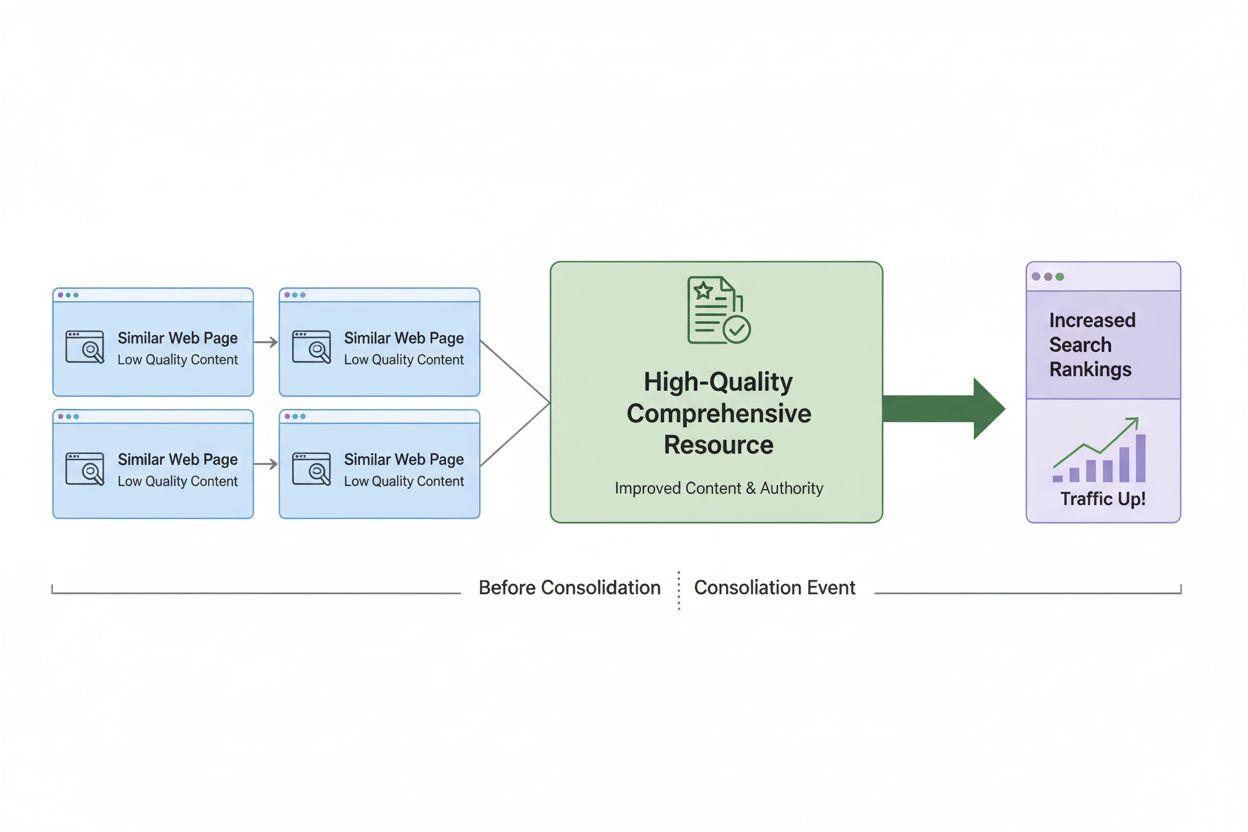
Content pruning solves this through consolidation—merging the two pages into a single, comprehensive resource that combines the best information from both. You would then implement a 301 redirect from the lower-performing page to the consolidated page, transferring all link equity and ensuring users and search engines are directed to the authoritative version. This approach is far more effective than keeping both pages live, as it concentrates keyword authority, improves rankings, and provides users with a single, comprehensive resource rather than forcing them to choose between similar pages.
Identifying cannibalization requires analyzing your keyword rankings and comparing them to your content inventory. Tools like Semrush’s Position Tracking feature and Google Search Console’s Performance report help identify which keywords your pages are ranking for. If you notice that multiple pages are ranking for the same keyword, or that a page is ranking for keywords you didn’t intend to target, you’ve likely identified cannibalization that needs to be addressed through content pruning.
The emergence of generative AI platforms has fundamentally changed how content pruning impacts brand visibility. Platforms like ChatGPT, Perplexity, Google AI Overviews, and Claude use different algorithms to source and cite content, but they share a common preference for fresh, accurate, and comprehensive information. Research indicates that up to 65% of AI search-bot hits target content updated within the last 12 months, meaning that outdated content is essentially invisible to these systems. This makes content pruning—particularly the refresh component—essential for maintaining visibility in AI-powered search.
When you remove outdated information and consolidate duplicate content through content pruning, you’re not just improving traditional search rankings; you’re also increasing the likelihood that AI systems will cite your content as authoritative sources. This is where platforms like AmICited become valuable. AmICited monitors how your brand, domain, and specific URLs appear in AI responses across multiple platforms, allowing you to track the impact of your content pruning efforts on AI visibility. By understanding which of your pruned and refreshed content pieces are being cited by AI systems, you can refine your strategy and focus on creating content that resonates with both traditional search engines and generative AI platforms.
Additionally, content pruning helps you maintain E-E-A-T signals that both search engines and AI systems value. By removing thin, inaccurate, or outdated content, you’re signaling that your site maintains high editorial standards. By refreshing content with expert insights, recent data, and comprehensive coverage, you’re demonstrating experience and expertise. This holistic approach to content pruning ensures that your content remains competitive across all discovery channels—traditional search, AI-powered search, and beyond.
Content pruning offers four primary actions, each suited to different situations. Refreshing involves updating existing content to improve quality, accuracy, and relevance. This is ideal for pages that are topically relevant but outdated, fail to fulfill current search intent, or lack depth. Refreshing might involve adding new statistics, updating case studies, incorporating expert interviews, fixing broken links, or rewriting sections to better address search intent. Pages labeled as “Intent mismatch,” “Outdated,” “Thin content,” or having “Technical issues” are typically good candidates for refreshing.
Consolidation involves merging two or more similar pages into a single, comprehensive resource. This is the primary solution for keyword cannibalization and duplicate content issues. When consolidating, you select the highest-performing URL (based on traffic and backlinks) as the target, incorporate the best information from other pages, and implement 301 redirects from the lower-performing pages. This approach preserves link equity while strengthening the authority of the consolidated page.
Deindexing uses the noindex meta tag to keep pages live on your website while removing them from search engine indexes. This is ideal for pages that serve internal purposes—such as sales landing pages with special discounts, internal tools, or resources for specific audiences—but shouldn’t appear in organic search results. Deindexing prevents these pages from competing with your primary content while maintaining their utility for internal teams.
Deletion is the final option, used when content is irrelevant, outdated, lacks strategic value, and has no high-quality backlinks. When deleting, always implement 301 redirects to relevant remaining pages to preserve link equity and prevent 404 errors. Deletion should be the last resort after considering whether refreshing, consolidating, or deindexing might be more beneficial.
One of the most costly mistakes is deleting content with valuable backlinks without considering the link equity implications. High-authority backlinks are difficult to earn, and removing pages that have them wastes that hard-earned authority. Instead, consider refreshing or consolidating such pages to maintain their value. Another critical error is failing to implement proper 301 redirects when deleting content, resulting in 404 errors that harm user experience and waste crawl budget. Additionally, many organizations fail to update internal links after pruning, creating redirect chains that slow page speed and dilute link equity.
Over-relying on single metrics—such as traffic volume or word count—without considering context is another common pitfall. A page with low traffic might still be valuable if it converts well or has strategic importance. Conversely, a page with high traffic might be attracting the wrong audience or failing to meet business objectives. Failing to establish baseline performance metrics before pruning makes it impossible to accurately measure the impact of your efforts. Finally, pruning without stakeholder alignment can lead to unexpected consequences—other teams might be using content you plan to delete for purposes you’re unaware of, such as sales teams sending links to prospects or marketing teams using pages in email campaigns.
The future of content pruning will be increasingly shaped by AI and automation. As generative AI platforms become more sophisticated and influential in content discovery, content pruning strategies will need to account for AI visibility alongside traditional search rankings. We can expect to see more organizations using AI-powered tools to automate content auditing, tagging, and pruning recommendations. Platforms like Contentful’s AI Actions already enable automated metadata tagging, keyword optimization, and content rewriting at scale, making content pruning more efficient for large organizations.
Additionally, content pruning will become more integrated with broader content governance strategies. As organizations recognize that content quality directly impacts both search visibility and AI citations, they’ll invest in systems that prevent low-quality content from being published in the first place, rather than relying solely on post-publication pruning. The rise of Generative Engine Optimization (GEO) will also influence content pruning practices, as organizations optimize not just for traditional search but for visibility across ChatGPT, Perplexity, Google AI Overviews, and emerging AI platforms.
Finally, we’ll likely see increased emphasis on content freshness as a pruning metric. With AI systems prioritizing recently updated content, organizations will need to establish regular refresh schedules rather than treating content pruning as a one-time project. This shift toward continuous content optimization—combining pruning, refreshing, and monitoring—will become standard practice for competitive organizations seeking to maintain visibility across all discovery channels. Tools like AmICited will play an increasingly important role in this ecosystem, providing visibility into how pruning efforts impact brand citations across AI platforms and enabling data-driven decisions about which content to prioritize for refresh and optimization.
Content pruning is a broader strategy that includes refreshing, consolidating, and removing content, while content refresh specifically focuses on updating existing content to improve accuracy and relevance. Pruning encompasses the entire decision-making process of evaluating what to keep, improve, or delete, whereas refreshing is just one action within that process. Both are essential for maintaining a healthy content ecosystem, but pruning provides a more comprehensive approach to content management.
Content pruning directly affects AI visibility because generative AI systems prioritize fresh, accurate, and high-quality content. Research shows that up to 65% of AI search-bot hits go to content updated within the last 12 months. By removing outdated information and consolidating duplicate content, you increase the likelihood that AI platforms will cite your content as authoritative sources. AmICited helps monitor these AI citations, allowing you to track how pruning efforts impact your brand's visibility across ChatGPT, Perplexity, Google AI Overviews, and Claude.
Key metrics to monitor include organic traffic, keyword rankings, impressions versus clicks in Google Search Console, bounce rate, conversion rate, and backlink data. Additionally, track crawl budget efficiency and page indexation status. Establishing baseline measurements before pruning allows you to accurately measure the impact of your actions and determine whether your pruning strategy was successful. Most SEO professionals recommend waiting at least 30 days after pruning to allow metrics to stabilize before drawing conclusions.
The decision depends on the content's strategic value. Delete content that is irrelevant, outdated, lacks backlinks, and serves no business purpose. Use deindexing (noindex tags) for pages that serve internal teams (like sales landing pages) but shouldn't appear in search results. If content has high-quality backlinks, consider refreshing or consolidating it instead of deleting. Always use 301 redirects when deleting indexed pages to preserve link equity and prevent 404 errors.
Content pruning optimizes crawl budget by removing low-value pages that waste Google's limited crawling resources. Every website has a unique crawl budget—the number of pages Google will crawl before moving on. By pruning thin, outdated, or duplicate content, you ensure that search engine bots focus on your highest-quality pages. This is especially critical for large websites with thousands of pages, where crawl budget inefficiency can significantly impact visibility and ranking potential.
Keyword cannibalization occurs when multiple pages on your site target the same or similar keywords, causing them to compete against each other in search results. This dilutes ranking potential and confuses search engines about which page should rank. Content pruning solves this by consolidating similar pages into a single, comprehensive resource and redirecting the lower-performing versions. This concentrates keyword authority on one page, improving its ranking potential and overall site SEO performance.
For larger websites publishing content daily or weekly, content pruning should be performed every one to three months in batches. Smaller websites can limit pruning to once or twice per year. However, content pruning should be an ongoing part of your content management strategy rather than a one-time project. Regular audits help you stay ahead of content decay, maintain alignment with business objectives, and ensure your site remains competitive in search results and AI visibility.
Content pruning can negatively impact SEO if executed poorly—specifically if you delete pages with valuable backlinks, fail to implement proper 301 redirects, or remove content that still drives conversions. To avoid negative impacts, always audit backlink data before deletion, update internal links to avoid redirect chains, and measure baseline performance before making changes. When done strategically with proper planning and monitoring, content pruning consistently improves SEO performance rather than harming it.
Start tracking how AI chatbots mention your brand across ChatGPT, Perplexity, and other platforms. Get actionable insights to improve your AI presence.
Learn what content consolidation is, how it improves SEO performance, and why merging similar content is essential for AI visibility and brand monitoring in sea...

Learn what content pruning for AI is, how it works, different pruning methods, and why it's essential for deploying efficient AI models on edge devices and reso...
Learn what content optimization is, why it matters for SEO and AI search engines, and discover proven techniques to improve your content's search visibility and...
Cookie Consent
We use cookies to enhance your browsing experience and analyze our traffic. See our privacy policy.