
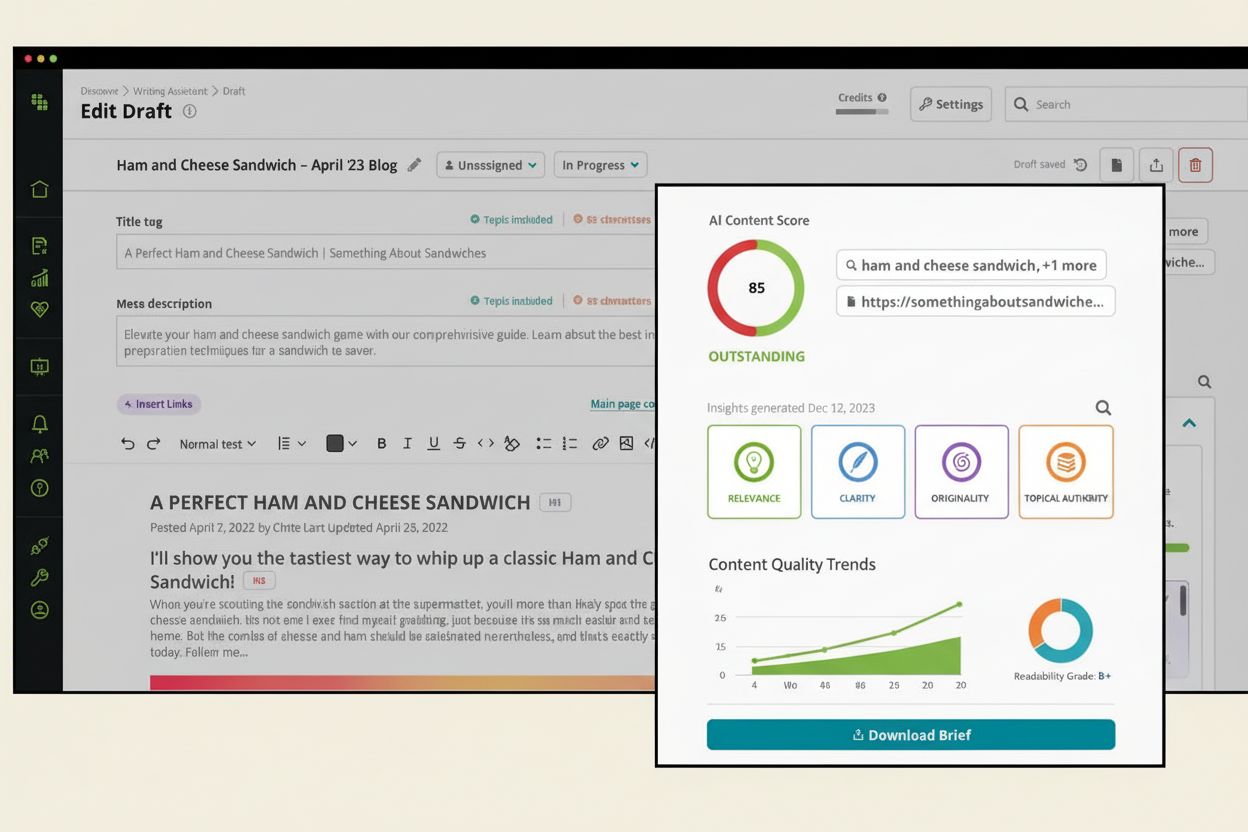
AI Content Score
Learn what an AI Content Score is, how it evaluates content quality for AI systems, and why it matters for visibility in ChatGPT, Perplexity, and other AI platf...
12 min read
Content relevance scoring is an AI-powered metric that measures how well a piece of content matches a user’s search query and underlying intent. This algorithmic assessment uses natural language processing and machine learning to evaluate the relationship between user queries and digital content. It is fundamental to how modern search engines, AI answer engines, and content optimization platforms determine which information to surface first. By analyzing semantic meaning, topical coverage, and contextual alignment, relevance scoring ensures users receive the most useful and appropriate content for their specific needs.
Content relevance scoring is an AI-powered metric that measures how well a piece of content matches a user's search query and underlying intent. This algorithmic assessment uses natural language processing and machine learning to evaluate the relationship between user queries and digital content. It is fundamental to how modern search engines, AI answer engines, and content optimization platforms determine which information to surface first. By analyzing semantic meaning, topical coverage, and contextual alignment, relevance scoring ensures users receive the most useful and appropriate content for their specific needs.
Content relevance scoring is an AI-powered metric that measures how well a piece of content matches a user’s search query and underlying intent. This algorithmic assessment uses natural language processing (NLP) and machine learning to evaluate the relationship between user queries and digital content, assigning a numerical score that indicates the degree of relevance. Content relevance scoring is fundamental to how modern search engines, AI answer engines like ChatGPT and Perplexity, and content optimization platforms determine which information to surface first. By analyzing semantic meaning, topical coverage, and contextual alignment, relevance scoring ensures that users receive the most useful and appropriate content for their specific needs.
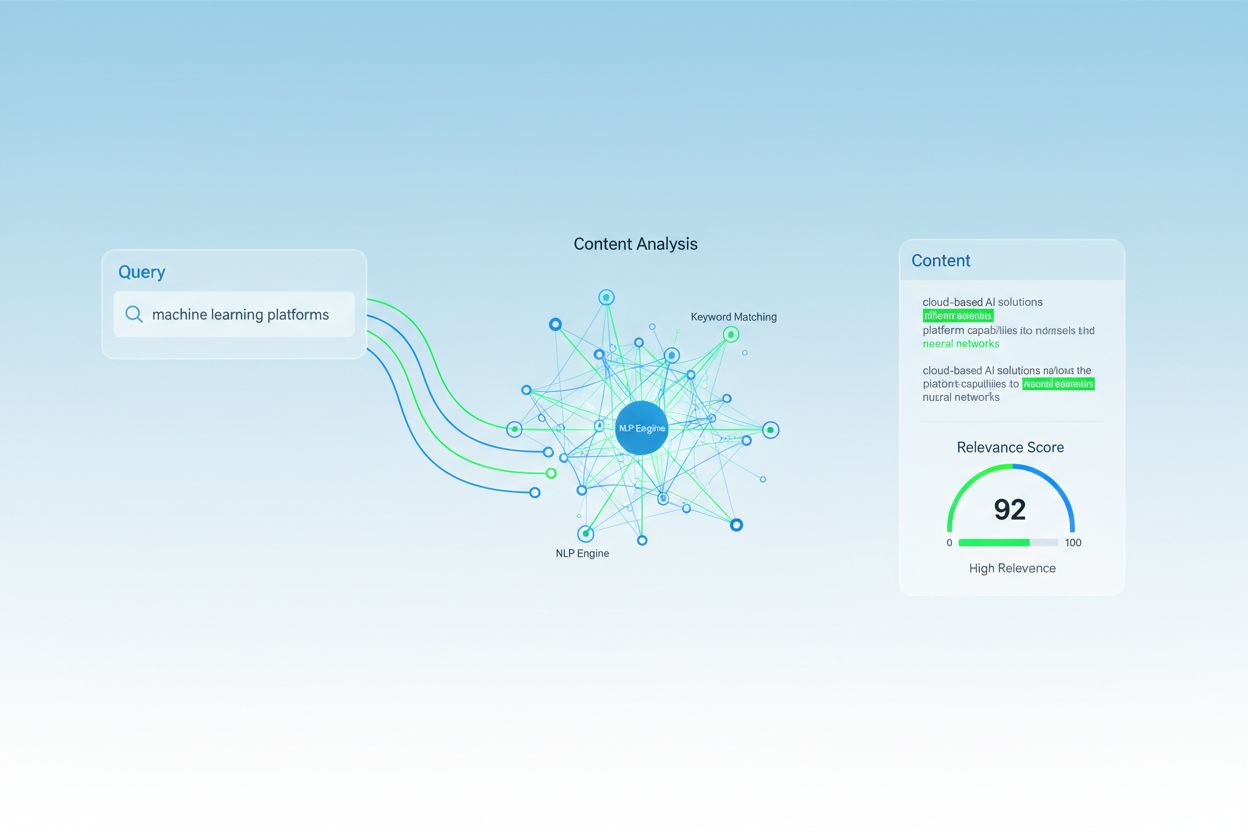
Content relevance scoring operates through a multi-step algorithmic process that begins with feature extraction, where the system breaks down both the user query and content into analyzable components. The algorithm then performs comparative analysis, measuring how closely the content’s features align with the query’s requirements using statistical models like TF-IDF (Term Frequency-Inverse Document Frequency) and the BM25 algorithm. Term frequency measures how often a query term appears in a document, while inverse document frequency weights terms based on their rarity across the entire dataset—rare terms that match the query receive higher importance. A predefined scoring model then weighs these factors based on their impact on content quality and relevance, ultimately generating a numerical score that ranks the content against other potential matches.
| Scoring Factor | Description | Impact on Score |
|---|---|---|
| Term Frequency | How often query terms appear in content | Higher frequency = higher relevance |
| Inverse Document Frequency | Rarity of terms across the dataset | Rare matching terms = higher weight |
| Semantic Similarity | Conceptual alignment between query and content | Better semantic match = higher score |
| Topical Authority | Depth and comprehensiveness of topic coverage | More thorough coverage = higher score |
| Content Structure | Organization and readability of content | Well-structured content = higher score |
| Intent Alignment | How well content answers the user’s actual question | Perfect intent match = highest score |
| Freshness | Recency of content publication | Newer content may score higher for current topics |
| User Engagement Signals | Click-through rates, time on page, bounce rates | High engagement = higher relevance indicator |
Modern content relevance scoring algorithms evaluate far more than simple keyword matching—they assess the holistic quality and appropriateness of content for a given query. The primary factors that influence relevance scores include:
Search engines like Google and Bing rely heavily on content relevance scoring to determine which pages appear at the top of search results. Google’s ranking systems analyze hundreds of signals to assess relevance, including the presence of query keywords, the semantic relationship between query and content, and the overall quality and authority of the source. The BM25 algorithm, which is the standard relevance ranking function used by major search engines, calculates scores based on term frequency and document length normalization, ensuring that longer documents don’t automatically rank higher simply because they contain more words. Search engines continuously refine their relevance scoring through machine learning, testing millions of ranking variations to ensure that the most helpful, authoritative, and relevant content reaches users first. This process has evolved significantly from simple keyword matching to sophisticated understanding of user intent, context, and the semantic meaning behind queries.
AI answer engines like ChatGPT, Perplexity, and Google AI Overviews use content relevance scoring differently than traditional search engines, prioritizing semantic understanding and contextual alignment over keyword density. These systems employ vector embeddings and retrieval-augmented generation (RAG) to find the most relevant source material, converting both queries and content into mathematical representations that capture meaning and context. Rather than simply ranking pages, AI answer engines use relevance scoring to select the most appropriate passages and sources to synthesize into coherent, conversational responses. The relevance assessment in these systems emphasizes whether content directly addresses the user’s question, provides authoritative information, and offers unique insights or perspectives. This approach means that content optimized for traditional search rankings may not perform as well in AI answer engines unless it also demonstrates clear intent alignment, topical depth, and direct answers to common questions.
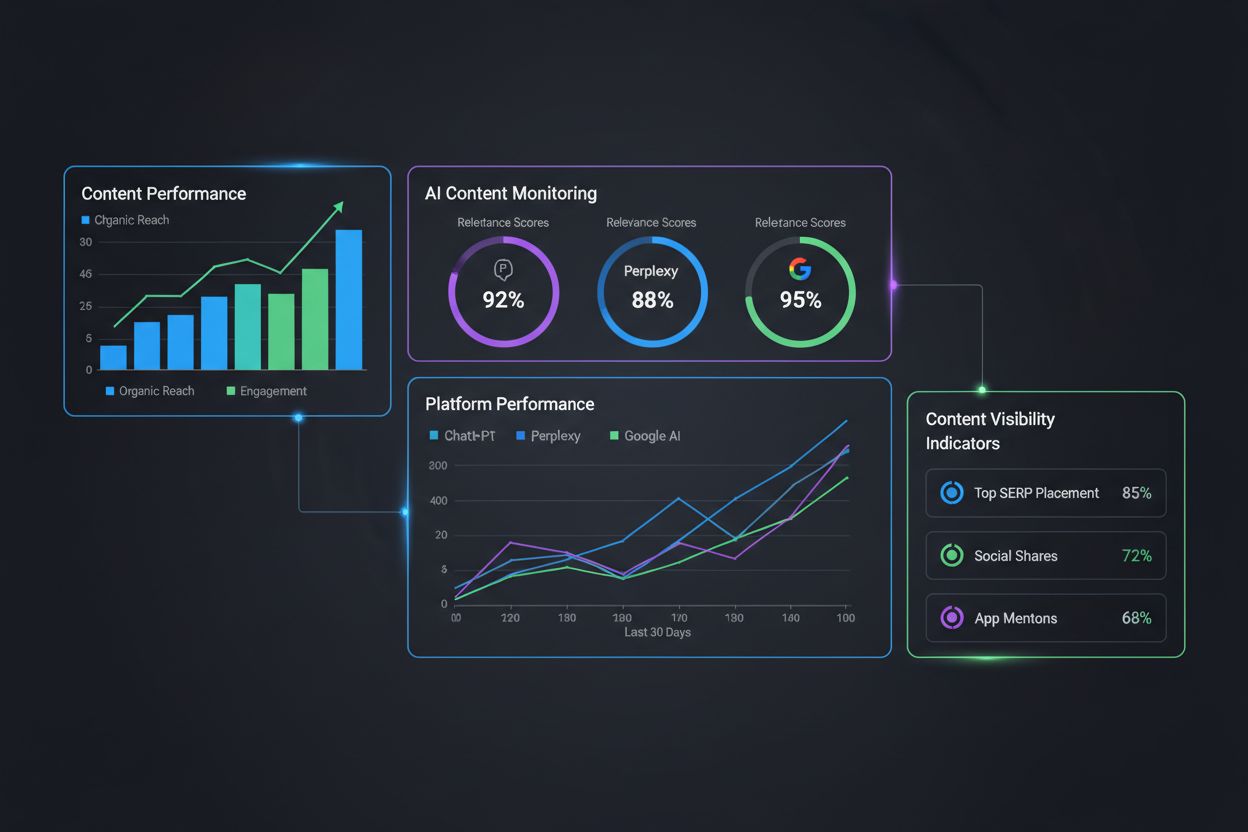
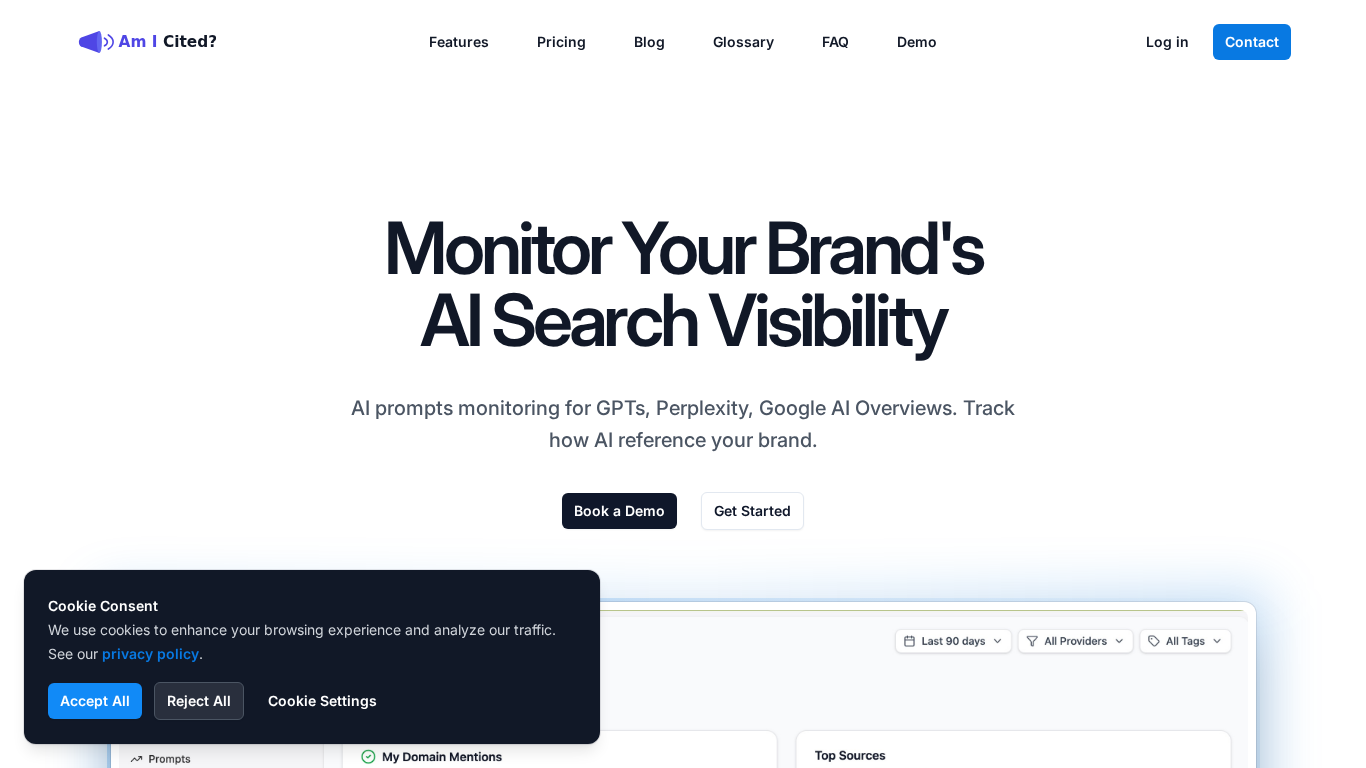
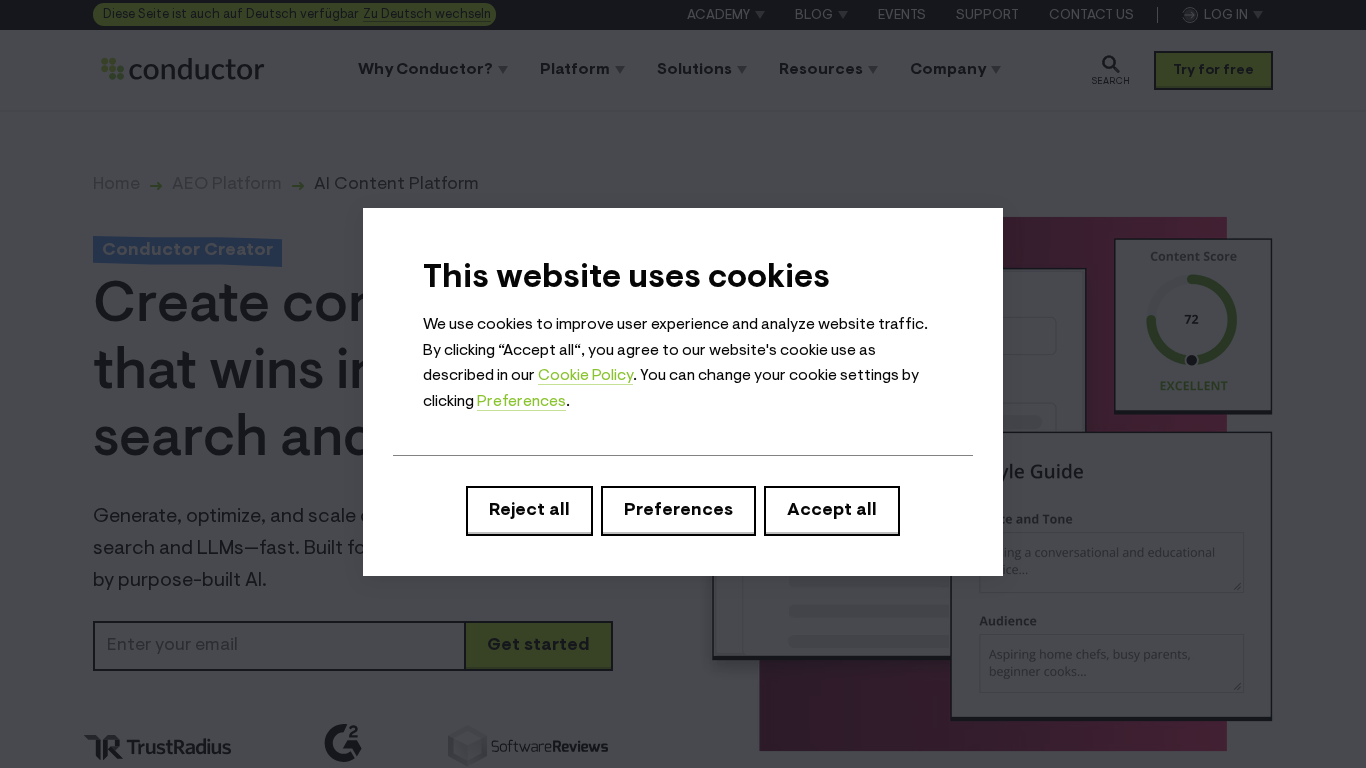
Several platforms now offer content relevance scoring capabilities to help creators and marketers optimize their content before publication. Conductor Creator provides an AI Content Score feature that evaluates content quality based on factors like topical coverage, intent alignment, and audience relevance, using real-time search data to ensure accuracy. AmICited.com monitors how brands and content are referenced across AI platforms, tracking content relevance and visibility in ChatGPT, Perplexity, and Google AI Overviews—providing insights into how well content performs in AI-driven search environments. These platforms transform content relevance scoring from a theoretical concept into actionable intelligence, helping teams identify specific areas for improvement and optimize content before it goes live. By leveraging AI-powered relevance assessment, content creators can ensure their work is positioned to succeed in both traditional search and emerging AI answer engines. The integration of relevance scoring into content workflows has become essential for brands seeking to maintain visibility and authority as search behavior continues to evolve.
Optimizing content for better relevance scores requires a strategic approach that goes beyond keyword optimization. Topical authority is built by creating comprehensive content that thoroughly explores a topic and addresses related subtopics, positioning your content as a definitive resource rather than a surface-level overview. Intent alignment improves when content directly answers the questions users are asking—structure your content with clear answers at the top, followed by supporting details and context. Enhance semantic coverage by naturally incorporating related terms, synonyms, and conceptual variations that demonstrate deep understanding of the topic. Improve content structure through clear headings, logical flow, concise paragraphs, and scannable formatting that helps both algorithms and readers quickly find relevant information. Additionally, ensure your content demonstrates expertise and authority through citations, data, original research, and clear author credentials. Finally, optimize for user engagement by creating content that is genuinely useful and engaging—metrics like time on page and click-through rates signal to algorithms that your content is delivering value.
As AI answer engines become increasingly important for content discovery, understanding how relevance scoring impacts visibility in these platforms is critical for brands. Content that scores well on relevance metrics is more likely to be selected as a source by AI systems, meaning your brand gets cited and referenced when users ask questions related to your expertise. This visibility in AI platforms directly influences brand awareness, authority, and traffic—making content relevance optimization essential for long-term digital strategy. Tools like AmICited.com help brands monitor how their content performs in AI-driven search, tracking which pieces are cited and how often your brand appears in AI-generated answers. By understanding and optimizing for content relevance scoring, brands can ensure they remain visible and authoritative not just in traditional search results, but in the emerging landscape of AI-powered information discovery.
Keyword matching is a basic technique that looks for exact or near-exact word matches between a query and content. Content relevance scoring is far more sophisticated—it uses machine learning and natural language processing to understand semantic meaning, context, and intent. Modern relevance scoring recognizes that a query about 'how to fix a leaky faucet' is semantically similar to content about 'repairing a dripping tap,' even though the exact words differ. This semantic understanding ensures users find truly relevant content, not just pages that happen to contain the right keywords.
Search engines like Google use complex algorithms such as BM25 to calculate relevance scores. These algorithms analyze multiple factors including term frequency (how often query terms appear in content), inverse document frequency (how rare those terms are across the entire web), semantic similarity, topical authority, content structure, and user engagement signals. The algorithm weighs these factors differently depending on the type of query—for example, freshness matters more for news queries than for evergreen topics. Search engines continuously refine these calculations through machine learning and testing millions of ranking variations.
Yes, absolutely. You can improve content relevance scores by building topical authority through comprehensive coverage of your subject, aligning your content directly with user intent by answering the actual questions people are asking, improving semantic coverage by naturally incorporating related terms and concepts, enhancing content structure with clear headings and logical flow, and demonstrating expertise through citations and original research. Additionally, optimizing for user engagement through genuinely useful and engaging content helps signal to algorithms that your content is delivering value.
Semantic understanding is crucial to modern relevance scoring. Rather than just matching keywords, algorithms now understand the meaning and context behind both queries and content. This allows systems to recognize that 'automobile,' 'car,' and 'vehicle' are semantically related, and that content about one might be relevant to queries about another. Semantic understanding also helps algorithms grasp the intent behind queries—recognizing that someone searching 'best running shoes for marathons' is looking for product recommendations, not just information about marathons. This deeper comprehension ensures more accurate and useful relevance assessments.
Content that scores well on relevance metrics is more likely to be selected as a source by AI systems like ChatGPT and Perplexity, meaning your brand gets cited and referenced when users ask related questions. This visibility in AI platforms directly influences brand awareness, authority, and traffic. As AI answer engines become increasingly important for content discovery, optimizing for content relevance scoring is essential for maintaining visibility. Tools like AmICited.com help brands monitor how their content performs in AI-driven search, tracking which pieces are cited and how often your brand appears in AI-generated answers.
BM25 (Best Matching 25) is a probabilistic relevance ranking function that is the standard algorithm used by major search engines for calculating relevance scores. It calculates scores based on term frequency (how often a query term appears in a document) and inverse document frequency (how rare that term is across all documents), while also normalizing for document length so longer documents don't automatically rank higher. BM25 is considered more intuitive and effective than older TF-IDF approaches because it better reflects how relevance actually works in practice. Understanding BM25 helps explain why certain documents rank higher than others in search results.
AI answer engines like ChatGPT and Perplexity use relevance scoring to select source material for synthesizing conversational responses, rather than simply ranking pages. They employ vector embeddings and retrieval-augmented generation (RAG) to find semantically similar content, prioritizing passages that directly address the user's question. AI answer engines emphasize whether content provides authoritative information, offers unique insights, and directly answers common questions. This means content optimized for traditional search rankings may not perform as well in AI answer engines unless it also demonstrates clear intent alignment, topical depth, and direct answers to user questions.
Topical authority signals to algorithms that your content is a comprehensive, authoritative resource on a subject. When you create content that thoroughly explores a topic and addresses related subtopics, algorithms recognize this depth and are more likely to rank your content higher for related queries. Topical authority is built over time through multiple pieces of interconnected content that collectively demonstrate expertise. Search engines and AI systems reward this comprehensive approach because it indicates you're providing genuinely useful information rather than surface-level coverage. Building topical authority is one of the most effective ways to improve your overall content relevance scores.
Track how your content performs in ChatGPT, Perplexity, and Google AI Overviews. Get insights into your content relevance scores and visibility in AI-powered search.
Learn what an AI Content Score is, how it evaluates content quality for AI systems, and why it matters for visibility in ChatGPT, Perplexity, and other AI platf...

Learn what readability scores mean for AI search visibility. Discover how Flesch-Kincaid, sentence structure, and content formatting impact AI citations in Chat...
Learn how to measure content performance in AI systems including ChatGPT, Perplexity, and other AI answer generators. Discover key metrics, KPIs, and monitoring...