


Cross-Border Ecommerce
Cross-border ecommerce is the practice of selling products online to customers located in a different country than the merchant's home base, requiring the business to manage currency conversion, international shipping, customs and duties, and localized customer experience. It's distinct from domestic ecommerce mainly in the added operational and regulatory complexity of each new market.
Definition of Cross-Border Ecommerce
Cross-border ecommerce refers to any online transaction where the merchant and the customer are located in different countries. It covers the full operational chain that makes an international sale possible: displaying prices in the customer’s currency, accepting payment through methods and providers common in that market, shipping across international borders, and handling the customs, duties, and returns process that a purely domestic transaction never has to deal with. As shipping and payment infrastructure have matured, cross-border ecommerce has become accessible even to small merchants, but it still introduces meaningfully more operational complexity than selling within a single home market.
How Cross-Border Ecommerce Works
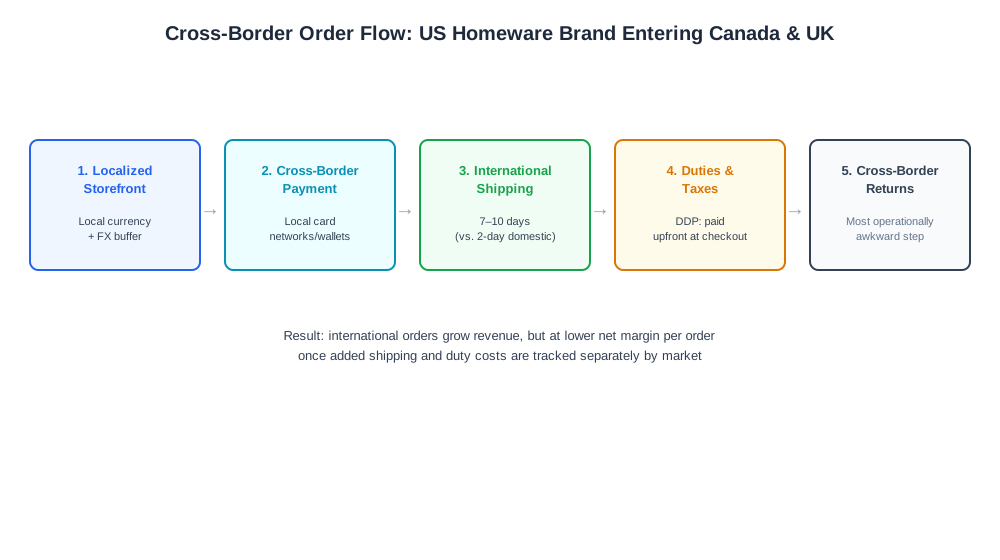
A cross-border transaction generally passes through several additional steps compared to a domestic one:
- Localized storefront experience — pricing in local currency, sometimes translated content and local payment method support
- Cross-border payment processing — handling currency conversion and payment methods common in the destination market, which aren’t always the same card networks or wallets used domestically
- International shipping — carrier selection, customs documentation, and realistic delivery time communication
- Duties and taxes — determined by the product category, destination country, and declared value, either collected upfront (Delivered Duty Paid) or on delivery (Delivered Duty Unpaid)
- Cross-border returns — often the most operationally awkward part, since return shipping costs and customs re-entry can make international returns expensive relative to the order value
Worked example: a US-based homeware brand begins shipping to Canada and the UK. It sets up local-currency pricing with a small FX buffer, partners with a carrier offering Delivered Duty Paid service so customers see an all-in checkout price with no surprise fees on delivery, and sets expectations for a 7–10 day delivery window rather than the 2-day domestic standard. Within a few months, international orders account for a meaningful share of total revenue, but at a lower net margin per order once added shipping and duty costs are factored in — a tradeoff the brand tracks explicitly by market rather than assuming international revenue carries the same margin as domestic.

Ready to Monitor Your AI Visibility?
Track how AI chatbots mention your brand across ChatGPT, Perplexity, and other platforms.
Why Cross-Border Ecommerce Matters for E-commerce Brands
Expanding into new geographic markets is one of the more scalable ways to grow revenue without having to acquire dramatically more customers within an already-saturated home market. But the economics of cross-border orders are often meaningfully different from domestic ones — added shipping cost, duties, and a higher return-handling cost per order can compress margin even when top-line international revenue looks attractive. Treating cross-border sales as a straightforward extension of the domestic business, without separately tracking margin and cost per market, is one of the more common ways this expansion underdelivers relative to expectations.
Cross-Border Ecommerce: Shipping Terms Compared
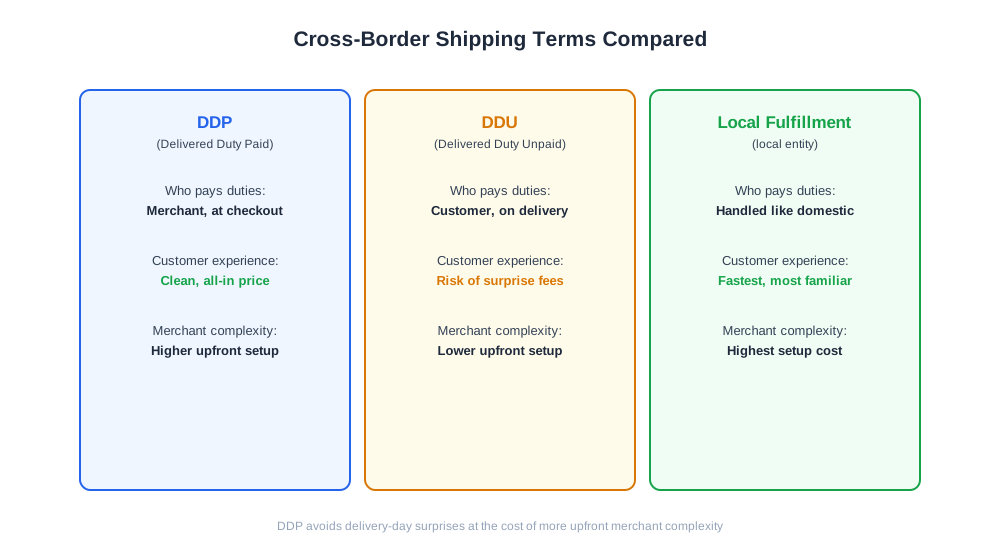
| Term | Who Pays Duties | Customer Experience | Merchant Complexity |
|---|---|---|---|
| DDP (Delivered Duty Paid) | Merchant, collected at checkout | Clean, all-in price, no delivery surprises | Higher upfront complexity, better experience |
| DDU (Delivered Duty Unpaid) | Customer, collected on delivery | Risk of surprise fees, can cause refused deliveries | Lower upfront complexity for merchant |
| Local fulfillment/entity | Handled like a domestic order | Fastest, most familiar experience | Highest setup cost and complexity |
Stay Updated on AI Visibility Trends
Get the latest insights on AI mentions, brand monitoring, and optimization strategies.
Cross-Border Ecommerce and AI-Driven Commerce
As AI shopping assistants like ChatGPT Shopping and Perplexity Shopping become more common starting points for product research, they increasingly need to communicate accurate shipping timelines, duties, and total landed cost for cross-border purchases — details that are more complex to convey correctly than a simple domestic price. Merchants with clear, structured international shipping and pricing data are better positioned to be represented accurately when an AI assistant surfaces their products to a shopper outside their home market.
Understanding which markets are actually worth the added operational cost requires visibility into profitability by geography, not just revenue. AmICited’s eshop_get_geo_profitability and eshop_get_geography tools break down revenue and margin by country for connected stores, helping merchants see, market by market, whether international expansion is genuinely profitable once shipping, duties, and currency effects are factored in — rather than assuming all markets perform similarly to the home market.
Best Practices for Cross-Border Ecommerce
- Show prices in local currency with a buffer for FX fluctuation and cross-border processing fees
- Choose Delivered Duty Paid shipping where feasible, so customers see a single all-in price with no delivery-day surprises
- Set realistic delivery time expectations per market rather than defaulting to domestic timelines
- Track margin and cost per international market separately from domestic performance, not as a blended average
- Start with a small number of markets to validate demand and operational fit before expanding broadly
- Localize returns policy communication clearly, since cross-border returns are often the most expensive part of the experience
Common Cross-Border Ecommerce Mistakes
A frequent mistake is expanding into a new country without adjusting delivery time expectations, leaving customers frustrated when a shipment that would have taken two days domestically takes two to three weeks internationally with no advance warning. Another common issue is defaulting to Delivered Duty Unpaid shipping without clearly disclosing that customs fees will be collected on delivery, which creates a jarring surprise cost at exactly the moment a customer expects to simply receive their order. Some merchants track only blended, company-wide margin and don’t realize that international orders are quietly less profitable per order once shipping and duties are included, masking a problem that only shows up when broken out by market. It’s also common to underestimate the cost and complexity of cross-border returns, since shipping a product back across a border and through customs again can cost more than the original shipping fee, sometimes making a return uneconomical for both merchant and customer. Finally, some businesses expand into too many markets simultaneously without validating demand first, spreading operational and localization effort thin across markets that individually don’t generate enough volume to justify the investment.