
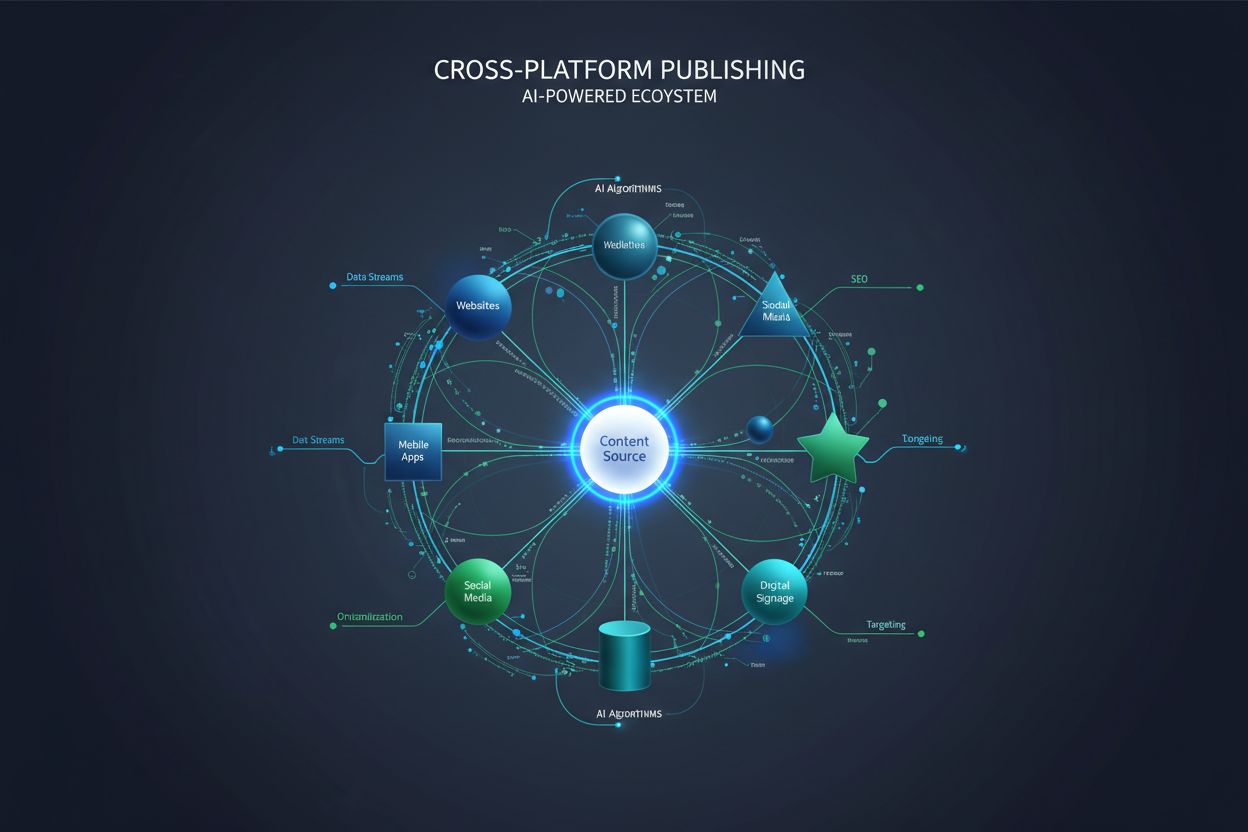
Cross-Platform AI Publishing
Learn how cross-platform AI publishing distributes content across multiple channels optimized for AI discovery. Understand PESO channels, automation benefits, a...
9 min read

Cross-platform optimization is the strategic coordination and unified management of content, campaigns, and brand visibility across multiple digital platforms and AI search engines to maximize overall performance, reach, and return on investment. It involves creating cohesive strategies that work seamlessly across different channels while maintaining consistent messaging and tracking unified performance metrics.
Cross-platform optimization is the strategic coordination and unified management of content, campaigns, and brand visibility across multiple digital platforms and AI search engines to maximize overall performance, reach, and return on investment. It involves creating cohesive strategies that work seamlessly across different channels while maintaining consistent messaging and tracking unified performance metrics.
Cross-platform optimization is the strategic coordination and unified management of content, campaigns, and brand visibility across multiple digital platforms and AI search engines to maximize overall performance, reach, and return on investment. Rather than managing each platform independently, cross-platform optimization treats all channels as interconnected parts of a unified system designed to amplify customer reach and conversion efficiency. This approach recognizes that modern customers interact with brands through multiple touchpoints—web, mobile, social media, and increasingly, AI search engines—before making purchasing decisions. The goal is to create cohesive strategies that work seamlessly across different channels while maintaining consistent messaging and tracking unified performance metrics that reveal the true impact of each platform on business outcomes.
The concept of cross-platform optimization emerged as digital marketing fragmented across numerous channels, forcing marketers to choose between managing isolated campaigns or developing integrated strategies. Historically, brands operated in platform silos, with separate teams optimizing Facebook, Google, and other channels independently. However, research demonstrates that 73% of customers use multiple channels before making a purchase, yet most agencies and organizations struggle with fragmented data and time-consuming manual processes. The cross-platform advertising market reflects this growing complexity, valued at $195.7 billion in 2023 and projected to reach $725.4 billion by 2033, growing at a compound annual growth rate of 14.2% from 2025 to 2033. This explosive growth underscores the critical importance of mastering cross-platform coordination. Additionally, 87% of retailers consider omnichannel marketing essential, yet the majority lack the technical infrastructure and unified tracking systems necessary to execute effective cross-platform strategies. The emergence of AI search engines like ChatGPT, Perplexity, Google AI Overviews, and Claude has added a new dimension to cross-platform optimization, requiring brands to optimize for algorithms that reason and synthesize information rather than simply rank pages.
Effective cross-platform optimization requires a robust technical foundation that enables seamless data flow between platforms and unified performance tracking. The foundation begins with unified tracking systems that capture the complete customer journey, not just platform-specific interactions. This involves implementing comprehensive UTM parameter strategies that track not just traffic sources, but campaign interactions across platforms. When someone clicks a LinkedIn ad, visits a website, and later converts through a Facebook retargeting ad, proper tracking captures this complete journey and attributes credit appropriately. Cross-platform pixel sharing represents another critical technical component, where Facebook’s Conversions API receives conversion data from other platforms, while Google’s Enhanced Conversions incorporate offline conversion data. This creates a more complete picture for each platform’s optimization algorithms. Data consolidation is equally important, requiring centralization of performance data in unified dashboards that show cross-platform performance in real-time. Standardizing KPI definitions across platforms ensures that “cost per acquisition” means the same thing whether the conversion came from Facebook, Google, or TikTok. Without this technical foundation, brands operate with incomplete information, making optimization decisions based on fragmented data that obscures the true impact of each platform.
| Aspect | Cross-Platform Optimization | Single-Platform Optimization | Omnichannel Marketing | Multi-Channel Attribution |
|---|---|---|---|---|
| Scope | Coordinates strategy across multiple platforms simultaneously | Focuses on maximizing performance within one channel | Integrates all customer touchpoints into unified experience | Tracks credit distribution across multiple touchpoints |
| Data Integration | Unified view of user behavior across all platforms | Isolated, platform-specific insights only | Seamless customer experience across all channels | Multi-touch attribution modeling across channels |
| Customer Journey | Tracks complete journey across multiple platforms | Captures platform-specific journeys only | Recognizes interconnected touchpoints in customer path | Analyzes how each touchpoint influences conversion |
| Performance Measurement | Unified ROAS and cost per acquisition across platforms | Platform-specific metrics and KPIs | Holistic customer experience metrics | Revenue attribution by touchpoint |
| Budget Allocation | Dynamic, based on cross-platform performance data | Static allocation per platform | Balanced investment across all channels | Optimized based on attribution insights |
| Implementation Complexity | Moderate to high, requires unified infrastructure | Low, platform-native tools sufficient | High, requires extensive integration | Moderate, depends on data quality |
| Effectiveness | 37% more effective than single-channel campaigns | Limited to single-channel impact | Highest effectiveness when properly executed | Enables data-driven optimization decisions |
| Best For | Agencies, enterprises, complex customer journeys | Small businesses, single-channel focus | Customer-centric organizations | Data-driven marketing teams |
The most successful cross-platform optimization strategies begin with comprehensive audience understanding rather than platform selection. This audience-first approach involves mapping one comprehensive customer profile across all touchpoints, understanding how customers move between platforms throughout their journey. Rather than asking “How do we optimize Facebook?” successful organizations ask “How do we reach our customer wherever they are?” This fundamental shift in perspective transforms optimization from platform-centric to customer-centric. Unified audience mapping requires analyzing existing data to identify cross-platform patterns, revealing which platforms customers discover your brand on, how they research and compare options, where they typically convert, and their post-purchase engagement patterns. For B2B organizations, this analysis might reveal that decision-makers start research on LinkedIn, validate options through Google search, and make final decisions after seeing Facebook retargeting ads. Understanding these patterns enables strategic message progression that guides customers toward conversion. The 80/20 rule applies effectively here: maintain 80% consistent core messaging while adapting 20% for platform-specific contexts and user behaviors. This ensures brand consistency while respecting each platform’s unique characteristics and audience expectations.
Attribution modeling represents one of the most critical yet challenging aspects of cross-platform optimization. Multi-touch attribution moves beyond outdated last-click models that give all credit to the final touchpoint before conversion, instead distributing credit across the entire customer journey. Different attribution models serve different purposes: first-click attribution works well for awareness campaigns, time-decay attribution suits consideration-stage content, and position-based attribution effectively measures complete funnel campaigns. Research shows that multi-channel campaigns are 37% more effective than single-channel campaigns, but only when properly attributed and measured across all touchpoints. Cross-device tracking adds another layer of complexity, as customers don’t live on one device. A B2B decision-maker might research on mobile during commutes but convert on desktop at the office. Without cross-device tracking, brands miss significant portions of the customer journey and misattribute conversions. Advanced conversion prediction models help understand which early-stage interactions are most likely to lead to conversions, enabling optimization for quality traffic rather than volume. This sophisticated approach to attribution reveals which platform combinations drive the highest-value customers and which touchpoints are most influential at different stages of the buyer journey.
Intelligent budget allocation across platforms requires moving beyond static allocations to dynamic, performance-based models. A typical baseline allocation might allocate 40% to Facebook/Instagram, 30% to Google, 20% to emerging platforms like TikTok and LinkedIn, and 10% to testing budget for new opportunities. However, these allocations should be dynamic, adjusting based on real-time performance data. When TikTok campaigns outperform Facebook by 20%, budget allocation should shift accordingly. Platform-specific cost factors influence allocation decisions: Facebook and Instagram offer lower CPMs but face higher competition in some niches, Google commands higher intent but higher CPCs, TikTok provides lower costs but newer audience behaviors, and LinkedIn offers valuable B2B targeting at premium costs. AI-powered optimization eliminates the manual burden of constant monitoring and adjustment. Systems that recommend budget shifting based on performance thresholds—for example, increasing budget by 15% when a platform achieves 20% better ROAS than target—free teams to focus on strategy rather than tactical management. These systems monitor campaigns 24/7, identifying optimization opportunities that humans would miss, and providing recommendations that ensure consistent performance improvement without overwhelming team capacity.
The emergence of AI search engines has fundamentally changed cross-platform optimization strategy. Unlike traditional search engines that rank pages, AI systems like ChatGPT, Perplexity, Google AI Overviews, and Claude extract meaning, synthesize knowledge, and respond using natural language. This requires fundamentally different optimization approaches. Research reveals that listicles are cited 25% of the time in AI answers, making them the most effective content format for AI visibility. Blogs and opinion pieces capture 12% of citations, while video content surprisingly has only 1.74% citation rates despite high engagement metrics. Platform-specific citation patterns vary dramatically: YouTube is cited 25% of the time in Google AI Overviews when at least one page is cited, but ChatGPT cites YouTube less than 1% of the time, indicating that video optimization strategies must differ by platform. Semantic URLs with 4-7 descriptive words get 11.4% more citations than generic URLs, making URL structure a critical optimization factor. Content must be structured for machines that reason, requiring factual, transparent, schema-supported writing that answers questions directly. The E-E-A-T framework (Experience, Expertise, Authoritativeness, Trustworthiness) becomes essential, as AI systems evaluate content credibility differently than traditional search algorithms.
Cross-platform optimization continues to evolve as technology advances and customer behavior shifts. The integration of generative AI into optimization workflows represents a significant trend, with AI systems increasingly capable of analyzing complex cross-platform data, identifying patterns humans would miss, and recommending optimizations automatically. The rise of AI search engines as primary discovery channels is reshaping how brands think about cross-platform presence. Rather than optimizing solely for Google rankings, brands must now ensure visibility across ChatGPT, Perplexity, Google AI Overviews, Claude, and emerging AI platforms. This expansion of platforms requiring optimization makes unified tracking and monitoring more critical than ever. Privacy-first optimization is becoming increasingly important as regulations like GDPR and CCPA tighten, requiring brands to collect useful insights while respecting user privacy. The future likely involves more sophisticated first-party data strategies that rely on direct customer relationships rather than third-party tracking. Real-time personalization powered by AI will enable brands to deliver platform-specific experiences that adapt to individual user behavior and preferences. The convergence of omnichannel marketing and AI visibility optimization suggests that future success requires brands to think simultaneously about customer experience across traditional channels and visibility in AI-generated responses. Organizations that master cross-platform optimization today—building unified tracking infrastructure, developing audience-first strategies, and implementing sophisticated attribution models—will be best positioned to adapt as the digital landscape continues to evolve.
Cross-platform optimization has evolved from a nice-to-have marketing practice to a critical business requirement in an increasingly fragmented digital landscape. The convergence of multiple advertising platforms, AI search engines, and sophisticated customer journeys means that brands can no longer succeed by optimizing channels in isolation. The data is clear: multi-channel campaigns are 37% more effective than single-channel campaigns, yet 73% of customers use multiple channels before purchasing, and most organizations still operate in platform silos. The technical foundation of cross-platform optimization—unified tracking, standardized event taxonomy, multi-touch attribution, and centralized dashboards—enables brands to see the complete customer journey and make data-driven optimization decisions. The strategic foundation—audience-first thinking, consistent messaging with platform-specific adaptation, and dynamic budget allocation—ensures that optimization efforts align with customer needs and business objectives. As AI search engines become increasingly important discovery channels, cross-platform optimization must expand to include visibility monitoring across ChatGPT, Perplexity, Google AI Overviews, and Claude. Organizations that invest in proper cross-platform infrastructure, develop sophisticated attribution models, and maintain regular optimization reviews will capture disproportionate value from their marketing investments while building stronger customer relationships and achieving sustainable competitive advantage.
Cross-platform optimization coordinates strategies across multiple channels simultaneously, recognizing that customers interact with brands through various touchpoints before converting. Single-platform optimization focuses on maximizing performance within one channel in isolation. Research shows that multi-channel campaigns are 37% more effective than single-channel campaigns, but only when properly attributed and measured across all touchpoints. Cross-platform approaches capture the complete customer journey, while single-platform methods miss critical interactions that influence purchasing decisions.
Cross-platform optimization in the AI context means ensuring your brand appears consistently and accurately across multiple AI search engines like ChatGPT, Perplexity, Google AI Overviews, and Claude. AmICited monitors these appearances to help brands understand their visibility across different AI platforms. Optimization involves creating content that resonates with each platform's algorithms while maintaining brand consistency, ensuring your domain and content are cited appropriately in AI-generated responses.
The primary challenges include data fragmentation across platforms, inconsistent tracking implementation, complex attribution modeling, and managing different platform specifications and best practices. According to industry research, 73% of customers use multiple channels before making a purchase, yet most organizations operate in platform silos that miss these cross-channel journeys. Additionally, compliance with privacy regulations like GDPR and CCPA while maintaining useful tracking adds technical complexity that requires careful planning and proper tool selection.
Success should be measured through unified business metrics rather than platform-specific vanity metrics. Key performance indicators include unified ROAS (return on ad spend), cost per acquisition across all platforms, customer lifetime value, and attribution-based revenue tracking. For AI visibility specifically, brands should track citation frequency, position prominence in AI responses, and conversion attribution from AI sources. Regular cross-platform reviews—weekly tactical, monthly trend analysis, and quarterly strategic assessments—help identify optimization opportunities and measure incremental revenue uplift.
Unified tracking is the foundation of effective cross-platform optimization, capturing the complete customer journey across all touchpoints rather than isolated platform interactions. This involves implementing consistent UTM parameters, cross-platform pixel sharing, and centralized data consolidation in unified dashboards. Proper tracking enables accurate multi-touch attribution, reveals how platforms work together to drive conversions, and provides the data necessary for intelligent budget allocation. Without unified tracking, brands cannot accurately understand which platforms deserve credit for conversions, leading to poor budget decisions and missed optimization opportunities.
Cross-platform optimization requires developing content that evolves strategically across platforms while maintaining core messaging consistency. This means creating platform-specific variations that respect each channel's unique characteristics, audience behavior, and technical specifications. For example, content optimized for TikTok's entertainment-focused audience differs significantly from content designed for Amazon's shopping-focused users. The 80/20 rule applies: maintain 80% consistent core messaging while adapting 20% for platform-specific contexts, ensuring content resonates with each platform's algorithms and user expectations.
Most organizations see initial improvements within 2-4 weeks of implementing unified tracking and optimization recommendations, particularly in data consolidation and basic performance improvements. Full cross-platform synergy typically develops over 6-8 weeks as data accumulates and AI optimization algorithms learn patterns across platforms. However, the timeline varies based on implementation complexity, data quality, and the number of platforms involved. Continuous optimization and regular strategy reviews accelerate results, while organizations that maintain consistent optimization practices see compounding improvements over time.
Start tracking how AI chatbots mention your brand across ChatGPT, Perplexity, and other platforms. Get actionable insights to improve your AI presence.
Learn how cross-platform AI publishing distributes content across multiple channels optimized for AI discovery. Understand PESO channels, automation benefits, a...

Learn how to optimize your brand presence on Discord, Slack, Reddit, and other community platforms for AI visibility. Discover strategies for authentic engageme...

Community discussion on optimizing for multiple AI platforms simultaneously. Real strategies for managing visibility across ChatGPT, Perplexity, Google AI, Clau...