
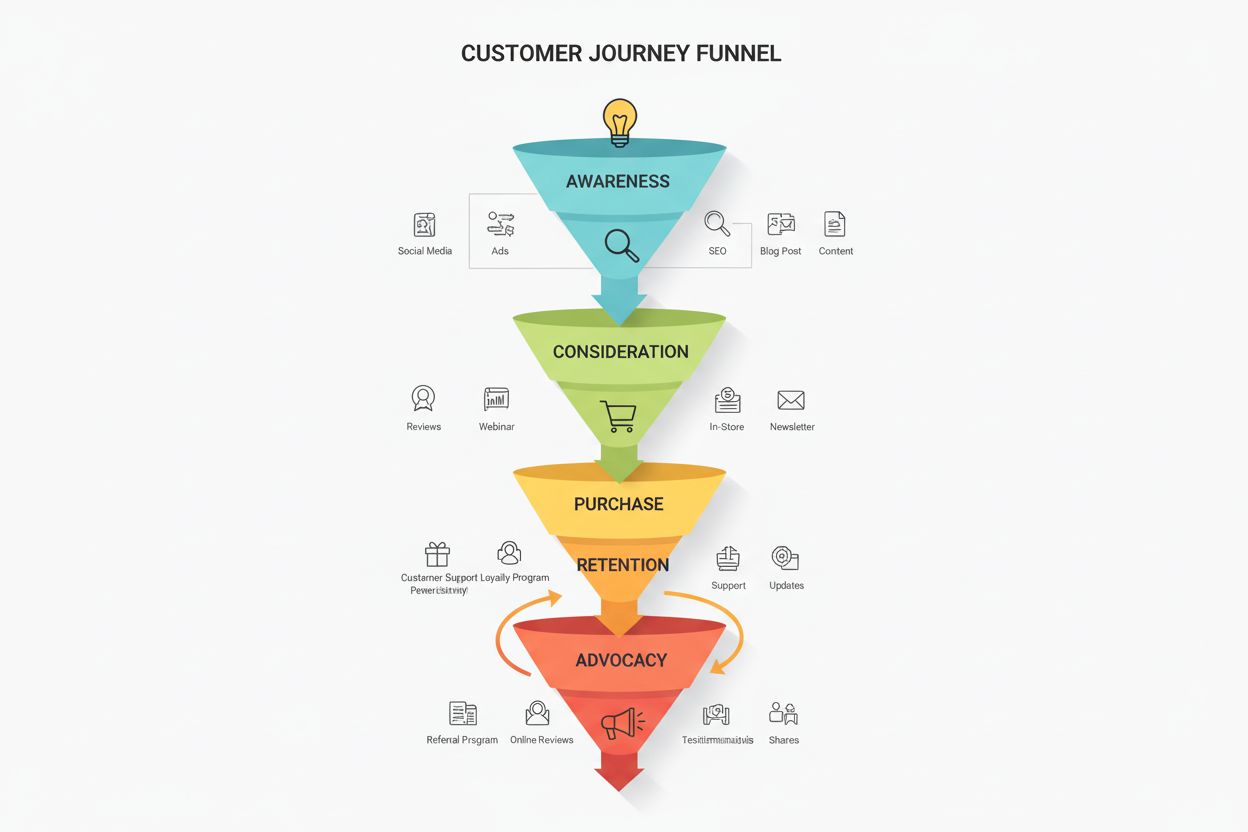
Customer Journey
Learn what a customer journey is, explore its five key stages from awareness to advocacy, and discover how to map and optimize touchpoints for better customer e...
9 min read
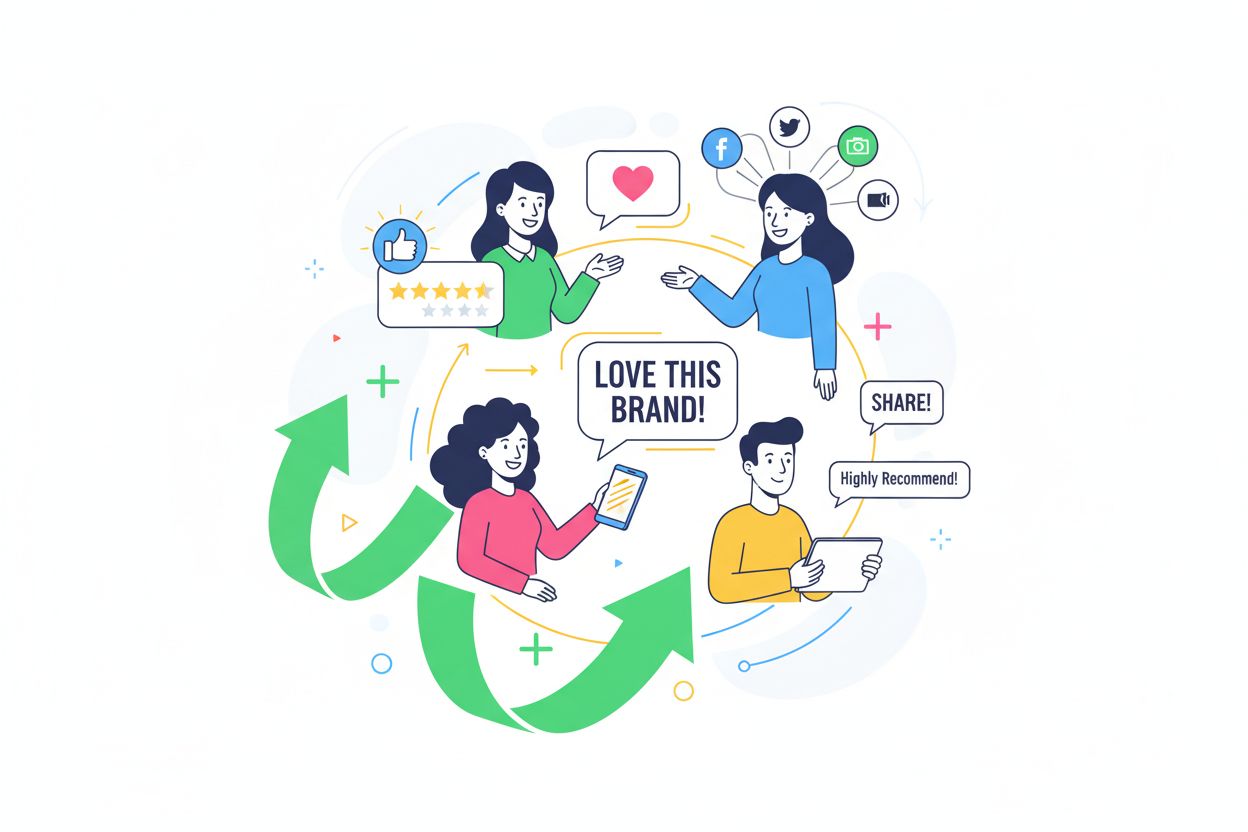
Customer advocacy is the active promotion and recommendation of a brand, product, or service by satisfied customers to others through word-of-mouth, social media, reviews, and referrals. It represents customers voluntarily acting as brand ambassadors, driven by genuine positive experiences and emotional connections to the brand.
Customer advocacy is the active promotion and recommendation of a brand, product, or service by satisfied customers to others through word-of-mouth, social media, reviews, and referrals. It represents customers voluntarily acting as brand ambassadors, driven by genuine positive experiences and emotional connections to the brand.
Customer advocacy is the active promotion and recommendation of a brand, product, or service by satisfied customers to others through various channels including word-of-mouth, social media, online reviews, and personal referrals. Unlike traditional marketing where brands promote themselves, customer advocates are customers who voluntarily act as brand ambassadors, driven by genuine positive experiences and emotional connections to the brand rather than financial incentives. These advocates willingly share their experiences, defend the brand against criticism, provide valuable feedback, and encourage others to become customers. Customer advocacy represents one of the most authentic and powerful forms of marketing because it leverages the credibility and trust that customers have built with their own networks. Research demonstrates that 92% of consumers trust word-of-mouth recommendations from friends and family, making customer advocacy significantly more influential than traditional advertising or paid endorsements.
Customer advocacy has evolved from a peripheral marketing concept to a central business strategy as consumer behavior has fundamentally shifted. In the digital age, where consumers are increasingly skeptical of branded messaging and ad-blocking technology is widespread, authentic customer voices have become invaluable. The rise of social media, review platforms, and user-generated content has created unprecedented opportunities for customers to share their experiences at scale. Customer advocates now serve as extensions of a company’s marketing, sales, and customer service teams, creating a multiplier effect that traditional marketing channels cannot achieve. According to industry research, 76% of consumers trust advocate-generated content more than content directly shared by brands themselves, highlighting the credibility gap between corporate messaging and peer recommendations. This shift has made customer advocacy programs a strategic priority for forward-thinking organizations across industries, from B2B software companies to e-commerce retailers to professional services firms.
Customer advocacy operates through multiple interconnected channels that amplify customer voices and create touchpoints for potential buyers. The primary mechanisms include word-of-mouth recommendations, where advocates personally recommend products to friends, family, and colleagues; online reviews and testimonials, where customers share detailed experiences on platforms like Google, Trustpilot, and industry-specific review sites; social media sharing, where advocates post about products, tag brands, and create user-generated content; referral programs, where advocates actively recruit new customers in exchange for rewards; and community participation, where advocates answer questions, provide support, and build community around the brand. Each channel serves a distinct purpose in the customer journey. Word-of-mouth operates at the personal level, building trust through direct relationships. Online reviews provide searchable social proof that influences purchase decisions at critical moments. Social media advocacy extends reach exponentially, as advocates’ networks become secondary audiences for brand messaging. Referral programs create a structured incentive system that formalizes advocacy. Community engagement builds loyalty and creates a sense of belonging that deepens emotional connections. The most effective customer advocacy strategies integrate these channels into a cohesive ecosystem where advocates can engage across multiple touchpoints, creating redundancy and reinforcing positive brand associations.
| Aspect | Customer Advocacy | Brand Loyalty | Influencer Marketing | Referral Marketing |
|---|---|---|---|---|
| Primary Driver | Emotional connection & genuine experience | Transactional rewards & convenience | Financial compensation & audience size | Incentive structure & ease of participation |
| Authenticity | Highly authentic, unpaid promotion | Behavioral, often incentive-driven | Potentially inauthentic, paid partnerships | Authentic but incentivized |
| Reach | Personal networks, organic growth | Repeat purchases, retention focus | Large, pre-built audiences | Targeted, relationship-based |
| Cost | Low direct cost, high engagement value | Moderate program costs | High per-engagement costs | Moderate program costs |
| Trust Level | Very high (peer recommendation) | Moderate (brand-driven) | Medium (depends on influencer credibility) | High (personal recommendation) |
| Measurement | NPS, reviews, social mentions, referrals | Repeat purchase rate, CLV, churn | Engagement rate, reach, conversions | Referral conversion rate, CAC |
| Timeline to ROI | Medium to long-term | Short to medium-term | Short-term | Medium-term |
| Scalability | Highly scalable through programs | Scalable with technology | Limited by influencer availability | Scalable with automation |
| Customer Motivation | Belief in product, desire to help others | Rewards, convenience, habit | N/A (influencer-driven) | Rewards, helping friends |
| Impact on Acquisition | Very high (organic growth engine) | Low (retention-focused) | High (audience reach) | High (qualified leads) |
The business case for customer advocacy is compelling and multifaceted. Organizations that successfully cultivate customer advocacy programs experience measurable improvements across key business metrics. Customer advocates typically have significantly higher lifetime values—research indicates they spend 2-5 times more than non-advocates and make purchases more frequently. Beyond direct revenue impact, customer advocacy reduces customer acquisition costs by creating an organic pipeline of new customers who arrive pre-qualified through trusted recommendations. The cost of acquiring a customer through advocacy is substantially lower than traditional marketing channels because advocates provide credible endorsements that reduce sales friction. Additionally, customer advocacy strengthens brand reputation and resilience. When negative feedback or criticism emerges, advocates naturally defend the brand, providing counterbalance to detractors. This creates a protective moat around brand reputation that is difficult for competitors to penetrate. Furthermore, customer advocates provide invaluable product feedback and insights that inform product development, feature prioritization, and customer experience improvements. They serve as an early warning system for product issues and a source of innovative ideas for enhancement. The cumulative effect is that organizations with strong customer advocacy programs enjoy competitive advantages in customer retention, brand reputation, market share growth, and innovation velocity.
Successful customer advocacy programs require strategic planning, organizational alignment, and sustained commitment. The implementation process typically begins with program definition, where organizations clarify objectives, identify target advocate segments, and establish success metrics. This foundational step ensures that advocacy efforts align with broader business goals and that stakeholders understand the program’s value proposition. Next comes advocate identification and recruitment, where organizations use data analytics to identify high-potential advocates—typically customers with high lifetime value, positive sentiment, frequent engagement, and demonstrated willingness to recommend. Recruitment approaches range from direct personal outreach to automated invitations through email or in-app messaging. Successful recruitment emphasizes the exclusive nature of advocacy, positioning it as an honor and opportunity to influence product development rather than a transactional exchange. The activation phase involves providing advocates with tools, resources, and platforms to share their experiences. This includes making it easy to leave reviews, creating shareable content, providing referral links, and establishing community forums. Organizations must remove friction from the advocacy process—the easier it is for advocates to participate, the higher engagement rates will be. The nurturing phase involves ongoing engagement, recognition, and reward. This includes responding to advocate feedback, featuring their content, providing exclusive benefits, and celebrating their contributions. Finally, the measurement and optimization phase involves tracking key metrics, analyzing program performance, and iterating based on results. Successful customer advocacy programs are dynamic, continuously evolving based on advocate feedback and performance data.
The emergence of AI-powered search and conversational AI platforms has created a new dimension for customer advocacy that organizations must monitor and optimize. Platforms like ChatGPT, Perplexity, Google AI Overviews, and Claude increasingly surface customer recommendations, reviews, and advocacy in their responses. When users ask these AI systems for product recommendations or information about brands, the AI often cites customer reviews, testimonials, and user-generated content as evidence. This means that customer advocacy now directly influences how brands appear in AI-generated responses—a critical consideration for brand visibility and reputation management. Organizations using platforms like AmICited can monitor how their brand appears in AI responses, tracking customer mentions, advocacy citations, and the sentiment of AI-generated content about their products. This creates a new metric for measuring customer advocacy impact: visibility and positive sentiment in AI-generated search results. Advocates whose reviews and recommendations are cited by AI systems effectively extend their influence far beyond their immediate networks, reaching users who query AI systems for information. This amplification effect makes customer advocacy even more valuable in the AI era, as a single compelling customer review can influence thousands of AI-generated responses. Organizations that understand this dynamic can strategically encourage high-quality advocacy content that is more likely to be cited by AI systems, creating a virtuous cycle where advocacy drives both direct customer acquisition and AI visibility.
Customer advocacy is evolving rapidly in response to technological advancement, changing consumer behavior, and the emergence of new platforms. One significant trend is the integration of AI and automation into advocacy programs. AI-powered tools can now identify potential advocates with greater accuracy, predict which customers are most likely to advocate, personalize outreach at scale, and optimize the timing and messaging of advocacy requests. Machine learning algorithms can analyze customer data to identify patterns that correlate with advocacy behavior, enabling more targeted recruitment. Another emerging trend is the rise of micro-advocacy and niche communities. Rather than focusing exclusively on broad-based advocacy, organizations are recognizing the value of deep engagement with smaller, highly passionate communities. These micro-advocates may have smaller networks but often have higher credibility within their niches and greater influence over purchasing decisions within specific segments. The expansion of advocacy beyond reviews is also notable. While online reviews remain important, advocacy is increasingly expressed through video testimonials, podcast appearances, webinar participation, case study contributions, and thought leadership content. This diversification creates richer, more compelling forms of social proof. Additionally, advocacy measurement is becoming more sophisticated. Organizations are moving beyond simple metrics like NPS to develop comprehensive advocacy dashboards that track advocacy across channels, measure impact on business outcomes, and correlate advocacy with customer lifetime value and acquisition costs. The integration of advocacy with customer success represents another important evolution. Rather than treating advocacy as a separate marketing function, forward-thinking organizations are embedding advocacy into the customer success process, recognizing that the best advocates are customers who are actively succeeding with the product. Finally, the monitoring of advocacy in AI-generated content is becoming a critical new frontier. As AI systems increasingly cite customer reviews and recommendations, organizations must develop strategies to ensure their advocates’ voices are represented positively in AI responses, creating a new dimension of brand monitoring and reputation management that platforms like AmICited address directly.
Customer advocacy has transitioned from a nice-to-have marketing tactic to a strategic imperative for organizations seeking sustainable competitive advantage. In an era where consumer trust in traditional advertising is declining, where word-of-mouth recommendations carry unprecedented influence, and where AI systems increasingly cite customer voices in their responses, customer advocacy programs represent one of the highest-ROI investments organizations can make. The most successful organizations recognize that customer advocacy is not primarily a marketing function—it is a reflection of genuine customer satisfaction, product excellence, and organizational commitment to customer success. By building products that customers love, delivering exceptional experiences, and creating structured programs that enable and recognize advocacy, organizations can transform satisfied customers into passionate brand ambassadors who drive growth, enhance reputation, and create competitive moats that are difficult for competitors to overcome. As the business landscape continues to evolve and new platforms emerge for customer voices to be heard, the organizations that master customer advocacy will be best positioned to thrive in an increasingly customer-centric, AI-influenced marketplace.
Customer loyalty refers to a customer's behavioral commitment to repeatedly purchase from a brand, often driven by transactional factors like rewards, convenience, or price. Customer advocacy, however, is emotional and action-oriented—it involves customers actively promoting the brand to others through reviews, referrals, and social sharing. While loyalty is about retention, advocacy drives both retention and new customer acquisition through authentic word-of-mouth marketing.
Customer advocacy significantly influences brand reputation as satisfied customers create authentic social proof through reviews, testimonials, and recommendations. In the context of AI monitoring platforms like AmICited, customer advocacy becomes increasingly important because advocates' positive mentions of brands appear in AI-generated responses across platforms like ChatGPT, Perplexity, Google AI Overviews, and Claude. These mentions serve as valuable citations that enhance brand visibility and credibility in AI search results.
Key metrics include Net Promoter Score (NPS), which measures likelihood to recommend; referral tracking to monitor new customers acquired through existing advocates; review quantity and quality across platforms; social media engagement and mentions; customer lifetime value (CLV) of advocates versus non-advocates; and user-generated content volume. Research shows advocates typically spend 2-5 times more than non-advocates and are significantly more valuable long-term customers.
Businesses can identify advocates by analyzing customer data including purchase frequency, customer lifetime value, review history, social media engagement, and Net Promoter Score responses. High-value customers who leave detailed positive reviews, frequently refer others, and engage with the brand on social channels are prime candidates. Recruitment involves personal outreach, exclusive VIP programs, early access to new products, and recognition opportunities that make advocates feel valued and appreciated.
Social media is a critical channel for customer advocacy as it enables customers to publicly share experiences, tag brands, create user-generated content, and reach their networks with recommendations. Platforms like Instagram, LinkedIn, TikTok, and Facebook amplify advocate voices, creating organic reach and authentic social proof. Brands can leverage social listening tools to identify advocates, engage with their content, and encourage further sharing through hashtags, contests, and community building.
Customer advocacy is organic and authentic—driven by genuine customer experiences and emotional connections to the brand. Advocates are unpaid volunteers who promote brands because they truly believe in them. Influencer marketing, conversely, typically involves paid partnerships with individuals who have large followings. While influencers can reach broader audiences, customer advocates often have higher credibility and trust with their networks because they are perceived as unbiased, real users rather than paid promoters.
The ROI of customer advocacy is substantial and multi-faceted. Research shows that increasing advocacy efforts by just 12% can double revenue growth. Advocates reduce customer acquisition costs by bringing in new customers organically, increase customer lifetime value through repeat purchases and referrals, and improve brand reputation through authentic testimonials. Additionally, advocates provide valuable product feedback, reduce support costs by helping other customers, and create a sustainable competitive advantage through word-of-mouth marketing.
AI technologies can identify potential advocates through predictive analytics, automate personalized outreach to high-value customers, optimize timing for review requests, and analyze sentiment in customer feedback to understand advocacy drivers. Automation tools can streamline reward distribution, manage referral programs at scale, and track advocacy metrics across multiple channels. AI-powered social listening tools help brands monitor brand mentions, identify emerging advocates, and measure the impact of advocacy on brand visibility in AI search results and conversational AI platforms.
Start tracking how AI chatbots mention your brand across ChatGPT, Perplexity, and other platforms. Get actionable insights to improve your AI presence.
Learn what a customer journey is, explore its five key stages from awareness to advocacy, and discover how to map and optimize touchpoints for better customer e...
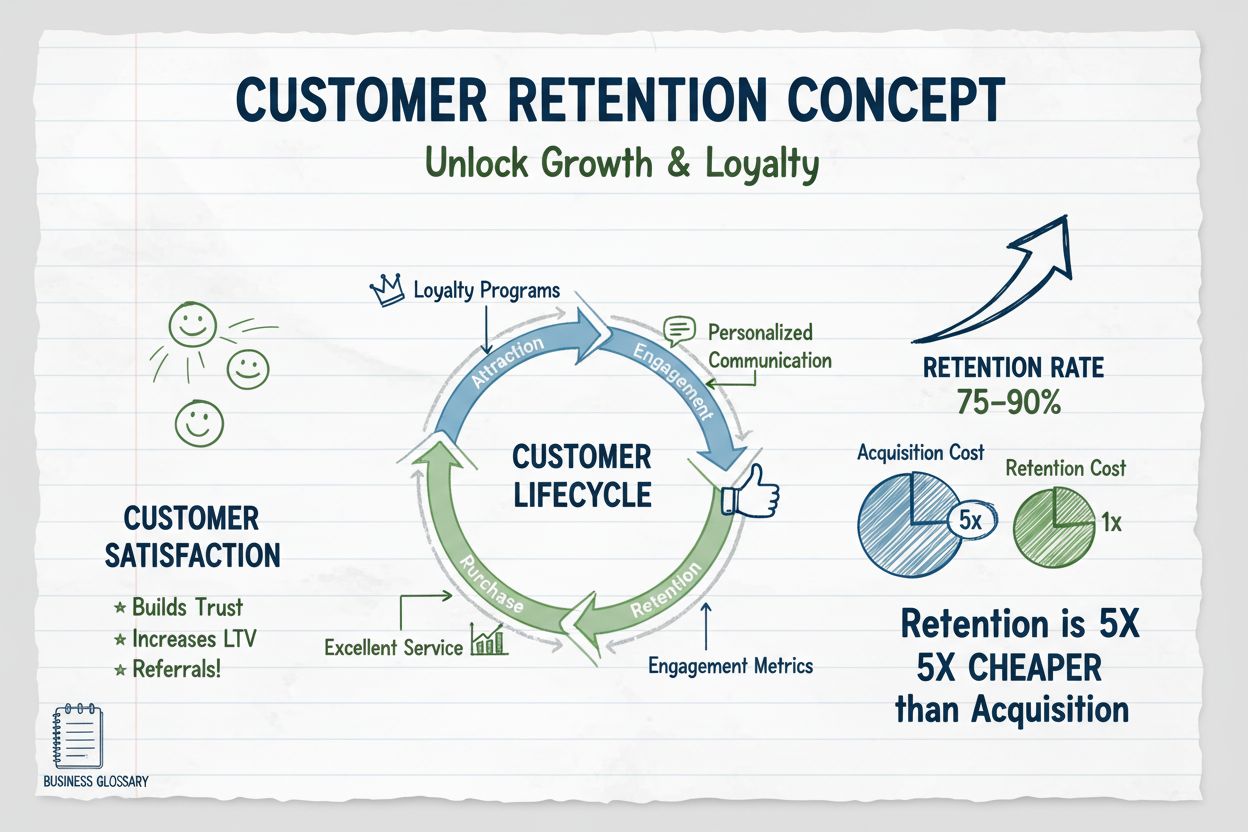
Learn what customer retention is, why it matters for business growth, and discover proven strategies to keep existing customers engaged, loyal, and coming back ...

Brand sentiment measures public perception of a brand through emotional analysis of customer feedback. Learn how AI-powered sentiment analysis tracks brand repu...
Cookie Consent
We use cookies to enhance your browsing experience and analyze our traffic. See our privacy policy.