Definition of Customer Retention
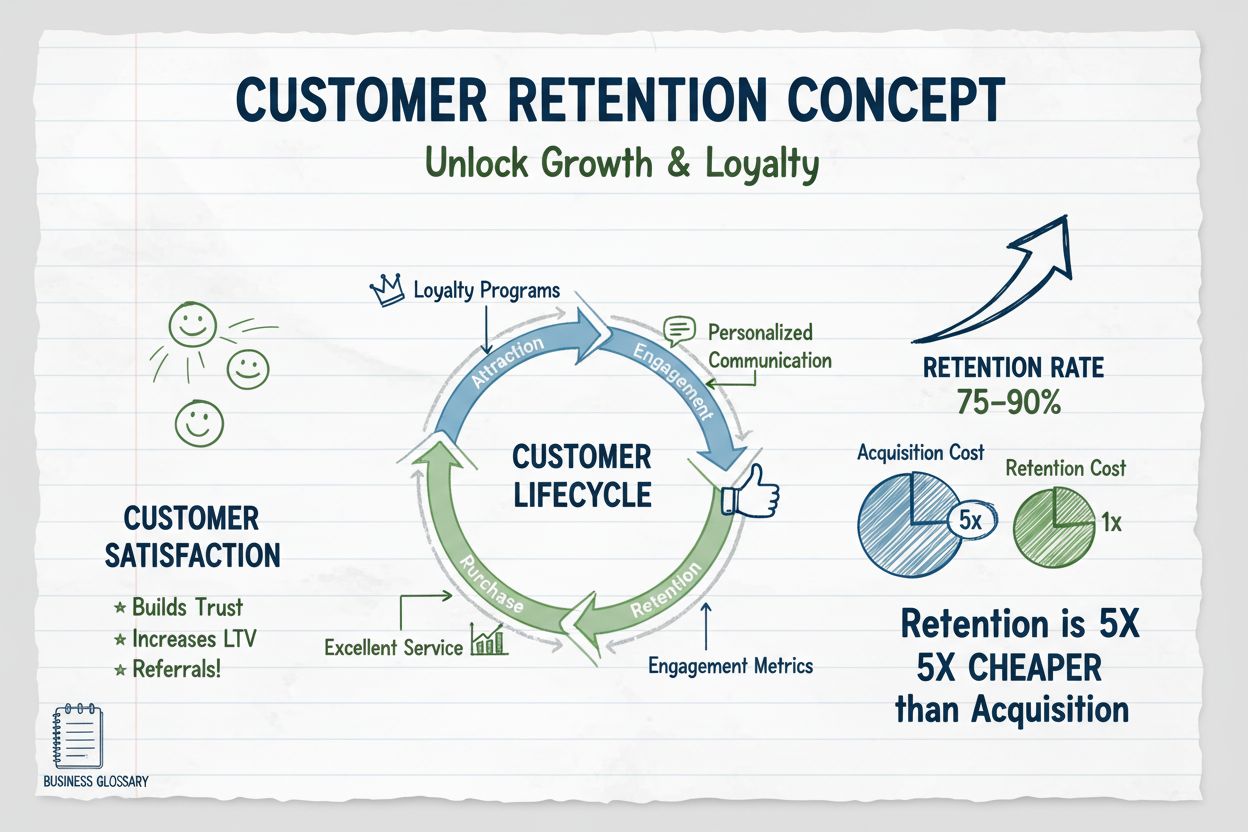
Customer retention is the strategic ability of a business to keep existing customers engaged, satisfied, and loyal, encouraging them to make repeat purchases and remain committed to the brand rather than switching to competitors. Unlike customer acquisition, which focuses on attracting new buyers, customer retention emphasizes building and maintaining long-term relationships that maximize customer lifetime value and minimize churn. It encompasses a comprehensive set of initiatives, processes, and practices designed to consistently deliver value, meet customer expectations, and create exceptional experiences at every touchpoint. The fundamental principle behind customer retention is that it is significantly more cost-effective and profitable to keep existing customers than to constantly acquire new ones. According to research from McKinsey, companies need to acquire three new customers to make up the business value of losing one existing customer, underscoring the critical importance of retention strategies in sustainable business growth.
The Strategic Importance of Customer Retention
Customer retention has become increasingly vital in today’s competitive marketplace where consumers have more choices than ever before. The business case for prioritizing retention is compelling and multifaceted. Research demonstrates that existing customers spend 67% more than new customers on average, and your top 10% of customers spend twice as much per order as the remaining 90%. This concentration of value means that losing high-value customers has an outsized impact on revenue. Furthermore, acquiring a new customer costs 5 to 7 times more than retaining an existing one, making retention not just a customer service priority but a fundamental business economics issue. The average customer retention rate across all industries stands at approximately 75.5%, though this varies significantly by sector—media and professional services achieve 84%, software reaches 77%, while e-commerce averages only 30%. Understanding where your industry stands and how your company compares provides essential context for setting realistic retention goals and identifying improvement opportunities.
Ready to Monitor Your AI Visibility?
Track how AI chatbots mention your brand across ChatGPT, Perplexity, and other platforms.
| Aspect | Customer Retention | Customer Acquisition | Customer Loyalty | Customer Satisfaction |
|---|
| Primary Focus | Keeping existing customers engaged and coming back | Attracting new customers to the business | Building emotional connection and brand advocacy | Meeting or exceeding customer expectations |
| Cost Efficiency | 5-7x cheaper than acquisition | Significantly more expensive | Moderate cost, high ROI | Foundational cost for retention |
| Time Horizon | Long-term relationship building | Short-term conversion focus | Long-term emotional investment | Ongoing throughout relationship |
| Key Metrics | Retention rate, churn rate, CLV | CAC, conversion rate, lead quality | NPS, repeat purchase rate, referrals | CSAT, NPS, customer effort score |
| Primary Benefit | Predictable recurring revenue | Revenue growth and market expansion | Brand advocacy and word-of-mouth | Foundation for retention and loyalty |
| Customer Behavior | Repeat purchases, consistent engagement | First-time purchase, trial conversion | Voluntary recommendations, premium spending | Positive reviews, continued usage |
| Strategic Outcome | Stable, profitable customer base | Expanded market reach and growth | Organic customer acquisition through referrals | Reduced churn and increased satisfaction |
Understanding Customer Retention Metrics and Measurement
Measuring customer retention effectively requires tracking multiple interconnected metrics that provide different perspectives on customer health and business performance. The customer retention rate is calculated using the formula: (Number of customers at end of period − New customers acquired during period) ÷ Number of customers at start of period × 100. For example, if a company starts a quarter with 1,000 customers, acquires 200 new customers, and ends with 1,150 customers, the retention rate would be 95% [(1,150 − 200) ÷ 1,000 × 100]. This metric reveals what percentage of your existing customer base remained with you, providing a clear snapshot of retention health. However, customer retention analysis becomes more sophisticated when you examine customer churn rate, which measures the inverse—the percentage of customers lost during a period. A 5% churn rate means a 95% retention rate, but tracking churn separately helps teams focus on the problem they’re trying to solve. Customer lifetime value (CLV) represents the total revenue expected from a customer throughout their entire relationship with your company, calculated as: Average customer value × Customer lifespan. This metric is particularly important because it reveals which customers are most valuable and where retention efforts should be concentrated. Monthly recurring revenue (MRR) and revenue churn rate provide additional perspective by measuring retention in terms of actual revenue rather than customer count, which is crucial for subscription-based businesses where customer value varies significantly.
Stay Updated on AI Visibility Trends
Get the latest insights on AI mentions, brand monitoring, and optimization strategies.
The Economics of Customer Retention: Why It Drives Profitability
The financial impact of customer retention on business profitability is substantial and well-documented. Research from Bain & Company demonstrates that a 5% increase in customer retention can result in a 25% to 95% increase in profit, depending on the industry and business model. This dramatic impact occurs because retained customers generate multiple revenue streams: they make repeat purchases, they are more receptive to upselling and cross-selling opportunities, and they require lower marketing and support costs compared to new customers. In the beauty and cosmetics industry specifically, customers spend 30% more per order after shopping with a brand for six months and 45% more after 36 months, illustrating how retention directly correlates with increased customer value over time. For small businesses, the impact is equally significant—61% of small businesses report that repeat customers account for more than half of their annual revenue. The cost advantage of retention is equally compelling: while acquiring a new customer requires extensive marketing spend to build brand awareness and trust, existing customers already understand your value proposition and are more likely to make additional purchases with minimal persuasion. This efficiency translates directly to improved profit margins, as the cost of serving an existing customer is substantially lower than acquiring a new one. Additionally, retained customers often become brand advocates who refer friends and family, effectively providing free customer acquisition through word-of-mouth marketing.
Core Strategies for Effective Customer Retention
Successful customer retention requires a multifaceted approach that addresses customer needs at every stage of their journey. Omnichannel support is foundational—customers expect to interact with your brand through their preferred channels, whether email, chat, phone, social media, or self-service portals. Companies with effective omnichannel engagement strategies retain approximately 89% of their customers, compared to only 33% for those with weak strategies. Personalization is equally critical; customers increasingly expect tailored experiences based on their purchase history, preferences, and behavior. This means moving beyond generic communications to deliver customized recommendations, segment-specific offers, and interactions that acknowledge previous conversations and transactions. Proactive customer service involves anticipating problems before they occur and reaching out to customers with solutions or preventive advice, rather than waiting for complaints. Research shows that 67% of customer churn can be prevented if issues are resolved at the first point of engagement, making proactive support a powerful retention lever. Loyalty programs reward customers for their continued business through points, exclusive discounts, VIP events, or tiered benefits. The usage of loyalty programs increased by 28% in 2024, and 83% of customers say being part of a loyalty program influenced them to make repeat purchases. Customer feedback loops are essential for continuous improvement—regularly collecting, analyzing, and acting on customer feedback demonstrates that you value their input and are committed to meeting their needs. Finally, community building creates spaces where customers can interact with each other, share experiences, and feel part of something larger than a transactional relationship.
Retention Challenges and How to Overcome Them
Despite the clear benefits of customer retention, businesses face significant challenges in executing effective retention strategies. Balancing automation with personalization is a primary tension—while automation improves efficiency and scalability, excessive automation can feel impersonal and erode customer trust. The solution lies in using automation to handle routine tasks while reserving human interaction for complex issues and high-value customers. Sustaining long-term engagement is another challenge, as customers’ initial excitement about a product often wanes after the first few weeks or months. This requires continuous value delivery through regular communication, feature updates, educational content, and reminders of why customers chose your product. Competing for attention in an increasingly crowded marketplace means your retention messaging must be compelling and relevant; customers are bombarded with offers from competitors, so your brand must consistently demonstrate unique value. Poor onboarding experiences contribute to 23% of average customer churn, making the initial customer experience disproportionately important. Many businesses focus heavily on acquisition but neglect the post-purchase experience, creating a gap where customers fail to realize value and subsequently churn. Building effective strategies requires ongoing adaptation to changing customer expectations, market conditions, and competitive dynamics. Companies that treat retention as a static program rather than a continuous improvement process often find their retention rates declining over time as customer needs evolve.
The Role of Technology and AI in Customer Retention
Modern customer retention strategies increasingly leverage technology and artificial intelligence to deliver personalized experiences at scale. Customer relationship management (CRM) systems unify customer data across multiple functions, enabling support teams to access complete customer histories and deliver contextual, personalized service. AI-powered chatbots provide 24/7 support, handling routine inquiries while escalating complex issues to human agents, ensuring customers receive assistance whenever they need it. Behavioral analytics tools track user engagement patterns, identifying customers at risk of churn before they leave, enabling proactive intervention. Email automation platforms deliver personalized messages at optimal times based on customer behavior and preferences. Predictive analytics use historical data to identify which customers are most likely to churn and which retention strategies are most effective for different segments. Platforms like AmICited take retention monitoring to a new level by tracking how your brand, products, and customer retention strategies are being discussed and recommended across AI systems like ChatGPT, Perplexity, Google AI Overviews, and Claude. This AI monitoring capability is increasingly important because customer retention strategies that generate positive mentions in AI-generated responses can significantly amplify their reach and credibility, influencing potential customers’ purchasing decisions through trusted AI recommendations.
Key Retention Metrics and What They Reveal
- Customer Retention Rate: Percentage of customers retained over a specific period; benchmark against industry standards to identify performance gaps
- Customer Churn Rate: Inverse of retention rate; focus on reducing this metric through targeted interventions and root cause analysis
- Customer Lifetime Value (CLV): Total revenue expected from a customer; use to prioritize retention efforts on high-value segments
- Monthly Recurring Revenue (MRR) and Revenue Churn: Measure retention in revenue terms rather than customer count; critical for subscription businesses
- Net Promoter Score (NPS): Measures customer willingness to recommend your brand; strong predictor of future retention and growth
- Customer Satisfaction Score (CSAT): Gauges satisfaction with specific interactions; use to identify pain points in the customer journey
- Repeat Purchase Rate: Percentage of customers making multiple purchases; indicates product-market fit and customer satisfaction
- Engagement Metrics (DAU/WAU/MAU): Daily, weekly, or monthly active users; declining activity often precedes churn
- Feature Adoption Rate: Percentage of users utilizing specific features; low adoption may indicate unmet customer needs
- Reactivation Rate: Percentage of churned customers who return; measures effectiveness of win-back campaigns
Industry-Specific Retention Benchmarks and Trends
Customer retention rates vary significantly across industries, reflecting different business models, customer expectations, and competitive dynamics. Media and professional services lead with 84% retention rates, benefiting from long-term client relationships and high switching costs. Software and IT services achieve 77% retention, supported by strong product-market fit and integration into customer workflows. Finance and banking maintain 78% retention, though this has been challenged by fintech disruption and changing consumer preferences. Automotive and transportation achieve 83% retention, reflecting the long-term nature of vehicle ownership and service relationships. E-commerce lags at 30% retention, reflecting the transactional nature of online retail and intense price competition. Hospitality, travel, and restaurants average 55% retention, challenged by seasonal variations and customer preference for variety. These benchmarks reveal that retention challenges are not uniform across industries; businesses in relationship-intensive sectors naturally achieve higher retention, while those in highly competitive, price-sensitive markets face greater churn pressures. Understanding your industry context is essential for setting realistic retention goals and identifying which strategies are most likely to succeed in your specific market.
Future Trends in Customer Retention Strategy
The landscape of customer retention is evolving rapidly, driven by technological advancement, changing customer expectations, and new competitive dynamics. Hyper-personalization powered by AI and machine learning is becoming the baseline expectation rather than a differentiator, with customers expecting experiences tailored to their individual preferences, behavior, and context. Predictive retention analytics will increasingly enable companies to identify at-risk customers before they churn, allowing for proactive intervention rather than reactive damage control. Omnichannel integration will become seamless, with customers expecting consistent experiences across all touchpoints without having to repeat information or context. Community-driven retention is gaining importance, as customers increasingly seek belonging and connection with brands and other customers, not just transactional value. Sustainability and values alignment are becoming retention factors, particularly for younger demographics who prefer to support companies aligned with their values. AI-powered customer service will continue to evolve, with AI agents handling increasingly complex interactions while maintaining the human touch that builds loyalty. The integration of AI monitoring platforms like AmICited into retention strategies represents a significant trend, as companies recognize that customer retention efforts must extend to how they are perceived and recommended by AI systems that increasingly influence purchasing decisions. As AI systems become more prevalent in customer decision-making, ensuring your retention strategies generate positive mentions in AI-generated responses will become as important as traditional customer satisfaction metrics.