


- Customer retention rate is the share of customers you had at the start of a period who are still customers at the end, leaving out new customers won during it.
- Formula: ((E − N) ÷ S) × 100. Forgetting to subtract new customers turns a retention problem into an apparent success.
- In ecommerce, define an active customer (for example, an order in the last 12 months) and keep that window in every report.
- Measure by cohort and by acquisition channel. One blended rate lets strong old cohorts hide weak new ones.
Where AmICited fits
With a shop connected, AmICited’s Customers and retention report tracks monthly cohort retention and places every customer in a segment by recency, frequency and spend: new, loyal, at risk, hibernating or lost.
See customers and retention
What Is Customer Retention Rate?
Customer retention rate (CRR) is the percentage of customers you had at the start of a period who are still customers at the end of it. New customers you win during the period are left out, so the number reflects loyalty, not growth. A store that doubles its customer count through ads can still have a weak retention rate if most of last year’s buyers never come back.
Subscription businesses, SaaS companies and banks track CRR monthly or annually because customers are on a contract and “still a customer” is easy to define. Ecommerce stores track it too, but need a rule for what counts as active, usually at least one order in a set window. You will find retention reports in Shopify analytics, in subscription tools, and in customer analytics platforms that work from order data.
How to Calculate Customer Retention Rate
The standard formula is:
CRR = ((E − N) ÷ S) × 100
- S = customers at the start of the period
- E = customers at the end of the period
- N = new customers acquired during the period
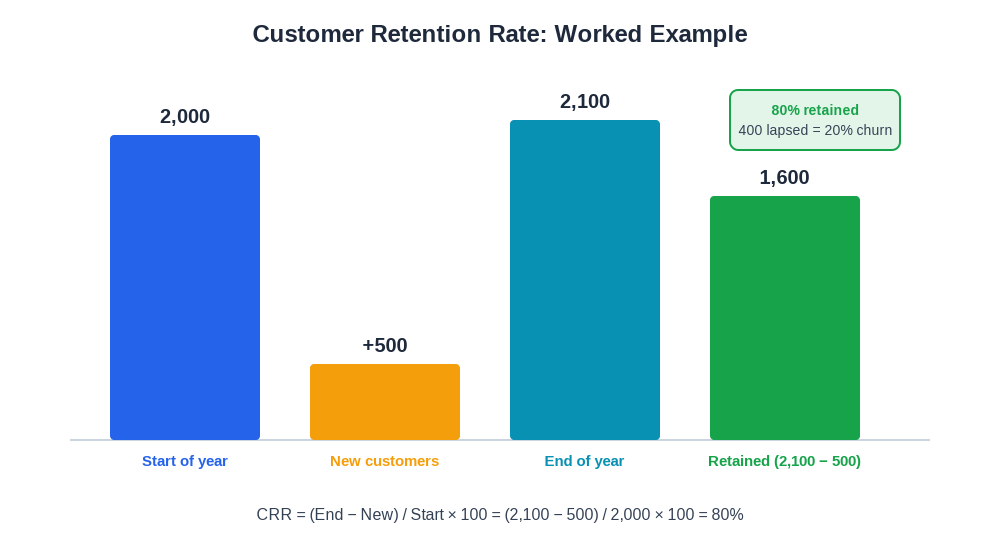
Here is a worked example for one year. You start with 2,000 active customers. During the year you acquire 500 new ones. At year end you have 2,100 active customers.
- Remove the new customers from the ending count: 2,100 − 500 = 1,600.
- Divide by the starting count: 1,600 ÷ 2,000 = 0.80.
- Multiply by 100: 80% customer retention rate.
That means 400 of your original 2,000 customers lapsed, a churn rate of 20%. Without the subtraction step, you would compare 2,100 with 2,000 and conclude you kept everyone and then some.
For ecommerce, the more useful version is cohort retention. Take everyone whose first order was in January, then measure what share ordered again in month 2, month 3 and so on. Cohort analysis shows whether retention is improving for newer customers, which a single company-wide rate hides.
Customer Retention Rate vs Churn Rate and Related Metrics
CRR is easy to confuse with metrics that sound similar but measure different things. The table below shows what each one answers.
| Metric | What it measures | Formula (simplified) | Best for |
|---|---|---|---|
| Customer retention rate | Share of starting customers still active | (E − N) ÷ S | Overall loyalty over a period |
| Churn rate | Share of starting customers lost | Lost ÷ S | Subscription health, early warning |
| Repeat purchase rate | Share of customers with more than one order | Repeat buyers ÷ all buyers | Ecommerce without contracts |
| Net revenue retention | Revenue kept from existing customers, incl. upgrades | (Start revenue + expansion − churn − contraction) ÷ start revenue | SaaS and B2B |
| Customer lifetime value | Total value of a customer over the relationship | Avg order value × purchase frequency × lifespan | Setting acquisition budgets |
Retention rate and churn rate always add up to 100% when they use the same period and the same definition of an active customer. Retention counts heads, while net revenue retention counts money. A business can lose customers and still grow revenue from the ones who stay.
Choosing the Right Period
The period changes the number. A monthly retention rate for a subscription box can look high while the annual rate is much lower, because small monthly losses compound. For ecommerce, pick a period that matches your natural purchase cycle: a coffee brand might measure quarterly, a furniture store yearly. Keep the same period in every report.
Customer Retention Rate and AI Search
The link to AI search is indirect. Retained customers are the ones who leave reviews, post in forums and recommend you in Reddit threads, and those sources are often what ChatGPT, Perplexity and Google AI Overviews draw on when they answer “which brand should I buy”. A product that people keep reordering tends to collect the kind of repeat, specific mentions that show up in those answers.
You can see which sources AI engines cite for your category with source and citation intelligence, and then compare that with the customers who actually stay.

Stay Updated on AI Visibility Trends
Get the latest insights on AI mentions, brand monitoring, and optimization strategies.
Best Practices for Customer Retention Rate
- Define “active customer” once and write it down. A 6-month and a 12-month window give very different rates.
- Measure by cohort, not just as one blended number, so a strong old cohort cannot hide weak new ones.
- Focus on the second order. Time your first follow-up to when the product typically runs out or needs a refill.
- Split retention by acquisition channel. Customers from discount-heavy campaigns often retain worse than those from search or referrals.
- Use segments such as recency, frequency and spend ( RFM analysis) to decide who gets a win-back campaign and who needs no discount at all.
- Report retention next to revenue retention, so a few big accounts leaving does not get lost in a stable headcount.
Common Customer Retention Rate Mistakes
The classic mistake is forgetting to subtract new customers, which turns a retention problem into an apparent success. A close second is changing the active-customer window between reports, so the rate jumps for reasons that have nothing to do with customer behavior.
Comparing your number with a benchmark from a different business model also misleads. A coffee subscription and a mattress store should not have similar retention rates, because people buy mattresses once a decade. Finally, many teams chase retention with blanket discounts. That can lift the rate for a quarter while training loyal customers to wait for a coupon, which cuts the margin those customers were worth in the first place.