


- Dead stock is inventory that has stopped selling and is unlikely to sell at its normal price. Most businesses define it as no sales in the last 6 to 12 months.
- Measure it at cost: dead stock rate is the value of items with no sales in the period divided by total inventory value. Holding it keeps costing storage, insurance and tied-up cash.
- Clear it from the highest recovery down: fix the listing, bundle it, discount it, sell it on another channel, return it to the supplier, then liquidate or donate.
- The loss happened when the stock stopped selling. Waiting only adds holding cost, and the cause (over-ordering, poor forecasts) needs fixing too.
Where AmICited fits
With a shop connected, AmICited’s Assortment report ranks every product by revenue with a running cumulative share, so the long tail of products that barely sell shows up before it turns into dead stock.
See the Assortment report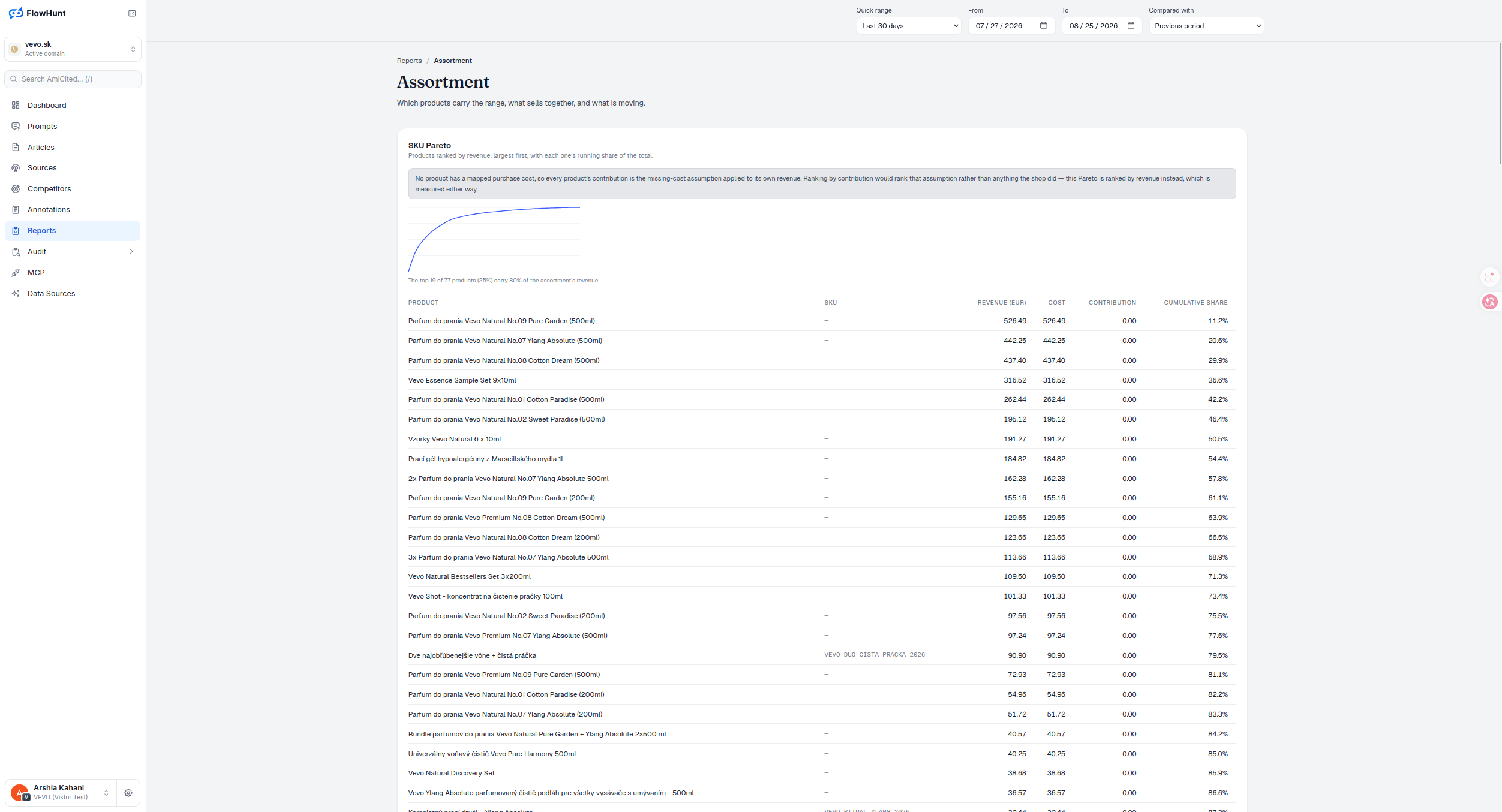
What Is Dead Stock?
Dead stock is inventory that has stopped selling and is unlikely to sell at its normal price. It’s the box of last year’s phone cases, the color nobody wanted, the size run that was over-ordered. Most businesses define it by time, typically no sales in the last 6 to 12 months, though fast-moving categories use shorter windows.
Every retailer and ecommerce brand has some. It shows up in Shopify inventory reports as items with stock but no recent orders, in Amazon Seller Central as aged inventory, and in accounting as stock that may need to be written down. The problem isn’t only the lost revenue: dead stock keeps costing money in storage, insurance and capital that could have bought products that sell.
How Dead Stock Is Measured
Two numbers tell you how big the problem is.
Dead stock rate = Value of items with no sales in the period ÷ Total inventory value × 100
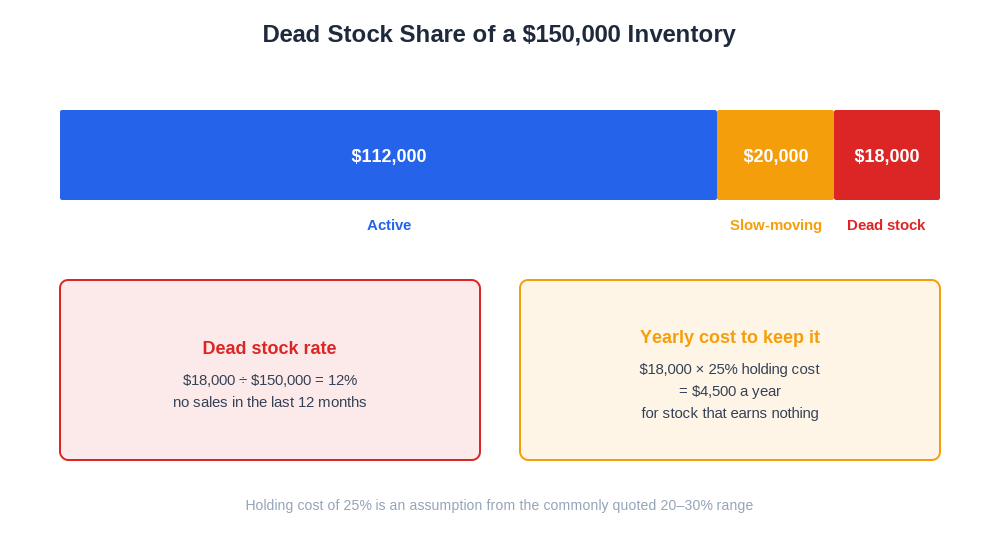
Use cost value, not retail value. Say you hold $150,000 of inventory at cost. Of that, $112,000 is selling normally, $20,000 is slow-moving, and $18,000 hasn’t sold at all in 12 months. Your dead stock rate is $18,000 ÷ $150,000 = 12%.
Annual holding cost of dead stock = Dead stock value × Holding cost rate
Holding cost covers storage, insurance, handling, shrinkage and the cost of the capital tied up. It’s commonly estimated at somewhere around 20–30% of inventory value per year, though your own figure depends on your warehouse costs and financing. At 25%, that $18,000 of dead stock costs about $4,500 a year to keep, for products that earn nothing. That number is often the strongest argument for clearing it, even at a loss.
What Causes Dead Stock
- Over-ordering, often to meet a supplier’s minimum order quantity or to get a volume discount.
- Poor forecasting, especially for new products with no sales history.
- Seasonality and trends that pass before the stock sells.
- Product changes, such as a new model, new packaging or a discontinued variant.
- Listing problems: bad photos, wrong categories or missing details that keep a product from being found.
- Returns that never get processed back into sellable stock.
How to Clear Dead Stock
Work through the options from the highest recovery to the lowest:
- Fix the listing. If the product never got proper photos, a clear title or a place in the right category, fix that first and give it a few weeks.
- Bundle it. Add the item to a bundle with a best seller or offer it as a gift with purchase above a threshold.
- Discount it. Mark it down in steps, in a clearance section, to customers who bought related products.
- Sell it elsewhere. Outlet channels, marketplaces or B2B buyers may value it more than your main customers do.
- Return or swap it. Some suppliers accept returns or exchanges, especially if you’re placing a new order.
- Liquidate or donate it. Liquidators pay little, but they clear the space at once. Donations may have tax benefits; check with your accountant.
The math is simple. Selling that $18,000 of dead stock for $10,800 (60% of cost) looks like a $7,200 loss, but the loss on paper already exists. What you gain is $10,800 of cash back and an end to about $4,500 a year in holding costs.

Stay Updated on AI Visibility Trends
Get the latest insights on AI mentions, brand monitoring, and optimization strategies.
Dead Stock vs Slow-Moving vs Obsolete vs Excess Inventory
| Type | Still selling? | Typical sign | What to do |
|---|---|---|---|
| Slow-moving inventory | Yes, below plan | Low sell-through rate, weeks of cover rising | Reduce reorders, promote, improve listings |
| Excess inventory | Yes | More stock than forecast demand needs | Pause reorders, run promotions |
| Dead stock | No, or almost never | No sales in 6–12 months | Bundle, discount, liquidate, return, donate |
| Obsolete inventory | No, and can’t be sold as is | Expired, discontinued, unsupported | Write off, recycle, scrap |
The categories move in one direction. Slow-moving and excess stock become dead stock if nothing changes, and dead stock eventually becomes obsolete. The earlier you act, the more value you recover.
Dead Stock and AI Search
Dead stock is mostly an inventory problem, but discovery plays a part. Some products stop selling because nobody finds them, not because nobody wants them. Shoppers who ask ChatGPT, Perplexity or Google AI Mode for product recommendations get a short list, and products with thin descriptions and few reviews rarely make it.
Before you liquidate, check whether a product’s page gives search engines and AI tools enough to work with: a clear title, specs, use cases and honest reviews. For a few products, better listings are cheaper than a fire sale.
Best Practices for Preventing and Clearing Dead Stock
- Set a clear definition. Choose a no-sales threshold per category and flag items automatically when they cross it.
- Review aged inventory monthly. Look at revenue rank across your range, for example with an assortment report, to see the long tail early.
- Order smaller first runs for new products, even at a higher unit cost, until demand is proven.
- Use product bundling. Pairing a slow item with a best seller moves stock without heavy discounting of either product.
- Negotiate returns or swaps with suppliers when you place large orders.
- Clear it, don’t hope. Compare the holding cost with the value you can recover now. Waiting rarely raises the price.
Common Dead Stock Mistakes
The most common mistake is holding dead stock because selling it below cost “feels like a loss”. The loss already happened when the stock stopped selling; every month it stays adds holding cost on top. Another is clearing dead stock without fixing the cause, then reordering the same quantities from the same supplier next season.
Businesses also measure dead stock at retail value, which makes the problem look smaller or larger than it is and leads to poor clearance pricing. Finally, many never connect dead stock back to inventory management decisions, so the same forecasting and ordering habits keep producing it.