


Demand Forecasting
Demand forecasting is the practice of predicting future customer demand for products using historical sales data, seasonality, and trend signals. E-commerce brands use it to plan inventory purchases, avoid stockouts and overstock, and time replenishment so cash isn't tied up in the wrong products.
Definition of Demand Forecasting
Demand forecasting is the process of estimating how much of a product customers will want to buy over a future period, based primarily on historical sales patterns along with seasonality, trend, and known upcoming events. In e-commerce, demand forecasting sits at the center of inventory strategy: it determines how much stock to buy, when to buy it, and which products deserve more warehouse space and cash commitment than others. A forecast doesn’t need to be perfect to be useful — even a directionally accurate estimate that says “this SKU will likely sell 15-20% more units next month due to seasonality” is enough to meaningfully improve purchasing decisions compared to ordering based on gut feel or last year’s raw totals.
How Demand Forecasting Works
At its simplest, demand forecasting starts from a baseline — average recent sales velocity — and adjusts for known factors. A common starting formula:
Forecasted Demand = Baseline Sales Velocity × Seasonality Factor × Trend Factor
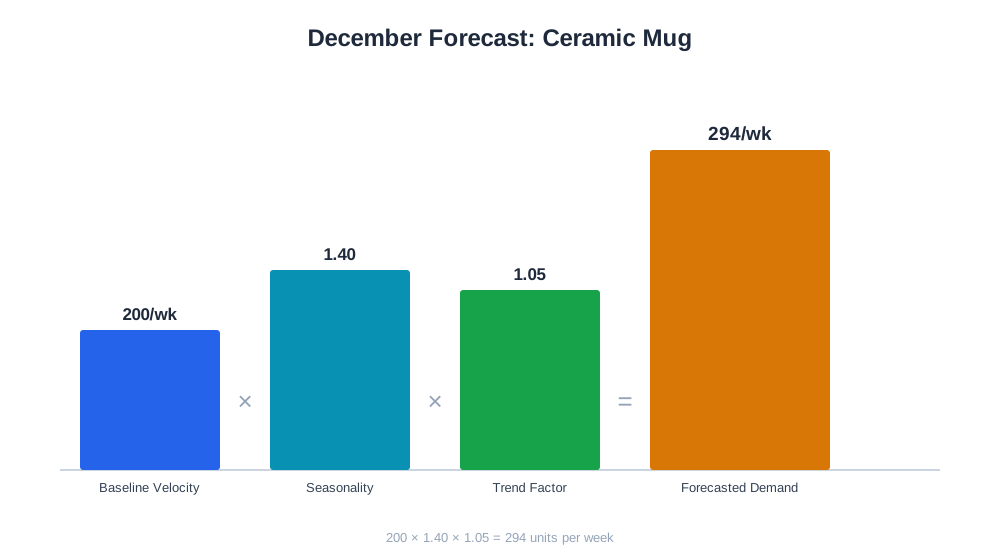
Consider a worked example. A home goods brand sells a ceramic mug at an average of 200 units per week over the past three months. Historically, December sales for this category run about 40% above the yearly average due to gift-buying season, giving a seasonality factor of 1.4. The product has also been trending upward roughly 5% month over month due to a recent influencer mention, giving a trend factor of 1.05.
Forecasted weekly demand for the upcoming December period = 200 × 1.4 × 1.05 = 294 units per week.
If the brand is placing a purchase order to cover a 6-week period before the next replenishment cycle, that forecast suggests ordering roughly 1,764 units, plus a safety stock buffer to cover forecast error and any supplier delay.

Ready to Monitor Your AI Visibility?
Track how AI chatbots mention your brand across ChatGPT, Perplexity, and other platforms.
Why Demand Forecasting Matters for E-commerce Brands
Getting demand forecasting right directly affects cash flow and customer experience in both directions. Under-forecasting leads to stockouts, lost sales, and — for products with committed marketing spend — wasted acquisition dollars driving traffic to a page that can’t convert. Over-forecasting ties up cash in inventory that sits in a warehouse, incurring storage costs and risking markdowns or write-offs if the product doesn’t sell through.
For growing or seasonal brands, demand forecasting is especially high-stakes because the historical baseline is thinner and the swings are larger — a first holiday season with no prior December data to anchor a forecast is inherently riskier than forecasting for a mature, several-year-old product line.
Demand Forecasting Methods Compared
| Method | How It Works | Best For | Limitation |
|---|---|---|---|
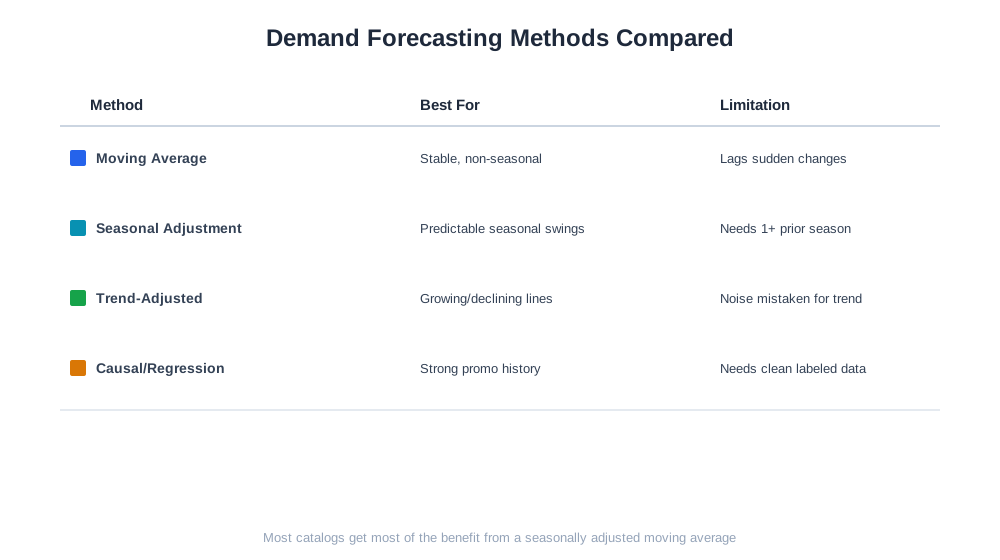
| Moving average | Averages recent sales over a fixed window | Stable, non-seasonal products | Lags behind sudden trend changes |
| Seasonal adjustment | Applies a multiplier based on historical seasonal patterns | Products with predictable seasonal swings | Needs at least one full prior season of data |
| Trend-adjusted forecasting | Combines a baseline with a growth or decline trend factor | Growing or declining product lines | Sensitive to short-term noise being mistaken for trend |
| Causal/regression models | Incorporates external variables like price, promotions, or marketing spend | Brands with strong historical promotional data | Requires clean, well-labeled historical data |
Most e-commerce brands don’t need a sophisticated statistical model to get meaningful value — a seasonally adjusted moving average, applied consistently and revisited regularly, captures most of the benefit for a typical catalog.
Stay Updated on AI Visibility Trends
Get the latest insights on AI mentions, brand monitoring, and optimization strategies.
Demand Forecasting and AI-Driven Commerce
As AI shopping assistants and AI Overviews increasingly influence which products get discovered and when, demand can shift faster and less predictably than traditional seasonal patterns would suggest — a product mentioned favorably in an AI-generated comparison or “best of” answer can see a demand spike that a backward-looking forecast won’t anticipate. Merchants who track their AI visibility alongside their sales data are in a better position to catch these demand shifts early and adjust purchasing before a stockout, rather than reacting to it after the fact.
AmICited’s eshop_get_replenishment tool operationalizes the practical side of demand forecasting by combining recent sales velocity with current stock-on-hand to flag which products are approaching a reorder point, giving merchants a demand-aware view of what needs restocking soon without requiring them to build and maintain a full forecasting model themselves.
Best Practices for Demand Forecasting
- Exclude stockout periods from historical sales data when building a baseline — a week with zero stock isn’t a week of zero demand.
- Build seasonality factors from at least one full prior cycle of data where possible; a single data point can look like a trend when it’s really noise.
- Maintain both a short-term forecast for replenishment timing and a longer-term forecast for purchase order planning, since supplier lead times rarely match reorder frequency.
- Revisit forecasts after any major marketing push, price change, or supply disruption — these events shift the baseline the forecast is built on.
- Keep a safety stock buffer sized to your forecast’s typical error margin and your supplier’s lead time variability, not a fixed arbitrary number across all products.
Common Demand Forecasting Mistakes
Treating stockout periods as low-demand periods. If a product was out of stock for two of the last twelve weeks, those weeks show zero sales that reflect a supply problem, not a demand problem. Including them unadjusted in a moving average will systematically understate true demand and perpetuate the stockout cycle.
Ignoring the effect of past promotions on historical data. A spike in sales from a discount event or a temporary marketing push can get baked into a forecast as if it represents ongoing baseline demand, leading to over-ordering once the promotional effect fades.
Forecasting new products from zero history. A newly launched SKU has no sales history to forecast from, so relying purely on historical data will always underestimate its demand initially. Category-level benchmarks or comparable-product analogies are a more reasonable starting point until enough of its own data accumulates.
Setting the forecasting horizon shorter than the supplier lead time. If it takes eight weeks to receive new inventory but the forecast only looks four weeks ahead, there’s no time to react to a shortfall the forecast reveals. The horizon needs to comfortably exceed lead time.
Never revisiting the forecast after it’s built. Demand patterns shift with competition, pricing, seasonality, and external trends. A forecast built once at the start of the year and left unchanged will drift further from reality every month that passes without a review.