

Domain Authority for AI Search: Why DA Doesn't Matter for AI Citations
Learn how domain authority affects AI search visibility. Discover why ChatGPT, Perplexity, and Claude prioritize expertise over DA scores and what metrics actua...
11 min read
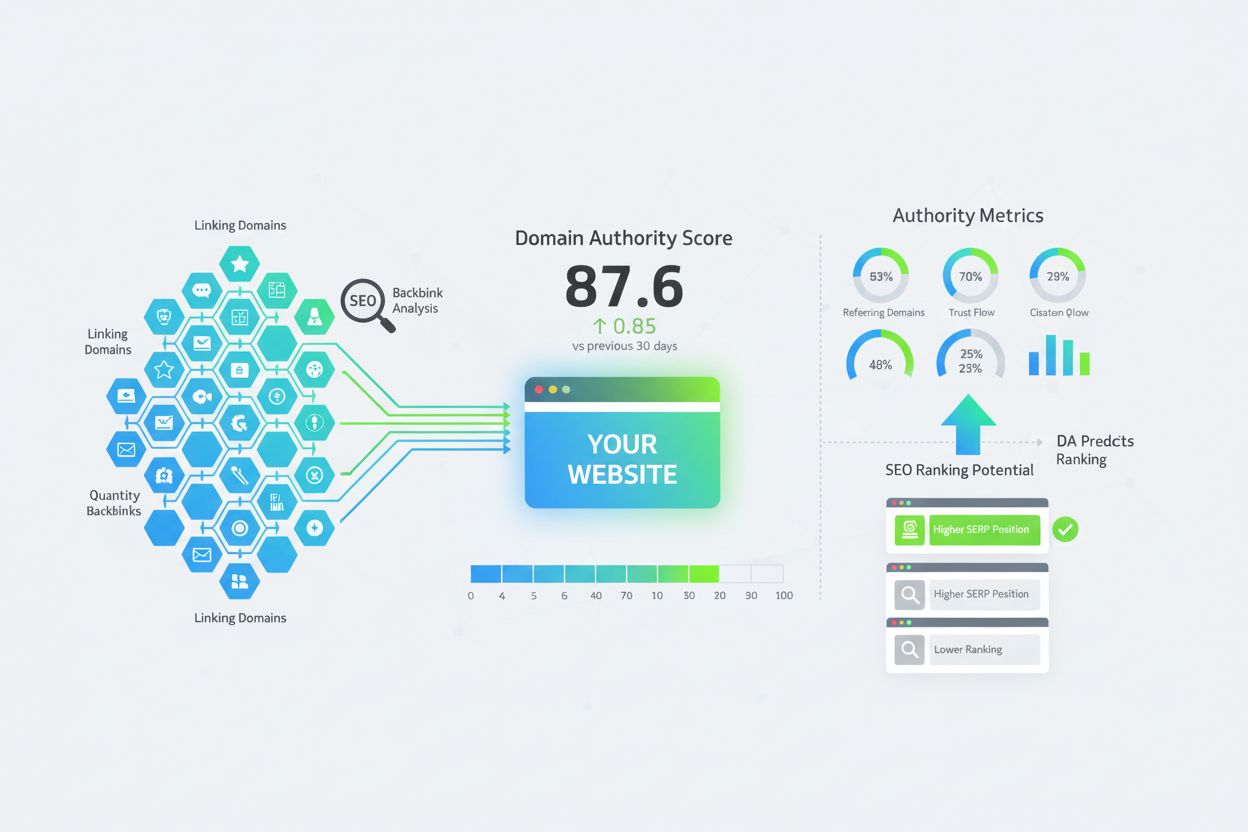
Domain Authority (DA) is a search engine ranking score developed by Moz that predicts a website’s ability to rank on search engine results pages (SERPs) on a scale from 1 to 100. It is calculated using machine learning algorithms that evaluate backlink quality, quantity, and other authority signals to provide a comparative metric for assessing a domain’s overall SEO strength and ranking potential.
Domain Authority (DA) is a search engine ranking score developed by Moz that predicts a website's ability to rank on search engine results pages (SERPs) on a scale from 1 to 100. It is calculated using machine learning algorithms that evaluate backlink quality, quantity, and other authority signals to provide a comparative metric for assessing a domain's overall SEO strength and ranking potential.
Domain Authority (DA) is a search engine ranking score developed by Moz that predicts how likely a website is to rank on search engine results pages (SERPs) compared to competitors. The metric operates on a logarithmic scale from 1 to 100, with higher scores indicating greater ranking potential and competitive strength. Unlike Google’s proprietary ranking algorithms, Domain Authority is not a direct ranking factor but rather a comparative metric that helps SEO professionals evaluate their website’s authority relative to others in their industry. DA is calculated using machine learning algorithms that analyze dozens of factors, with particular emphasis on the quality and quantity of backlinks pointing to a domain, making it one of the most widely recognized authority metrics in the SEO industry.
Domain Authority was introduced by Moz in 2011 as a response to the deprecation of Google’s PageRank public toolbar, which had been a standard metric for evaluating website authority for over a decade. The original DA algorithm was designed to replicate the predictive power of PageRank while incorporating additional signals that correlate with search engine rankings. In 2019, Moz released Domain Authority 2.0, a significant update that refined the calculation methodology using more sophisticated machine learning models and expanded the data sources used in the algorithm. This evolution reflected the changing landscape of search engine optimization and the increasing complexity of ranking factors. Today, over 78% of SEO professionals use Domain Authority as part of their competitive analysis and strategy development, according to industry surveys. The metric has become so influential that it is now considered a standard benchmark in the SEO industry, with thousands of agencies and marketers relying on DA scores to guide their link-building efforts and content strategies.
Domain Authority is calculated using a proprietary machine learning algorithm that evaluates multiple factors across a domain’s backlink profile and historical performance data. The primary calculation focuses on linking root domains—the number of unique domains that link to your website—rather than total backlink count, as this diversity signal is more predictive of ranking potential. Moz’s algorithm incorporates data from their extensive Link Explorer web index, which contains over 44 trillion links, allowing for comprehensive analysis of backlink patterns and authority distribution. The calculation process evaluates factors including the authority of linking domains, the relevance of linking pages, anchor text patterns, link velocity (how quickly new links are acquired), and the overall quality of your backlink profile. The algorithm also considers historical data about your domain, including domain age, previous link patterns, and any penalties or issues that may have affected your site. Since DA is calculated on a logarithmic scale, it becomes progressively more difficult to increase your score as you move higher—for example, improving from DA 20 to 30 is significantly easier than improving from DA 70 to 80. This logarithmic structure reflects the reality that the most authoritative domains occupy the highest positions, leaving limited room at the top of the scale.
| Metric | Developer | Scale | Primary Focus | Key Calculation Factor | Industry Adoption |
|---|---|---|---|---|---|
| Domain Authority (DA) | Moz | 1-100 | Overall domain ranking potential | Backlink quality and quantity | Very High (78%+ of SEO professionals) |
| Domain Rating (DR) | Ahrefs | 1-100 | Backlink profile strength | Referring domain authority and distribution | High (widely used for competitive analysis) |
| Trust Flow (TF) | Majestic SEO | 0-100 | Link quality and trustworthiness | Quality of linking sources | Moderate (specialized use cases) |
| Citation Flow (CF) | Majestic SEO | 0-100 | Link quantity and reach | Number of links and their distribution | Moderate (used alongside Trust Flow) |
| Authority Score | Semrush | 0-100 | Domain strength and authority | Backlinks, organic traffic, spam factors | High (integrated into Semrush platform) |
| Domain Strength (DS) | SEO PowerSuite | 0-10 | Overall SEO strength | Domain age, backlinks, social signals | Moderate (proprietary to SEO PowerSuite) |
The calculation of Domain Authority involves numerous technical and structural factors that extend beyond simple backlink counting. Linking root domains represent the most significant factor, as they indicate how many unique, authoritative sources recognize your website as a valuable resource. The quality assessment of these linking domains is crucial—a single backlink from a domain with DA 80 carries substantially more weight than ten backlinks from domains with DA 20. Anchor text diversity also plays an important role, as natural link profiles contain varied anchor text rather than repetitive keyword-focused anchors. The link velocity—the rate at which new backlinks are acquired—is monitored to identify natural growth patterns versus artificial link schemes. Domain age contributes to DA calculations, as older domains with consistent link profiles typically demonstrate greater stability and trustworthiness. The presence of toxic or spammy backlinks can negatively impact DA, which is why regular backlink audits and disavowal of harmful links are essential practices. Additionally, Moz evaluates the topical relevance of linking domains, recognizing that backlinks from contextually related websites carry more authority than links from unrelated sources. The algorithm also considers page-level authority of the linking pages, understanding that links from high-authority pages within a domain pass more value than links from low-authority pages.
Domain Authority serves as a critical benchmark for understanding your competitive position in search engine rankings and developing realistic SEO goals. When analyzing your DA score in relation to competitors, you gain valuable insights into the relative strength of your backlink profile and the effort required to outrank competitors for target keywords. Many SEO professionals use DA as a preliminary filter when evaluating link-building opportunities, often targeting websites with DA scores above 30 for guest posting and partnership opportunities. The metric helps identify content gap opportunities—if competitors with similar DA scores rank for keywords you don’t, it suggests those keywords may be achievable with optimized content. Domain Authority also informs decisions about resource allocation, as improving from DA 40 to 50 may require significantly less effort than improving from DA 60 to 70, allowing marketers to prioritize efforts based on realistic timelines and ROI. For agencies managing multiple client websites, DA provides a standardized metric for tracking progress and demonstrating the impact of SEO efforts over time. The metric is particularly valuable for competitive benchmarking, allowing you to set performance targets based on your industry’s typical DA ranges and identify which competitors pose the greatest ranking threats.
The emergence of AI-powered search engines like ChatGPT, Perplexity, Claude, and Google AI Overviews has introduced new dimensions to the importance of Domain Authority. These AI systems are trained on vast amounts of web data and tend to prioritize content from authoritative sources when generating responses, making DA an increasingly relevant metric for AI visibility. Websites with higher DA scores are more likely to be cited in AI-generated responses, as the training data and ranking algorithms used by these systems favor established, trustworthy domains. For brands using AI monitoring platforms like AmICited, tracking Domain Authority alongside AI citation frequency provides valuable insights into how traditional SEO authority translates to visibility in AI search contexts. The relationship between DA and AI citations is not perfectly linear—a website with DA 50 may receive more AI citations than a DA 60 site if its content is more directly relevant to common AI queries. However, the general trend shows that higher DA correlates with increased AI visibility, making domain authority optimization a strategic priority for brands seeking to maximize their presence across both traditional and AI-powered search channels. Understanding this connection helps marketers develop integrated strategies that improve both traditional search rankings and AI-generated content citations.
A widespread misconception is that Domain Authority directly impacts Google rankings, when in fact DA is a Moz-specific metric that Google does not use in its ranking algorithms. This confusion often leads marketers to over-prioritize DA improvement at the expense of other important SEO factors like content quality and user experience. Another common misunderstanding is that DA is a fixed score that remains constant, when in reality it fluctuates regularly based on changes to your backlink profile, updates to Moz’s index, and shifts in competitors’ scores. Some professionals mistakenly believe that Domain Authority is equivalent to Google’s PageRank, though they are distinct metrics with different methodologies and purposes. The notion that DA is the only metric that matters is another significant misconception—while DA is valuable, metrics like Page Authority, organic traffic, keyword rankings, and user engagement provide essential complementary insights. Additionally, many assume that a low DA score indicates poor website quality or ranking potential, when in fact new websites naturally start with DA 1 and gradually build authority over time. The belief that DA can be quickly manipulated through aggressive link-building is also incorrect, as Moz’s algorithm is designed to identify and discount artificial link schemes. Understanding these misconceptions ensures that marketers use Domain Authority appropriately as a comparative and directional metric rather than an absolute measure of success or a direct ranking factor.
As search engines continue to evolve and incorporate artificial intelligence into their ranking algorithms, Domain Authority is likely to remain a relevant metric for understanding competitive positioning and predicting ranking potential. The rise of AI-powered search introduces new considerations for how authority is evaluated and weighted, as AI systems may prioritize different signals than traditional search engines. Moz has indicated that future updates to Domain Authority may incorporate additional signals related to brand authority, topical authority, and entity recognition, reflecting the increasing sophistication of search algorithms. The metric’s importance in AI monitoring and brand tracking is expected to grow as more organizations recognize the connection between traditional SEO authority and visibility in AI-generated responses. For platforms like AmICited, which track brand mentions across AI search engines, Domain Authority serves as a predictive indicator of which brands are likely to receive citations in AI responses. The integration of DA with other authority metrics and the development of more nuanced authority scoring systems will likely provide marketers with increasingly sophisticated tools for understanding and optimizing their competitive position. As the digital landscape continues to shift toward AI-driven search and content discovery, maintaining and improving Domain Authority will remain a fundamental component of comprehensive digital marketing strategy, particularly for brands seeking visibility across both traditional and emerging search channels.
Domain Authority (DA) measures the overall ranking strength of an entire domain or subdomain on a 1-100 scale, while Page Authority (PA) focuses on the ranking potential of individual pages. DA reflects the reputation of your entire website, whereas PA shows how a specific page performs. Both metrics are calculated using similar backlink-based algorithms, but DA provides a broader view of your site's authority across all pages, making it useful for competitive benchmarking at the domain level.
Domain Authority is dynamic and can fluctuate regularly based on several factors including changes to your backlink profile, updates to Moz's web index, shifts in competitors' scores, and algorithm updates. Moz typically updates DA scores as their index crawls and processes new link data, which can happen multiple times per month. However, significant changes in DA usually reflect substantial changes in your backlink profile or competitive landscape rather than minor daily fluctuations.
No, Domain Authority is not a direct Google ranking factor. DA is a proprietary Moz metric designed to predict ranking potential based on backlink analysis and other signals that correlate with rankings. While Google uses its own algorithms to determine rankings, DA serves as a useful comparative tool for SEO professionals to benchmark their site's authority against competitors and estimate ranking potential. Understanding this distinction is crucial for developing realistic SEO strategies.
There is no universal 'good' DA score because it is a relative metric that depends on your industry and competitive landscape. A DA of 30 might be excellent for a new business website but low for an established brand. The best approach is to compare your DA score to direct competitors in your niche and aim to match or exceed their scores. Generally, websites with DA scores above 50 are considered to have strong authority, while scores above 70 indicate very high authority in most industries.
Domain Authority influences how AI systems like ChatGPT, Perplexity, and Google AI Overviews perceive and cite your website. Higher DA scores indicate greater authority and trustworthiness, making AI models more likely to reference your content when generating responses. For brands using AI monitoring platforms like AmICited, tracking DA alongside AI citation frequency helps understand how domain authority correlates with visibility in AI-generated responses and helps identify opportunities to improve brand mentions across AI search engines.
Domain Authority typically increases gradually over time rather than quickly, as it is based on accumulated backlink data and domain history. While you cannot directly manipulate DA, you can accelerate growth by acquiring high-quality backlinks from authoritative domains, creating link-worthy content, improving technical SEO, and maintaining a clean backlink profile. Most websites see meaningful DA improvements within 3-6 months of consistent effort, though the pace depends on your starting point and competitive landscape.
Backlinks are the primary factor in Domain Authority calculation, accounting for the majority of the DA score. Moz's algorithm evaluates both the quantity and quality of backlinks pointing to your domain, with emphasis on linking root domains (unique referring domains) rather than total link count. High-quality backlinks from authoritative, relevant domains carry more weight than numerous low-quality links. The diversity of your backlink profile, anchor text variation, and the authority of linking domains all significantly influence your DA score.
Domain Authority is increasingly relevant for brand monitoring in AI search contexts. Platforms like AmICited track where brands appear in AI responses across ChatGPT, Claude, Perplexity, and Google AI Overviews. Higher DA scores correlate with increased likelihood of brand citations in AI-generated content, as AI models are trained to prioritize authoritative sources. Understanding your DA helps predict and optimize your brand's visibility in AI search results, making it a key metric for modern digital marketing and reputation management strategies.
Start tracking how AI chatbots mention your brand across ChatGPT, Perplexity, and other platforms. Get actionable insights to improve your AI presence.
Learn how domain authority affects AI search visibility. Discover why ChatGPT, Perplexity, and Claude prioritize expertise over DA scores and what metrics actua...
Learn how traditional domain authority impacts AI search engines like ChatGPT, Perplexity, and Google AI Overviews. Discover what actually matters for AI visibi...
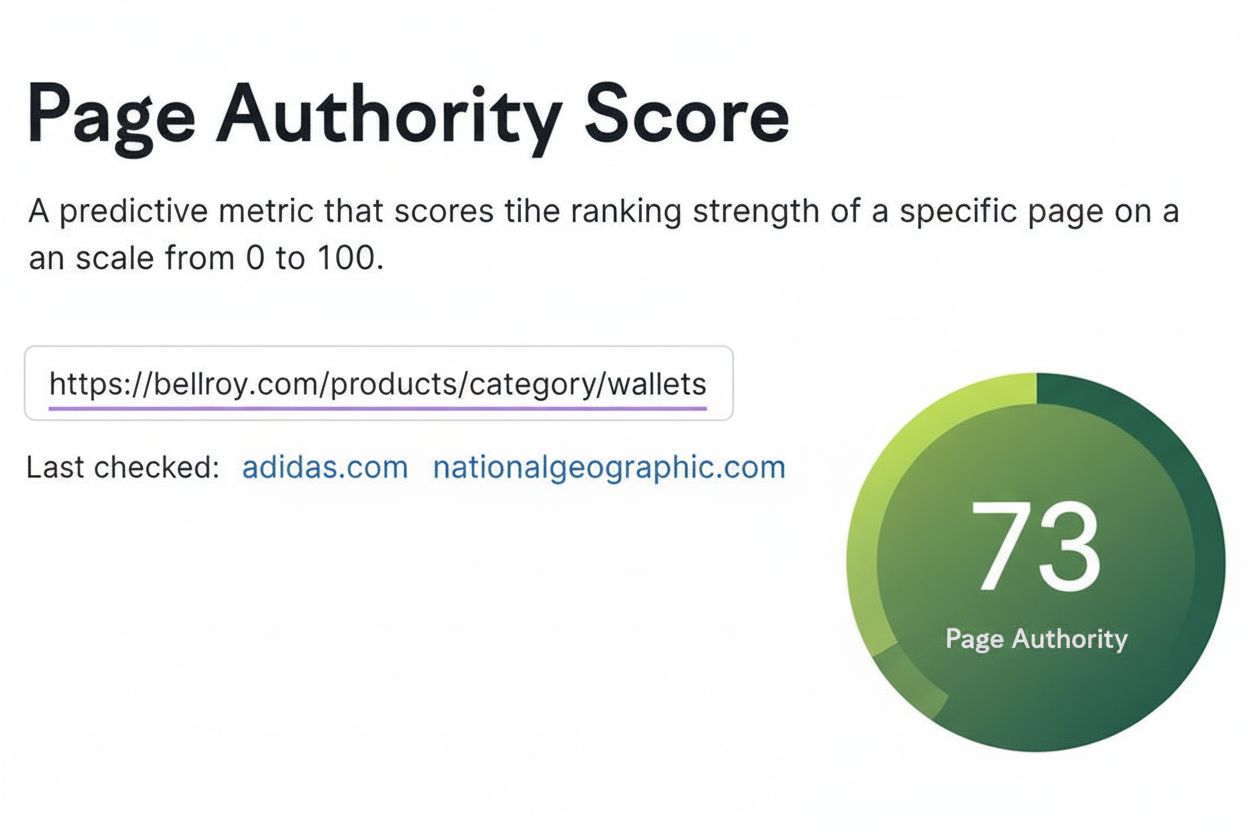
Page Authority is a Moz-developed metric (0-100 scale) predicting individual webpage ranking potential. Learn how PA works, its importance for SEO, and strategi...
Cookie Consent
We use cookies to enhance your browsing experience and analyze our traffic. See our privacy policy.